Diabetes Kills One Person Every Six Seconds; Diabetes battle “being lost” as cases hit record 382 million
November 15, 2013 Leave a comment
Diabetes Kills One Person Every Six Seconds, Estimates Show
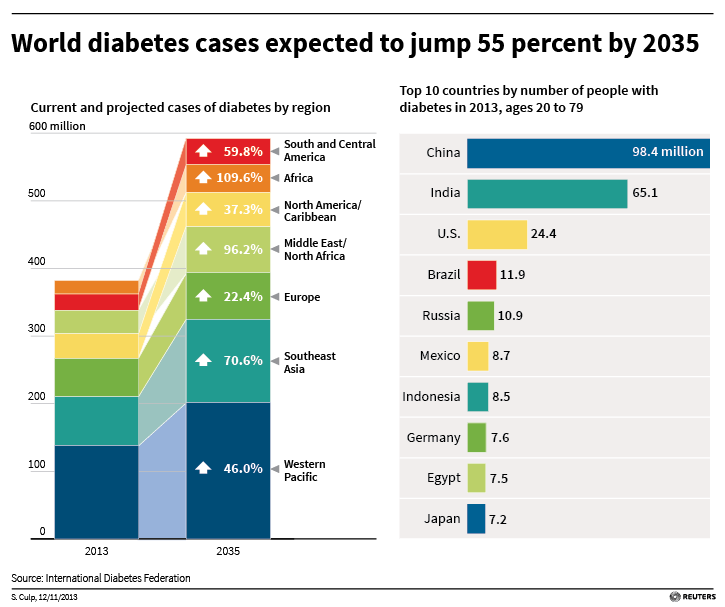
Diabetes kills one person every six seconds and afflicts 382 million people worldwide, according to the International Diabetes Federation, which has been canvassing the help of people ranging from celebrity chef Jamie Oliver to Bob Marley’s nephew to raise awareness about the problem. The number of diabetes cases has climbed 4.4 percent over the past two years and is more than 5 percent of the world’s population, according to new figures the Brussels-based federation released today. The number of people affected by the disease is expected to climb 55 percent to 592 million by 2035 as factors including poor diet, a more sedentary lifestyle, increases in obesity and life expectancy fuel an epidemic, it said. There were only 285 million sufferers worldwide in 2009.“We haven’t seen any kind of stabilizing, any kind of reversal,” Leonor Guariguata, an epidemiologist and project coordinator for IDF’s Diabetes Atlas, published every two years, said in a phone interview. “Diabetes continues to be a very big problem and is increasing even beyond previous projections.”
The disease, caused by a lack of insulin the body needs to convert blood sugar into energy, is becoming a financial burden on governments, and led to $548 billion in global health-care spending this year, the federation said. To counter the surge, it recommends policy makers across many sectors should devise concerted action.
Celebrity Action
Jamie Oliver and Charles Mattocks, Bob Marley’s nephew, are among celebrities that have been helping IDF advocate the need for healthy living. TV celebrity Oliver, who has sold more than 30 million cookbooks and owns restaurants from London to Sydney, has appeared in IDF’s magazine Diabetes Voice while Mattocks, also a chef, is currently touring the U.S. in a camper to speak about the benefits of a healthy lifestyle and eating habits.
“It’s all about awareness, awareness and awareness,” Mike Doustdar, Senior Vice President of Novo Nordisk A/S (NOVOB), the world’s biggest insulin maker, said during a webcast co-hosted with IDF before the announcement. “Diabetes is a silent disease, so the best thing we can do about it is to talk about it.”
The call is not going unheard. Health officials from almost 200 countries in May adopted nine targets, such as reducing average daily salt consumption by 30 percent by 2025, in a bid to fight cancer, heart disease and diabetes, and called for curbs on marketing unhealthy food to children under a plan to cut the world’s leading causes of death.
Toll Rises
More help is needed. IDF estimates that 5.1 million people die annually because of the disease, with an average 10 million diabetes cases emerging every year. The majority of cases affects 40- to 59-year-olds, according to IDF. Every year, diabetes also leads to more than 1 million amputations, 500,000 kidney failures and 1.5 million cases of blindness, according to a slide provided by Novo Nordisk.
The spread of the disease has increased faster than the world’s population, which exceeds 7 billion and has increased 2.2 percent in two years, according to U.S. Census Bureau estimates.
“More younger adults are developing diabetes,” Guariguata said. “That’s telling us that the pace of the epidemic is faster than the pace of change of demographics alone.”
The new projections may not even be giving a full picture of the situation, according to the federation.
Underestimated Issue?
“These are probably substantial underestimates of what the real problem is,” Paul Zimmet, honorary president of IDF and director emeritus of the Baker IDI Heart and Diabetes Institute in Melbourne, said in an interview before the announcement. “You can only work on the information that’s available to work on.”
Four of every five people with diabetes are in developing countries where there aren’t big studies to work with, he added.
In China, recent figures showed that the epidemic being much worse than previously estimated. The most comprehensive nationwide survey for diabetes ever conducted in the Asian country showed 12 percent of adults, or 114 million people, have the disease. The finding, published Sept. 4 in the Journal of the American Medical Association, added 22 million diabetics, equivalent to the population of Australia, to a 2007 estimate. That means almost one in three diabetes sufferers globally is in China.
The China study wasn’t included in the Atlas figures presented today for lack of time, IDF said.
The problem is bigger in poorer regions that have fewer resources at hand to fight the diseases, for example South Africa, and where more people die of disease before the age of 60, Guariguata said.
“These are preventable deaths, premature deaths that don’t have to occur,” she said.
To contact the reporter on this story: Albertina Torsoli in Geneva at atorsoli@bloomberg.net
Updated: Thursday November 14, 2013 MYT 7:29:04 AM
Diabetes battle “being lost” as cases hit record 382 million
LONDON: The world is losing the battle against diabetes as the number of people estimated to be living with the disease soars to a new record of 382 million this year, medical experts said on Thursday.
The vast majority have type 2 diabetes – the kind linked to obesity and lack of exercise – and the epidemic is spreading as more people in the developing world adopt Western, urban lifestyles.
The latest estimate from the International Diabetes Federation is equivalent to a global prevalence rate of 8.4 percent of the adult population and compares to 371 million cases in 2012.
By 2035, the organisation predicts the number of cases will have soared by 55 percent to 592 million.
“The battle to protect people from diabetes and its disabling, life-threatening complications is being lost,” the federation said in the sixth edition of its Diabetes Atlas, noting that deaths from the disease were now running at 5.1 million a year or one every six seconds.
People with diabetes have inadequate blood sugar control, which can lead to a range of dangerous complications, including damage to the eyes, kidneys and heart. If left untreated, it can result in premature death.
“Year after year, the figures seem to be getting worse,” said David Whiting, an epidemiologist and public health specialist at the federation. “All around the world we are seeing increasing numbers of people developing diabetes.”
He said that a strategy involving all parts of society was needed to improve diets and promote healthier lifestyles.
The federation calculates diabetes already accounts for annual healthcare spending of $548 billion and this is likely to rise to $627 billion by 2035.
Worryingly, an estimated 175 million of diabetes cases are as yet undiagnosed, so a huge number of people are progressing towards complications unawares. Most of them live in low- and middle-income countries with far less access to medical care than in the United States and Europe.
The country with the most diabetics overall is China, where the case load is expected to rise to 142.7 million in 2035 from 98.4 million at present.
But the highest prevalence rates are to be found in the Western Pacific, where more than a third of adults in Tokelau, Micronesia and the Marshall Islands are already living with the disease.
Pharmaceutical companies have developed a range of medicines over the years to counter diabetes but many patients still struggle to control their condition adequately, leading to a continuing hunt for improved treatments.
Novo Nordisk <NOVOb.CO>, Sanofi <SASY.PA> and Eli Lilly <LLY.N> are all major suppliers of insulin and other diabetes therapies.
 About bambooinnovator
 Bamboo Innovator