This Map Shows How America Is Divided Into 11 Nations
November 15, 2013 Leave a comment
This Map Shows How America Is Divided Into 11 Nations
ROB WILE NOV. 12, 2013, 1:37 PM 80,598 111
Remember when that crazy Russian professor said America would break up into several different nations? He may not have been totally far off. In a new article in Tufts Magazine, Colin Woodard, author of “American Nations: A History of the Eleven Rival Regional Cultures of North America”, argues that the U.S. has long been divided into several different cultural entities that, with only a couple of notable exceptions, have somehow been able to coexist alongside one another. He writes: “The original North American colonies were settled by people from distinct regions of the British Isles—and from France, the Netherlands, and Spain—each with its own religious, political, and ethnographic traits. For generations, these Euro-American cultures developed in isolation from one another, consolidating their cherished religious and political principles and fundamental values, and expanding across the eastern half of the continent in nearly exclusive settlement bands. Throughout the colonial period and the Early Republic, they saw themselves as competitors—for land, capital, and other settlers—and even as enemies, taking opposing sides in the American Revolution, the War of 1812, and the Civil War. There’s never been an America, but rather several Americas—each a distinct nation. There are eleven nations today.
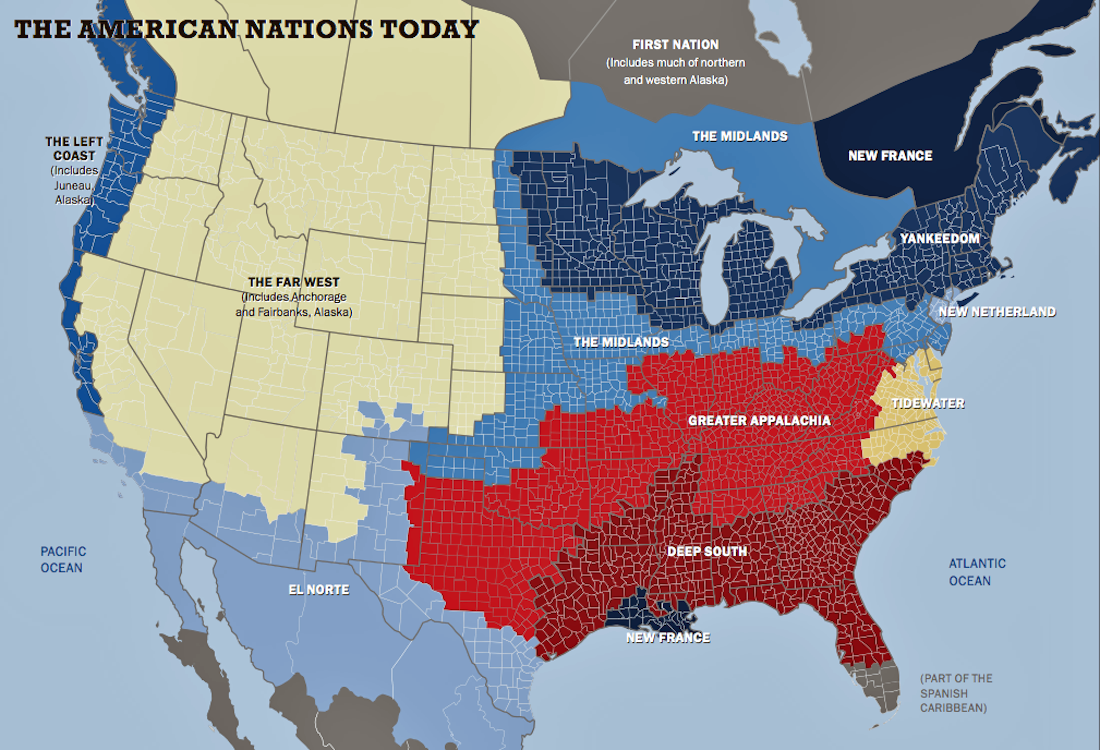
And here’s what’s inside each one:
“Yankeedom”
The brains of America. This region has kept the Protestant ethics of its founders, valuing education, sacrificing for the greater good, and intellectual development. However, “many of the other nations… regard the Yankee Utopian streak with trepidation,” Woodward writes.
“New Netherland”
This region retains the sophistication and commercial bent its Dutch founders exhibited in the 17th century. “Materialistic, with a profound tolerance for ethnic and religious diversity and an unflinching commitment to the freedom of inquiry and conscience.”
“The Midlands”
Politically moderate though somewhat inward looking despite a fair amount of ethnic diversity, the legacy of having been settled by both Germans and English Quakers. “It shares the Yankee belief that society should be organized to benefit ordinary people, though it rejects top-down government intervention.”
“Tidewater”
In the South but not of the South. Places a premium on tradition but today is “in decline” as Yankee values have breached through the Mason-Dixon line and have begun trickling into places like Charlotte.
“Deep South”
Rejects all forms of regulation, whether from taxes or through environmental policy, and occasionally shows signs of its historical penchant for restricting liberty.
“Greater Appalachia”
Founded by war-ravaged British subjects, this region has a mercurial set of values, having supported the Union during the Civil War but now favoring conservative ethics.
“El Norte”
Though Spain once controlled the entire Western part of the country, its Latin influence has now been confined to this region. “… norteños have a reputation for being exceptionally independent, self-sufficient, adaptable, and focused on work.”
“The Far West”
The conservative west. Developed through large investment in industry, yet where inhabitants continue to “resent” the Eastern interests that initially controlled that investment.
“New France”
A pocket of liberalism nestled in the Deep South, where 18th century Enlightenment values still prevail. “Its people have emerged as down-to-earth, egalitarian, and consensus driven, among the most liberal on the continent.”
“The Left Coast”
“A hybrid of Yankee Utopians and Appalachian self-expression and exploration” where farms and i-Pods can live side by side.
“First Nation”
Enjoys de facto independence thanks to its Native American legacy. Yet this often comes at an economic cost.
 About bambooinnovator
 Bamboo Innovator