Caught in Unemployment’s Revolving Door; Some economists fear that the long-term unemployment crisis affecting millions of Americans might be a permanent change, with far-reaching and damaging consequences

November 16, 2013

Caught in Unemployment’s Revolving Door

By ANNIE LOWREY

On a cold October morning, just after the federal government shutdown came to an end, Jenner Barrington-Ward headed into court in Boston to declare bankruptcy. It took weeks to put the paperwork together, given that her papers and belongings were scattered across the country — there was a broken-down car and boxes of paperwork in Virginia Beach, clothes in Colorado and personal possessions at a friend’s house in Somerville, Mass. She managed to estimate her income — maybe $5,000 last year, but maybe half that this year — from odd jobs. Soon, she would officially have nothing. Read more of this post
Buying Low Thwarted by Narrowest Stock Valuation Gap Ever

Buying Low Thwarted by Narrowest Stock Valuation Gap Ever

Cheap is converging with expensive in the American equity market, narrowing options for investors looking for bargains after the broadest rally on record lifted almost 90 percent of the Standard & Poor’s 500 Index this year. The difference in valuations shrank to the smallest since at least 1990 after companies such as Hormel Foods Corp. and CenterPoint Energy Inc. rose to levels that match Ralph Lauren Corp. and Citrix Systems Inc., whose five-year average profit growth rate is twice as big. A measure of the dispersion of price-earnings ratios in the S&P 500 compiled by Goldman Sachs Group Inc. narrowed to 41 percent in June, the lowest on record, and held around that level since. Read more of this post

Bond Investors Should Brace for Higher Rates

Bond Investors Should Brace for Higher Rates

Rise Will Likely Be More Gradual Than Last Summer’s

TOM LAURICELLA

Nov. 16, 2013 8:32 p.m. ET

SJ-AG911_LEDE_G_20131115154804

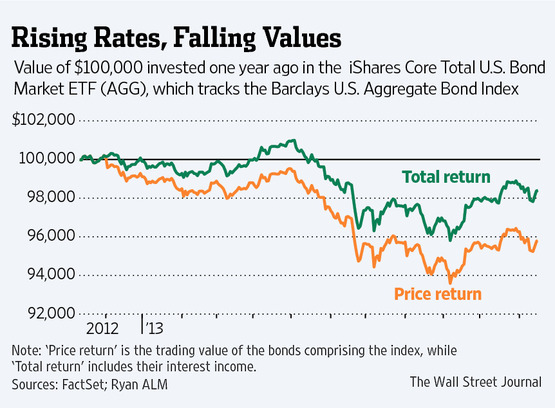
After a sharp selloff hit the bond market earlier this year, investors have gotten a reprieve: The Barclays BARC.LN -0.22% Capital U.S. Aggregate Bond Index, a widely watched benchmark tracking total returns on government and corporate bonds, was down as much as 3.9% for the year at the start of September. As of last week, it was down only 1.8%. But bond-fund managers warn that investors should brace for a resumed rise in interest rates—and the potential for more losses—over the coming year. Read more of this post

Andy Kessler: Private Startups, Where Investor Dollars Often Go to Die; Now anyone can join the crowd to fund startups—but most are crapshoots. Trust me, I know

Andy Kessler: Private Startups, Where Investor Dollars Often Go to Die

Now anyone can join the crowd to fund startups—but most are crapshoots. Trust me, I know.

ANDY KESSLER

Updated Nov. 15, 2013 6:57 p.m. ET

When President Obama signed the Jumpstart Our Business Startups Act in April 2012, he hailed it as “exactly the kind of bipartisan action we should be taking in Washington to help our economy.” Well, maybe. Some JOBS Act provisions kicked in right away. “Emerging growth companies”—those with under $1 billion in revenues—are exempt from many reporting provisions of Sarbannes-Oxley. And so TwitterTWTR -1.59% for example, only had to show two years of audited results (instead of three) in its IPO filing. And private companies can now have 2,000 investors, up from 500, before they have to file annual reports with the Securities and Exchange Commission. Less information is never better. Read more of this post

Aluminium traders accused over Bahrain fraud

Last updated: November 15, 2013 9:42 pm

Aluminium traders accused over Bahrain fraud

By Caroline Binham, Legal Correspondent

Aluminium traders from GlencoreMitsui and Sojitz made payments to one of Bahrain’s most senior royals who is at the centre of a high-profile corruption trial, a London court heard. Sheikh Isa bin Ali al-Khalifa, the former chairman of Alba, Bahrain’s state-run aluminium producer, and who was also the minister of finance and close to the Gulf state’s influential prime minister, ordered the system as a way “to control the flow of money” to and from Alba, a jury heard on Friday amid the trial of Victor Dahdaleh, a “power broker” accused of creaming 10 per cent off contracts that he negotiated. Read more of this post

Collaboration, Stars, and the Changing Organization of Science: Evidence from Evolutionary Biology

Collaboration, Stars, and the Changing Organization of Science: Evidence from Evolutionary Biology

Ajay Agrawal, John McHale, Alexander Oettl

NBER Working Paper No. 19653
Issued in November 2013

We report a puzzling pair of facts concerning the organization of science. The concentration of research output is declining at the department level but increasing at the individual level. For example, in evolutionary biology, over the period 1980 to 2000, the fraction of citation-weighted publications produced by the top 20% of departments falls from approximately 75% to 60% but over the same period rises for the top 20% of individual scientists from 70% to 80%. We speculate that this may be due to changing patterns of collaboration, perhaps caused by the rising burden of knowledge and the falling cost of communication, both of which increase the returns to collaboration. Indeed, we report evidence that the propensity to collaborate is rising over time. Furthermore, the nature of collaboration is also changing. For example, the geographic distance as well as the difference in institution rank between collaborators is increasing over time. Moreover, the relative size of the pool of potential distant collaborators for star versus non-star scientists is rising over time. We develop a simple model based on star advantage in terms of the opportunities for collaboration that provides a unified explanation for these facts. Finally, considering the effect of individual location decisions of stars on the overall distribution of human capital, we speculate on the efficiency of the emerging distribution of scientific activity, given the localized externalities generated by stars on the one hand and the increasing returns to distant collaboration on the other.

The Economics of China: Successes and Challenges

The Economics of China: Successes and Challenges

Shenggen Fan, Ravi Kanbur, Shang-Jin Wei, Xiaobo Zhang

NBER Working Paper No. 19648
Issued in November 2013

This paper is the first chapter in the Oxford Companion to the Economics of China (Oxford University Press, forthcoming). Rather than trying to summarize other contributors’ views, we provide our own perspectives on the Economics of China—the past experience and the future prospects. Our reading of China’s economic development over the past 35 years raises two major sets of issues, one of which is inward looking, and the other of which is outward looking. While Chinese aggregate development is impressive, it has raised the question of whether the growth is sustainable, and has led to a set of distributional issues and well-being concerns. We argue that these internal issues combine with those raised by China’s rapid integration and ever growing presence in the international arena, to jointly frame the challenges faced by China in the next 35 years, as it approaches the 100th anniversary of the People’s Republic in 2049.