He Xinming has just one job and one life mission – Dongpeng, China’s largest ceramic tile manufacturer.
November 20, 2013 Leave a comment
The good earth
Grace Cao
Monday, November 18, 2013
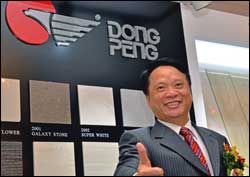
He Xinming has just one job and one life mission – Dongpeng Holdings Company. “Chinese love ceramic products. That’s why our country is named China,” chuckles the 57-year-old chairman of the largest mainland ceramic tile manufacturer. At first glance, there appears nothing special about the entrepreneur, who is of average height and build. He seems a bit defensive at the start of the conversation but quickly loosens up when asked about his career.“Are you sure you are interested?” He asks as he relaxes a bit and seems to ponder over the best place to start. “Young people never want to know about it. My daughter often stops me before I begin.”
And then he says: “My generation suffered a lot, but we learned to be content with reality and to be thankful.”
Despite growing up during arguably the hardest period in the history of the nation, He displays no hard feelings when speaking about the worst of times. As a child, a full stomach was a luxury he rarely enjoyed, and tried to keep himself from starving by eating chaff.
At the time, China was in the grip of a utopian dream of becoming industrially developed overnight through the Great Leap Forward campaign. As a result, agricultural tasks were neglected.
As a boy He barely had to go to school. All young men, including teachers and intellectuals, from the cities had been sent to toil in rural areas amid the Cultural Revolution and, already a country boy, He had no choice but to spend time on farmwork.
“[At 1
8] I became a cook at a primary school and dealt with kitchen chores for four years,” he said. “I couldn’t believe my ears when we heard that universities had resumed admissions.”
A keen reader, he never went out on the town at weekends but just immersed himself in books. With expectations at rock bottom, He became the first batch of university graduates after the Cultural Revolution. Armed with a bachelor’s degree in engineering in 1981, He found himself employed at Shiwan Town Civil Administration Multi-Products Factory in Foshan, Guangdong.
“I got a shock on my first day at the collectively state-owned factory, as all production was still manually processed and workers were all barebacked,” He laughs. “But I felt happy; at least I was in a city. It has been 32 years since, and I have stayed on.”
Two months after being promoted to factory manager in 1994, He had to deal with the aftermath of a flood that ruined all the equipment. As part of top management, He was instrumental in renaming the factory as Dongpeng in 1996.
And then he faced his second challenge – restructuring a mainland state- owned enterprise.
At the time, the largest ceramic factory in Foshan saw annual sales tumble to 1.6 billion yuan (HK$2 billion at today’s rates) from a peak of 2.5 billion yuan – due to old-style management style and fierce competition.
But as a small player, Dongpeng survived the changing times and smoothly underwent the transformation. Not only that, the local government decided to make He chairman. Later, He acquired seven local peers that were deep in debt and near bankruptcy, saving 2,000 jobs.
“Lots of [SOE] managers quit and established their own businesses at that time. Many people approached me and offered me better remuneration, but I chose to stay with Dongpeng.”
That was typical. He takes pride in being hard-working but low-profile; single-minded but long-sighted. He takes on challenges passively but handles them in a positive way. “I believe that efforts finally pay off.”
Under He’s leadership, Dongpeng has become China’s largest ceramic tile producer, just like a mighty hawk soaring into the sky – as suggested by the company name. Dong in Putonghua means “east” and “peng” is hawk. Under a wholesale model, the firm has established solid business relationships with distributors and dealers who sold “Dongpeng-branded tiles” through 1,466 retail stores nationwide as of June 30.
Revenue in the first nine months of this year has hit 2.3 billion yuan – close to full-year sales in 2012. Gross profit soared by 81 percent on-year to 855.7 million yuan in the period due to improved operation efficiency and changes in the product mix.
“The strategy to position ourselves as a high-end supplier helps us enjoy above-average sales price and margin,” a confident He says.
Last year, Dongpeng ranked as the 10th most influential bathroom ceramic products brand, joining the likes of top international brands Kohler and Toto, and its peers in Foshan, Fujian and Taiwan.
“There is competition, but the market is fragmented – with huge potential,” He says. “Don’t make me mention their names. We are buddies.”
On the top-ten list, there are Taiwan’s HCG, Fujian’s Ying and Foshan’s Annwa and Hegii.
“As far as I know, they [our major competitors] have no plan for public listing. So, we will be the first,” he says.
Dongpeng has started preparations for an initial public offering to raise as much as HK$1.13 billion by selling 249.4 million shares. The IPO is expected to boost Dongpeng’s brand recognition and facilitate expansion.
Around 500 retail stores for ceramic tiles are expected to be added this year and the next, most of them in lower-tier mainland cities. As for bathroom products, the firm plans a new factory with 72,000 tonnes of annual capacity. “We are looking for acquisition opportunities,” He says, adding that likely targets will be small players.
He said the firm has no inventory concerns, something that has troubled the mainland retail industry whenever economic growth slowed down. “The distributors pay before delivery and they cannot return unsold goods to us,” He says, but adds that Dongpeng still offers subsidies to distributors if they open new stores.
The tile maker has also created long- term strategic relationships with large property developers such as China Vanke, China Resources Land (1109) and Guangzhou R&F Properties (2777) – for whom Dongpeng is the first choice.
“As a part of the interior decoration industry, we will not be hurt by the central government’s cooling policies for the property market,” He says.
Retail clients who are willing to spend to buy a house and decorate it well are not the speculators the government is targeting, he points out.
But it is not all just about profits. Dongpeng also believes in giving something back to the community, and is involved in building social housing.
“We survive by it, and thus, focus on it,” He says of ceramics in summing up his 32 years in the industry. The slogan also hangs in his office in Foshan. “I am not smarter than others. But I am more focused on the industry and on our brand,” He says. “The success belongs to my team.”
Several executives and managers – such as executive director Chen Kuilie, president Cai Chuyang, sales and marketing head Liang Huicai and technical head Jin Guoting – have been with Dongpeng for at least 10 years.
“They stay on because of a sense of belonging,” he says, his voice rising with emotion.
He still has one big dream – to win worldwide respect for Chinese ceramic products. Products tagged “Made in China” have reached standards similar to international peers, but still lack a solid reputation for design and marketing.
In September, He led the firm to represent China at the Cersaie International Exhibition of Ceramic Tile and Bathroom Furnishings in Italy. He sits up straight with pride as he describes how Dongpeng products drew high praise from international peers. Last year, the firm became the exclusive distributor of high-end Italian ceramic producer Rex Ceramiche Artistiche. “I learn from the cooperation and Rex is a model for Dongpeng.”
He attaches great importance to corporate culture. As early as 1998, He invited a Taiwan scholar to build up Dongpeng’s unique culture, inspiring young employees to grow with the firm.
“I tell my employees – be patient and calm down as success will come to you one day as long as you put in the effort.”
 About bambooinnovator
 Bamboo Innovator