Investment, not the surplus, is Germany’s big problem

November 18, 2013 7:44 pm

Investment, not the surplus, is Germany’s big problem

By Marcel Fratzscher

The challenge for the new government is to cut the private investment gap, says Marcel Fratzscher

Germany is under attack from the US government, the International Monetary Fund and the European Commission for its huge current account surplus. The criticism is right, but for the wrong reasons. The surplus is excessive, but the accusation that it hurts Europe is nonsense. Worse, it distracts German policy makers from tackling the true cause of the national surplus and the country’s economic Achilles heel: its huge private investment gap. Read more of this post

Integrating ESG at Norway’s giant SWF

Integrating ESG at Norway’s giant SWF

Posted By AMANDA WHITE On 20/11/2013 @ 3:36 pm In ANALYSIS | No Comments

How could you integrate ESG into a portfolio of 7,000 stocks? Behind the Strategy Council’s report to the Norwegian Ministry of Finance on responsible investment for the Norwegian Government Pension Fund Global.

The Strategy Council, led by Professor Elroy Dimson from the London Business School and Cambridge Business School, has advised the Norwegian Ministry of Finance on the responsible investment strategy for the giant Norwegian Government Pension Fund Global, focusing on its strategy, issues of transparency and a more integrated approach to responsible investing. Read more of this post

GMO’s Inker Sees Losses for Stocks in Coming Seven Years

GMO’s Inker Sees Losses for Stocks in Coming Seven Years

U.S. stocks will decline over the next seven years after almost tripling from their 2009 lows because they are overvalued, said Ben Inker, head of global asset allocation at investment firm Grantham Mayo Van Otterloo & Co. The decline will happen either through a “quick bear market or a longer period of more of less flat returns,” Inker said in a letter released yesterday. Stock prices may still rise 20 percent to 30 percent over the next year or two before collapsing, Jeremy Grantham, the Boston-based money manager’s chief investment strategist, wrote in the same letter. Read more of this post

FX Dealers Said to Use Day Traders to Make Personal Bets

FX Dealers Said to Use Day Traders to Make Personal Bets

Currency dealers in London passed information about client orders to day traders who then placed bets on their behalf, sidestepping restrictions on personal trading, three people with knowledge of the practice said. Bank employees used their mobile phones and instant-messages to transmit details of impending orders to individuals working from rented trading desks in offices on the outskirts of the U.K. capital, according to three traders who said they had witnessed the practice over a period of years. The day traders then made bets on the direction of currencies and any profit was later divvied up in cash, said two of the people, who asked not to be identified because the agreements are private. Read more of this post

CEO Salaries Spark Passions as Swiss Split Ahead of Vote

CEO Salaries Spark Passions as Swiss Split Ahead of Vote

Thomas Aebischer, who grew up on a farm, studied at Harvard Business School and traversed four continents to secure the top finance post at the world’s largest cement maker, Holcim Ltd. (HOLN) On Sunday, Swiss voters will decide if he deserves his salary. Read more of this post

Actively managed funds require a steel stomach; To beat the indexes, investors have to endure a wrenching ride

Actively managed funds require a steel stomach

To beat the indexes, investors have to endure a wrenching ride

By Jason Kephart

Nov 19, 2013 @ 12:57 pm (Updated 3:23 pm) EST

Long-term investors had about a 1-in-5 chance of outperforming major market indexes over the last 15 years. To do so, they would’ve had to hold on through some tough times. The Vanguard Group Inc., which manages more than $650 billion in actively managed equity mutual funds or more than Pacific Investment Management Co. manages in all its mutual funds combined, recently looked at the 1,540 U.S. stock funds that existed in 1998 and found that it takes a strong stomach to reap the benefits of active management’s outperformance. Read more of this post

Italy Banks’ Bad-Loan Ratio Rises to Highest Since 1999

Italy Banks’ Bad-Loan Ratio Rises to Highest Since 1999

Bad loans at Italian banks climbed to the highest in almost 14 years as the nation’s economy endured its longest recession since World War II and sovereign-debt risks drove up funding costs for companies. Non-performing loans at face value as a proportion of lending increased to 7.5 percent in September from 5.9 percent a year earlier, according to data published by the Italian Banking Association today. That’s the highest since November 1999 and up from 3 percent in June 2008, prior to the financial crisis, said the Rome-based association, known as ABI. Read more of this post

Are You Crafty Enough? Yellen’s Non-Bubble, Henry Ford’s Art Book Present and Korea’s Com2Us-Gamevil (Bamboo Innovator Insight)

The following article is extracted from the Bamboo Innovator Insight weekly column blog related to the context and thought leadership behind the stock idea generation process of Asian wide-moat businesses that are featured in the monthly entitled The Moat Report Asia. Fellow value investors get to go behind the scene to learn thought-provoking timely insights on key macro and industry trends in Asia, as well as benefit from the occasional discussion of potential red flags, misgovernance or fraud-detection trails ahead of time to enhance the critical-thinking skill about the myriad pitfalls of investing in Asia at the microstructure- and firm-level.

The weekly Bamboo Innovator Insight series brings to you:

  • Are You Crafty Enough? Yellen’s Non-Bubble, Henry Ford’s Art Book Present and Korea’s Com2Us-Gamevil, Nov 18, 2013 (Moat Report AsiaBeyondProxy)

Bubble

Dear Friends and All,

Are You Crafty Enough? Yellen’s Non-Bubble, Henry Ford’s Art Book Present and Korea’s Com2Us-Gamevil

“Mirror, mirror on the wall, who’s the bubble of them all?”

Checking the various Fed quant valuation models that attempt to mirror the actual world’s fundamentals and prospects, Fed chair Janet Yellen replied at her confirmation hearing before the Senate Banking Committee on Thursday 14 Nov asking about bubbles: “Stock prices have risen pretty robustly, but I think that if you look at traditional valuation measures, you would not see stock prices in territory that suggests bubble-like conditions.” Yet, the very action of artificially driving down interest rates is what’s making stocks look cheap. When pressed further by the senators, Yellen reassured them that she does not see the era of low interest rates and quantitative easing continuing indefinitely. “This program cannot continue forever,” Yellen said. The FOMC “is focused on a variety of risks and recognizes that the longer this program continues, the more we will need to worry about those risks,” she said.

Yellen’s non-bubble proclamation reminded me of a closed-door presentation two-plus years ago that the Bamboo Innovator did to the CEO and top management team of an Asean-listed tech company that had a market value of over S$500 million then. I deliberately asked rhetorically a difficult question that would embarrass myself in front of the group of tech veterans: “Is there a bubble in tech stocks? What’s the difference between now and the Internet bubble that burst in 2000/01?”

Legs shuffle, some murmurings, people look uncomfortably at one another before settling their piercing eyes on me, waiting to shred apart my comments since everyone knows firmly that no one has the clear answer to this question. Before I made my remarks, the word regret did flash quickly through my brain but I believe in asking the authentic and uncomfortable questions to bring forth a meaningful dialogue, even if it makes me look painfully stupid. “Do you observe that this time round, there’re more large sophisticated giant buyers such as the likes of Tencent, Baidu, Alibaba holding sway the valuation – and overvaluation – of the off-market new assets created whose present fundamentals may still be awkward? In the previous round, it’s the mom-and-pop retail investors and fund managers driving the craze in the public market. Now, there’s an active private market for trade sellers with spillovers to the public market. These mega trade buyers believe they can integrate these smaller companies into their own business model as an offensive strategy to create bigger value for their customers. The mom-and-pop and fund managers hold paper; the trade buyers wring value – hopefully.” This is an important but less-visible fringe activity around the visible “bubble” that they have also observed but did not articulate it out to one another. The palpable tension in the room eased and positive energy ensued in our interesting discussion on wide-moat business models in Asia’s tech sector.

Observing the less-visible fringe activities that are not and cannot be captured in the traditional valuation measures has yielded interesting insights on the evolution of bubbles. Now, (too) many smaller private investors seek access to the party, lured by the explosion of VCs, PEs and dealmakers promising multibaggers. They want to be part of the thrill and become the conversational life of the party: “Oh, I have invested in that Unicorn”. Partly blinded by the “social returns” of investing in promising growth companies, the blasé attitude of private investors to the investment risks, believing that they are clever and crafty enough to discern the right VC, PE and dealmaker and right investments reminds me of the thought-provoking story of Henry Ford’s art book present and Joseph Duveen:

The year of 1920 had been a particularly bad one for American art dealers. Big buyers – the robber-baron generation of the previous century – were getting to an age where they were dying off like flies, and no new millionaires had emerged to take their place. Things were so bad that a number of the major dealers decided to pool their resources, an unheard-of-event, since art dealers usually get along like cats and dogs.

Joseph Duveen, art dealer to the richest tycoons of America, was suffering more than the others that year, so he decided to go along with this alliance. The group now consisted of the five biggest dealers in the country. Looking around for a new client, they decided that their last best hope was Henry Ford, then the wealthiest man in America. Ford had yet to venture into the art market, and he was such a big target that it made sense for them to work together.

The dealers decided to assemble a list, “The 100 Greatest Paintings in the World” (all of which they happened to have in stock), and to offer the lot of them to Ford. With one purchase, he could make himself the world’s greatest collector. The consortium worked for weeks to produce a magnificent object: a three-volume set of books containing beautiful reproductions of the paintings, as well as scholarly texts accompanying each picture. Next they made a personal visit to Ford at his home in Dearborn, Michigan. There they were surprised by the simplicity of his house: Mr Ford was obviously an extremely unaffected man.

Ford received them in his study. Looking through the book, he expressed astonishment and delight. The excited dealers began imaging the millions of dollars that would shortly flow into their coffers. Finally, however, Ford looked up from the book and said, “Gentlemen, beautiful books like these, with beautiful coloured pictures like these, must cost an awful lot!” “But Mr Ford!” exclaimed Duveen, “we don’t expect you to buy these books. We got them up especially for you, to show you the pictures. These books are a present to you.” Ford seemed puzzled. “Gentlemen,” he said, “it is extremely nice of you, but I really don’t see how I can accept a beautiful, expensive present like this from strangers.” Duveen explained that the reproductions in the books showed paintings they had hoped to sell to him. Ford finally understood. “But gentlemen,” he exclaimed, “what would I want with the original pictures when the ones right here in these books are so beautiful?”

Duveen prided himself on studying his victims and clients in advance, figuring out their weaknesses and the peculiarities of their tastes before he ever met them. He was driven by desperation to drop this tactic just once, in his assault on Henry Ford. It took him months to recover from his misjudgement, both mentally and monetarily. Ford was the unassuming, plain-man type who just isn’t worth the bother. He was the incarnation of those literal-minded folks who do not possess enough imagination to be deceived. From then on, Duveen saved his energies for the Mellons and Morgans of the world – men crafty enough for him to entrap in his snares.

The tone of the fringe activities in the past two-plus years in Asia has changed from one of healthy doubt to that of “craftiness”. Most of every private investors and high-net-worth entrepreneurs these days believe that they are “crafty enough” to invest in the right “art piece”, the right lottery-like multibagger company and exit at the right time and avoid losses during this evolution of the muddle-through bubble period. After all, the negative news and expectations are supposed to be already all out there in the market and prices have already impounded these informational content. In some sense, they resemble the sophisticated investors whom art dealer Joseph Duveen – the VCs, PEs, dealmakers – sought to court: “the Mellons and Morgans of the world – men crafty enough for him to entrap in his snares.” Sometimes, we ourselves determine the kind of people whom we attract and value investors who are lifelong learners are never crafty enough – we are simple-minded folks who appreciate the value of having a authentic dialogue with a group of like-minded people who genuinely care about one another.

Also, what are the implications of the recent merger of Korea’s top mobile gaming operators Com2Us and Gamevil? What are the 4 key Bamboo Innovator takeaways?


Why Monk Mode Is The Secret To Insane Productivity

WHY MONK MODE IS THE SECRET TO INSANE PRODUCTIVITY

IF YOU HAVE A GIGANTIC PROJECT AND A TON OF PEOPLE WANTING YOUR TIME, HOW DO YOU SATISFY BOTH? BY SLIPPING INTO MONK MODE.

BY DRAKE BAER

The most productive people structure solitude into their working lives: Marie Curie experimenting deep into Parisian nightsFriedrich Nietzsche tramping around Alpine lakesHenry Thoreau camping and contemplating in a Massachusetts forest. That was back in the day. But can you make that same headspace in our hyper-busy, hypertextual world? Business writer Greg McKeown couldn’t. He was fortunate to have a monster of a project on his hands–his first solo book–but he was kept awake at night with authorly anxiety. And quite ironically, the book was about the pursuit of less. “Being stressed out for a year while I wrote it simply was not an option,” he says on LinkedIn. But he had a hunch. If there was more time and space to really concentrate, then his levels of stress would go down–and the quality of work would go up. The proposal: monk mode. Read more of this post

Credit-Driven China Glut Threatens Surge Into Bank Crisis

Credit-Driven China Glut Threatens Surge Into Bank Crisis

In China’s “Shipping Valley,” where the Yangtze River empties into the sea north of Shanghai, the once-bustling home of the nation’s biggest private shipbuilder is deadly quiet on a recent morning. Rows of dilapidated five-story dormitories in the city of Nantong, previously housing China Rongsheng Heavy Industries Group Holdings Ltd.’s 38,000 employees, were abandoned after the shipbuilder teetering on collapse cut almost 80 percent of its workers over the past two years. Most video arcades, restaurants and shops serving them have closed. Read more of this post

The mindfulness business: Western capitalism is looking for inspiration in eastern mysticism

The mindfulness business: Western capitalism is looking for inspiration in eastern mysticism

Nov 16th 2013 |From the print edition

20131116_WBD000_1

IN HIS 1905 book, “The Protestant Ethic and the Spirit of Capitalism”, Max Weber credited the Protestant ethic with giving rise to capitalism. Now it sometimes seems as if it is the Buddhist ethic that is keeping capitalism going. The Protestants stressed rational calculation and self-restraint. The Buddhists stress the importance of “mindfulness”—taking time out from the hurly-burly of daily activities to relax and meditate. In today’s corporate world you are more likely to hear about mindfulness than self-restraint. Read more of this post

The Art Of Doing Everything: Our complete guide to maximizing your productivity in an increasingly distracting world

THE ART OF DOING EVERYTHING

OUR COMPLETE GUIDE TO MAXIMIZING YOUR PRODUCTIVITY IN AN INCREASINGLY DISTRACTING WORLD.

BY DRAKE BAER

SECRETS OF THE MOST PRODUCTIVE PEOPLE

3021699-inline-i-2-caro-archtypes 3021699-inline-i-1-caro-archtypes 3021699-inline-i-8-caro-archtypes 3021699-inline-i-7-caro-archtypes 3021699-inline-i-3-caro-archtypes 3021699-inline-i-6-caro-archtypes 3021699-inline-i-5-caro-archtypes 3021699-inline-i-4-caro-archtypes

When it comes to being productive, we are a nation obsessed. Look no further than the launch last February of email-management app Mailbox, which allows users to put off dealing with certain emails until a later date while prioritizing others. Email–that great productivity destroyer–was transformed into a productivity enhancer. Almost immediately, nearly 1 million people joined a waiting list to receive the app, and on March 15, before it was even available to the public, Dropbox acquired Mailbox for a reported $100 million. Read more of this post

Motivating workers: Ranked and yanked; Firms that keep grading their staff ruthlessly may not get the best from them

Motivating workers: Ranked and yanked; Firms that keep grading their staff ruthlessly may not get the best from them

Nov 16th 2013 | NEW YORK |From the print edition

IT IS a brutal management technique in which bosses grade their employees’ performance along a “vitality curve” and sack those who fall into the lowest category. Known as “ranking and yanking”, it had its heyday in the 1980s and 1990s. In America its popularity faded somewhat after it was seen to have contributed to the fall of Enron. Now it is back in the headlines. Read more of this post

The Luck Factor in Great Decisions

The Luck Factor in Great Decisions

by Michael Wheeler  |   9:00 AM November 18, 2013

Bill Gates made a bad decision early in his career. In fact, if it weren’t for the fact that some other people made even worse mistakes, we might not ever have heard of him. Yes, Gates was and is brilliant, and he worked hard. Malcolm Gladwell, author of Outliers, attributes his success to the 10,000 hours he spent mastering computer programming at an early age. Like star athletes and musical prodigies, Gates invested serious time and effort to deepen his knowledge and hone his skills. Gladwell also acknowledges that Gates had the benefit of good education. He went to a private school with a computer lab long before such facilities were commonplace. Read more of this post

Start-Up Leaders Recall Choice to Cash In or Stay Independent

Published: November 17, 2013

Start-Up Leaders Recall Choice to Cash In or Stay Independent

18startups-lead-image-custom1

Clockwise from top left, Peter DaSilva and Jennifer S. Altman for The New York Times, Greg Cohen, Richard Drew/Associated Press

The reactions last week flowed like those to a Rorschach test. Were the young founders of Snapchat, a mobile-messaging start-up, delusional for turning down a multibillion-dollar buyout offer? Greedy to think they might get more later? Or courageous to chase their dreams? The decision they faced — to cash out or remain independent — is one that all successful technology entrepreneurs eventually confront. The founders face cold business considerations: pressure from investors and workers who want liquidity, and complex calculations about timing in a dynamic industry. But the choices also involve ambition and exhaustion, competition and loyalty, dreams and reality. Read more of this post

Jim Chanos on Taking Risks Early

Jim Chanos on Taking Risks Early

Joshua M Brown

November 17th, 2013

I took the biggest risk of my life at age 33 and I was terrified.

With a wife and two kids, a mortgage and almost nothing in the bank, I left my management position at a broker-dealer and dropped my Series 7. I essentially bolted from the business I had been in for a decade, giving up my license and my livelihood on a bet that I could be doing better for my clients as their advisor and make a lot more money once I was happy and the pit in my stomach dissolved. Read more of this post

Jeremy Grantham’s GMO: “The S&P Is Approximately 75% Overvalued; Its Fair Value Is 1100”

Jeremy Grantham’s GMO: “The S&P Is Approximately 75% Overvalued; Its Fair Value Is 1100”

Tyler Durden on 11/18/2013 19:20 -0500

It has been a while since we heard from the rational folks over at GMO. Which is why we are happy that as every possible form of bubble in the capital markets rages, Jeremy Grantham lieutenant Ben Inkster was kind enough to put the raging Fed-induced euphoria in its proper context. To wit “the U.S. stock market is trading at levels that do not seem capable of supporting the type of returns that investors have gotten used to receiving from equities. Our additional work does nothing but confi rm our prior beliefs about the current attractiveness – or rather lack of attractiveness – of the U.S. stock market…. On the old model, fair value for the S&P 500 was about 1020 and the expected return for the next seven years was -2.0% after inflation. On the new model, fair value for the S&P 500 is about 1100 and the expected return is -1.3% per year for the next seven years after inflation. Combining the current P/E of over 19 for the S&P 500 and a return on sales about 42% over the historical average, we would get an estimate that the S&P 500 is approximately 75% overvalued.”

Key highlights:

  • Our recent client conference saw the unveiling of our new forecast methodology for the U.S. stock market, a methodology that we are extending to all of the other equity asset classes that we forecast. It is the result of a three-year research collaboration by our asset allocation and global equity teams, and involved work by a large number of people, although Martin Tarlie of our global equity team did a disproportionate amount of the heavy lifting. In a number of ways it is a “clean sheet of paper” look at forecasting equities, and we have broadened our valuation approach from looking at valuations through the lens of sales to incorporating several other methods. It results in about a 0.7%/year increase in our forecast for the S&P 500 relative to the old model. On the old model, fair value for the S&P 500 was about 1020 and the expected return for the next seven years was -2.0% after inflation. On the new model, fair value for the S&P 500 is about 1100 and the expected return is -1.3% per year for the next seven years after inflation. For those interested in the broader U.S. stock market, our forecast for the Wilshire 5000 is a bit worse, at -2.0%, due to the fact that small cap valuations are even more elevated than those for large caps.
  • With that assumption, “true” ROE has been 6.5%, against a real return of 5.7% for the S&P 500 since 1970, which is certainly in the ballpark, if not quite spot on. You could simply stop there and declare that the S&P 500, which is currently trading at about 2.5 times book value, must therefore be overvalued by 25%. The problem is, even if book value has been half of economic capital on average over the last 40 years, how do we know it is still half of economic capital today?
  • One way to get around the problem of accounting changes on book value is to look instead at return on sales. Sales have the nice feature that accounting changes have relatively little impact on them. Sales figures from 1970 were calculated on basically the same basis as sales figures today, and probably the same as they will be in 2050. Return on sales has looked fairly stable historically, and as you can see in Exhibit 3, we are significantly further above normal profit margin on sales than we are above normal ROEs.
  • Combining the current P/E of over 19 for the S&P 500 and a return on sales about 42% over the historical average, we would get an estimate that the S&P 500 is approximately 75% overvalued. But the assumption of stable return on sales is problematic for a different reason than ROE. Book value is at least an accounting estimate of equity capital, and as imperfect as it is, return on equity capital is what is supposed to mean revert in a capitalistic system. There is not such a strong argument for reversion when it comes to return on sales. Historically it has been mean reverting, but a high return on sales for a given company does not necessarily mean that competition will follow. Intel has a high return on sales on its microprocessors, but being in a position to sell those microprocessors requires huge amounts of investment and intellectual capital. An economy driven by Intels could easily support higher profit margins than one of supermarkets. So there is a chance that this return on sales framework overstates the degree of overvaluation in the U.S.
  • But enough about the details. The basic point for us remains the same – the U.S. stock market is trading at levels that do not seem capable of supporting the type of returns that investors have gotten used to receiving from equities. Our additional work does nothing but confirm our prior beliefs about the current attractiveness – or rather lack of attractiveness – of the U.S. stock market. To answer the question we get most often about our forecast – “How could you be wrong?” – there are a couple of ways we could be wrong. One of them is pleasant and implausible, the other is more plausible, but far less pleasant.
  • The less pleasant way we could be wrong is if 5.7% real is no longer a reasonable guess at an equilibrium return for U.S. equities. If equity returns for the next hundred years were only going to be 3.5% real or so, today’s prices are about right. We would be wrong about how overvalued the U.S. stock market is, but every pension fund, foundation, and endowment – not to mention every individual saving for retirement – would be in dire straits, as every investors’ portfolio return assumptions build in far more return. Over the standard course of a 40-year working life, a savings rate that is currently assumed to lead to an accumulation of 10 times final salary would wind up 40% short of that goal if today’s valuations are the new equilibrium. Every endowment and foundation will find itself wasting away instead of maintaining itself for future generations. And the plight of public pension funds is probably not even worth calculating, as we would simply fi nd ourselves in a world where retirement as we now know it is fundamentally unaffordable, however we pretend we may have funded it so far. William Bernstein wrote a piece in the September issue of the Financial Analysts Journal, entitled “The Paradox of Wealth,” which explains far too plausibly why generally increasing levels of wealth might drive down the return on capital across the global economy. It’s well worth a read, although perhaps not on a full stomach, as it is one of the most quietly depressing pieces I have ever come across (and this is coming from someone who has spent the last 21 years reading Jeremy Grantham’s letters!).

Accounting Fraud Gets Sexy at the SEC; The Securities and Exchange Commission is ferreting out fraud and fake financial reporting with renewed zeal

November 18, 2013

Accounting Fraud Gets Sexy at the SEC

The Securities and Exchange Commission is ferreting out fraud and fake financial reporting with renewed zeal, attorneys and investigators find.

David M. Katz

After a period in which the Securities and Exchange Commission turned most of its attention to misdeeds involving collateralized debt obligations, subprime mortgages and similar products of the financial crisis, the SEC appears to be focusing on accounting fraud and faulty financial reporting again — with a vengeance, insiders say. Read more of this post

The Hospital Room of the Future: A patient-centered design could reduce infections, falls, errors—and ultimately costs

The Hospital Room of the Future

A patient-centered design could reduce infections, falls, errors—and ultimately costs.

Nov. 17, 2013 4:07 p.m. ET

IV-AA516_ROOMco_G_20131113160016

The hospital room may be due for a checkup. Doctors and nurses, architects and designers all say the room setting has an important but largely neglected role to play in the delivery of quality care and outcomes. Consider infections. One out of every 20 patients admitted to a hospital picks up an infection while there, according the Centers for Disease Control and Prevention. These infections can be serious and deadly, and they cost the U.S. $10 billion a year.

Read more of this post

The Biggest Mistake Doctors Make; Misdiagnoses are harmful and costly. But they’re often preventable.

The Biggest Mistake Doctors Make

Misdiagnoses are harmful and costly. But they’re often preventable.

LAURA LANDRO

Updated Nov. 17, 2013 7:56 p.m. ET

IV-AA534_IVCOVE_GV_20131114165725 IV-AA527_ERRORc_NS_20131115115405

A patient with abdominal pain dies from a ruptured appendix after a doctor fails to do a complete physical exam. A biopsy comes back positive for prostate cancer, but no one follows up when the lab result gets misplaced. A child’s fever and rash are diagnosed as a viral illness, but they turn out to be a much more serious case of bacterial meningitis. Read more of this post

Sleep Therapy Seen as an Aid for Depression

November 18, 2013

Sleep Therapy Seen as an Aid for Depression

By BENEDICT CAREY

Curing insomnia in people with depression could double their chance of a full recovery, scientists are reporting. The findings, based on an insomnia treatment that uses talk therapy rather than drugs, are the first to emerge from a series of closely watched studies of sleep and depression to be released in the coming year. The new report affirms the results of a smaller pilot study, giving scientists confidence that the effects of the insomnia treatment are real. If the figures continue to hold up, the advance will be the most significant in the treatment of depression since the introduction of Prozac in 1987. Read more of this post

Risk Calculator for Cholesterol Appears Flawed; The calculator appears to greatly overestimate risk, so much so that it could mistakenly suggest that millions more people are candidates for statin drugs

November 17, 2013

Risk Calculator for Cholesterol Appears Flawed

By GINA KOLATA

Last week, the nation’s leading heart organizations released a sweeping new set of guidelines for lowering cholesterol, along with an online calculator meant to help doctors assess risks and treatment options. But, in a major embarrassment to the health groups, the calculator appears to greatly overestimate risk, so much so that it could mistakenly suggest that millions more people are candidates for statin drugs. Read more of this post

Meet 2014’s Blockbuster Drugs

Meet 2014’s Blockbuster Drugs

November 14, 2013

These five medicines are predicted to be big moneymakers:

GA101
Roche’s (RHHBY) experimental leukemia drug beat the company’s top seller, Rituxan, in a trial that may position it as the older treatment’s heir. Annual revenue is forecast to reach $1.4 billion in 2018, based on a Bloomberg survey of six analysts. Read more of this post

Medical Device Makers Look East

Medical Device Makers Look East

By Bruce Einhorn November 14, 2013

Like a lot of people in the medical-device business, Larry Jasinski built his career in Massachusetts. Now he spends much of his time in Israel. Last year the former Boston Scientific (BSX) exec became chief executive officer of Argo Medical Technologies, a 42-person startup in Yokneam Illit, Israel. Argo’s main product is the ReWalk, an exoskeleton for helping paraplegics walk again. The company’s research facility is at a Yokneam industrial park, which Jasinski says has become a center for health-care innovation. “Everybody here is a medical-device company,” he says. In Israel, “we are on the cusp of a golden age of medical-device investment,” says Jonathan Medved, founder and CEO of Jerusalem-based OurCrowd, a crowdfunding site that has invested in Argo. “People sense this is where the money is.” Read more of this post

Kidney Artery Stents Fail to Provide Greater Heart Help

Kidney Artery Stents Fail to Provide Greater Heart Help

A procedure to clear and prop open clogged kidney arteries didn’t offer a cardiovascular benefit to patients more than drug therapy, researchers said, underscoring the need to use medicines first to reduce heart disease. The study released today builds on two previous trials that also found the procedure known as renal stenting was no better than aggressive drug therapy. Doctors cited flaws in the original research and continued to perform the procedures since clogged renal arteries have been linked to high blood pressure, kidney damage and long-term complications. Read more of this post

Hospitals Try Yogurt to Prevent Infections in Patients; For people on antibiotics, probiotics can stymie a common, virulent bug

Hospitals Try Yogurt to Prevent Infections in Patients

For people on antibiotics, probiotics can stymie a common, virulent bug

LAURA LANDRO

Nov. 17, 2013 4:07 p.m. ET

At Holy Redeemer Hospital in Meadowbrook, Pa., a worrisome trend emerged in 2011: an uptick in cases of one of the most virulent hospital infections, despite measures to battle the bug by scrubbing surfaces with bleach and isolating affected patients. But the hospital was able to drive down cases last year after adding a new weapon to its arsenal: probiotics, the small organisms that help maintain the natural balance of bacteria in the intestines. Read more of this post

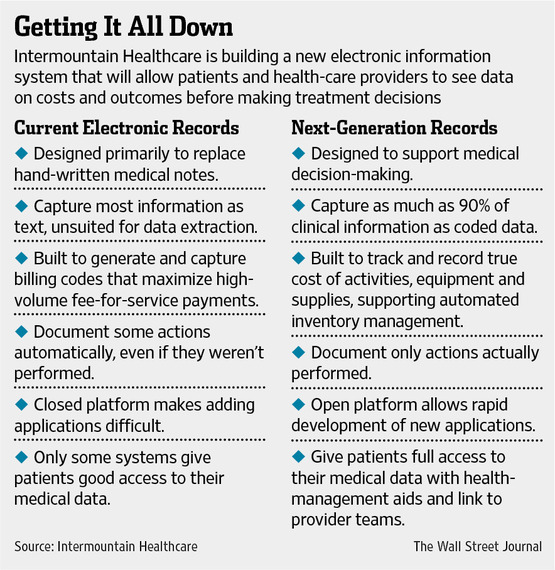
Here’s What Your Operation Will Really Cost; Intermountain Healthcare extends data-driven approach to reducing costs

Here’s What Your Operation Will Really Cost

Intermountain Healthcare extends data-driven approach to reducing costs

MELINDA BECK

Nov. 17, 2013 4:07 p.m. ET

IV-AA518D_RECOR_G_20131113160022

Brent C. James may be starting another medical revolution. As chief quality officer for Intermountain Healthcare, a Salt Lake City-based network of 22 hospitals and 185 clinics in Utah and Idaho, Dr. James has been using electronic records to improve care and cut costs since the 1980s. Read more of this post

Drug companies in Japan invest in curing diseases of the poor

Drug companies in Japan invest in curing diseases of the poor

Nov 16th 2013 |From the print edition

JAPAN’s pharmaceutical firms are an inventive bunch: only the American and British drugs industries produced more new medicines between 2005 and 2008. But their record on healing the diseases of the poor is not so good. The Access to Medicine Foundation, a non-profit group, tracks drug firms’ efforts to serve patients in developing countries; and in its ranking of the 20 biggest ones, Japanese firms occupy four of the bottom six rungs. Read more of this post

Biotech Bubble Watch 2014

Biotech Bubble Watch 2014

November 14, 2013

With valuations at historic highs, the industry’s bull run is looking frothy. Investors should brace for a correction, though not a 2000-like bust.

health_biotechgraphic47_970b

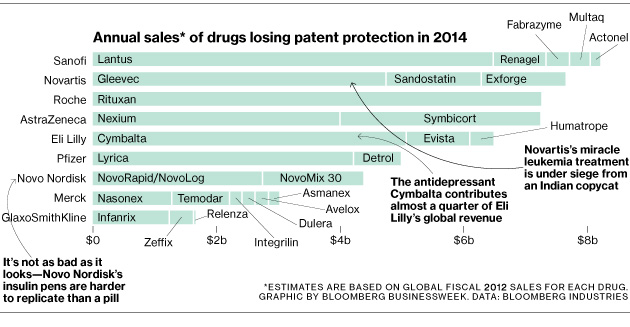
Big Pharma’s Patent Cliff

Big Pharma’s Patent Cliff

November 14, 2013

Drugs going off-patent in 2014 contribute just under $50 billion in pharmaceutical industry revenue. Not all products losing protection face imminent competition from generics; biological products and drugs delivered by devices are best poised to extend their money-spinning streak.

health_drugpatentchart447_630