Taj Hotels and Orient-Express: Two luxury hotel chains will not be checking in together

Taj Hotels and Orient-Express: Two luxury hotel chains will not be checking in together

Nov 16th 2013 | MUMBAI |From the print edition

INDIA and Orient-Express have never rubbed along. The luxury hotel firm’s buccaneering founder, James Sherwood, visited the country in the early 1990s and had “a nightmare”. His private jet was delayed for an age in Mumbai while officials checked that the bottles in its on-board bar were sealed correctly. He signed a deal to run the Lake Palace Hotel in Rajasthan (pictured), owned by local royalty. The deal collapsed when lawyers discovered that Mr Sherwood’s interlocutor was not the real Maharana of Udaipur, but his brother. Read more of this post

Interview: Raghuram Rajan plans ‘dramatic remaking’ of India’s banking system

November 18, 2013 10:54 am

Interview: Raghuram Rajan plans ‘dramatic remaking’ of India’s banking system

By James Crabtree, Lionel Barber and Victor Mallet in Mumbai

India’s central bank governor Raghuram Rajan is planning a “dramatic remaking” of banking in Asia’s third-largest economy, with an expanded role for foreign groups, more licences for domestic private sector institutions and a push to shake-up state-backed banks in advance of a new era of robust competition. Read more of this post

India Weighs Investment Cap in Pharmaceutical Sector; Proposal Would Bar Foreigners From Owning More Than 49% of Makers of ‘Rare and Critical’ Drugs

India Weighs Investment Cap in Pharmaceutical Sector

Proposal Would Bar Foreigners From Owning More Than 49% of Makers of ‘Rare and Critical’ Drugs

RAJESH ROY And KENAN MACHADO

Updated Nov. 18, 2013 10:01 a.m. ET

NEW DELHI—India is considering sharp new limits on investment in the country’s pharmaceutical industry that would bar foreign companies from taking control of makers of “rare and critical” medicines, a senior government official said Monday. Read more of this post

Angry NSEL investors accuse India’s Financial Tech of another fraud

Angry NSEL investors accuse Financial Tech of another fraud

Financial Technologies claims it is repaying foreign currency loans, but angry investors in NSEL allege that the promoters are taking money out of the company to pre-empt any adverse regulatory/judicial ruling. Financial Technologies shares touched a 2-month high of Rs 201 this morning after the company said it had sold its entire 100 percent equity ownership in Singapore Mercantile Exchange for USD 150 million. Read more of this post

A strongman is not the solution to India’s troubles

November 17, 2013 7:57 pm

A strongman is not the solution to India’s troubles

By Ramachandra Guha

Congress misrule has led to stalling growth – but Modi alone cannot fix it, says Ramachandra Guha

In the first weeks of 1967, the New Delhi correspondent of The Times wrote a series on “India’s Disintegrating Democracy”. “Universally believed to be corrupt”, the “government and the governing party have lost public confidence and belief in themselves as well”, he remarked. But he also thought that, among Indians, there was “emotional readiness for the rejection of parliamentary democracy”. They were due to vote in what the Times man saw as “the fourth – and surely last – general election”. Read more of this post

Hong Kong Seeks to Build REIT Business Amid Regional Competition

Hong Kong Seeks to Build REIT Business Amid Regional Competition

Hong Kong needs to attract more real estate investment trusts and allow new types of investment funds as it seeks to compete with other Asian financial centers, the city’s Financial Services Development Council said. Hong Kong should amend its rules on REITs, including giving them an exemption from profit tax on rental incomes, according to one of six reports published by the council today. The city should also allow the establishment of open-ended investment companies, encouraging fund management firms to choose the city as their domicile, the reports said. Read more of this post

The U.S., Crude Oil Refinery to the World

The U.S., Crude Oil Refinery to the World

November 14, 2013

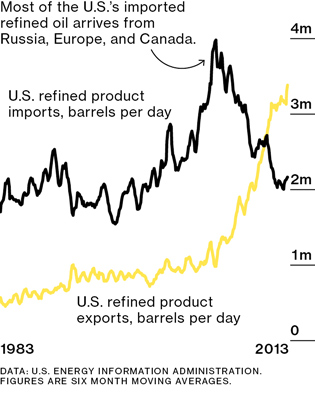
1. The U.S. has become the world’s fueling station, sending more gasoline, diesel, and other refined petroleum products abroad than ever before. Exports of these fuels have almost tripled in 10 years.  

2. In 2011, the U.S. became a net exporter of refined oil products for the first time since World War II.

3. Exports are forecast to keep rising as European refiners close, domestic crude production rises, and demand swells in emerging markets.

BW47_energy_refinerylinechart_315 BW47_energy_refinerymap_630

Solar Energy Shakeout: Concentrating vs. Photovoltaic

Solar Energy Shakeout: Concentrating vs. Photovoltaic

By Ken Wells and Mark Chediak November 14, 2013

BW47_energy_solarchart_315

Sometime next year, BrightSource Energy’s $2.2 billion Ivanpah solar power station will become fully operational and begin feeding enough green electricity to California’s two largest utilities to power 140,000 homes. Located in the Mojave Desert, 45 miles south of Las Vegas, the 392-megawatt plant works like a giant reflector. Its 173,500 computer-guided solar mirror arrays focus sunlight onto three 45-story towers. The heat generated by the sun’s concentrated rays boils water inside, creating steam to run electrical turbines. Spread across 3,500 acres of public land, Ivanpah is the largest plant of its kind. It may also be among the last of its kind ever built in the U.S. Read more of this post

Fracking Spreads Worldwide

Fracking Spreads Worldwide

By Nidaa Bakhsh and Brian Swint November 14, 2013

BW47_energy_oilservices_withhed_630

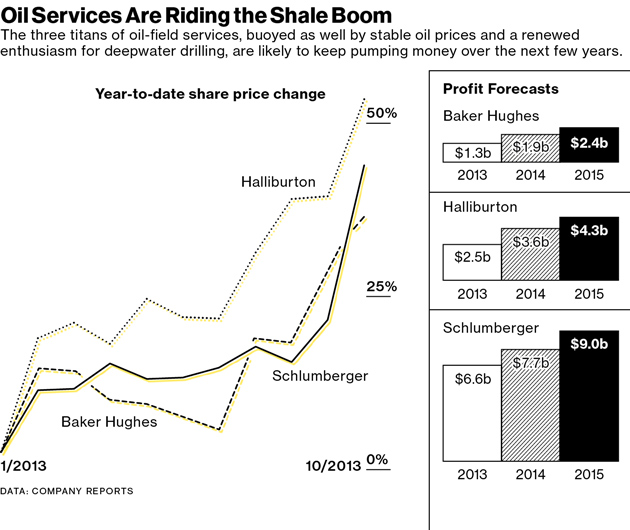
The hydraulic fracturing of shale in search of oil and gas has hardly started outside the U.S., but that’s changing. A record 400 shale wells may be drilled beyond U.S. borders in 2014, with most of the activity in China and Russia, according to energy consultants Wood Mackenzie. (In contrast, thousands of shale wells will be drilled in the U.S. next year.) The number of rigs used onshore in Europe and the Asia-Pacific region has increased 10 percent over the past year, data compiled by oil services company Baker Hughes (BHI) show. Most of those rigs are meant for shale. “It’s likely there will be a revolution,” says Maria van der Hoeven, executive director at the Paris-based International Energy Agency. “But not everywhere at the same time. And you just can’t copy the U.S. experience.” Read more of this post

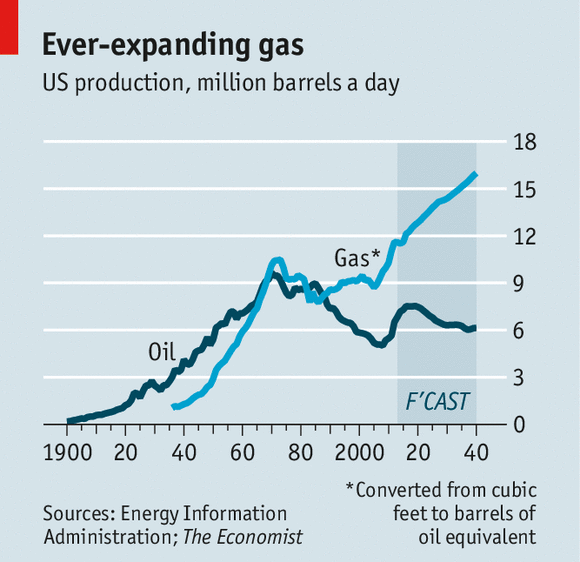
American industry and fracking: From sunset to new dawn; Capitalists, not just greens, are now questioning how significant the benefits of shale gas and oil will be for America. The new sceptics are missing the big picture

American industry and fracking: From sunset to new dawn; Capitalists, not just greens, are now questioning how significant the benefits of shale gas and oil will be for America. The new sceptics are missing the big picture

Nov 16th 2013 | NEW YORK |From the print edition

20131116_WBC785

IN A new book, “The Frackers”, Gregory Zuckerman says of the late George Mitchell, a pioneer of the technique of hydraulic fracturing to tap “unconventional” reserves of oil and gas, that “his impact eventually might even approach that of Henry Ford and Alexander Graham Bell.” Yet of late doubters have been making themselves heard too. In October Peter Voser said that one of his biggest regrets as boss of Shell is the $24 billion his firm has invested in North America’s shale beds. This summer, the firm took a big writedown on this investment and slashed its production targets. Also last month BHP Billiton, which spent around $20 billion in 2011 in a bet on shale, said it would auction half of its oil and gas acreage in Texas and New Mexico. Read more of this post

Zara’s Fast-Fashion Edge

Zara’s Fast-Fashion Edge

By Susan Berfield and Manuel Baigorri November 14, 2013

Arteixo is a small town in northwestern Spain near the Atlantic, surrounded by fishing villages. In its center, a glass building sits amid acres of green lawn. It’s the headquarters of Zara, the company that introduced the idea of fast fashion some two decades ago, then developed a highly centralized and often studied—but rarely duplicated—design, manufacturing, and distribution system. The building is officially known as the Cube. Those who work there think of it as the brain. Read more of this post

Fast-Food Chains Inch Toward Healthiness

Fast-Food Chains Inch Toward Healthiness

By Leslie Patton November 14, 2013

retail_restaurant47__01_b__630x420

Going cold turkey is hard—especially if it means denying yourself a 730-calorie frozen caramel coffee Coolatta or an 840-calorie steak and cheese sandwich. That’s why restaurants are getting Americans off unhealthy food gradually. Amid a national obesity epidemic, chains such as Au Bon Pain and Subway are tweaking their fare by tiny degrees instead of introducing openly lighter menus. They don’t want to frighten customers with terms such as “low-sodium” and “diet.” Read more of this post

Food is replacing iron ore and coal as the boom commodity. The takeover battle for Warrnambool Cheese and Butter has heated up to the point where it is hard to see the bids making economic sense

Dining out on a hot commodity

November 20, 2013

Richard Hemming

Food is replacing iron ore and coal as the boom commodity. The takeover battle for Warrnambool Cheese and Butter has heated up to the point where it is hard to see the bids making economic sense. The four protagonists, or antagonists, depending upon how you see them – the Australian-listed dairy producer Bega Cheese, the Canadian firm Saputo, the dairy co-operative Murray Goulburn, and the Japanese-owned dairy, beer and wine group Kirin – have bid the Victorian dairy producer’s stock up to more than $9 a share. Read more of this post

Despite Defaults, USDA Sweetens the Pot: The government is losing money on its sugar loan program

Despite Defaults, USDA Sweetens the Pot: The government is losing money on its sugar loan program

ALEXANDRA WEXLER

Nov. 18, 2013 7:21 p.m. ET

MI-BZ763A_SUGAR_G_20131118180303

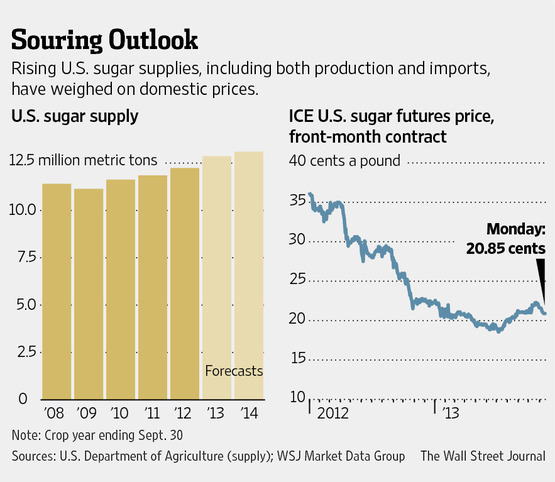
There is no way to sugarcoat it: The U.S. government is being forced to support sugar companies even though taxpayers are already footing a $280 million bill stemming from loans the companies can’t repay. The loans are part of a U.S. Department of Agriculture program aimed at supporting sugar prices. When sugar prices are high, processors—companies that turn raw beet and cane into sugar—pay the agency back on time and the program costs the government nothing. Read more of this post

John Hussman: Chumps, Champs, and Bamboo

November 18, 2013

Chumps, Champs, and Bamboo 
John P. Hussman, Ph.D.
“The seed of a bamboo tree is planted, fertilized and watered. Nothing happens for the first year. There´s no sign of growth. Not even a hint. The same thing happens – or doesn´t happen – the second year. And then the third year. The tree is carefully watered and fertilized each year, but nothing shows. No growth. No anything. Then the bamboo tree suddenly sprouts and grows thirty feet in three months.”

― Zig Ziglar

This story is more than a quote about persistence – it’s actually a reasonable description of risk-managed investing. Over the years, I’ve observed that numerous simple risk-managed investment strategies have substantially outperformed the market over the complete market cycle – particularly those that accept market risk in proportion to the estimated return/risk profile associated with prevailing conditions at each point in time. What I may not have done sufficiently is to describe the profile of how that outperformance is typically achieved over the market cycle. Read more of this post

2014: A User’s Guide to the Global Economy

2014: A User’s Guide to the Global Economy

By Peter Coy November 14, 2013

intro_oilchart630intro_balancechart630

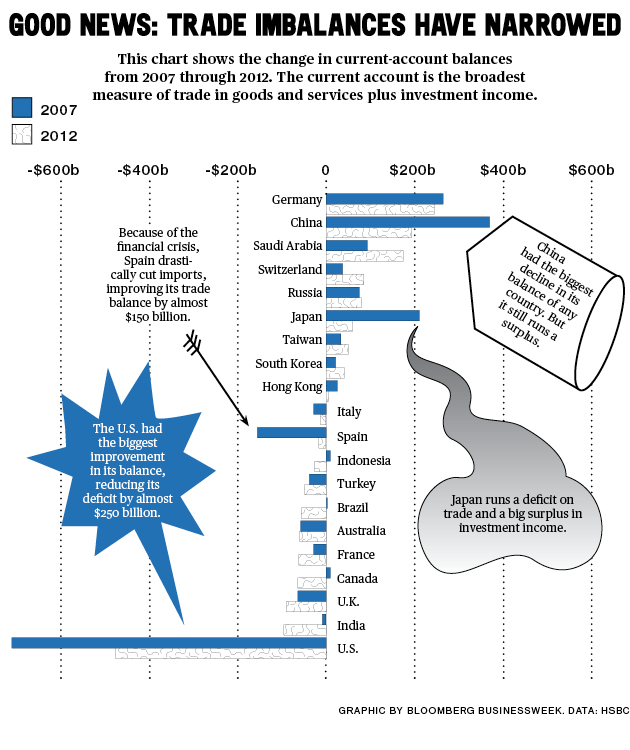
On Jan. 1, 2014, Latvia will adopt the euro, and its lats currency will be no more. Farewell to the fulsomely bearded Krišjānis Barons, the collector of folk songs who graces the 100-latu note. Goodbye to images of sailing ships and maidens, oak trees and the Daugava River. The little Baltic nation is shucking a piece of its national heritage because its leaders think that joining Europe’s somewhat troubled common currency zone will lead to more trade, investment, and prosperity. “We are looking to growth,” Finance Minister Andris Vilks told reporters in June. Read more of this post

“Bubble” In Riskiest Credit Exceeds 2008 Peak

“Bubble” In Riskiest Credit Exceeds 2008 Peak

Tyler Durden on 11/18/2013 19:48 -0500

20130923_loans1_0 (1)

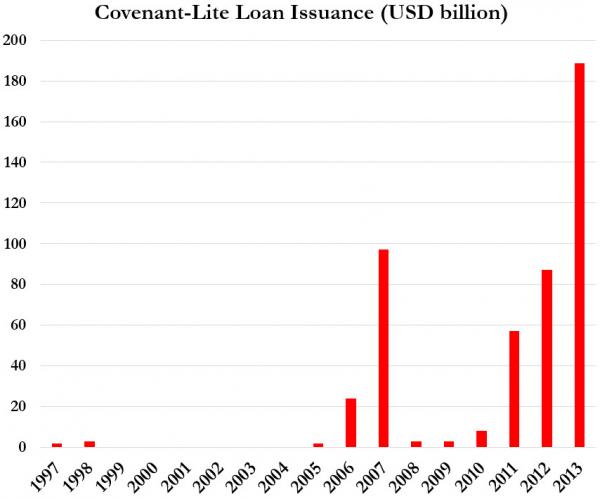
As we warned two months ago, the bubble in credit markets (which if you ask anyone at the Fed, except Jeremy Stein, does not exist) is nowhere more evident than in the explosive growth of so-called cov-lite loans. While total volumes of cov-lite loans are already at record, as the FT reportswe now have 55% of new leveraged loans come in “cov-lite” form, far eclipsing the 29% reached at the height of the leveraged buyout boom just before the financial crisisLBO multiples have reached record highs and demand for secutizations of these levered loans (CLOs) has surged on the back of the Fed’s repressive push of investors into more-levered firms and more-levered instruments. Read more of this post

Is France the New Italy?

Is France the New Italy?

If U.S. President Barack Obama thinks he’s having a difficult autumn, then maybe he should consider the season French President Francois Hollande is experiencing. Paris in springtime may have been lovely as usual, but fall has been horrible. The French unemployment rate stands at 11 percent. After growing tepidly in the second quarter, the economy shrank again in the third. Standard and Poor’s just downgraded the government’s debt — for the second time in less than two years. Hollande’s Socialist administration faces protests over taxes and burdensome regulation not just from business leaders, as you might expect, but also from farmers, shopkeepers, teachers, truck drivers and soccer players. Read more of this post

A 2014 Cheat Sheet

A 2014 Cheat Sheet

November 14, 2013

We know what you’re thinking. If only all the invaluable information contained in this issue could be distilled to one handy list—a series of tidbits you could use to impress friends, foes, spouses, and maybe a few teenagers. Reader, wish no longer. Read more of this post

50,000 Products but 3M Still Searching for Growth; CEO Thulin Sticks With Long-Term Research; Looks to ‘Fix’ Sluggish Units

50,000 Products but 3M Still Searching for Growth

CEO Thulin Sticks With Long-Term Research; Looks to ‘Fix’ Sluggish Units

JAMES R. HAGERTY 

Nov. 18, 2013 2:39 p.m. ET

MK-CH945_THULIN_NS_20131118142403

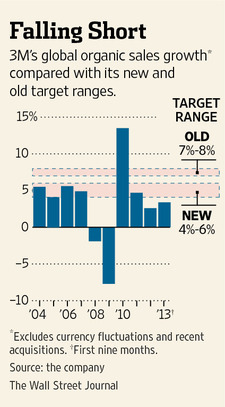
ST. PAUL, Minn.— Inge Thulin, 3M Co. MMM +0.22% ‘s chief executive officer, likes to talk about how the company’s research labs are cooking up “disruptive” technologies, such as a new kind of film designed to make colors brighter on cellphone and tablet screens. Yet 3M’s vast product line also includes such prosaic items as sandpaper, masking tape and dog-poop bags. Read more of this post

Hemaraj to Raise Funds Backed by Property Assets: Southeast Asia

Hemaraj to Raise Funds Backed by Property Assets: Southeast Asia

Hemaraj Land & Development Pcl (HEMRAJ), Thailand’s biggest industrial land developer, plans to raise about 4.5 billion baht ($142 million) by selling its first property fund to help finance new projects. The fund will be backed by rental revenue from factories and warehouses, and the proceeds will be used to develop a new industrial park in Rayong province and pay debt, Chief Executive Officer David Nardone said in an interview in Bangkok yesterday. Read more of this post

Blowing the whistle: Thailand’s former prime minister, Thaksin Shinawatra, loses a battle but is winning the war

Blowing the whistle: Thailand’s former prime minister, Thaksin Shinawatra, loses a battle but is winning the war

Nov 16th 2013 |From the print edition

THE truce in the street warfare into which Thai politics descended in 2006-10 is over. To the shrill peeps of ubiquitous whistles, protesters have yet again crowded Bangkok, the capital, brandishing portraits of Bhumibol Adulyadej, Thailand’s long-serving king, revered but frail. What has so far been a peaceful movement earlier this month seemed to threaten the survival of the government of Yingluck Shinawatra, the prime minister. Her tactical retreat has probably saved it. But the political divide looks as unbridgeable as ever, and as dangerous to Thailand’s stability. Read more of this post

Ubiquitous cameras: It is getting ever easier to record anything, or everything, that you see. This opens fascinating possibilities—and alarming ones

Ubiquitous cameras: It is getting ever easier to record anything, or everything, that you see. This opens fascinating possibilities—and alarming ones

Nov 16th 2013 | SAN FRANCISCO |From the print edition

ABOUT halfway through Dave Eggers’s bestselling dystopian satire on Silicon Valley, “The Circle”, the reader meets Stewart, a bald, silent, stooped 60-year-old who has “been filming, recording, every moment of his life now for five years”. Stewart is the first of the novel’s characters to make all his actions visible to anyone with a computer who cares to look—the first “transparent man”. Read more of this post

The Year of the Paywall

The Year of the Paywall

By Edmund Lee November 14, 2013

In the early days of the Internet, digital libertarians scolded anyone trying to make a buck on the Web, and traditional newspaper publishers essentially gave away their expensive-to-create content for free. Today, the weakened industry’s survivors seem determined to get readers to pay up, and they’re busily erecting electronic paywalls around their news and entertainment to make sure that happens. Read more of this post

The Social Media “Bubble”: Six Important Points by Brad Cornell, Professor of Finance at Caltech

The Social Media “Bubble”: Five Important Points

by Global PostNovember 16, 2013

The Social Media “Bubble”: Six Important Points by Brad Cornell, Professor of Finance at Caltech

In a post on valuing social media companies, Aswath Damodaran, properly warns not to be misled by the fallacy of aggregation (http://aswathdamodaran.blogspot.com/2013/10/when-pieces-dont-add-up-micro-dreams.html).  More specifically, with regard to these companies relying on advertising as a source of revenue he notes that the total advertising revenues of the companies cannot exceed total online advertising.  His calculations suggest that the valuations of social media companies are inconsistent with this constraint – implied total advertising revenues of even a relatively small sample of companies exceeds total projected on-line advertising expenditure. Read more of this post

SurveyMonkey aims new product at businesses, hires first sales team

SurveyMonkey aims new product at businesses, hires first sales team

11:10am EST

By Alexei Oreskovic

SAN FRANCISCO (Reuters) – Online company SurveyMonkey rolled out on Monday its new polling product aimed at business customers, the company said. The company also is hiring its first sales people to pitch the new SurveyMonkey Enterprise product directly to corporations and other large organizations. The product will also be available internationally. Read more of this post

Spotlight on video streaming service Vimeo with 100mil unique users

Updated: Monday November 18, 2013 MYT 12:36:39 PM

Spotlight on video streaming service Vimeo with 100mil unique users

As one of the media properties tucked away within IAC/Interactive Corp’s vast group of online holdings, executives are putting the spotlight on Vimeo, breaking out the number of users and revenue for the first time. IAC revealed that Vimeo has an audience of more than 100 million unique users, 400,000 paying subscribers and about $40 million in revenue over the past 12 months ending October. Read more of this post

Software Makers’ Subscription Drive

Software Makers’ Subscription Drive

By Sam Grobart November 14, 2013

In 2013 consumer software companies proved they could pull off the switch from one-time software purchases to an online subscriber model that costs customers more long term. Market researcher IDC estimates software subscription revenue has risen about 16 percent, to roughly $65 billion this year from $56 billion in 2012, and will approach $78 billion next year. IDC analyst Amy Konary says it’s too soon for those software makers to declare victory, “but what they consider a success is having a [subscription] model out there, having customers choosing that approach.” Read more of this post

Snap Out of It: Kids Aren’t Reliable Tech Predictors; As Much as We Think Youth Know ‘the Next Big Thing,’ They Are Often Wrong

Snap Out of It: Kids Aren’t Reliable Tech Predictors

As Much as We Think Youth Know ‘the Next Big Thing,’ They Are Often Wrong

FARHAD MANJOO

Nov. 17, 2013 4:46 p.m. ET

I believe the children aren’t our future. Teach them well, but when it comes to determining the next big thing in tech, let’s not fall victim to the ridiculous idea that they lead the way. Yes, I’m talking about Snapchat. Last week my colleagues reported that Facebook FB -2.60% recently offered $3 billion to acquire the company behind the hyper-popular messaging app. Stunningly, Evan Spiegel, Snapchat’s 23-year-old co-founder and CEO, rebuffed the offer. Read more of this post

Salesforce.com’s CEO Marc Benioff To Steve Ballmer: Yes, You’re ‘An Emblem Of An Old Era’ And It’s Time To Leave Microsoft

Marc Benioff To Steve Ballmer: Yes, You’re ‘An Emblem Of An Old Era’ And It’s Time To Leave Microsoft

JULIE BORT NOV. 18, 2013, 8:53 PM 6,286 5

Salesforce.com’s CEO Marc Benioff has something to say about Steve Ballmer’s decision to leave Microsoft: You’re right, Steve. Time to go. Benioff was commenting on an article that appeared in the Wall Street Journal on Sunday, where Ballmer, Microsoft’s CEO, described his decision to retire: Read more of this post