Europe’s Most Entrepreneurial Country? It’s Ireland

Europe’s Most Entrepreneurial Country? It’s Ireland

BEN ROONEY

Nov. 20, 2013 12:15 p.m. ET

EM-AX962_TECHEU_G_20131120120005

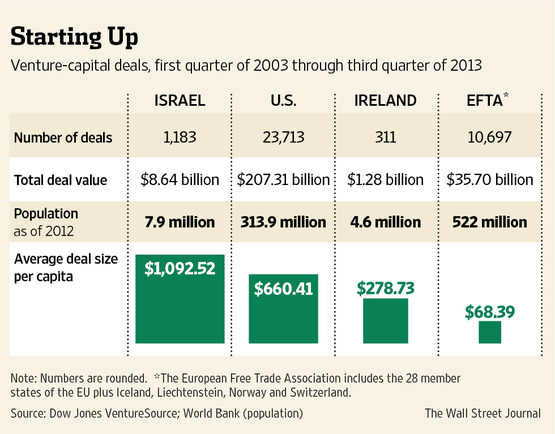
Ranking tech entrepreneurialism is a tricky task and whatever measure you come up with is going to annoy somebody, but by at least one measure, Europe’s most entrepreneurial country is Ireland. What does “most entrepreneurial country” mean? In this analysis, we looked at Dow Jones VentureSource data on the total amount of venture capital raised by tech companies in each European country since 2003, divided by population to get the per capita figure, then averaged it out over the 39 quarters. Read more of this post

Does cheapness predict subsequent outperformance?

November 21, 2013 4:10 pm

Does cheapness predict subsequent outperformance?

By Dominic Picarda

Europe looks cheap, but the US is pricey

Nothing sets off alarm bells quite like investors claiming that old valuation rules no longer apply. The classic case of this was during the technology bubble of the late 1990s. Faced with internet firms that made little or no profit, analysts spurned traditional valuation tools and cooked up new techniques based – among other things – upon website clicks. When investors woke to the incoherence of this “new paradigm”, technology stocks collapsed. Read more of this post

BMW, Cadillac Aim to Pull Plug on Tesla With Pricey New Cars

BMW, Cadillac Aim to Pull Plug on Tesla With Pricey New Cars

JOSEPH B. WHITE

Nov. 20, 2013 6:25 p.m. ET

LOS ANGELES— Tesla Motors Inc. TSLA -3.95% is about to get deep pocketed rivals in the luxury electric luxury car market after largely having the business to itself since the 2012 launch of the Model S sedan. BMW AG BMW.XE +0.31% , General Motors Co. GM -0.84% ‘s Cadillac and VolkswagenAG VOW3.XE +0.08% ‘s Porsche and Audi NSU.XE +0.30% brands are among the luxury brands using this week’s Los Angeles Auto Show to promote new plug-in models aimed at affluent, eco-conscious Californians who make up the heart of Tesla’s buyers. Read more of this post

Blame Rich, Overeducated Elites as Our Society Frays

Blame Rich, Overeducated Elites as Our Society Frays

Complex human societies, including our own, are fragile. They are held together by an invisible web of mutual trust and social cooperation. This web can fray easily, resulting in a wave of political instability, internal conflict and, sometimes, outright social collapse. Analysis of past societies shows that these destabilizing historical trends develop slowly, last many decades, and are slow to subside. The Roman Empire, Imperial China and medieval and early-modern England and France suffered such cycles, to cite a few examples. In the U.S., the last long period of instability began in the 1850s and lasted through the Gilded Age and the “violent 1910s.” Read more of this post

Big trucks still rule Detroit in energy-conscious era

Big trucks still rule Detroit in energy-conscious era

8:38am EST

By Paul Lienert

DETROIT (Reuters) – Five years into a remarkable rebound from near-disaster, the Detroit 3 automakers still count on sales of pickup trucks and SUVs in the North American market for the bulk of their global profits, despite efforts to shift buyers into smaller, greener vehicles as part of a broader move to remake the Motor City. Promotion of green technologies, notably hybrid and electric vehicles, has been a signature policy of the Obama administration, which oversaw the $80 billion taxpayer-funded bailout in 2009 of General Motors and Chrysler. Read more of this post

Asset price ‘security alerts’ mask real risks

Last updated: November 22, 2013 9:44 am

Asset price ‘security alerts’ mask real risks

By Tracy Alloway in New York

Defining value is hamstrung by assumptions and expectations

Any reader who has flown commercially in the US during the past dozen years will no doubt have a passing awareness of the Homeland Security Advisory System. The now defunct terrorism threat scale was rolled out to indicate the threat level faced by the nation, from green – for a “low” risk of an attack – to red for “severe”. I was this week reminded of the now-moribund warning system thanks to a flight to Florida and a new research report by Fitch Ratings that draws an unusual parallel between the nation’s old colour-coded scale and US accounting rules. Read more of this post

Anxiety Over Asset Bubbles From Homes to Internet Rising in Poll

Anxiety Over Asset Bubbles From Homes to Internet Rising in Poll

Asset bubbles are forming in Internet and social media stocks as well as in the housing markets of London and China, according to the latest Bloomberg Global Poll. Eighty-two percent of the responding investors, analysts and traders who are Bloomberg subscribers said Internet and social media shares are either at or near unsustainable levels. Seventy-three percent said the same of Chinese house prices and 69 percent identified London homes as already or almost frothy. They were less concerned about U.S. housing, with 31 percent seeing prices approaching or at excessive levels. Read more of this post

An ECB Negative Deposit Rate? Don’t Hold Your Breath, Says Citi

An ECB Negative Deposit Rate? Don’t Hold Your Breath, Says Citi

Tyler Durden on 11/20/2013 13:18 -0500

While the FOMC Minutes due out in less than an hour is what everyone is looking forward to, the big surprise announcement of the day was the repeat of a rumor released initially 6 months ago, namely that the ECB is considering negative deposit rates – a concept we first speculated aboutback in June of 2012. Alas, just like last time, the latest incarnation of the NIRP rumor appears to be merely more hot air (and certainly will be exposed as such once the non-compliant mostly German ECB members hit the tape). One person who says not to hold your breath for an ECB negative rate, is Citi’s Valentin Marino, who says not only is a negative deposit rate unlikely before the results of the AQR and stress tests as it would accelerate bank deleveraging, but that it could worsen the pervasive credit crunch and add to the growth headwinds and deflation risks in in the currency block. It would erode investors’ confidence in Eurozone’s financial institutions and accentuate their relative underperformance.”  Read more of this post

Shortcomings of The NPV Approach To Valuing Stocks

Shortcomings of The NPV Approach To Valuing Stocks

by csinvestingNovember 20, 2013

Part I: What are the three major shortcomings of using the Net Present Value Approach (“NPV”) to valuing companies?

The NPV approach has three fundamental shortcomings. First, it does not segregate reliable information from unreliable information when assessing the value of a project. A typical NPV model estimates net cash flows for several years into the future from the date at which the project is undertaken, incorporating the initial investment expenditures as negative cash flows. Five to ten years of cash flows are usually estimated explicitly. Cash flows beyond the last date are usually lumped together into something called a “terminal value.” A common method for calculating the terminal value is to derive the accounting earnings from the cash flows in the last explicitly estimated year and then to multiply those earning by a factor that represents an appropriate ratio of value to earnings (i.e., a P/E ratio). If the accounting earnings are estimated to be $12 million and the appropriate factor is a P/E ratio of 15 to 1, then the terminal value is $180 million. Read more of this post

The Top-Heaviness Problem in Indexation and the Wealth Index

Horizon Kinetics: The Top-Heaviness Problem in Indexation and the Wealth Index

by ValueWalk StaffNovember 20, 2013

These two normally separate sections have been combined for this issue, since the two categories converge in my discussion of a new approach to the top-heaviness problem in indexation. Let’s review the problem. We understand the need for indexation, and we also understand the need for liquidity. The first problem in constructing an index is to provide the customer base enough liquidity for investing sufficient funds in the index. The only recognized approach is that of market capitalization, because that measurement is more or less a guide to the liquidity of the constituent elements of an index. This approach creates a top-heaviness problem, one aspect of which is that if a company is very highly valued in a conventional metric sense, as in having a very high P/E, it has a proportionately larger market capitalization. Therefore, anyone who buys the index would be buying companies that are overvalued. Read more of this post

Cross-Border Reverse Mergers: Causes and Consequences

Cross-Border Reverse Mergers: Causes and Consequences

Jordan I. Siegel Harvard Business School

Yanbo Wang Boston University School of Management

September 24, 2013
Harvard Business School Strategy Unit Working Paper No. 12-089

Abstract: 
We study non-U.S. companies that have used reverse mergers as a means to adopt U.S. corporate law (and sometimes U.S. securities law as well). Early adopters of cross-border reverse mergers and those firms that hired a Big Four auditor exhibited superior corporate governance outcomes. Later adopters of cross-border reverse mergers were likely to strategically mimic the early entrants only to gain access to U.S. capital markets — that is, they took some governance actions but not others — and are shown to be likely to have worse corporate governance outcomes over time. Firm-level origins in China initially appears to be a significant negative determinant of at least some corporate governance outcomes, but the variable loses its statistical power when examining the most comprehensive data set on cross-border reverse mergers yet assembled and when including a battery of relevant control variables. Adoption of Nevada’s corporate law is associated with some of the most serious restatements involving real corporate governance and data manipulation problems. In summary, the evidence supports the existence of strategic mimicry, which the capital market did not fully discern for many years. It also supports the explanatory power of reputational bonding to explain the fact that adoption of U.S. institutions can be used either to build reputation or to exploit relatively weak U.S. cross-border law enforcement.

Independent Directors’ Dissent on Boards: Evidence from Listed Companies in China

Independent Directors’ Dissent on Boards: Evidence from Listed Companies in China

Juan Ma Harvard Business School

Tarun Khanna Harvard University – Strategy Unit

October 24, 2013
Harvard Business School Strategy Unit Working Paper No. 13-089

Abstract: 
In this paper, we examine the circumstances under which so-called “independent” directors voice their independent views on public boards in a sample of Chinese firms. First, we ask why independent directors dissent, i.e. how they justify such dissent to public investors. We find that when independent directors dissent, they tend to offer mild, subjective justifications. Overt criticism of the management is rare. Next, we ask when an independent director is more likely to dissent and who is more likely to dissent. Controlling for firm and board characteristics, we find that dissent is significantly correlated with breakdown of social ties between the independent director and the board chair who locates at the center of the board bureaucracy in China. Dissent is more likely to occur when the board chair who appointed the independent director has left the board. Dissent also tends to occur at the end of board “games”, defined as a 60-day window prior to departure of the board chair or departure of the independent director herself. The endgame effect is particularly strong, seeing 27% of the dissent issued at board “endgames” which represents only 4% of independent directors’ average tenure. While directors with foreign experience are more likely to dissent, we do not find that academics, accountants and lawyers are significantly more active in voicing dissent. Lastly, we show that dissent is consequential to both the director and the firm. For directors, dissent significantly increases one’s likelihood of exiting the director labor market, which translates to a more-than-10% estimated loss of annual income. For firms, we document an economically and statistically significant cumulative abnormal return of -0.97% around announcement of dissent. Although the literature has suggested that dissent might be reflective of diverse viewpoints, and perhaps beneficial in and of itself through reduction of firm variability, we do not find this offsetting beneficial effect to be strong.