Virtual-Currency Craze Spawns Bitcoin Wannabes; Entrants Include Litecoin, Worldcoin and Even Bbqcoin; a Ticket to Fortune?
November 22, 2013 Leave a comment
Virtual-Currency Craze Spawns Bitcoin Wannabes
Entrants Include Litecoin, Worldcoin and Even Bbqcoin; a Ticket to Fortune?
JOE LIGHT
Updated Nov. 20, 2013 9:00 p.m. ET
Owner Taylor Minor waits on customers at Stoney Creek Roasters in Cedarville, Ohio, which accepts a form of payment called bbqcoin. Ty Wright for The Wall Street Journal
Gary Thomas plans to get rich off virtual currencies—but not bitcoin. The electrical engineer is betting big on newcomers like alphacoin and fastcoin. Mr. Thomas started trading the digital currencies from his home outside Boston earlier this year. He said he is convinced this is his ticket to fortune, even after an earlier attempt—investing in Internet stocks during the dot-com bubble—ended in disaster.“I think this is a point in history that will never be repeated,” said Mr. Thomas, who is in his 50s. “These things will take off like nobody will imagine.”
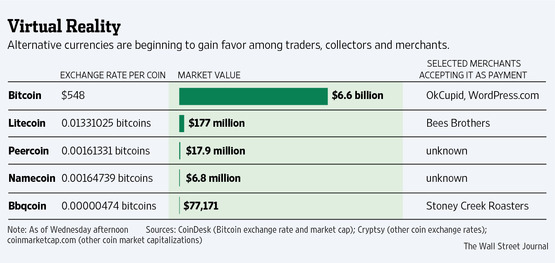
A “cryptocurrency” craze has spawned more than 80 entrants, from peercoin and namecoin, to worldcoin and hobonickels. In October and November alone, developers launched gridcoin, fireflycoin and zeuscoin. Bbqcoin has enjoyed a renaissance after a false start in 2012. Litecoin, launched in 2011, has turned into the strongest bitcoin alternative.
Virtual-currency experts credit bitcoin’s explosion into the public consciousness for a flurry of new currencies—and an increasing legion of fans hoping to make a quick buck trading them. Bitcoin, launched in 2009, fetched about $548 a coin as of late-afternoon Wednesday in New York, making all the existing bitcoin worth about $6.6 billion, according to CoinDesk.com, which averages bitcoin prices across exchanges. Its rise sparked hearings on Capitol Hill this week during which enforcement agencies described it as a legitimate currency but expressed worries that it could be used for illegal activities.
That was a golden moment for the cryptomania. Bitcoin prices soared as high as $781.82 on Monday, before plunging. Some other digital currencies jumped, as well.
Bitcoin was invented by an unidentified person or group going by the name of Satoshi Nakamoto. A finite number of bitcoin can be created, or “mined,” by using computers to find solutions to complex math problems. The bitcoin can then be traded digitally. Investors also buy and sell the coins via online exchanges, and a few merchants accept virtual currencies as payment for goods and services.
The new coins generally use the same basic principles as bitcoin but have slightly different algorithms or rules that can speed up transactions or change the frequency and difficulty with which the coins are awarded.
Because none of the coins are as widely accepted or used as bitcoin, investors place a fraction of bitcoin’s value on the upstarts.
Many of the new coins trade on exchanges such as Cryptsy, of Delray Beach, Fla., a unit of Project Investors Inc., and BTC-e.com. Cryptsy founder Paul Vernon said his exchange has handled as many as 33,000 trades in a day from enthusiasts such as Mr. Thomas.
A pool of day traders also has popped up, trying to take advantage of rate discrepancies on different exchanges to make money.
One bbqcoin, for example, traded at about 0.00000474 bitcoin on Cryptsy Wednesday afternoon. One litecoin bought 0.01331025 bitcoin and one krugercoin bought 0.00000024 bitcoin.
Greg Schvey, head of research for the Genesis Block, a New York research and data firm that tracks digital currencies, said the sheer number of new currencies being launched “can be distracting.”
Many of them likely won’t succeed and will ultimately be worthless, Mr. Schvey said. “These coins are only as good as the next person who is going to accept it,” he said.
A couple of the coins weren’t even created as a serious venture.
Andy Pilate, a software coder who also goes by the name Cubox, in July 2012 rolled out bbqcoin, “just for ‘fun,’ ” according to his post on bitcointalk.org, a digital-currency online forum. Many of the forum’s users derided bbqcoin for being a clone of other currencies and for making light of virtual currencies. It quickly disappeared.
But earlier this year, some of its original supporters resurrected bbqcoin. Now, a couple of merchants even take it as payment.
Taylor Minor, owner of the Stoney Creek Roasters coffee shop in Cedarville, Ohio, mines bbqcoin and takes it in his shop. In October, he made his first bbqcoin-denominated sale to a friend, who bought two servings of Cookies and Cream ice cream for 7,000 bbqcoins. “It kind of brought my two worlds together of food and cryptocurrencies,” he said.
Mr. Pilate, who is 17 years old and studying computer science in Paris, said he hadn’t paid much attention to the coin since abandoning it. “It makes me happy that finally people are using it,” he said.
Litecoin has emerged as the strongest alternative to bitcoin, with a market capitalization of about $176.8 million as of late afternoon Wednesday, according to coinmarketcap.com, which tracks the market capitalizations of virtual currencies.
Litecoin is designed to process transactions four times faster than the bitcoin network while sacrificing some efficiency in the mining process, said litecoin creator Charlie Lee, who is now a software engineer at Coinbase Inc., a startup that seeks to make it easier for merchants to take bitcoin.
A few vendors now accept litecoin, as well. For example, Bees Brothers, which sells honey and caramels in North Logan, Utah, takes bitcoin and litecoin.
Some bitcoin supporters say they don’t feel threatened by litecoin.
Jinyoung Lee Englund, a spokeswoman for the Bitcoin Foundation, a Washington-based nonprofit that promotes bitcoin, said she thinks the currencies can coexist in the same way investors use more than one commodity as a store of value. “If bitcoin is like gold, litecoin is like silver,” she said.
Mr. Thomas, who mined his digital coins using his computer, says many more currencies will gain value. He is confident his pile, which he said is now worth about 8 bitcoins, or about $4,384, will be worth more than $10 million by next November.
“There have been so many times where in the past, I’ve been right at the right spot and unwilling to take the big risk, and as a result I look back and say, ‘Why didn’t I do that?’ ” he said.
 About bambooinnovator
 Bamboo Innovator