Xbox One vs. PS4: Microsoft More Profit Per Console
November 24, 2013 Leave a comment
Xbox One vs. PS4: Microsoft More Profit Per Console
11/22/2013 05:40 PM EST
OTTAWA, — Microsoft comes out punching with a significant upgrade to the Xbox franchise console and a true competitor to Sony’s PS4 while delivering per-unit profits. TechInsights Teardown costing shows both companies can profit from sales of their gaming consoles this holiday season. In fact, they used many similar parts to optimize their investment in the next generation of gaming consoles. Though AMD came out as a big winner in the APU (integrated CPU and GPU), there are choice design differences around both the processor design and the use of memory in each device. The TechInsights bill of materials for the Microsoft Xbox One amounts to $331. Based on this — and when the estimated costs for the peripherals are included — TechInsights believes Microsoft will have a gross profit of approximately $100 per console sold. This is far better than the $43 Sony will make per complete unit.
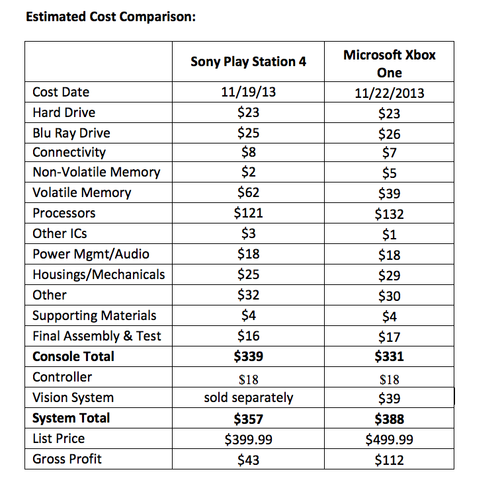
Bill of materials cost comparison of TechInsights.Said Al Cowsky, TechInsights’ costing director:
At the console level, the Xbox One is $10 less expensive than the PS4. This is primarily due to a $23 memory premium on the PS4, but it is offset by an $11 cost premium on the Xbox One processor. The Xbox One also has 4GB eMMC NAND flash, making the nonvolatile category $3 higher for Xbox One, while the housings/mechanicals of the Xbox One add another $4 premium over the PS4.
The Xbox One also comes with a Kinect vision system in-box with an estimated cost of $39. This is more than made up for by the $100 list price premium. Likewise, PS4 has an optional vision system accessory available for a list price of $60 (unit not costed at this time).
Though Microsoft seems to have generated more profit per console, it remains to be seen how the devices will compare as developers invest in building radical new games for the powerful platforms. Nonetheless, this initial profitability places both suppliers on equal footing for the real revenue (and profits) promised through the sales of games and the online experience.
 About bambooinnovator
 Bamboo Innovator