All about Adam: A furious—and political—debate about the origins of mankind
November 25, 2013 Leave a comment
All about Adam: A furious—and political—debate about the origins of mankind
Nov 23rd 2013 |From the print edition
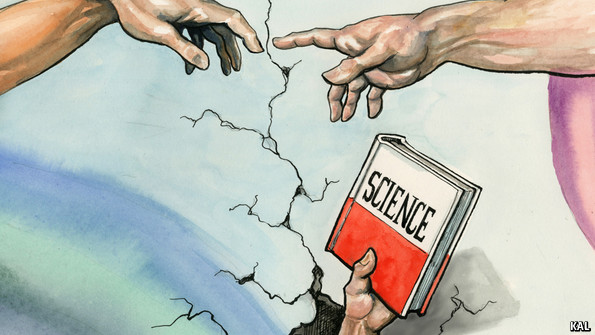
THAT old-time religion is strong in America. To take just one measure, for decades more than 40% of all Americans have consistently told Gallup pollsters that God created humans in pretty much their current form, less than 10,000 years ago. They are embracing an account of man’s origins promoted by Young Earth Creationists who lean on a painstakingly literal reading of the Scriptures, swatting aside the counter-claims of science (fossils are a relic of Noah’s flood, they argue, and evolution is a myth peddled by atheists). In a recent poll 58% of Republicans and 41% of Democrats backed creationism. The glue that underpins such faith is the principle of Biblical inerrancy—a certainty that the Scriptures are infallibly and unchangingly true.A quest for certainty is an American tradition. Old World believers often inherit religion passively, like a cultural artefact. Americans, an individualistic bunch, are more likely to switch churches or preachers until they find a creed that makes sense to them. They admire fundamental texts (the constitution, for example) that plain citizens may parse for immutable truths.
At the same time, the literalist faith is in crisis. Young Americans are walking away from the stern denominations that have held such sway over post-war American life, from Billy Graham’s crusades to the rise of the religious right. After they hit 18, half of evangelical youngsters lose their faith; entering a public university is especially perilous. As a generation, millennials (those born between the early 1980s and 2000s), are unimpressed by organised anything, let alone organised religion. Many young adults told the Barna Group, an evangelical research outfit, that they felt stifled by elders who demonised secular America. Young Christians are more accepting of gay rights than their elders. In a challenge to creationists, a quarter of young adults told Barna’s study that their churches were “anti-science”.
The seeming paradox of a strong faith in crisis is explained by rigidity: that which cannot bend may break instead. The danger is keenly felt in conservative Christian circles, where a debate has broken out over the long-term outlook for the movement. That debate took Lexington this week to unfamiliar territory: the annual meeting, in Baltimore, of America’s largest society for evangelical theologians, where Biblical inerrancy topped the agenda. Some discussions were a trifle arcane, it is true, with sharp exchanges about ancient Hebrew cosmology and the degree to which the Book of Genesis draws on Mesopotamian creation and flood motifs. But a bang-up-to-date, and distinctly political, dispute hummed along underneath the scholarly sparring: what to do about core principles threatened by new facts. Evangelical Christianity is being shaken not only by the irreverence of the young but also by new discoveries flowing from genetic science.
Some discoveries mostly serve to inject fresh evidence into long-running disputes. It is nearly 90 years since the “Monkey Trial” of John Scopes, a young schoolmaster accused of teaching evolution to Tennessee children. Recent research (notably cross-species comparisons of gene sequences rendered non-functional by mutations) has greatly strengthened the case that humans and chimpanzees share a common ancestor. A creationist speaker in Baltimore shrugged such discoveries off, declaring that “science changes, but the word of God never changes.”
A trickier controversy has been triggered by findings from the genome that modern humans, in their genetic diversity, cannot be descended from a single pair of individuals. Rather, there were at least several thousand “first humans”. That challenges the historical existence of Adam and Eve, and has sparked a crisis of conscience among evangelical Christians persuaded by genetic science. This is not an esoteric point, says Michael Cromartie, an evangelical expert at the Ethics and Public Policy Centre, a Washington think-tank: many conservative theologians hold that without a historical Adam, whose sin descended directly to all humanity, there would be no reason for Jesus to come to Earth to redeem man’s Fall.
Academics have lost jobs over the Adam controversy. Many Christian universities, among them Wheaton (a sort of evangelical Harvard and Yale, rolled into one), oblige faculty members to sign faith statements declaring that God directly created Adam and Eve, the “historical parents of the entire human race”. John Walton, an Old Testament scholar at Wheaton, suggested that Adam and Eve are presented in Genesis as archetypes, though he called them historical individuals too.
Would you Adam and Eve it?
In a breach with orthodoxy that would have been unthinkable a few years ago, the Baltimore meeting was also addressed by a Canadian, Denis Lamoureux, who sees no evidence for a historical Adam. The Bible, he argues, is “ancient science” filled with archaisms and metaphors. Mr Lamoureux is a prominent member of the “evolutionary creation” movement, which credits God with creating Darwinian evolution and overseeing its workings (a view shared by, among others, the pope). A prime mover, Francis Collins, is an atheist-turned-Christian who directs the National Institutes of Health (NIH), the American government’s biomedical research agency. Biologos, an evolutionary creation group that Mr Collins set up in 2007, calls this a moment to match Galileo’s trial for insisting that the Earth circles the sun.
Academic papers on Adam are flying. Perhaps a dozen Adam books are out or due out soon. Baltimore’s packed Adam session turned professors away at the door. This is a dispute between conservative Christians, not an outbreak of soggy, believe-what-you-like European deism. Much is at stake. Denying science is a bad habit among conservatives of all stripes: Paul Broun, a Georgia Republican who sits on the House science committee (and who wants to run for the Senate), says evolution is a lie “straight from the pit of hell”. That’s pandering, not piety.
 About bambooinnovator
 Bamboo Innovator