It’s complicated: Management thinkers disagree on how to manage complexity
November 25, 2013 Leave a comment
It’s complicated: Management thinkers disagree on how to manage complexity
Nov 23rd 2013 |From the print edition
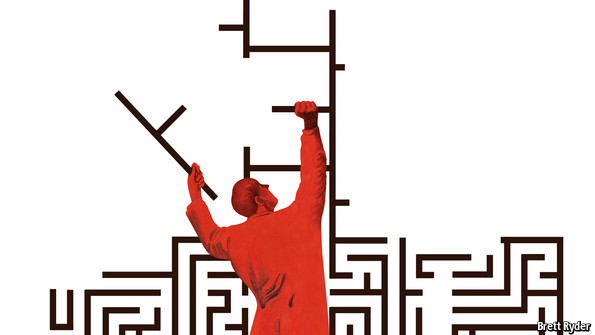
THERE can be few better places to talk about complexity than Vienna. This was the capital of the most complicated political organisation yet seen: the Austro-Hungarian Empire. It was also the centre of some of the most convoluted cold-war spy games. On November 14th and 15th hundreds of management enthusiasts converged on the Austrian capital to debate the subject. They had little interest in the complexities of the Habsburgs or the cold war. They were preoccupied instead by two points: that business is more complicated than ever before; and that managing complexity is at the top of businesspeople’s agenda.Whether they were right about the first point is debatable. In the 18th century it took six months for letters to travel from East India House in London to Calcutta and back. Today, supply chains can be managed in real time, and masses of data can be crunched instantly at the touch of a button. But they were right about the second. Businesspeople are confronted by more of everything than ever before: this year’s Global Electronics Forum in Shanghai featured 22,000 new products. They have to make decisions at a faster pace: roughly 60% of Apple’s revenues are generated by products that are less than four years old. Therefore, they have a more uncertain future: Harvard Business School’s William Sahlman warns young entrepreneurs about “the big eraser in the sky” that can come down at any moment and “wipe out all their cleverness and effort”.
The Vienna conference—the fifth in an annual series to celebrate Peter Drucker’s work—produced two starkly different solutions to the complexity problem (Schumpeter is, of course, simplifying to avoid unnecessary complexity). The first is to recognise and accept that complexity is just a misnomer for a new sort of order. Don Tapscott, of “Wikinomics” fame, argued that the information revolution is replacing one kind of management (command-and-control) with another (based on self-organising networks). John Hagel of Deloitte talked about the growing disconnect between “linear institutions and the non-linear world that is developing around us”.
Organisations built for this new world may look complex and unwieldy but they have an inner logic and powers of self-organisation. Global networks such as Kiva, a crowdfunding website, and CrisisCommons, which musters tech volunteers to help out in disasters like the Philippines typhoon, can mobilise thousands of people with little top-down direction. Accelerate, a call-centre company, employs 20,000 people but has no call centres: they work from home. Such outfits suffer from complexity only when managers apply command-and-control techniques to them.
The second, rival solution to dealing with complexity is to impose simplicity. The bosses of Tupperware Brands and Tata Consultancy Services could hardly face more different challenges. Tupperware has 3m freelance salespeople, working everywhere from plush Austrian suburbs to Indian slums. TCS employs almost 300,000 people to solve complex technological problems. Rick Goings of Tupperware and Natarajan Chandrasekaran of TCS agreed that the only way to avoid being blinded by complexity is to concentrate on the few simple things that can give their businesses focus and their workers direction.
What to make of these two contrasting views of complexity? The first argument contains a kernel of truth. Massive computing power and fast internet speeds make it easier to create networked, devolved organisations like Kiva and CrisisCommons. But it is easy to get carried away. The most striking development of the past couple of decades is how well monolithic companies have survived the technological storm: the internet is now dominated by a handful of giant problem-solvers like Google, with its mission to organise all the world’s information.
The second view is more persuasive. It is striking how many of the world’s most successful businesses thrive on simplicity of some sort. German Mittelstandcompanies are doing well by focusing on narrow niches. Built-to-last companies, such as Coca-Cola, are masters of distilling their corporate identity into a simple formula which employees can internalise and customers can easily recognise. McDonald’s is a global success because its business model is so simple and replicable. Tim Brown, the boss of IDEO, argues that design companies like his are enjoying success by showing organisations how to “design complexity out”.
Simplistic about simplicity
The pursuit of simplicity can certainly be taken too far if it is applied in a simple-minded way. Focusing on simple targets can be counter-productive: for example, British police, told to improve their overall clear-up rates, have been criticised for devoting too much time to relatively minor offences such as speeding rather than more difficult crimes such as sexual assaults and gang-related killings. And applying the simplicity mantra to some kinds of businesses can be silly: there is no way that Boeing can engineer the complexity out of producing its Dreamliner jet.
However, there are good reasons why sensible CEOs like Mr Goings think as they do. The biggest threat to business almost always comes from too much complexity rather than too much simplicity. The conglomerates of the 1960s crumbled because they tried to manage too many businesses in too many different industries. Enron imploded because the company abandoned old-fashioned command-and-control in favour of fashionable ideas about running energy companies as if they were financial organisations. The banks were so bedazzled by complex mathematical formulae (and corrupted by greed) that they lost sight of the simplest principles of banking. That old US Navy saying, “Keep it simple, stupid”, is not a bad rule for management too, simple-minded though it may sound.
 About bambooinnovator
 Bamboo Innovator