The Indian problem: Opposition to a global trade deal risks hurting the very countries India claims it is trying to protect
November 25, 2013 Leave a comment
The Indian problem: Opposition to a global trade deal risks hurting the very countries India claims it is trying to protect
Nov 23rd 2013 |From the print edition
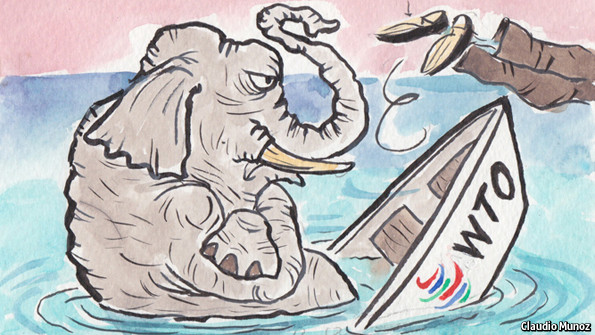
INDIA, home to a third of the world’s extremely poor people, takes pride in being a champion of the poor. But words are one thing, deeds another. Right now, India stands in the way of a deal that members of the World Trade Organisation (WTO) are hoping to do in less than two weeks’ time—and its stubborn opposition could deliver a serious blow to the poorest countries in the emerging world.Negotiators meet on the Indonesian island of Bali in early December in a final attempt to salvage the Doha round of world-trade talks. Since its start in 2001 Doha has stumbled from impasse to impasse, then to a collapse in 2008. Revived talks aimed for a slimmed-down deal. It would focus on “trade facilitation”: efforts to ease trade through simplified customs rules, which almost everyone can support. But a fierce disagreement over agriculture is tangling up the talks and threatening a breakdown in Bali. India is mostly to blame.
Its objections are not exactly surprising. Like many other developing economies, India strengthened “food security” policies in response to recent swings in food prices, stepping up subsidies to meet production goals. Those subsidies may soon grow large enough to violate WTO rules. A club of developing economies, led by India, is demanding a rule change. Rich countries are reluctant to give ground.
Domestic politics is part of the problem. Manmohan Singh, India’s prime minister, would like a deal. But his government faces a general election in the first half of next year. The leader of his Congress party, Sonia Gandhi, is sure to resist efforts to weaken the food-security law. India’s truculence is also rooted in its self-image as a torch-bearer for the interests of the world’s poor.
In election season, politicians often object to sensible but unpopular reforms. Yet such short-sightedness can prove costly. And in this case it is India and other developing countries that will pay the highest price. The trade-facilitation measures in the Bali package would add an estimated $68 billion a year to global output, with much of the gain concentrated in poor countries. More important, failure would destroy the credibility of the WTO, a body which boosts the developing world’s bargaining power.
The WTO already has the look of a vestigial institution. Richer countries are pushing forward with ambitious new regional deals—including a Trans-Pacific Partnership and a Trans-Atlantic Trade and Investment Partnership—that exclude the biggest emerging markets. Still poorer economies in Africa and Latin America rely on the WTO to get their voices heard.
Your own special dreams in Bali
India may consent to a temporary expedient: a “peace clause” that would waive WTO rules for a few years. But that would be a shoddy compromise, yet another sign that the global forum cannot deliver meaningful agreements. India should instead bring its law within the trade body’s rules: a hard choice, but one likely to pay dividends over time. Such a deal in Bali would enable the WTO’s new director-general, Roberto Azevêdo from Brazil, to blaze an ambitious path for liberalisation. A post-Bali agenda would almost certainly include a binding schedule for elimination of rich-country farm subsidies—something the developing world has long desired.
 About bambooinnovator
 Bamboo Innovator