More Singaporeans succumbing to money mule temptation
November 26, 2013 Leave a comment
More Singaporeans succumbing to money mule temptation
Monday, Nov 25, 2013
Siow Li Sen
The Business Times
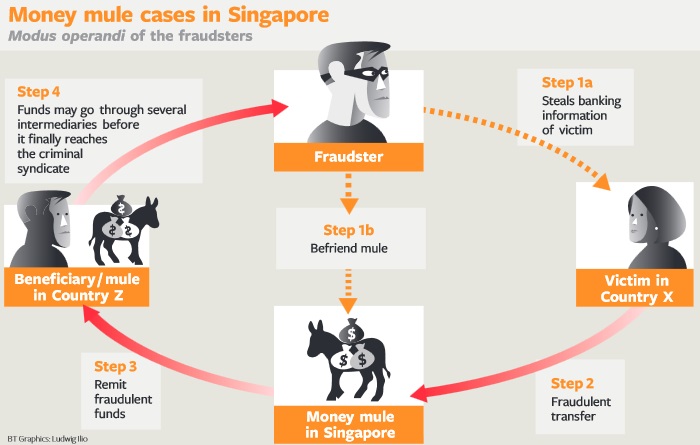
THERE has been a spike in the number of Singaporeans acting as money mules, that is, individuals who let their bank accounts be used to receive ill-gotten funds. The police have received a number of reports in which overseas banks have asked for their customers’ funds to be recalled on the grounds that the remittances were fraudulent. And it is a matter of urgency for these overseas banks, because most of these funds are moved out of Singapore on the same day.In the first nine months of this year, 133 cases involving $15.5 million were investigated – 43 per cent higher than the 93 cases that cropped up in the whole of last year, when $24.6 million was involved.
With these monies zipping electronically out of Singapore, the rate of recovery has not been sparkling: 20 per cent for the first nine months of this year. Last year’s recovery rate was more dismal – 11 per cent.
Ian Wong, deputy director of the Commercial Affairs Department (CAD) of the Singapore Police Force, said that the customers of the overseas banks claimed that their e-mail accounts had been compromised by fraudsters who used them to send instructions to the victims’ banks to transfer funds to bank accounts here.
Upon realising that their money had been fraudulently moved, the victims then instruct their banks to recall the remittances.
The accounts into which these funds land and are transferred out of soon after belong to individuals, who, sometimes enticed by the commissions to be earned, are commonly recruited through social networking websites to become mules; sometimes, they are duped into becoming mules.
The fraudsters are known to be creative in roping in their accomplices. Some would claim to be recruiting “Singapore agents” for a foreign company – agents whose job is to open personal bank accounts to receive funds – usually from online scams.
The fraudsters are also known to use real-estate agents to launder their ill-gotten gains. Posing as potential clients responding to online property ads, they would obtain a property agent’s bank account number to transfer one month’s rent, but “mistakenly” transfer a much larger sum, after which the fraudsters would ask the agent to transfer the excess to another mule.
Law firms are also a target. Fraudsters, posing as potential clients, would engage a law firm to settle a civil dispute, say, one to recover a certain sum of money from an individual. The law firm would then receive funds in its account, purportedly transferred by the individual, though the firm may not even have contacted this individual. The fraudsters then move in and instruct the firm to keep a portion of the money as legal fees and to move the rest to a mule.
The Association of Banks in Singapore (ABS), the police here and the National Crime Prevention Council warned yesterday that individuals who allow their accounts to receive stolen funds could be fined up to $500,000 and/or be jailed up to seven years upon conviction for money laundering; if corporate accounts are used for money laundering, the fine is stiffer – up to $1 million.
The CAD’s Mr Wong said the police take a serious view of the activities of money mules because their actions facilitate crime and enable the wrong-doers to evade detection.
“The illicit funds money mules help to transfer may also be used by fraudsters to finance and perpetuate their criminal activities.”
Of the 32 money mules charged since last year, 17 have been convicted, he said, the heaviest sentence so far being a 41/2-year jail term for a mule who received $1.25 million from remitters in the US, Canada and Cooks Islands.
Mr Wong ventured that Singaporeans are targeted because the fraudsters communicate with them easily in English, and because of the relative ease with which bank accounts can be opened in this financial hub.
There are fewer than a handful cases of the reverse scenario – that of Singaporeans getting their funds stolen and transferred out.
Richard Moore, who is with the ABS anti-fraud task force, said Singapore is not immune to such attempts, but “Singapore banks are not losing money because of robust controls here. While there have been attempts at this type of activity, loss has not been incurred.”
ABS director Ong-Ang Ai Boon said banks here are on high alert, and will file suspicious transaction reports (STRs) with the police whenever there is unusual movement of funds into customers’ accounts. Last year, 17,000 STRs were filed; 15,000 have so far been filed this year.
 About bambooinnovator
 Bamboo Innovator