Hyundai Seeks to Improve Status With Redesigned Genesis Luxury Sedan
November 27, 2013 Leave a comment
Hyundai Seeks to Improve Status With Redesigned Genesis Luxury Sedan
IN-SOO NAM
Updated Nov. 26, 2013 9:24 p.m. ET
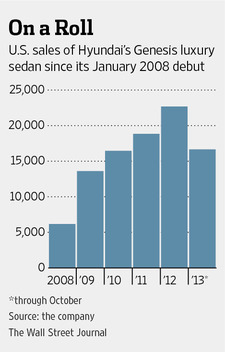
SEOUL—More than five years after entering the U.S. premium-car market, Hyundai MotorCo. 005380.SE +0.39% is betting that the latest version of its Genesis sedan will help elevate the company’s global status and erase its reputation for offering a cheaper luxury alternative. With the redesigned Genesis, which sports an edgier and bolder look, including LED signal and fog lamps, the South Korean auto maker is targeting more affluent customers and seeking to improve profit as demand slows for its lower-end models.The new Genesis, introduced Tuesday in South Korea, will mark the first attempt by the world’s No. 5 car maker to sell its luxury models in Europe, home to some of the world’s most renowned premium auto brands. The Genesis will go on sale in Europe and the U.S. early next year, and Hyundai aims to sell 62,000 of the model in 2014. The company has sold about 100,000 of the original Genesis sedan since its 2008 rollout in the U.S.
“Hyundai has shown that it can make a premium car. And now it has to prove that it can compete with stronger rivals in the luxury-car market, where quality is already a given,” said Cho Soo-hong, an analyst at Woori Investment & Securities in Seoul.
Hyundai for years was viewed as a bargain brand that offered mostly basic models. But over the past several years, the company has invested heavily to improve its product quality and design and offers a 10-year or 100,000-mile warranty plans to U.S. customers, at least twice what is typical in the market.
While its cars remain competitively priced, Hyundai’s brand recognition has increased, particularly in the U.S., since the introduction of the rear-wheel-drive Genesis in North America.
The new Genesis is Hyundai’s first all-wheel-drive sedan, which makes it better suited for winter driving in North America and Europe. The model’s use of more ultra-high-strength steel, which is sturdier and lighter than typical steel, gives the car better fuel economy than the existing Genesis, Hyundai said. Details on fuel economy weren’t available.
The car also features a roomier interior. Hyundai gave rear passengers more legroom by extending the model’s wheelbase—the distance between the front and rear wheels—by 3 inches to 118.5 inches, longer than that for BMW AG BMW.XE -0.30% ‘s 5 series, Daimler AG DAI.XE -0.12% ‘s Mercedes-Benz E-class and Toyota Motor Corp.’s 7203.TO -0.16% Lexus ES350.
The new Genesis also is equipped with a carbon-dioxide sensor, an industry first according to Hyundai, that would adjust its ventilation system to prevent driver drowsiness.
The six- and eight-cylinder engines on the new car will remain largely unchanged from the model it replaces, the company said.
The new Genesis is part of Hyundai’s drive to boost profit through premium vehicles. The company’s earnings have been hurt by slowing sales growth for its smaller cars, which sell at higher volumes but generate lower profit margins than luxury vehicles.
The company’s third-quarter operating profit rose 1.7% from a year earlier to 2.01 trillion won ($1.9 billion). But for the first nine months of the year, Hyundai’s operating profit fell 4.9% from a year earlier. Many analysts expect Hyundai this year to post its first earnings decline since 2008, citing slowing global sales.
Hyundai’s sales in the U.S., the company’s biggest market, rose less than 2% in the first 10 months of this year, compared with an industry average of 8%.
Ahn Young Jin, director and head of Hyundai’s U.S. operations, said the company aimed to increase U.S. sales by 10% next year from this year’s target of 734,000 units, helped by the new Genesis.
“Rich consumers still favor German brands in the U.S. But in the past five years, Hyundai’s brand has also been recognized through word of mouth. We expect to raise prices close to levels charged by Lexus and other Japanese rivals soon,” Mr. Ahn said.
The price for the existing Genesis starts at $35,200 in the U.S., according to the company. The Lexus ES350 starts at $36,470 and the BMW 5 series starts at $49,500. Hyundai hasn’t announced a U.S. price for the new Genesis, though in Korea the new model is priced about 4.5% more than the old, which would make the Genesis slightly more expensive than the ES350.
In the U.S., the new Genesis could face a crowd of competitors in the market for larger, luxury sedans. If Hyundai prices the new Genesis above $40,000 it would compete with the BMW 5-series or Volkswagen AG VOW.XE -0.21% ‘s Audi NSU.XE +0.90% A6 and enter a segment where sales growth has been flat this year. In the U.S., as in China and Europe, demand for smaller luxury sedans and sport-utility vehicles with fuel-efficient four-cylinder engines is rising more rapidly than sales of larger sedans with six- or eight-cylinder motors.
The Genesis isn’t the only premium model that Hyundai is using to win over customers in the U.S. The company’s ultraluxury sedan, the Equus, looks similar to the Genesis but is equipped with more luxury features and starts at $61,000. And Hyundai’s Kia 000270.SE -0.82% unit recently unveiled the $50,000 K900 luxury sedan. The three cars share the same platform.
Hyundai’s first redesign of the Genesis comes as the company is trying to rebuild its reputation after large recalls in South Korea and abroad and following an admission last year that Hyundai and its related Kia operation overstated fuel economy for more than a third of the vehicles they sold in the U.S. for two years.
Hyundai this month fired three executives in charge of design and quality, including research-and-development chief Kwon Moon-sik, who was hired shortly before the fuel-efficiency issue arose.
 About bambooinnovator
 Bamboo Innovator