A son of billionaire philanthropist Eric Hotung is suing an accounting giant and the surveying firm that HK Chief Executive Leung Chun-ying used to head, for fraud

Tycoon’s son names CY firm in fraud suit
Mary Ann Benitez
Tuesday, November 26, 2013
A son of billionaire philanthropist Eric Hotung is suing an accounting giant and various other entities, including the surveying firm that Chief Executive Leung Chun-ying used to head, for fraud. CY Leung & Co, which merged with property consultant DTZ in 2000, is named as one of 10 defendants in a writ filed yesterday in the High Court by Sean Eric Mclean Hotung. Read more of this post

Chinese real estate developers hit back at claims of unpaid RMB3.8 trillion ($623 billion) tax

Nov 25, 2013

CCTV Real Estate Exposé Triggers Business Backlash

A critical report by China’s official television broadcaster over the weekend has set off a rare public dispute between the powerful propaganda organ and business leaders. China Central Television reported on Sunday that property developers neglected to pay more than 3.8 trillion yuan ($623 billion) in land appreciation taxes from 2005 to 2012 (in Chinese). The report said 45 listed developers – including major well-known developers such as Soho China and China Vanke Co.000002.SZ +0.12%, owe land appreciation taxes. The one with the highest bill was Guangzhou-based Agile Property Holdings3383.HK +0.23%, with  8.3 billion yuan at stake, the report said. Read more of this post

China Said to Plan Crackdown on Banks’ Evasion of Lending Limits

China Said to Plan Crackdown on Banks’ Evasion of Lending Limits

China has drafted rules banning banks from evading lending limits by structuring loans to other financial institutions so that they can be recorded as asset sales, two people with knowledge of the matter said. The rules drafted by the China Banking Regulatory Commission ban borrowers from using resale or repurchase agreements to move assets off their balance sheets, said the people, who asked not to be identified because they aren’t authorized to discuss the rules publicly. Read more of this post

More than a million seek China government jobs

More than a million seek China government jobs

Monday, November 25, 2013 – 18:45

AFP

BEIJING – More than one million people took China’s national civil service exam at the weekend in a modern version of an age-old rite, but faced huge odds against clinching one of the few government jobs available. A total of 1.12 million took the National Public Servant Exam, according to figures from the State Administration of Civil Service figures. Read more of this post

Qualcomm’s China Growth Plans Threatened by Anti-Monopoly Probe

Qualcomm’s China Growth Plans Threatened by Anti-Monopoly Probe

Qualcomm Inc. (QCOM)’s growth prospects in the world’s largest mobile-phone market may be under threat after China’s National Development and Reform Commission began an investigation related to an anti-monopoly law. Qualcomm disclosed the probe yesterday, saying the NDRC advised that specific details are confidential. The San Diego-based company said it knows of no charge by the agency that it violated the law. Qualcomm gets revenue from sales of smartphone chips and collects license fees from wireless providers for the shipment of most Internet-capable handsets. Read more of this post

Cinda IPO unveils secrets of a Chinese bad debt factory

Updated: Tuesday November 26, 2013 MYT 7:54:26 AM

Cinda IPO unveils secrets of a Chinese bad debt factory

HONG KONG: China Cinda Asset Management Co Ltd lifted the lid on how Beijing turns bad loans from its banks into profits, issuing a prospectus for an initial public offering that has reeled in some of the world’s biggest investors. The IPO, seeking up to US$2.5bil, is set to be the largest in Hong Kong this year as sovereign wealth funds join hedge funds in betting that soured loans will be a growth business in China’s slowing economy. Cinda plans to list shares on Dec 12. Read more of this post

Brokers Beat Banks as China Revamps Economy: Chart of the Day

Brokers Beat Banks as China Revamps Economy: Chart of the Day

Investors are betting China’s brokerages will gain more than commercial banks and other companies from a plan unveiled this month to make market forces the “decisive factor” in the world’s second-largest economy. The CHART OF THE DAY shows the average price-to-book ratio for the three Chinese brokerages whose shares are traded in Hong Kong — China Galaxy Securities Co., Citic Securities Co. and Haitong Securities Co. — compared with a similar measure for the five largest banks and the Hang Seng China Enterprises Index, which tracks 40 mainland companies. Since the Communist Party announced a package of 60 reforms on Nov. 15, the brokers’ ratio surged to 1.76, while banks lagged behind at 1.08. Read more of this post

M&A Mystery: Why Are Takeover Prices Plummeting?

M&A Mystery: Why Are Takeover Prices Plummeting?

VIPAL MONGA

Nov. 25, 2013 8:26 p.m. ET

MK-CI131_PREMIU_NS_20131125180916MK-CI135A_PREMI_G_20131125183012

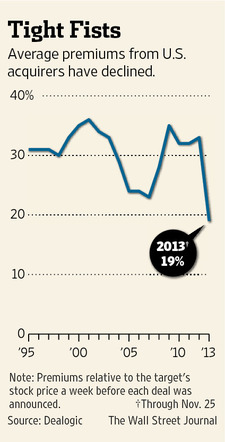
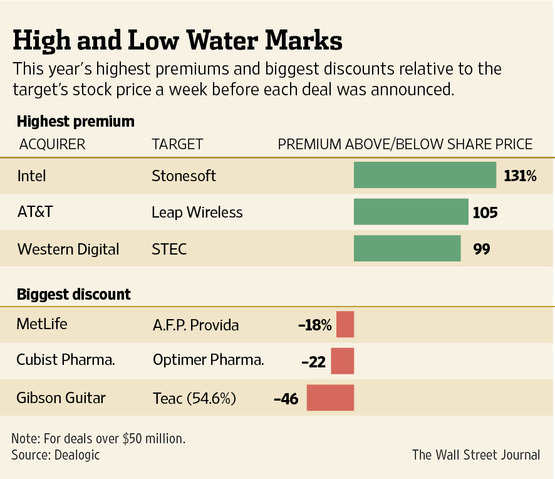
Mergers and acquisitions have been dominated by cheapskates this year. U.S. companies are paying just 19% more, on average, than their acquisition target’s trading price one week before the deal was announced.  That’s the lowest takeover premium since at least 1995, as far back as records go at Dealogic, which analyzed the data for The Wall Street Journal. Historically, the premiums have averaged 30%. Read more of this post

Turn on the tap, F&N – show what’s brewing in Myanmar

Turn on the tap, F&N – show what’s brewing in Myanmar

Monday, Nov 25, 2013

Kenneth Lim

The Business Times/MyPaper

Looking at Fraser and Neave’s (F&N’s) latest results announcement, one would think that all is fine and dandy at its Myanmar Brewery business. But there is more than just beer brewing in that business, and F&N needs to shed more light on the ongoing dispute with its Myanmar partner that threatens a significant part of its beverage business. In its full-year results announcement earlier this month, F&N appeared to paint a fairly robust picture of its Myanmar beer business. Read more of this post

China at a crossroads

China at a crossroads

By Robert J. Samuelson, Monday, November 25, 8:52 AM

It has been only a few years since China was widely regarded as an unstoppable economic colossus. For three decades, its economy grew about 10 percent annually; China seemed to be gliding through the global economic storm. Well, maybe not. Many economists — Chinese and foreign — think China’s economic model is unworkable. Without a new model, they say, China will someday face a collapse of growth or worse. The outcome has huge implications for China’s internal stability and its global economic footprint. The precedent of Japan, a highflier laid low, suggests that rapid growth can’t be taken for granted. Read more of this post

Mockingjay and IFRS 10/FRS 110 in Asia 2014: Changing Balance Sheet and The Rebellion Year for Accounting Frauds?

The following article is extracted from the Bamboo Innovator Insight weekly column blog related to the context and thought leadership behind the stock idea generation process of Asian wide-moat businesses that are featured in the monthly entitled The Moat Report Asia. Fellow value investors get to go behind the scene to learn thought-provoking timely insights on key macro and industry trends in Asia, as well as benefit from the occasional discussion of potential red flags, misgovernance or fraud-detection trails ahead of time to enhance the critical-thinking skill about the myriad pitfalls of investing in Asia at the microstructure- and firm-level.

The weekly Bamboo Innovator Insight series brings to you:

  • Mockingjay and IFRS 10/FRS 110 in Asia 2014: Changing Balance Sheet and The Rebellion Year for Accounting Frauds? Nov 25, 2013 (Moat Report Asia, BeyondProxy)

Rebellion

Dear Friends and All,

Mockingjay and IFRS 10/FRS 110 in Asia 2014: Changing Balance Sheet and The Rebellion Year for Accounting Frauds? 

“Fire is catching! And if we burn, you burn with us!” 
― Katniss Everdeen in Mockingjay, series #3 of The Hunger Games

When you’re in the arena … you just remember who the enemy is.”

– Haymitch in Catching Fire, series #2 of The Hunger Games

Audit firms that show up year after year to express their “true and fair” opinion on the financial statements to be free of material misstatements run the risk of getting complacent and, worse still, in cahoots with their clients in their chemical dependence on the comfortable audit fees, like the victors of previous Hunger Games who show up annually at the event and spend the rest of their time in the relative comfort of the Victor’s Village in each district. Last week on Nov 19, an arrow struck into the client-auditor nexus that perpetuates frauds in Asia: The Seoul Central District Court ordered Samil-PwC, the largest auditor in Korea, to pay a $13 million fine to a group of 137 shareholders for failing to conduct its audit in Kosdaq-delisted software firm Forhuman with due care. The shareholders filed the lawsuit to claim compensation for their losses after the company was delisted from the Kosdaq exchange over embezzlement and accounting fraud scandals. Lee Yong-hee, the company’s CEO, was ordered to pay more than $23 million on charges of embezzling $9.4 million. Forhuman was listed on the Kosdaq market in 2002. From 2008 to 2010 it recorded $15.5 million of net losses. However, the software developer forged its accounting records, recording $39 million of net profit instead. During that period, Samil-PwC consistently gave Forhuman high evaluation scores.

This is the first time that a court has ruled to hold big accounting firms such as Samil-PwC responsible for poor auditing, whether in Korea or in Asia. And this ruling came despite the financial regulator defending Samil-PwC, arguing that it would be wrong if an auditor should assume responsibility for what was perpetrated by a client company. Both retail and institutional investors in Asia have frequently fallen prey to the negligence of auditors in terms of their duties or collusion with companies, as has been seen in the savings banks and Tongyang Group scandals which prompted the unprecedented ruling in Korea. Over the last three years in Korea, accounting firms had to pay a total of only $3.2 million for partial responsibility and settlements in accounting scandal cases. Incorporated accounting companies also came up with clever ways to escape responsibility over charged of negligence. The ruling against Samil PricewaterhouseCoopers was the second decision made by the same court in the same month that an accounting firm is responsible for negligence. The Seoul Central District Court ruled on Nov 9 that BDO-Daejoo is partially responsible for compensating investors of the failed Samhwa Mutual Savings Bank.

Accounting fraud has long been a prevalent and deep-seated problem. There had been various measures to tackle it, but fraudulent practices continue. In Hunger Games, the mockingjay bird becomes a symbol of rebellion in the second series Catching Fire. Hopefully, the Forhuman is the “mockingjay” symbol that can spread throughout Asia to unravel more accounting frauds with the various colluders from auditors to financial advisors/dealmakers with the company’s insiders. The S-chip (or Singapore-listed Chinese companies) scandals have also cases of auditor partners directly or indirectly involved, such as Ziwo in which the Deloitte Singapore audit partner was advertised to have invested in the company as one of the largest shareholders. As explained in our series on Detecting Accounting Frauds (Part 1 and Part 2), Ziwo is a typical case in employing the capex inflation (“Grand Capex”) and consolidation trick in accounting by using balance-sheet items in the “Subsidiary”, “Amount Due from Subsidiary” and “Prepayment/Advances” accounts (“Roll-Away Loans or Advances”) to generate artificial sales and mask possible acts of tunneling and expropriation of cash and assets. Since the media blitz which includes the audit partner’s investment, the all-expense-paid IR trip and bullish sell-side research piece, share price of Ziwo is down nearly 90% from S$0.42 to S$0.05.

Like Ziwo, the fraudulent accounts of Korea’s Forhuman are detected via their affiliate overseas business partners in Japan. These are all part of the related-party transactions atypical of Asian firms. Noteworthy for Forhuman, Ziwo and Prince Frog is that if their hidden “related-party” entities (subsidiaries, associates, SPEs/VIEs (special purpose entities/ variable interest entities), JVs, pool arrangements, financial assets/instruments) are consolidated into the balance sheet as they ought to be, a far clearer picture on the financial health, particularly the hidden liabilities and debt, of the group (of companies) can be analyzed and evaluated. Value investors would be able to observe the explosion in the hidden debt and liabilities for Korea’s Forhuman at the group level once the Japanese affiliated entities are consolidated into their balance sheet and not be misled by the nice quant numbers of just the listed vehicle at the company level.
IFRS10

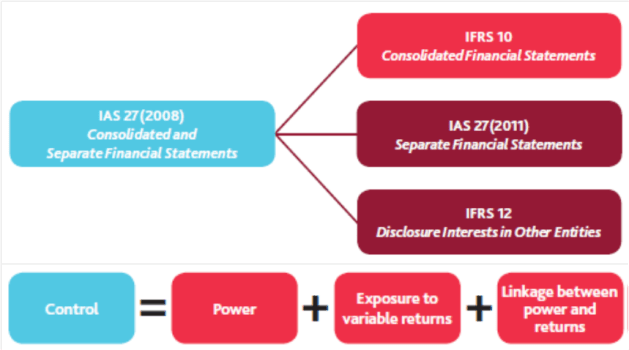
What are the implications of the new IFRS 10 Consolidated Financial Statements (the outgoing IAS 27), effective for annual periods beginning on or after Jan 1, 2013 but delayed in Singapore to allow more time for implementation. In Singapore, the FRS 110 will be effective for annual periods beginning on or after Jan 1, 2014. The power of control is one of the most difficult questions to answer in accounting since it involves subjective judgment, leading to diversity in practice related to consolidation. What is the impact on family business groups such as Jindal, Jaypee/Jaiprakash, Essar, Adani, JSW, GMR, Lanco, Videocon, and GVK? Or the chaebols in Korea such as Doosan, Dongbu, Hanjin and Kolon? Or to the REIT/real estate/construction industry and shipping industry? Yet, all these accounting standard changes are not impactful if the auditors are not held accountable for any material misstatements and fraud revelation. Hence the importance of the mockingjay symbolized by the court ruling case for delisted Kosdaq tech firm Forhuman last week. The auditors are now in the fire. What are the 4 key Bamboo Innovator takeaways?
It’s complicated: Management thinkers disagree on how to manage complexity

It’s complicated: Management thinkers disagree on how to manage complexity

Nov 23rd 2013 |From the print edition

20131123_WBD000_1

THERE can be few better places to talk about complexity than Vienna. This was the capital of the most complicated political organisation yet seen: the Austro-Hungarian Empire. It was also the centre of some of the most convoluted cold-war spy games. On November 14th and 15th hundreds of management enthusiasts converged on the Austrian capital to debate the subject. They had little interest in the complexities of the Habsburgs or the cold war. They were preoccupied instead by two points: that business is more complicated than ever before; and that managing complexity is at the top of businesspeople’s agenda. Read more of this post

‘Overworked people become hopelessly inefficient’

November 24, 2013 1:58 pm

Unfair demands on your free time

By Rhymer Rigby

We all know that the line between work and personal time has become blurred. But how do you cope with a boss or organisation that makes constant demands on time that is clearly yours?

Where do I begin? 
First, you need to be on solid ground. “If you’re doing an outstanding job, you’ll be able to say ‘I’m going home on time because I’m hitting all my targets,’” says Fergus O’Connell, author of The Power of Doing Less. Jane Barrett, founder of the Career Farm coaching consultancy, adds: “Do a bit of due diligence – are these hours the norm in your industry?” Read more of this post

The leader as a driver in the great race for good results; Gone is the time-wasting focus on why something happened and finding who is responsible. When something isn’t going well, a “high-octane leader” will probably completely skip the “why” and root cause analysis, and instead ask and get answers to a series of questions that keep the race car (team) moving forward and adjusting their approach as the car continues. Everything is about what can and will be done

The leader as a driver in the great race for good results

James Engel
senior executive director and director
 
The Centre of Excellence at The APMGroup.
November 25, 2013 1:00 am

Let’s have a race – a race for business results. The winner gets increased profits, market-share and growth in the Asean Economic Community (AEC) marketplace; the loser, a lot less. You, as a leader, are the driver. Your team is the car. The racetrack is your strategy. The finishing line is achieving your key performance indicators (KPIs). Now imagine that the “fuel” is supplied by your mouth and ears. Remember, you can have the best race car in the world, but without fuel, you’re going nowhere.  Read more of this post

Blood, sweat and tears; How the Napoleonic wars made Britain

Blood, sweat and tears; How the Napoleonic wars made Britain

Nov 23rd 2013 |From the print edition

20131123_BKP002_0

Britain against Napoleon: The Organisation of Victory, 1793-1815. By Roger Knight. Allen Lane; 678 pages; £30. Buy from Amazon.co.uk

THE role of Britain in the world was transformed by the Napoleonic conflict. By the time France declared war in 1793 the British empire was in decline; it had lost its North American colonies a decade earlier. But after Napoleon’s defeat at the Battle of Waterloo in 1815 Britain emerged as the world’s pre-eminent superpower. How did it overcome its previous setbacks to inflict a crushing defeat on Napoleon’s France? Historians have tended to explain this in terms of military and naval strategy. But “Britain against Napoleon”, a new book by Roger Knight of the University of Greenwich, argues that Britain was just far better at organising its war effort. Read more of this post

Clarity of purpose, values vital for leaders

Updated: Monday November 25, 2013 MYT 7:14:58 AM

Clarity of purpose, values vital for leaders

BY WONG WEI-SHEN

PETALING JAYA: The Iclif Leadership and Governance Centre aims to help individuals find their purpose in life and values, among others, at the upcoming Leadership Energy Summit Asia 2013 (LESA). “I strongly believe that genuine leadership transformation is only possible when there is clarity of purpose and values together with a deeper understanding of human consciousness,” said Iclif chief executive officer Rajeev Peshawaria in an e-mail interview with StarBiz. Read more of this post

From Tickle Me Elmo to Big Hugs Elmo: nearly two decades of Christmas toy dominance

From Tickle Me Elmo to Big Hugs Elmo: nearly two decades of Christmas toy dominance

By Roberto A. Ferdman @robferdman

November 22, 2013

Christmas time is Elmo time. The lovable red monster from Sesame Street has been one of the most popular gifts in the US nearly every year since 1996. And his dominance reveals a lot about the state of the American toy industry. Each year’s Elmo is a different interactive incarnation. The latest, Big Hugs Elmo, has been declared one of this year’s hottest toys on every list known to US moms: Toys R Us’sTarget’s, etc. It follows in the steps of, to name just a few, Rock ‘n Roll Elmo, Chicken Dance Elmo, Hokey Pokey Elmo, TMX Elmo, Let’s Rock Elmo, and the bestselling Elmo of all time, Tickle Me Elmo. Read more of this post

Meet the accountant behind Yogurtland who is bringing California’s frozen yoghurt craze to Australia

Nassim Khadem Reporter

Meet the accountant behind Yogurtland who is bringing California’s frozen yoghurt craze to Australia

Published 25 November 2013 09:42, Updated 25 November 2013 11:58

4c5ed276-5559-11e3-a7a5-15425b5b67eb_Paul--646x363

Yogurtland Australia chief executive Paul Siderovski: “The Australian market’s ripe to adopt the US frozen yoghurt craze.”

It was only a matter of time before Australians jumped on board with California’s frozen yoghurt food craze. Yogurtland, the frozen yoghurt company that started in Fullerton, California in 2006, came to Australia in January. The international franchise chain of frozen yoghurt stores now has more than 200 locations across Australia, the US, Guam, Mexico and Venezuela. The company’s target is to expand beyond 550 stores by 2015 and 1000 stores by 2017. Read more of this post

How Larry Bird built the Pacers into a title contender

How Larry Bird built the Pacers into a title contender

Phil Richards, USA TODAY Sports2:05 p.m. EST November 22, 2013

In 2004, the Pacers appeared poised a title run with a young, talented nucleus. Then came the brawl. But Indiana is back. Larry Bird and Donnie Walsh tell the inside story of the rebuild.

STORY HIGHLIGHTS

Indiana Pacers President Larry Bird rebuilt franchise in wake of 2004 brawl, fractured roster

Hall of Fame player’s biggest moves came in 2010, 2011, in adding Paul George and others

Bird had help in veteran executive Donnie Nelson, and both look back on how it happened here

Larry Bird’s gut told him it was time. The Indiana Pacers had lost seven of their past eight games, but that wasn’t the stretch Bird was looking at. He was looking ahead. He saw a stretch of 10 games and figured coach Jim O’Brien could win at least seven of them. Read more of this post

How Martin Gilbert, the City’s original bogeyman, pulled it out of the fire again; You wouldn’t bet against Aberdeen’s controversial chief executive Martin Gilbert

How Martin Gilbert, the City’s original bogeyman, pulled it out of the fire again

You wouldn’t bet against Aberdeen’s controversial chief executive Martin Gilbert

martin-gilbert_2744352b

9:00PM GMT 24 Nov 2013

If Martin Gilbert had a personal share price, it would have wrong-footed the best money managers in the world. Last week the boss of Aberdeen Asset Management nimbly snapped up Scottish Widows Investment Partnership (SWIP) for £660m, his 40th acquisition since founding the group 30 years ago. As a result, Aberdeen will leap-frog the 200-year-old Schroders to become not only Britain’s biggest fund manager but the largest investment house outside America. The shares leaped too; Aberdeen, which only joined the FTSE100 last year, is up 41pc in 12 months. Read more of this post

Keynes’s new heirs: Britain leads a global push to rethink the way economics is taught

Keynes’s new heirs: Britain leads a global push to rethink the way economics is taught

Nov 23rd 2013 |From the print edition

FOR economists 2008 was a nightmare. The people who teach and research the discipline mocked by Thomas Carlyle, a 19th-century polemicist, as “the dismal science”, not only failed to spot the precipice, many forecast exactly the opposite—a tranquil stability they called the “great moderation”. While the global economy is slowly healing, the subject is still in a state of flux, with students eager to learn what went wrong, but frustrated by what they are taught. Some bold new projects to retune economics aim to change this. Read more of this post

All about Adam: A furious—and political—debate about the origins of mankind

All about Adam: A furious—and political—debate about the origins of mankind

Nov 23rd 2013 |From the print edition

20131123_USD000_0

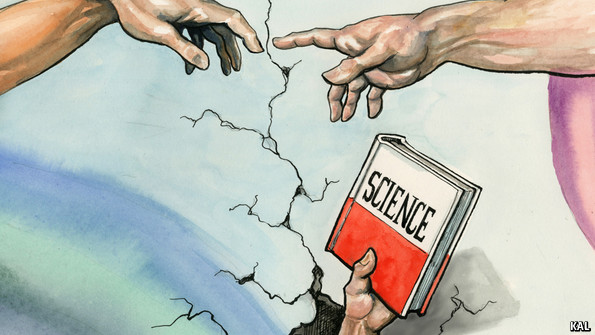
THAT old-time religion is strong in America. To take just one measure, for decades more than 40% of all Americans have consistently told Gallup pollsters that God created humans in pretty much their current form, less than 10,000 years ago. They are embracing an account of man’s origins promoted by Young Earth Creationists who lean on a painstakingly literal reading of the Scriptures, swatting aside the counter-claims of science (fossils are a relic of Noah’s flood, they argue, and evolution is a myth peddled by atheists). In a recent poll 58% of Republicans and 41% of Democrats backed creationism. The glue that underpins such faith is the principle of Biblical inerrancy—a certainty that the Scriptures are infallibly and unchangingly true. Read more of this post

DaVita Spared as Medicare Wipes Out 9.4% Dialysis Cut

DaVita Spared as Medicare Wipes Out 9.4% Dialysis Cut

DaVita HealthCare Partners Inc. (DVA), Fresenius Medical Care AG (FME) and other dialysis companies received a break from U.S. regulators, who are scrapping a proposed 9.4 percent cut in Medicare payments to the companies next year. DaVita, the second-largest dialysis provider in the U.S., rose 13 percent in late trading after the Centers for Medicare and Medicaid Services finalized a rule today that keeps payments flat for 2014. Medicare proposed in July the 9.4 percent cut in pay for treating patients with end-stage renal disease. Read more of this post

Dolby family invests $3m in ASX-listed Alzheimer’s testing company Cogstate

Caitlin Fitzsimmons Online editor

Dolby family invests $3m in ASX-listed Alzheimer’s testing company Cogstate

Published 25 November 2013 11:32, Updated 25 November 2013 13:07

It takes decades before Alzheimer’s disease becomes dementia but a new test might be able to detect it in people who are still well. Photo: Jessica Shapiro

US billionaire Dagmar Dolby, the widow of inventor Ray Dolby, has taken a $3 million stake in Australian medical company Cogstate. The investment is part of a $7.5 million capital raising to accelerate the roll-out of Cognigram, a test that lets doctors detect early-stage Alzheimer’s disease. Read more of this post

Bitter pill for traditional Chinese medicine; New quality and safety rules may stifle sales prospects of TCM in the European market

Bitter pill for traditional Chinese medicine

By Zhang Chunyan in London ( China Daily )Updated: 2013-11-25 01:48:30 Read more of this post

Signs of rapidly worsening Chinese demand for IT giants IBM and Cisco Systems Inc are starting to spook Hewlett-Packard investors

HP may have yet another problem: China

10:06am EST

By Poornima Gupta

SAN FRANCISCO (Reuters) – Signs of rapidly worsening Chinese demand for IT giants IBM and Cisco Systems Inc are starting to spook Hewlett-Packard investors. HP’s year-long stock rally sputtered last week amid fears a faster-than-anticipated slowdown in emerging markets, above all China, may dash the computing giant’s hopes for a return to growth in 2014 or beyond. Read more of this post

Intel Looks Beyond Traditional Markets; Intel’s Newly Appointed President Renée James Talks About Embracing Market Trends in Asia and Plans for the Company’s Growing Cash Pile

Intel Looks Beyond Traditional Markets

Intel’s Newly Appointed President Renée James Talks About Embracing Market Trends in Asia and Plans for the Company’s Growing Cash Pile

YUN-HEE KIM

Nov. 24, 2013 1:13 p.m. ET

Technology companies are looking beyond traditional PCs, smartphones and tablets to drive growth in the next decade, and Intel Corp. INTC -5.39% wants to be ahead of the curve. The Santa Clara, Calif.-based semiconductor maker, which initially lagged behind rivals in mobile computing, is developing chips that can be used in wearable devices and placing more emphasis on software and services to drive growth. The moves are important because Intel, which has traditionally focused on chips for personal computers, expects next year’s revenue to be flat because of weak PC sales. Read more of this post

Google’s showcased shopping found to come at a premium; Five out of every six items in the panels shown on a Google search made in America are more expensive than the same items from other merchants hidden deeper in the index

November 24, 2013 8:01 pm

Google’s showcased shopping found to come at a premium

By Richard Waters in San Francisco

Anyone in the US doing their holiday shopping from the product showcases that appear at the top of Google’s search results is almost certain to pay substantially more than if they delved deeper in the search engine. Five out of every six items in the panels shown on a Google search made in America are more expensive than the same items from other merchants hidden deeper in the index, with an average premium of 34 per cent, according to a Financial Times analysis. Read more of this post

TV Is Dying, And Here Are The Stats That Prove It

TV Is Dying, And Here Are The Stats That Prove It

JIM EDWARDS NOV. 24, 2013, 10:11 AM 566,542 116

screen shot 2013-11-18 at 5.59.42 pm screen shot 2013-11-18 at 10.49.00 am-1 screen shot 2013-11-18 at 10.36.56 am screen shot 2013-11-18 at 10.35.27 am screen shot 2013-11-18 at 5.59.54 pm slide079-4 slide030-4 screen shot 2013-11-22 at 10.34.33 am advertiser demand for tv has led to pricing growing faster than ratings have declined

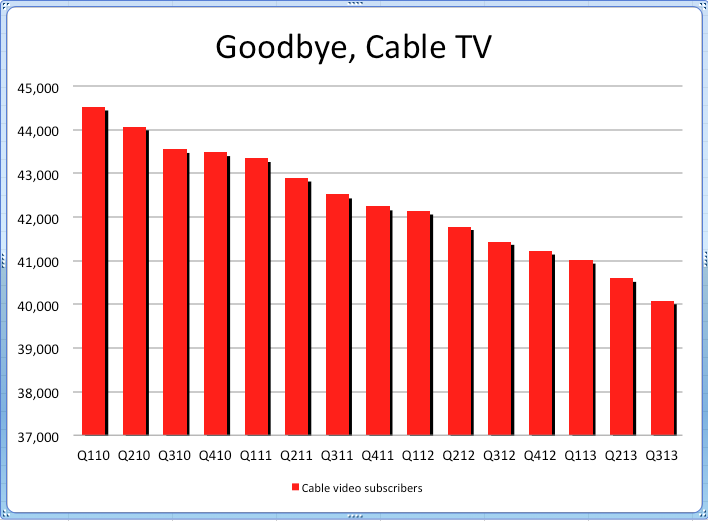
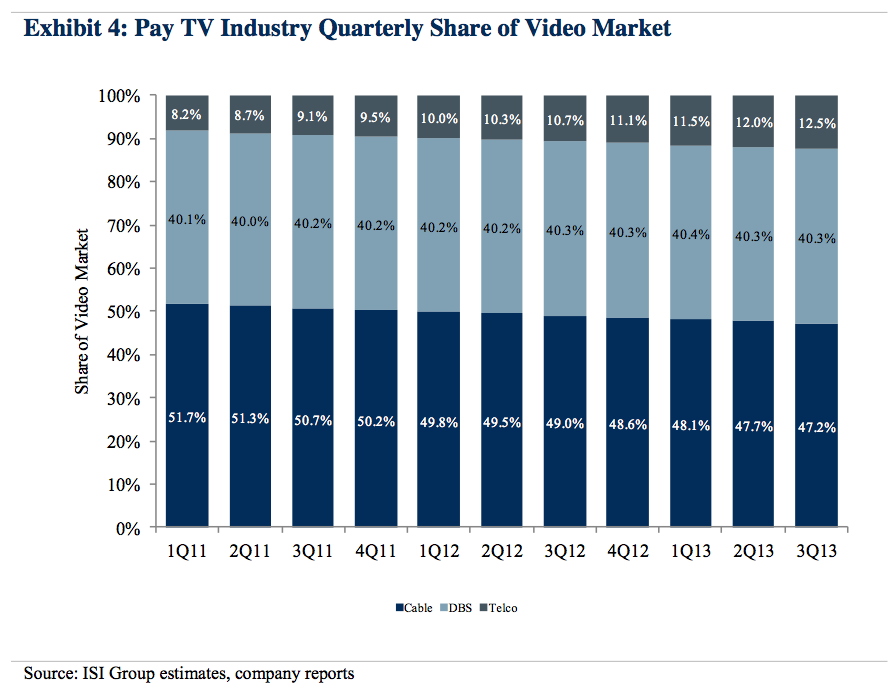
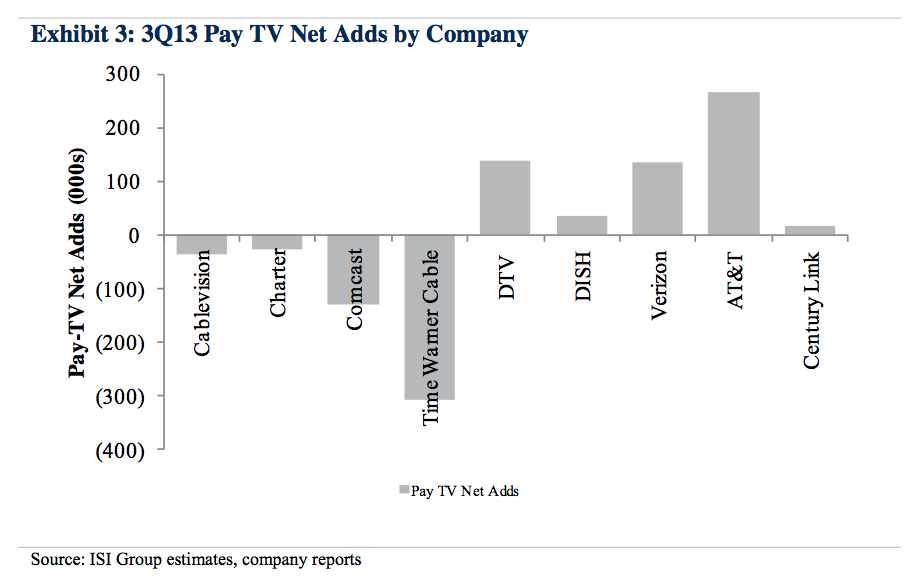
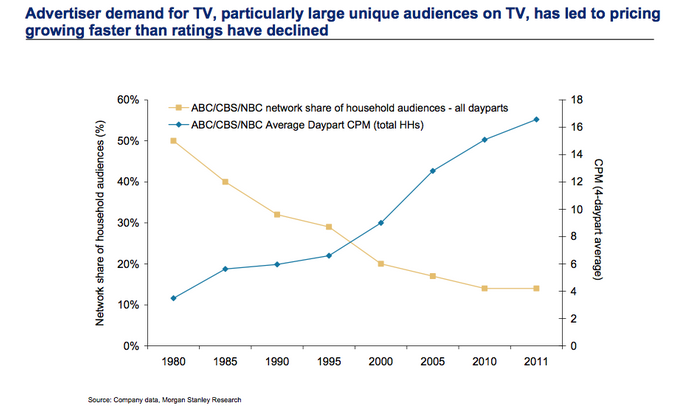
The TV business is having its worst year ever. Audience ratings have collapsed: Aside from a brief respite during the Olympics, there has been only negative ratings growth on broadcast and cable TV since September 2011, according to Citi Research. Media stock analysts Craig Moffett and Michael Nathanson recently noted, “The pay-TV industry has reported its worst 12-month stretch ever.” All the major TV providers lost a collective 113,000 subscribers in Q3 2013. That doesn’t sound like a huge deal — but it includes internet subscribers, too. Read more of this post

Some content on this page was disabled on December 14, 2020 as a result of a DMCA takedown notice from Citigroup Inc., Citigroup Global Markets Inc., Citigroup Global Markets Limited, and Citibank, N.A.. You can learn more about the DMCA here:

https://wordpress.com/support/copyright-and-the-dmca/
Some content on this page was disabled on December 14, 2020 as a result of a DMCA takedown notice from Citigroup Inc., Citigroup Global Markets Inc., Citigroup Global Markets Limited, and Citibank, N.A.. You can learn more about the DMCA here:

https://wordpress.com/support/copyright-and-the-dmca/

Qualcomm Ages Gracefully; Wireless chip-maker may be having something of a midlife crisis as it matures with the cellphone market. But it’s not about to embarrass itself—or investors

SATURDAY, NOVEMBER 23, 2013

Qualcomm Ages Gracefully

By RESHMA KAPADIA | MORE ARTICLES BY AUTHOR

Wireless chip-maker may be having something of a midlife crisis as it matures with the cellphone market. But it’s not about to embarrass itself—or investors.

In an industry that prizes youthful energy, investors have been worried about a midlife crisis at wireless chip giant Qualcomm . Ageists will miss out: Qualcomm is still fit and has the resources to stay healthy and profitable for a good long time. Qualcomm (ticker: QCOM) dominates the market for communications chips used in smartphones and wireless devices worldwide, and has an estimated three-year lead over competitors in the latest cellular technology, known as LTE. In addition to manufacturing its own chips, it licenses its technology to other chipmakers, which provides a lucrative royalty stream. Read more of this post