Moocs are no magic bullet for educating Americans; Methods of teaching make only marginal difference if content is irrelevant to the jobs market

November 24, 2013 7:08 pm

Moocs are no magic bullet for educating Americans

By Edward Luce

Methods of teaching make only marginal difference if content is irrelevant to the jobs market

Optimists have scoured the dictionary for superlatives to describe the future of internet education. But the cult of the Mooc – massive online open courses – took a blow last week when one of its leading Silicon Valley pioneers, Sebastian Thrun,described it as a “lousy product”. Students taking Mr Thrun’s online courses at Udacity performed far worse – and dropped out in far higher numbers – than those with a human instructor. Mr Thrun, who invented the self-driving car, is at least temporarily dropping out of the business. Luddites everywhere will be feeling vindicated. Read more of this post

After 32 years, BRW goes out of print; For much of its 32-year history, BRW had the highest per capita circulation in the world for a business magazine

Leo D’Angelo Fisher Columnist

After 32 years, BRW goes out of print

Published 25 November 2013 00:29, Updated 25 November 2013 11:46

For much of its 32-year history, BRW had the highest per capita circulation in the world for a business magazine. At its peak it boasted a circulation of 80,200. But a flat and rapidly fragmenting advertising market, consumer preference for digital platforms and a sluggish economy have finally caught up with one of Australia’s most respected media brands. Read more of this post

The Weinstein Company, Seeking Hits, Shift to TV; The heavy investment in the production and sale of TV series mirrors changes occurring elsewhere in Hollywood

November 24, 2013

The Weinstein Company, Seeking Hits, Shift to TV

By MICHAEL CIEPLY

LOS ANGELES — As Oscar season approaches fever pitch, Harvey Weinstein, master of the movie awards game, is talking about … television. The Weinstein Company, founded eight years ago by Mr. Weinstein and his brother, Bob, is making a surge into TV production that will soon test whether it can extend its success in film to the world of television. Read more of this post

Though Silicon Valley insists there is not a technology bubble, average investors should be cautious, especially when many highly valued companies have yet to produce earnings

NOVEMBER 24, 2013, 1:05 PM

Disruptions: If It Looks Like a Bubble and Floats Like a Bubble …

By NICK BILTON

SAN FRANCISCO — It sounds like heresy around here. But here goes: Is this another tech bubble? Back East, the Wall Street money is starting to worry that it feels like 1999 all over again. Money-losing technology companies are going public at you’ve-got-to-be-joking prices. The founders of Snapchat are getting multibillion-dollar offers — and turning them down. And the Nasdaq composite index, a visible symbol of the ’90s dot-com boom and bust, is a sneeze away from 4,000, a level it last reached just before, well, you know. Read more of this post

One Way or Another, Big TV Is Getting Bigger. Will You Care?

One Way or Another, Big TV Is Getting Bigger. Will You Care?

Published on November 22, 2013
by Peter Kafka

Can Comcast, the country’s biggest pay-TV provider, really get bigger? That’s the scenario that’s floating out today, sparked by CNBC’s report that Time Warner Cable, the country’s second-biggest cable company, might be looking to Comcast as a white knight. That’s because Charter Communications, another big cable operator, is getting ready to make an offer for Time Warner, and Time Warner either wants a different buyer or at least someone to raise the price for its eventual takeout. Read more of this post

Reincarnation at Nokia: Planning the next bounceback; After the sale of its devices division to Microsoft, what was once the world’s biggest mobile-phone maker is reinventing itself. Again

Reincarnation at Nokia: Planning the next bounceback; After the sale of its devices division to Microsoft, what was once the world’s biggest mobile-phone maker is reinventing itself. Again

Nov 23rd 2013 | HELSINKI |From the print edition

20131123_WBD001_020131123_WBC833

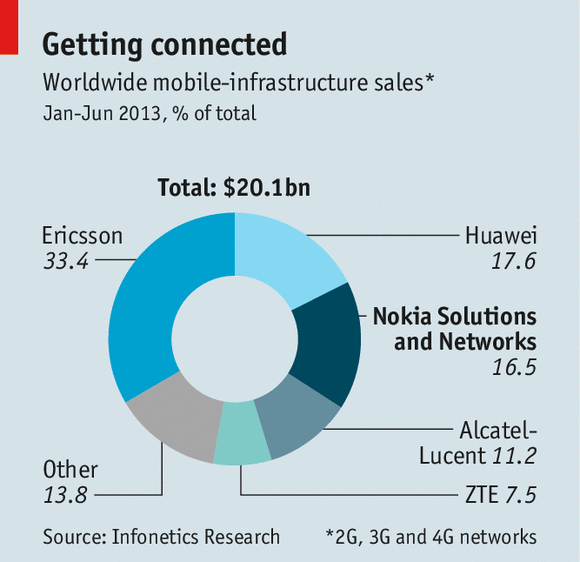
SAMULI SIMOJOKI knew the outcome was a formality, but he still wanted his say, “not so much as a Nokia shareholder, but as a Finn.” Mr Simojoki, a lawyer from Helsinki, was one of the 3,200 who attended the company’s extraordinary general meeting on November 19th. He voted against the only motion, the proposed sale of Nokia’s mobile-phone division to Microsoft for €3.8 billion ($5.4 billion) in cash. More than 99% of votes were cast in favour. When the deal is sealed early in 2014, Nokia, once the world’s biggest maker of mobile phones, and still its second-biggest, will be out of the business. Read more of this post

That queasy feeling when a Web rally starts losing steam

That queasy feeling when a Web rally starts losing steam

KEVIN KELLEHER 
ON NOVEMBER 24, 2013

What happened to the Great Web Rally of 2013? Until two months ago, investors were clamoring for companies in the sector so much they were willing to buy stocks with triple-digit PE ratios. They snapped up well-known names that had a track record of losses. After years of shying away from Web stocks, investors couldn’t get enough. Read more of this post

The Financialization of Commodity Markets

The Financialization of Commodity Markets

Ing-Haw Cheng Dartmouth College – Tuck School of Business

Wei Xiong Princeton University – Department of Economics; National Bureau of Economic Research (NBER)

October 1, 2013

Abstract: 
The large inflow of investment capital to commodity futures markets in the last decade has generated a heated debate about whether financialization distorts commodity prices. Rather than focusing on the opposing views concerning whether investment flows either did or did not cause a price bubble, we critically review academic studies through the perspective of how financial investors affect risk sharing and information discovery in commodity markets. We argue that financialization has substantially changed commodity markets through these mechanisms.

Where India has advantage over China

November 24, 2013 7:43 pm

Where India has advantage over China

Review by James Crabtree

McKinsey’s ‘Reimagining India’ portrays a state that is at least able to discuss itself openly

Unlocking the Potential of Asia’s Next Superpower, Edited by McKinsey & Company, (Simon & Schuster, $29.95)

India’s parliamentary elections next year, like each of its predecessors, will be the biggest in history. They are also set to be among its most engrossing. Mostly this is down to personality, given the rowdy contest betweenNarendra Modi, the prime ministerial candidate of the opposition Bharatiya Janata party; and Rahul Gandhi, scion of the ruling Congress party’s family dynasty. But the battle also offers an ideological choice: the former’s centre-right agenda of better governance and economic reform against the latter’s focus on social welfare. Read more of this post

Muddy Waters NQ Call Fails to Halt IPOs: China Overnight

Muddy Waters NQ Call Fails to Halt IPOs: China Overnight

Chinese companies are selling shares in New York at the fastest pace in two years less than a month after short seller Carson Block’s call spurred a 62 percent plunge in Beijing-based NQ Mobile Inc. (NQ) Three Chinese companies have debuted on U.S. bourses this month, raising $345.4 million, the most since May 2011, when six companies listed $1.3 billion of shares. 500.com Ltd., an online sports lottery service, raised $75.2 million in an initial public offering. Sungy Mobile Ltd., which makes applications for Google Inc. (GOOG)’s Android software, sold 7 million shares at $11.22. 58.Com Inc. (WUBA), an online marketplace similar to Craigslist, and travel agency Qunar Cayman Islands Ltd. (QUNR) have sold shares above their price targets since Oct. 30. Read more of this post

Thai Anti-Government Protests Swell as Yingluck Calls for Unity

Thai Anti-Government Protests Swell as Yingluck Calls for Unity

Thai anti-government groups pledged to spread their protest to military bases, government offices and television stations today after more than 100,000 people joined rallies to oust Prime Minister Yingluck Shinawatra. “We will not stop even if she dissolves parliament or resigns,” Suthep Thaugsuban, a former member of the largest opposition party who resigned this month to lead the protests, told supporters at Bangkok’s Democracy Monument. “We will create a real democracy with the king as the head of state.” Read more of this post

Christians seek time off for Sunday services in Johor

Christians seek time off for Sunday services in Johor

Sunday, November 24, 2013 – 08:49

The Star/Asia News Network

PETALING JAYA, Malaysia – The Council of Churches Malaysia (CCM) will seek time off for Christians in Johor to fulfil their religious obligations on Sundays following the change of the state’s rest days to Friday and Saturday. “We will request for time off for both workers and students to attend church services on Sunday,” said CCM general secretary Rev Dr Hermen Shastri. Read more of this post

Indian fund managers fumble even as stocks hit record highs

Indian fund managers fumble even as stocks hit record highs

4:07pm EST

By Himank Sharma

MUMBAI (Reuters) – In a year when Indian shares have hit record highs, the country’s embattled fund managers are headed for a milestone of their own: their worst performance since the global financial crisis in 2008. The poor showing comes at a bad time for an industry already under pressure from a market regulator angry about results and an ongoing exodus of retail investors from Indian stocks. Read more of this post

Taxing times for Singapore as corporate strategy faces scrutiny

Taxing times for Singapore as corporate strategy faces scrutiny

4:12pm EST

By Rachel Armstrong

SINGAPORE (Reuters) – Tiny Singapore does not look at first sight like one of Apple Inc’s priority markets: it has no official Apple Store and doesn’t even rate a mention in the company’s latest annual report. Apple South Asia Pte Ltd, however, its Singapore entity, booked $14.9 billion in revenue for the 12 months to September 2012 – more than it would have received had the country’s entire 5.3 million population each bought an iPhone 5S, an iPad Air and a MacBook Pro. Read more of this post

Chemicals Maker’s $2 Billion U.S. Bet Driven by Fracked Gas

Chemicals Maker’s $2 Billion U.S. Bet Driven by Fracked Gas

Formosa (6505) Plastics Group, Asia’s largest chemical producer, is seeking U.S. permits for a $2 billion expansion of its Texas operations as cheaper natural gas prices make U.S. production more competitive. The Taiwanese company asked federal and state environmental regulators to approve plans for an ethane cracker unit and downstream derivatives, Formosa Plastics Vice Chairman Susan Wang said in an interview in Washington yesterday. She is visiting the U.S. as part of a business delegation led by former Taiwan Vice President Vincent Siew. Read more of this post

Nonprofit that flipped homes to investors faces scrutiny

Nonprofit that flipped homes to investors faces scrutiny

1:40pm EST

By Matthew Goldstein and Emily Flitter

NEW YORK (Reuters) – A U.S. housing regulator has been investigating the activities of a small California not-for-profit that bought hundreds of foreclosed homes through a federally backed program intended to help local communities hurt by the housing bust, according to government documents reviewed by Reuters. The U.S. Department of Housing and Urban Development’s Office of the Inspector General late last year began probing San Diego-based Heartland Coalition’s participation in the “First Look” program in Las Vegas and other U.S. cities, according to a redacted investigation report and a letter from the regulator in response to a Freedom of Information Act request. Read more of this post

EDB’s next big thing: connections; Strengthening vertical and horizontal linkages key for S’pore economy

PUBLISHED NOVEMBER 25, 2013

EDB’s next big thing: connections

Strengthening vertical and horizontal linkages key for S’pore economy

TEH SHI NING TSHINING@SPH.COM.SG

“What Singapore has done to date is to build up very strong industry verticals,” says Yeoh Keat Chuan – PHOTO: SPH

[SINGAPORE] Singapore’s economic planners continue to scan the horizon for the “next big thing”. But this is no longer just about picking out unexplored sectors to zero in on and make winners of, as they once did with electronics, petrochemicals or biomedicals. Rather, the next big things now are the ligaments connecting these industries: potentially disruptive technologies such as 3D printing, digital advancements, consumer analytics, supplier networks, and access to the growth market of Asean. Read more of this post

Governments Losing Full Faith and Credit

Governments Losing Full Faith and Credit

RICHARD BARLEY

Nov. 24, 2013 1:58 p.m. ET

MI-BZ869_RISKHE_G_20131124184806

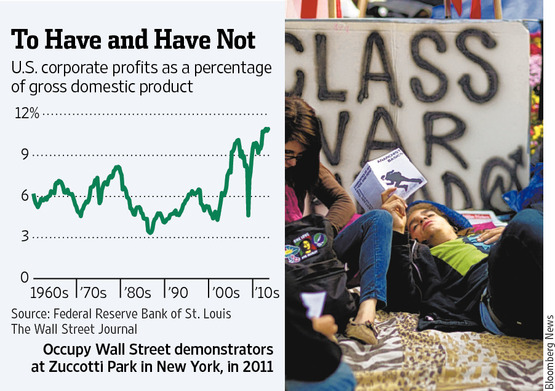
Investing is inherently risky. But in the postcrisis world, old notions about what is and isn’t safe are in doubt. Political risk, as governments juggle strained finances and social tensions over rising wealth and income inequality, is increasingly in focus. The outcome is that traditionally “risky” instruments, such as nonfinancial corporate bonds and stocks, may actually be among the places investors feel more comfortable. Conversely, government securities, traditionally a haven, may now be a source of unease. Read more of this post

28% of M&A deals in emerging markets hit snags

PUBLISHED NOVEMBER 25, 2013

28% of M&A deals in emerging markets hit snags

India and Indonesia prove particularly challenging in Asia

MICHELLE QUAH MICHQUAH@SPH.COM.SG

Regulatory probes were the most common among the issues faced, affecting half of the troubled deals, followed by litigation.

[SINGAPORE] Emerging and growth markets are often an attractive destination for many dealmakers, but it is no secret that they also come with greater risks. A substantial number of merger-and-acquisition (M&A) deals in these markets are hit by major setbacks, says a study conducted by international law firm Freshfields Bruckhaus Deringer. Read more of this post

Swiss Voters Reject High-Pay Initiative; Referendum to Limit Executive Pay Overwhelmingly Rejected

Swiss Voters Reject High-Pay Initiative

Referendum to Limit Executive Pay Overwhelmingly Rejected

NEIL MACLUCAS

Updated Nov. 24, 2013 12:34 p.m. ET

ZURICH—Switzerland stepped back from a movement to control corporate pay, overwhelmingly rejecting an initiative that would have restricted executive salaries to 12 times that of the lowest paid employee. Roughly 65% of Swiss voters Sunday opposed the 1:12 Initiative for Fair Pay, according to results from all of the country’s 26 cantons reported by Swiss television. Another 34% supported the proposal, which was named for the organizers’ belief that no one in a Swiss company should earn more in a month than someone else makes in a year. Read more of this post

Fund management reform will help avert groupthink

November 24, 2013 7:04 pm

Fund management reform will help avert groupthink

By John Authers

Can globalised capital markets co-exist with democracy and the nation state? It is reasonable now to fear that the answer is “no,” and that means that reforming the investment industry should be a far higher priority than it is. Markets and democracy have much in common. Just as Winston Churchill said democracy was the worst form of government apart from all the others that had been tried, so markets may well be the worst way to allocate capital and set prices – apart from all the others. Read more of this post

Europe’s Easy-Money Policy Snubs German Savers; Nation Finds Lacks the Clout It Once Had With Central Bank

Europe’s Easy-Money Policy Snubs German Savers

Nation Finds Lacks the Clout It Once Had With Central Bank

BRIAN BLACKSTONE And ANTON TROIANOVSKI

Nov. 24, 2013 5:35 p.m. ET

German savers angry over low interest rates are complicating the European Central Bank’s efforts to keep Europe from sliding into a downward spiral of falling prices and economic stagnation. But the uproar in Europe’s biggest economy over the ECB’s latest interest-rate cut earlier this month to a record-low 0.25% is unlikely to stop the ECB from pursuing radical measures if needed to avoid a decade of economic malaise. For while Germany still matters greatly, it has lost its perceived veto at the ECB on major decisions. Read more of this post

One in six UK manufacturers reverse offshoring in growing trend

November 25, 2013 12:05 am

One in six UK manufacturers reverse offshoring in growing trend

By Brian Groom, Business and Employment Editor

One in six UK manufacturers has brought production back from overseas during the past year or is in the process of doing so, suggesting that “reshoring” is starting to gain traction. The number of companies returning production from countries such as China is outstripping those moving output overseas, according to a survey of more than 500 small and medium-sized manufacturers. Read more of this post

Indian health activists are seeking to prevent Gilead from patenting its new treatment for Hepatitis C in the country in a fresh battle over affordable access to medicine

November 24, 2013 6:56 pm

Indian health activists move to prevent Gilead’s drug patent

By Andrew Jack in London

Indian health activists are seeking to prevent Gilead from patenting its new treatment for Hepatitis C in the country in a fresh battle over affordable access to medicine. The Initiative for Medicines, Access & Knowledge in India said it had filed a “pre-grant” application in Calcutta to block a patent application on the drug sofosbuvir, just as Gilead, the US pharmaceutical group that developed the medicine, won European regulatory authorisation for its use. Read more of this post

Do shareholder perks add up for investors?

November 22, 2013 7:04 pm

Do shareholder perks add up for investors?

By Lucy Warwick-Ching

Twenty years ago, shareholder perks played a major part in persuading investors to buy shares. Discounts of thousands of pounds on new-build properties were commonplace for shareholders in housebuilders, while generous shopping vouchers for retail share owners abounded. Today’s investors, however, often need to spend hundreds, if not thousands, of pounds to accumulate enough shares to qualify for perks attached to shares. The tough economic climate of the past few years has resulted in some companies focusing on other priorities such as dividend payments at the expense of their most generous shareholder offers. Read more of this post

China rides rollercoaster love affair with Bitcoin

Last updated: November 22, 2013 3:03 pm

China rides rollercoaster love affair with Bitcoin

By Simon Rabinovitch in Shanghai

Such has been the explosive growth of Bitcoin in China that the country’s biggest exchange for the digital currency had its logo scrawled on its front entrance in magic marker until this week. With about $60m in daily transactions, BTCChina is, as of early this month, also the world’s biggest Bitcoin exchange, accounting for nearly one-third of the global market. Not bad for a company that was officially registered only in June.   Read more of this post

‘Chocfinger’ ambitions soured by tough cocoa market; In the world of cocoa, there are few who know more about the market than the man dubbed “Chocfinger”

Last updated: November 24, 2013 12:24 pm

‘Chocfinger’ ambitions soured by tough cocoa market

By Emiko Terazono

In the world of cocoa, there are few who know more about the market than the man dubbed “Chocfinger”. So it was a shock to many in the commodities market when the London-based trading house Armajaro, co-founded by Anthony Ward, the canny trader known for his audacious trades in the cocoa market, had to be rescued earlier this month. Under pressure from its financing banks, his commodities and hedge fund group was forced into the fire sale of lossmaking Armajaro Trading – which moves physical cocoa, coffee and sugar around the world – to Swiss-based rival Ecom Agroindustrial. Read more of this post

‘Boiler room’ scam shut down; The majority of boiler room scams are targeted at men aged 65 and older who are active investors. On average, victims tend to lose about £20,000, which they are unlikely to recover

November 22, 2013 6:55 pm

‘Boiler room’ scam shut down

By Elaine Moore

A suspected boiler room scam has been closed in an unusual pre-emptive action by the financial regulator. On Tuesday, the Financial Conduct Authority (FCA) announced that it had frozen the global assets of First Capital Wealth, which is suspected of promoting and selling dubious investments without authorisation. First Capital Wealth has also been forbidden from selling investments after a High Court judge said that it posed a serious risk to consumers. Read more of this post

Starbucks is now selling 46% more things an hour than it was five years ago

Starbucks is now selling 46% more things an hour than it was five years ago

By Matt Phillips @MatthewPhillips

November 22, 2013

screen-shot-2013-11-21-at-3-04-55-pm

Maybe it’s all the caffeine. The productivity of Starbucks staff has been surging over the last few years. According to a presentation it made to investors earlier this week, a key number by which the Seattle coffee giant measures productivity—”transactions per labor hour”—is set to end the current fiscal year at 11.7. “If you look back to 2008, you would have seen this [at] eight transactions per labor hour, and we base it on transactions,” said Starbucks executive Clifford Burrows at Morgan Stanley’s Global Consumer & Retail Conference earlier this week. That’s a roughly 46% increase since 2008. Read more of this post

Fund management reform will help avert groupthink

November 24, 2013 7:04 pm

Fund management reform will help avert groupthink

By John Authers

Can globalised capital markets co-exist with democracy and the nation state? It is reasonable now to fear that the answer is “no,” and that means that reforming the investment industry should be a far higher priority than it is. Markets and democracy have much in common. Just as Winston Churchill said democracy was the worst form of government apart from all the others that had been tried, so markets may well be the worst way to allocate capital and set prices – apart from all the others. Read more of this post