Management itself needs innovation

Management itself needs innovation

When I say the word “innovation”, what pops into your mind? Great products like the iPhone or iPad? Breakthroughs in scientific drug research? Social-media platforms like Twitter or Facebook? Maybe others.

BY NATALIE TURNER –

4 HOURS 27 MIN AGO

When I say the word “innovation”, what pops into your mind? Great products like the iPhone or iPad? Breakthroughs in scientific drug research? Social-media platforms like Twitter or Facebook? Maybe others. But I doubt the eight-hour workday, popularised by Henry Ford in 1914, or the Management by Objectives concept, coined by Peter Drucker in the mid-1950s, comes to mind. They have been around so long that we take them for granted. Read more of this post
Managers and Market Capitalism

Managers and Market Capitalism

Rebecca M. Henderson Harvard Business School; NBER

Karthik Ramanna Harvard University – Harvard Business School

November 9, 2013
Harvard Business School Accounting & Management Unit Working Paper No. 13-075
Harvard Business School Strategy Unit Working Paper No. 13-075
Harvard Business School General Management Unit Working Paper No. 13-075

Abstract: 
In a capitalist system based on free markets, do managers have responsibilities to the system itself? If they do, should these responsibilities shape their behavior when they are engaging in the political process in an attempt to structure the institutions of capitalism? The prevailing view — perhaps most eloquently argued by Milton Friedman — is that the first duty of managers is to maximize shareholder value, and thus that they should take every opportunity (within the bounds of the law) to structure market institutions so as to increase profitability. We maintain here that this shareholder-return view of political engagement applies in cases where the political process is sufficiently ‘thick,’ in that diverse views are well-represented and sufficiently detailed information about the issues is widely available. However, we draw on a series of detailed examples in the context of the determination of corporate accounting standards to argue that when the political process of determining institutions of capitalism is ‘thin,’ in that managers find themselves with specialized technical knowledge unavailable to outsiders and with little political resistance from the general interest, then managers have a responsibility to market institutions themselves, even if this entails acting at the expense of corporate profits. We make this argument on grounds that this behavior is both in managers’ long-run self-interest and, expanding on Friedman’s core contention, that it is managers’ moral duty. We provide a framework for future research to explore and develop these arguments.

Tales of the Greatest Investors: Alfred Lee Loomis

Tales of the Greatest Investors: Alfred Lee Loomis

by ValueWalk StaffNovember 19, 2013

Alfred Lee Loomis was accomplished in many areas, including science, philanthropy, law and investment banking. His laboratory in Tuxedo Park, New York was responsible for the development of enormously prolific scientific contributions, especially to the U.S. defense in World War II. He is not to be understated as a scientist; however, this discussion is not focused on Loomis the scientist, but on Loomis the investor. Originally, he was an attorney. Later he became an investment banker who made a lot of money in the 1920s in utilities. He and his partner, Landon K. Thorne, took over a nearly bankrupt investment bank known as Bonbright. Between 1924 and 1929 Bonbright underwrote 15% of not merely utility securities, a field in which Loomis specialized, but of all the securities issued in the U.S. Read more of this post

Big drugmakers such as Novartis turn from expansion to divestment

November 19, 2013 12:33 pm

Big drugmakers such as Novartis turn from expansion to divestment

By Andrew Jack

When Novartis revealed the sale of its blood diagnostics business last week, investment bankers could lick their lips at the prospect of fresh fees. After the mega-mergers of the previous decade, Novartis and other larger pharmaceutical groups are considering further divestments. Under Daniel Vasella, the longstanding chairman of Novartis, the focus of the Swiss company has been on expansion and diversification through acquisitions, culminating in the staggered $52bn takeover of Alcon, the eyecare business, between 2008 and 2010. Read more of this post

Daiichi Sankyo’s edoxaban, the latest in a new group of blood thinners aimed at replacing warfarin, was found to be as effective as the drug that has been the standard of care for 60 years, in a study

Daiichi Sankyo Blood Thinner Works as Well as Standard

Daiichi Sankyo Co. (4568)’s edoxaban, the latest in a new group of blood thinners aimed at replacing warfarin, was found to be as effective as the drug that has been the standard of care for 60 years, in a study. Research presented today at the meeting of the American Heart Association in Dallas showed edoxaban was as good as warfarin at preventing embolisms and strokes in patients with abnormal heart rhythms. It was also found to be safer, with fewer incidents of serious bleeding. Read more of this post

Leaderless Teva Seen Beckoning Mylan Merger: Real M&A

Leaderless Teva Seen Beckoning Mylan Merger: Real M&A

As Teva Pharmaceutical Industries Ltd. (TEVA) attempts to revitalize one of this year’s worst-performing drug stocks, a remedy may come in the form of a deal. If the $32 billion company can’t restore value on its own and doesn’t find a new chief executive officer soon, a merger with fellow generic-drug makers Mylan Inc. (MYL) or Valeant Pharmaceuticals International Inc. (VRX) will become increasingly likely, Sanford C. Bernstein & Co. said. Petach Tikva, Israel-based Teva may even become vulnerable to an activist investor, said Matrix Asset Advisors Inc. Read more of this post

Merck unlikely to undertake large-scale consumer health buys

November 19, 2013 12:51 pm

Merck unlikely to undertake large-scale consumer health buys

By Andrew Jack

Merck of Germany is unlikely to undertake a large-scale acquisition in consumer health in the coming months, while being open to deals in “single-digit billions” across its other three divisions. In remarks following the group’s third-quarter results last week, Matthias Zachert, chief financial officer, appeared to rule out his company as a potential purchaser ifNovartis  put its consumer health division up for sale in the coming months. He said that after significant restructuring leading to rising margins and a reduction in debt, Merck was “now open again to acquisitions” over the next two years, while stressing that they would be “targeted and focused” and “not in the double-digit billions”. He said deals were possible in its pharmaceuticals, performance materials and life science tools divisions, but that Novartis’s consumer health division was much larger than that of Merck, and multiples in the niche meant “it is not the right time for deals of global transformational scale”. Smaller acquisitions of individual products globally or in some countries were more likely, he said.

Berkshire-Invested Verisk Promotes Hays to Run Health Unit After Sales Slump

Verisk Promotes Hays to Run Health Unit After Sales Slump

Verisk Analytics Inc. (VRSK), the supplier of actuarial and risk data to banks and insurers, promoted Nadine Hays to lead the health unit after a slump in sales. Hays was named president of the business, which has 1,850 employees and focuses on clinical risk-assessment technologies and data, the Jersey City, New Jersey-based company said today in a statement. She replaces Joel Portice, who is leaving to “pursue other interests” and will report to Verisk Chief Executive Officer Scott Stephenson, according to the statement. Read more of this post

South Korean companies: Needed on the home front; Conglomerates that lifted Korea out of poverty are now creating more opportunities abroad

November 18, 2013 7:36 pm

South Korean companies: Needed on the home front

By Simon Mundy

Conglomerates that lifted Korea out of poverty are now creating more opportunities abroad

Flanked by rolling woodland and close to the peak of Mount Jiri, Namwon is one ofSouth Korea’s most scenic towns. But its location in the southwestern province of Jeollabuk-do did it few favours when the military ruler Park Chung-hee unrolled his transformative industrialisation of the 1960s and 1970s. Investment by powerful chaebol conglomerates benefited Seoul and southeastern port cities, while the region around Namwon felt far less impact. Decades later Namwon – one of the poorest towns in the country – shows the lasting regional disparities left by that policy. Industry here amounts to a few small factories making dumplings and textiles – although the regional government is seeking to woo investment by offering help with finance and drawing attention to Namwon’s low land prices.

Read more of this post

South Korea’s $21bn alternative to Seoul lacks transport and soul

November 19, 2013 3:56 am

South Korea’s $21bn alternative to Seoul lacks transport and soul

By Simon Mundy in Sejong City, South Korea

Stretching from the top of the transport ministry to that of the prime minister’s office, the undulating rooftop garden lends a futuristic touch to South Korea’s new government complex in Sejong City, 150km south of Seoul. But Lee Dae-young casts a lonely figure as he makes his way through the park. Like many other civil servants, the 53-year-old accident investigator left his family behind in Seoul when he moved to Sejong late last year, and now sees his two children only at weekends. Read more of this post

Reforms to shift Japan’s huge pension fund towards riskier investments

Reforms to shift Japan’s huge pension fund towards riskier investments

4:15pm EST

By Chikafumi Hodo and Noriyuki Hirata

TOKYO (Reuters) – The world’s biggest pension fund is preparing its most ambitious overhaul since its creation more than a decade ago, a process that will eventually see more of Japan’s $2 trillion in public funds invested in stocks and other riskier assets and relatively less cash parked in government bonds. An advisory panel to the government of Prime Minister Shinzo Abe, in a highly anticipated report on Wednesday, will propose far-reaching reforms to the Government Pension Investment Fund (GPIF), encompassing fundamental change to its governance and investment strategy. Read more of this post

Made in Japan’ not so big in Japan

Made in Japan’ not so big in Japan

Wednesday, November 20, 2013 – 03:02

au Boon Lai, Japan Correspondent In Tokyo, The Straits Times

Mr Makoto Miyazaki swears by the made-in-Japan office furniture he sells at a store in Tokyo’s suburban ward of Taito. “They are better than the China-made ones as they are more solidly built,” he said. But despite his spirited attempts at explaining to customers why they should pay about 30 to 50 per cent more for a Japan-made cabinet, it is those that were made in China that fly off the shelves, leading to a three-month wait in some cases. Read more of this post

Japan IPOs Surge to Most Since 2007 as Each Climbs on First Day

Japan IPOs Surge to Most Since 2007 as Each Climbs on First Day

Japan’s biggest equity rally in four decades is driving a boom in initial public offerings, with new listings this year poised to reach the most since 2007 and every stock rising on its debut. About 60 companies have gone public in 2013 or plan to do so by year-end, the most since 121 offerings in 2007, according to projections by Nomura Holdings Inc. The 36 IPOs since December have climbed on their first trading day, the longest streak of gains since 39 listings advanced in 2006, data compiled by Bloomberg show. The average opening-day advance this year was 131 percent, according to the data. Reprocell Inc., a stem-cell medical research company, soared more than fivefold in June for the largest of the year. Read more of this post

Honda to Nissan Bet Small Is Profitable With Minicar Push: Cars

Honda to Nissan Bet Small Is Profitable With Minicar Push: Cars

Japan’s automakers are betting that small will be the next big thing.

At the Tokyo Motor Show opening this week, Honda Motor Co. will unveil the two-seat S660 convertible, its first mini sports car since 1996. Daihatsu Motor Co. has a rival model with panels that can be changed like an iPhone cover. More than a third of the show’s debuts will be mini vehicles, up from about 14 percent in 2011, data compiled by Bloomberg show. Read more of this post

The rediscovery of India; Is diversity an excuse for disunity? CNN’s Fareed Zakaria says Indians must embrace their common ambitions if the nation is to fulfill its tremendous potential

The rediscovery of India

Is diversity an excuse for disunity? CNN’s Fareed Zakaria says Indians must embrace their common ambitions if the nation is to fulfill its tremendous potential.

November 2013 | byFareed Zakaria

Is India even a country? It’s not an outlandish question. “India is merely a geographical expression,” Winston Churchill said in exasperation. “It is no more a single country than the Equator.” The founder of Singapore, Lee Kuan Yew, recently echoed that sentiment, arguing that “India is not a real country. Instead it is thirty-two separate nations that happen to be arrayed along the British rail line.” Read more of this post

Multiplexes rake in the rupees in Bollywood-mad India

Multiplexes rake in the rupees in Bollywood-mad India

4:06pm EST

By Nandita Bose and Abhishek Vishnoi

MUMBAI (Reuters) – For a country that produces twice as many movies a year as Hollywood, India has a problem that’s making cinema theatre operators beam: a shortage of modern multi-screen cinemas and plenty of increasingly affluent film fans. Multiplex operators like PVR Ltd, Inox Leisure, Reliance Mediaworks and Mexican chain Cinepolis are scrambling to set up theatres targeting the rapidly growing number of middle-class Indians willing to pay to watch Bollywood movies in more comfortable surroundings. Read more of this post

Billionaire Birla Said to Delay Idea Share Sale: Corporate India

Idea Said to Delay $482 Million Share Sale After Stock Declines

Idea Cellular Ltd. (IDEA), India’s second-largest listed mobile-phone operator, delayed plans to raise as much as 30 billion rupees ($482 million) in a stock sale after its shares fell, said two people with knowledge of the matter. The company, controlled by billionaire Kumar Mangalam Birla, may start the sale to institutions next year after originally aiming to complete it this month, said the people. They asked not to be identified because the deliberations are private. Idea shares dropped as much as 17 percent from an Oct. 15 all-time high before rebounding in the past week. The stock is still down 7.5 percent from last month’s 188.40 rupees peak, data compiled by Bloomberg show. Mumbai-based Idea had aimed to shell shares for least 190 rupees each, one person said. Bank of America Corp., Citigroup Inc., Morgan Stanley, Standard Chartered Plc, JPMorgan Chase & Co. and Axis Bank Ltd. are managing the share sale, the people said. Rajat Mukarji, a spokesman for Idea, declined to comment. Idea announced plans in August to raise money through a share sale to institutional investors. The company will also sell as much as 7.5 billion rupees of stock to an existing shareholder, Malaysia’s Axiata Group Bhd., according to a statement at the time.

To contact the reporter on this story: George Smith Alexander in Mumbai at galexander11@bloomberg.net

China’s slowdown is not just affecting the mainland – its shift in economic gears has also put a brake on the velocity of the Hong Kong stock market

November 19, 2013 6:45 pm

Hong Kong’s gears grind slowly

By Paul J Davies in Hong Kong

China’s slowdown is not just affecting the mainland – its shift in economic gears has also put a brake on the velocity of the Hong Kong stock market. This velocity measure – the turnover of the market divided by its total value – is close to its weakest level in a decade, according to Morgan Stanley. For the exchange itself, this is bad news – holding back its earnings both last year and this to a level below that recorded in 2011. Read more of this post

Computer giant Lenovo plays down China roots

Computer giant Lenovo plays down China roots

By Cecilia Kang, Published: November 19 | Updated: Wednesday, November 20, 7:59 AM

Computer giant Lenovo wants to tweak its image. That means emphasizing its global reach as the largest maker of personal computers and de-emphasizing its roots in China — where it has 35,000 employees. “We are a global company,” said chief executive Yang Yuanquing in an interview with Washington Post reporters and members of the editorial board this week. He pointed to the interconnected nature of the global technology industry, where a smartphone’s chips may come from the United States or South Korea and its glass screen from Japan or China. “We source from the same providers as U.S. companies.” Read more of this post

Wenzhou fake tycoon Lin Chunping gets life in jail for fraud

Wenzhou fake tycoon Lin Chunping gets life in jail for fraud

Wednesday, 20 November, 2013, 3:48am

Jeremy Blum jeremy.blum@scmp.com

The Wenzhou rice trader who invented a fictitious US bank which he claimed to have bought last year has been sentenced to life imprisonment yesterday for the separate crime of issuing fabricated tax documents. Lin Chunping during trial in the Wenzhou Intermediate People’s Court. Photo: Screenshot via Sina WeiboLin Chunping, 43, was accused of making 1,266 false value-added tax invoices worth 520 million yuan (HK$658 million) and selling them to companies across the country between September 2011 and May last year for profit, Xinhua reported, citing the city’s intermediate court verdict. Read more of this post

To Curb Graft, Party to Consider Changes to Official Housing System

11.20.2013 15:25

To Curb Graft, Party to Consider Changes to Official Housing System

Professor’s idea to provide homes for more leaders – then make sure they move out after they leave office – made it into plenum document

By staff reporter Zhou Tian

(Beijing) – The ruling Communist Party will explore ways to provide housing to officials as a way of trying to curb property-related graft, a document released after a major party meeting says. The idea for the system comes from Wang Yukai, a professor at the Chinese Academy of Governance, an institution in the capital that trains government officials. Wang proposed the idea to the party’s 18th Central Committee in July. His ideas were presented in an essay that explored how officials’ housing was handled abroad and in ancient China, and the feasibility of implementing new approaches. Read more of this post

The Booming Bottled Water Business Represents Everything That’s Wrong With Government Regulation In China

The Booming Bottled Water Business Represents Everything That’s Wrong With Government Regulation In China

MAMTA BADKAR NOV. 19, 2013, 4:49 PM 1,663 3

The bottled water business has boomed in China as concerns about contaminated water sources persist. Sales of bottled water are expected to surge to $16 billion by 2017, from $9 billion last year, according to Euromonitor International. “This water story illustrates how much China’s economy is distorted by unhealthy government power,” writes Andy Xie, independent economist and former Morgan Stanley chief Asia-Pacific economist, in Caixin Online. Read more of this post

Oberweis Defies Muddy Waters by Doubling Down on NQ Mobile

Oberweis Defies Muddy Waters by Doubling Down on NQ

Jim Oberweis, whose China-focused fund is the best performer this year, said he’s doubled his stake in NQ Mobile Inc. (NQ), betting that claims by Muddy Waters LLC about the company’s finances are unfounded. Oberweis Asset Management Inc. increased its holding to 1.8 million shares of NQ Mobile, from 990,894 on Sept. 30, he said in a telephone interview on Nov. 18 from Lisle, Illinois. This would make the firm the second-largest shareholder with a 5.8 percent stake, according to data compiled by Bloomberg. His China Opportunities Fund has returned 53 percent this year. Read more of this post

Jim Rogers: I’m Buying Chinese Stocks Including HollySys And Fab Universal

Jim Rogers: I’m Buying Chinese Stocks Including HollySys And Fab Universal

November 19, 2013

In this episode of China Money Podcast, returning guest and veteran investor Jim Rogers, chairman of Rogers Holdings, talked with our host Nina Xiang on his reading of China’s third plenum meeting, why China should open its financial markets completely “this afternoon”, and what Chinese stocks he has been buying lately.

Q: The just completed third plenum meeting provided a road-map for China’s future reforms. It created this renewed sense of optimism about China’s future. Do you share that feeling?

A: I was quite delighted to see what they said. The one overriding point is that the market is going to make the final decision. That is contrary to what is happening in the U.S., and that is why the world is moving to Asia. Read more of this post

Chinese Skeptics Deepening Biggest A-Share Discount in 3 Years

Chinese Skeptics Deepening Biggest A-Share Discount in 3 Years

China’s largest package of economic reforms since the 1990s is getting a bigger vote of confidence from foreign investors than from the nation’s own citizens. The benchmark index for Chinese stocks traded in Hong Kong has jumped 6.2 percent, more than twice the Shanghai gauge, since policy makers led by President Xi Jinping pledged to ease China’s one-child policy and liberalize interest rates on Nov. 15. That left mainland shares valued at a 5.8 percent discount, the most in three years, according to the Hang Seng China AH Premium Index. Read more of this post

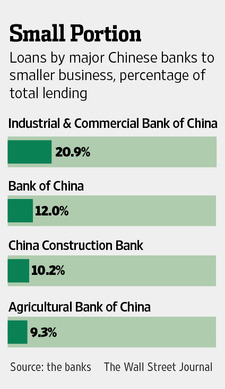
China’s top leaders are giving the go-ahead to create new, privately held banks, opening up a sector that has been mostly off-limits to private capital and indirectly acknowledging that the current system isn’t working.

China Clears a Path for New Banks

Government, Seeking to Expand Access to Credit, to Permit Creation of Lenders

DINNY MCMAHON

Updated Nov. 19, 2013 9:57 p.m. ET

MI-BZ789_CBANKS_NS_20131119170904

BEIJING—After decades of relying on state banks, China’s top leaders are giving the go-ahead to create new, privately held banks, opening up a sector that has been mostly off-limits to private capital and indirectly acknowledging that the current system isn’t working. A program endorsed last week by the Communist Party leadership calls for letting private investors that meet certain as-yet-undefined requirements set up small and medium-size banks and other financial institutions. Read more of this post

China To Ban Another Off-Balance Sheet Bank Channel

China To Ban Another Off-Balance Sheet Bank Channel: Press

Created on Monday, November 18, 2013 – 21:54 EST

BEIJING (MNI) – New rules limiting borrowing and lending practices in the Chinese interbank market may not be as draconian as previously feared but will still close off a channel which currently allows banks to transfer assets off their balance sheets, according to Caijing magazine. The weekly says that, according to newly finalized rules from the China Banking Regulatory Commission (CBRC), banks will no longer be allowed to use tri-party agreements to transfer those assets off, but won’t ban the agreements outright as the interbank market had rumored. Read more of this post

China Has ‘High’ Chance of Small Bank Failure, Official Says

China Has ‘High’ Chance of Small Bank Failure, Official Says

One or two small Chinese banks may fail next year as they face pressure from their reliance on short-term borrowing, a Communist Party economic official said. Small banks get about 80 percent of their funding from interbank markets and deposits in savings vehicles known as wealth management products, Fang Xinghai, a bureau director at the Central Leading Group for Financial and Economic Affairs, said at a conference in Beijing today. They face risks from the mismatch with their long-term loans to borrowers such as local-government financing vehicles, he said. Read more of this post

China Central TV: champion of the people with a blurred picture

November 20, 2013 3:15 am

China Central TV: champion of the people with a blurred picture

By FT reporters

At the end of October, a young journalist in handcuffs, green prison jacket and a freshly-shaved head appeared on China Central Television, the state-owned national broadcaster, and confessed to taking bribes in exchange for writing negative articles about a large Chinese company. Just days earlier, the newspaper that employed Chen Yongzhou, 27, had published front-page banner headlines calling for his release, while human rights groups had mobilised to defend him. But after his admission on national television, the issue quickly died away. Read more of this post

China banks forced to delay or dramatically reduce Chinese bond issues as the impact of a tight onshore credit market begins to be felt

November 19, 2013 9:34 am

China banks forced to delay bond issues

By Paul J Davies in Hong Kong and Simon Rabinovitch in Shanghai

China Development Bank and fellow state policy lender Agricultural Development Bank of China have had to delay or dramatically reduce Chinese bond issues as the impact of a tight onshore credit market begins to be felt. The China Railway Corporation, another state entity, was forced to delay a deal recently, while well-known private companies including the electric carmaker BYD and internet company Baidu also saw deals delayed over the summer, according to bankers familiar with the situation. Read more of this post