Bitcoin under pressure: Virtual currency: It is mathematically elegant, increasingly popular and highly controversial. Bitcoin’s success is putting it under growing strain

Bitcoin under pressure: Virtual currency: It is mathematically elegant, increasingly popular and highly controversial. Bitcoin’s success is putting it under growing strain

Nov 30th 2013 | From the print edition

ALL currencies involve some measure of consensual hallucination, but Bitcoin, a virtual monetary system, involves more than most. It is a peer-to-peer currency with no central bank, based on digital tokens with no intrinsic value. Rather than relying on confidence in a central authority, it depends instead on a distributed system of trust, based on a transaction ledger which is cryptographically verified and jointly maintained by the currency’s users. Read more of this post

Bitcoin needs to learn from past e-currency failures

November 28, 2013 8:45 am

Bitcoin needs to learn from past e-currency failures

By Stephen Foley

Before Bitcoin, there was e-gold. In 1999, the Financial Times called it “the only electronic currency that has achieved critical mass on the web”. As it kept growing through the next decade, users ultimately opened more than 4m accounts, with more than $60m in deposits, backed by almost 4 metric tonnes of precious metal, and millions of dollars of transactions on a typical day. And then it all stopped. The founder of e-gold, an oncologist and economic history buff in Florida called Douglas Jackson, had hoped his gold-backed electronic currency would become a new base money to rival flawed fiat currencies. Read more of this post

Bank of England cuts mortgage support to avoid housing bubble

Bank of England cuts mortgage support to avoid housing bubble

8:10am EST

By David Milliken and Huw Jones

LONDON (Reuters) – The Bank of England moved to head off the risk of a bubble in house prices on Thursday, making a surprise announcement that it would put the brakes on a scheme launched last year to boost mortgage lending. Shares in British construction firms tumbled after the central bank said it would refocus the Funding for Lending Scheme (FLS) on helping small firms that find it hard to borrow. Read more of this post

Asset managers told to ‘be more visible’; Backlash feared unless industry presents a more human face

November 28, 2013 11:32 am

Asset managers told to come out of the shadows

By Gillian Tett

Backlash feared unless industry presents a more human face

In recent years Helena Morrissey, head of Newton, the asset management group, has attracted much attention. She is something of a rarity, being a truly senior woman in British finance, and she has used that platform to speak out on many issues including the 30 per cent campaign, which aims to get more women on British boards. But Ms Morrissey is currently promoting another cause: the profile of the British asset management industry. Earlier this month she delivered a speech to the CFA Institute in London, in which she urged fund managers to become far more vocal and visible. Read more of this post

“Quant” hedge funds: Computer says no; Hedge funds looking to spot and ride market trends are hoping for a fresh start

“Quant” hedge funds: Computer says no; Hedge funds looking to spot and ride market trends are hoping for a fresh start

Nov 30th 2013 | From the print edition

20131130_fnd001 20131130_FNC878

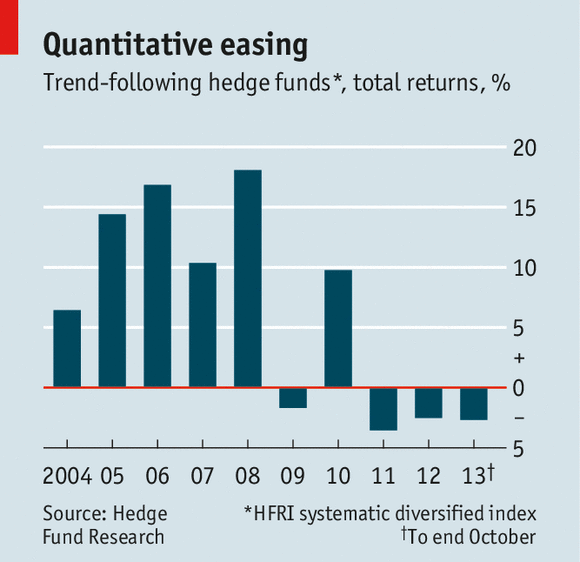
IF SOMETHING has not worked for five years, most people would conclude that it was broken. Tell that to the geeks managing “quant” hedge funds, who craft elaborate algorithms to profit from market movements. Once money-spinners, their prized formulae have misfired since 2009, losing money in four of the past five years. Unless their results improve markedly, the giant funds will finish this year as the worst-performing of the most common hedge-fund strategies. Read more of this post

On Thanksgiving, understanding what gratitude requires

On Thanksgiving, understanding what gratitude requires

By E.J. Dionne Jr., Thursday, November 28, 7:37 AM

Thanksgiving Day is awash in sentiment, but gratitude is not a sentiment. It’s a virtue. It’s certainly nice, but it is more than a feeling or an emotion. Properly understood, gratitude is hard because it entails both an admission and a demand. A genuine sense of gratitude is rooted in the realization that when I think about all that I am, all that I have and all that I might have achieved, I cannot claim to have done any of this by myself. None of us is really “self-made.” We must all acknowledge the importance of the help, advice, comfort and loyalty that came from others. Read more of this post

Gratitude is more than simple sentiment; it is the motivation that can save the world

Gratitude is more than simple sentiment; it is the motivation that can save the world

By Miles Kimball 30 minutes ago

Miles Kimball is an economics professor at the University of Michigan. He blogs about economics, politics and religion.

As my regular academic work slows down in the days leading up to Thanksgiving, my thoughts have turned toward gratitude. In a visceral way, I feel thankful for my family, for my work, for the exhilarating November air on a brisk walk around my neighborhood, for my friends both here in Ann Arbor and online, and for being alive in this very interesting era—in what I believe is still close to the dawn of human history, yet a time of great abundance compared to what has gone before in past centuries. Read more of this post

Where Is the Love? It’s easy to scorn the poor from a position of privilege. But, on Thanksgiving, maybe we need a conversation about empathy for fellow humans in distress

November 27, 2013

Where Is the Love?

By NICHOLAS D. KRISTOF

When I’ve written recently about food stamp recipientsthe uninsured and prison inmates, I’ve had plenty of pushback from readers. A reader named Keith reflected a coruscating chorus when he protested: “If kids are going hungry, it is because of the parents not upholding their responsibilities.” A reader in Washington bluntly suggested taking children from parents and putting them in orphanages. Jim asked: “Why should I have to subsidize someone else’s child? How about personal responsibility? If you procreate, you provide.” Read more of this post

Giving Thanks: I fear that far too many people have no familiarity – or even empathy – with what it means to be poor.

November 27, 2013

Giving Thanks

By CHARLES M. BLOW

Tuesday morning, I got a call about a girl — now a woman — whom I had gone to grade school with. She was gravely ill. Cancer. It had spread to her brain, I was told. From where, it wasn’t clear. She was on life support. By early afternoon her childhood friend and next-door neighbor had posted on Facebook: “This isn’t good bye, it’s just see u later. God saw ur suffering n decided u should suffer no more.” Read more of this post

The Solution Revolution: How business, government and social enterprises are teaming up to solve society’s toughest problems

November 27, 2013 4:15 pm

‘The Solution Revolution’, by William Eggers and Paul Macmillan

Review by Tanjil Rashid

The Solution Revolution: How business, government and social enterprises are teaming up tosolvesociety’stoughestproblems, by William Eggers and Paul Macmillan, Harvard Business Review Press $26/£17.99

Like many revolutionary manifestos, The Solution Revolution seeks the overthrow of government as we know it. But for authors William Eggers and Paul Macmillan – both of whom work for the public sector practice at Deloitte – this is a revolution very much in the interests of business, not against it. Read more of this post

Lessons on breaking into a new market: it takes time

Michael Bleby Reporter

Lessons on breaking into a new market: it takes time

Published 27 November 2013 12:02, Updated 28 November 2013 07:56

It takes time to break into a new market. Whether that market is for large infrastructure projects or business in China, establishing relationships with local potential clients and building up a local track record is crucial, businesses say. Of course, foreigners’ access to the local market can be impeded. Italian construction company Salini says in a submission to the Productivity Commission that access to Australia’s infrastructure market is hindered by a Leighton-Lend Lease duopoly and infrastructure funder Hastings supports that view. Read more of this post

For entrepreneurs, too often the holidays are anything but happy

For entrepreneurs, too often the holidays are anything but happy

BY MICHAEL CARNEY 
ON NOVEMBER 27, 2013

For most people the holidays are about family, escaping work, overindulging on food and drink, and overall checking out. Those with jobs as teachers, bankers, and mechanics put their work lives on hold for a few hours or days. But for entrepreneurs, that’s not possible. Depending on where they are along their entrepreneurial journey, this time of year can be any combination of suffocating, exhausting, or jubilant. Read more of this post

Five reasons why now is the time to be an entrepreneur

Amanda Gome Publisher, BRW and Smart Investor

Five reasons why now is the time to be an entrepreneur

Published 27 November 2013 12:01, Updated 27 November 2013 12:58

Amanda Gome says most of us will be entrepreneurs at some stage in our working lives. 

It’s a big claim, but here it is: there has never been a better time to be an entrepreneur. I came to this conclusion after reflecting on more than two decades of interviewing entrepreneurs, writing about their conditions, being an entrepreneur myself and researching how companies grow as an adjunct professor at RMIT. And it’s just as well it’s easier, because most of us will be entrepreneurs at some stage in our working lives. Read more of this post

‘It’s like Star Trek’: If you think the last 30 years have been a rollercoaster, you ain’t seen nothing yet

Michael Bleby Reporter

‘It’s like Star Trek’: If you think the last 30 years have been a rollercoaster, you ain’t seen nothing yet

Published 27 November 2013 12:04, Updated 27 November 2013 13:41

You ain’t seen nothing yet. If you think the past 30 years have seen great changes in Australia’s business and economic environment, hold on while the next 30 take off. Actually, you don’t even need to go back 30. As Atlassian co-founder Mike Cannon-Brookes points out, it’s hard to think how much our lives have changed since the launch of the first iPhone in 2007. Read more of this post

Charles Ellis: Lessons on Grand Strategy; Investing Lessons From Military Strategists

Lessons on Grand Strategy

Charles D. Ellis, CFA

July/August 2013, Vol. 69, No. 4: 6–9
(doi: 10.2469/faj.v69.n4.5)

Abstract


Grand Strategy,1 whereby all aspects of a nation’s strength—military, economic, political, cultural, and organizational—are combined into an overall, long-term program to advance the nation’s major interests, has important lessons for all leaders of investment management organizations. For long-term success, such leaders need a coherent, integrated combination of an inspiring purpose or mission and superior recruiting and training of investment managers and professional managers who will excel in information technology, trading, risk controls, efficient and effective support operations, business development, customer service, and both research and portfolio management. Read more of this post

This Is the Man Bill Gates Thinks You Absolutely Should Be Reading

This Is the Man Bill Gates Thinks You Absolutely Should Be Reading

BY CLIVE THOMPSON

11.25.13

ut_smil_f

“There is no author whose books I look forward to more than Vaclav Smil,” Bill Gates wrote this summer. That’s quite an endorsement—and it gave a jolt of fame to Smil, a professor emeritus of environment and geography at the University of Manitoba. In a world of specialized intellectuals, Smil is an ambitious and astonishing polymath who swings for fences. His nearly three dozen books have analyzed the world’s biggest challenges—the future of energy, food production, and manufacturing—with nuance and detail. They’re among the most data-heavy books you’ll find, with a remarkable way of framing basic facts. (Sample nugget: Humans will consume 17 percent of what the biosphere produces this year.) Read more of this post

People Who Use Nicknames Earn Bigger Paychecks

People Who Use Nicknames Earn Bigger Paychecks

ALISON GRISWOLD

NOV. 27, 2013, 2:28 PM 2,613 3

Sam or Samantha? Bill or William? Should you opt for short and friendly, or formal and serious? Experts say that not only can you use a nickname at work, you should, since doing so could boost your career. According to a study conducted earlier this year by job search site TheLadders, people who go by shorter names tend to earn more money. From an analysis of nearly 6 million names, the study found that every extra letter in a person’s name tended to correlate with a $3,600 drop in annual salary. That was true of names as similar as Sara and Sarah, Michele and Michelle, and Philip and Phillip. Over a 40-year career, the corresponding loss in earnings can amount to nearly $150,000. Read more of this post

The Overlooked Secret to Great Performance; Few companies or leaders systematically focus on, and invest in, how their employees feel, even though doing so would serve their bottom line

NOVEMBER 27, 2013, 10:33 AM

The Overlooked Secret to Great Performance

By TONY SCHWARTZ

Think of a time when you were performing at your best and another occasion when you were performing at your worst. Now, take a few moments to visualize the two occasions in your mind. The vast difference between these two experiences has nothing to do with your inborn talent or your skills. How much of your capacity you bring to work on any given day depends, to a large degree, on how much energy you’ve got in your tank. Read more of this post

Leading in the 21st century: An interview with HCA CEO Richard Bracken; The chairman and chief executive officer of one of the world’s largest operators of health-care facilities discusses leadership in a time of significant industry change

Leading in the 21st century: An interview with HCA CEO Richard Bracken

The chairman and chief executive officer of one of the world’s largest operators of health-care facilities discusses leadership in a time of significant industry change.

November 2013

With 165 hospitals, 113 freestanding surgery centers, and more than 200,000 employees in the United Kingdom and the United States, Nashville-based Hospital Corporation of America (HCA) is one of the world’s largest operators of health-care facilities. Chairman and CEO Richard M. Bracken is steering his publicly traded company through the significant changes now transforming the health-care industry—and doing so amid considerable uncertainty. For Bracken, the leadership challenge comes down to getting the balance right between performing in the short term and taking the necessary steps to position his company to cope successfully under multiple possible scenarios in the future. Read more of this post

Kids who like vinyl would love newspapers; Never write off any technology, even when it seems to have been buried

November 27, 2013 4:19 pm

Kids who like vinyl would love newspapers

By Michael Skapinker

Never write off any technology, even when it seems to have been buried

The biggest surprise about the rise in vinyl record sales is the age of the buyers. A poll by the BPI, the UK music industry body, found that more than a third of the record enthusiasts were under 35 years old. How do they even know what vinyl is? Surely their parents had converted to cassette tapes, if not CDs, by the time they came along? Read more of this post

Japan Wants To Turn The Moon Into A Giant Power Plant

Japan Wants To Turn The Moon Into A Giant Power Plant

DYLAN LOVE

NOV. 27, 2013, 10:52 AM 24,522 56

luna_img003

Shimizu Corporation, a Japanese architecture and engineering firm, has a plan to effectively turn the moon into a giant solar power plant, reports Inhabitat. It proposes building a massive collection of solar panels (a “Luna Ring”) 6,800 miles long by 12 miles wide on the moon’s surface. That’s certainly a heavy-duty construction job for human beings, so Shimizu plans to get the work done with robots, only involving humans in supervisory roles. Read more of this post

How to Buy Diamonds

November 27, 2013, 1:46 P.M. ET

How to Buy Diamonds

By Robert Milburn

Simply must buy yourself or your spouse a diamond? If you’re not up on gemology lingo, stumbling down New York City’s Diamond District on 47th Street can be an intimidating business. That’s why Penta caught up with the diamond experts at Leviev, famous for breaking through the De Beers stranglehold on the diamond industry, to get the low-down on selecting the proper diamond. Read more of this post

Freeports: Über-warehouses for the ultra-rich; Ever more wealth is being parked in fancy storage facilities. For some customers, they are an attractive new breed of tax haven

Freeports: Über-warehouses for the ultra-rich; Ever more wealth is being parked in fancy storage facilities. For some customers, they are an attractive new breed of tax haven

Nov 23rd 2013 | GENEVA, LUXEMBOURG AND NEW YORK | From the print edition

20131123_FBD001_0 20131123_FBC826 20131123_FBD002_0 20131123_FBC807

PASSENGERS at Findel airport in Luxembourg may have noticed a cluster of cranes a few hundred yards from the runway. The structure being erected looks fairly unremarkable (though it will eventually be topped with striking hexagonal skylights). Along its side is a line of loading bays, suggesting it could be intended as a spillover site for the brimming cargo terminal nearby. This new addition to one of Europe’s busiest air-freight hubs will not hold any old goods, however. It will soon be home to billions of dollars’ worth of fine art and other treasures, much of which will have been whisked straight from collectors’ private jets along a dedicated road linking the runway to the warehouse. Read more of this post

“How Academia Resembles a Drug Gang”

Wednesday, November 27, 2013

“How Academia Resembles a Drug Gang”

From Alexandre Afonso:

ppt_euimw

In 2000, economist Steven Levitt and sociologist Sudhir Venkatesh published an article in the Quarterly Journal of Economics about the internal wage structure of a Chicago drug gang. This piece would later serve as a basis for a chapter in Levitt’s (and Dubner’s) best seller Freakonomics[1] The title of the chapter, “Why drug dealers still live with their moms”, was based on the finding that the income distribution within gangs was extremely skewed in favor  of those at the top, while the rank-and-file street sellers earned even less than employees in legitimate low-skilled activities, let’s say at McDonald’s. They calculated 3.30 dollars as the hourly rate, that is, well below a living wage (that’s why they still live with their moms). [2] Read more of this post

An Analysis of Related-Party Transactions in India

An Analysis of Related-Party Transactions in India

Padmini Srinivasan Indian Institute of Management Bangalore

September 30, 2013
IIM Bangalore Research Paper No. 402

Abstract: 
Related-party transactions (RPTs) refer to transactions between a company and its related entities such as subsidiaries, associates, joint ventures, substantial shareholders, executives, directors and their relatives, or entities owned or controlled by its executives, directors, and their families. RPTs are widespread and are part of every business group activity. RPTs have come under close scrutiny in recent years as they have been misused by companies as revealed in various corporate scandals. The study analyses Indian companies for three years between 2009 and 2011 and finds that RPTs were widespread and present in almost all companies during this period. Further, companies with high RPTs related to sales and income were found to report lower performance compared to companies with low RPTs. While ownership structure failed to offer any explanation for the magnitude of RPTs, RPTs were found to be lower in companies where big audit firms were statutory auditors.

Business Groups in the United States: A Revised History of Corporate Ownership, Pyramids and Regulation, 1930-1950

Business Groups in the United States: A Revised History of Corporate Ownership, Pyramids and Regulation, 1930-1950

Eugene Kandel Hebrew University of Jerusalem – Department of Economics; Centre for Economic Policy Research (CEPR)

Konstantin Kosenko Bank of Israel

Randall Morck University of Alberta – Department of Finance and Statistical Analysis; National Bureau of Economic Research (NBER)

Yishay Yafeh Hebrew University of Jerusalem – Jerusalem School of Business Administration; European Corporate Governance Institute (ECGI); Centre for Economic Policy Research (CEPR)

November 2013
CEPR Discussion Paper No. DP9759

Abstract: 
The extent to which business groups ever existed in the United States and, if they did exist, the reasons for their disappearance are poorly understood. In this paper we use hitherto unexplored historical sources to construct a comprehensive data set to address this issue. We find that (1) business groups, often organized as pyramids, existed at least as early as the turn of the twentieth century and became a common corporate form in the 1930s and 1940s, mostly in public utilities (e.g., electricity, gas and transportation) but also in manufacturing; (2) In contrast with modern business groups in emerging markets that are typically diversified and tightly controlled, many US groups were focused in a single sector and controlled by apex firms with dispersed ownership; (3) The disappearance of US business groups was largely complete only in 1950, about 15 years after the major anti-group policy measures of the mid-1930s; (4) Chronologically, the demise of business groups preceded the emergence of conglomerates in the United States by about two decades and the sharp increase in stock market valuation by about a decade, so that a causal link between these events is hard to establish, although there may well be a connection between them. We conclude that the prevalence of business groups is not inconsistent with high levels of investor protection; that US corporate ownership as we know it today evolved gradually over several decades; and that policy makers should not expect policies that restrict business groups to have an immediate effect on corporate ownership.

The Sovereign Wealth Fund Discount: Evidence from Public Equity Investments

The Sovereign Wealth Fund Discount: Evidence from Public Equity Investments

Bernardo Bortolotti Università di Torino

Veljko Fotak SUNY Buffalo; Bocconi University – BAFFI Center on International Markets, Money, and Regulation

William L. Megginson University of Oklahoma

September 17, 2013
Baffi Center Research Paper No. 2013-140
FEEM Working Paper No. 22.2009

Abstract: 
Using a sample of 1,018 Sovereign Wealth Fund (SWF) equity investments in publicly traded firms and a control sample of 5,975 transactions by private-sector financial institutions over 1980-2012, we find that announcement-period abnormal returns of SWF investments are positive, but lower than those of comparable private-sector investments by approximately 2.67 percentage points. We do not find evidence of long-term stock price performance of SWF investment targets differing from that of private-sector investment targets. We do find, however, significant differences among SWFs which are only partially captured by the short-term market reaction: firms acquired by passive funds tend to underperform over the following three years, while positive abnormal returns are associated with actively monitoring SWFs. We conclude that SWFs’ corporate governance role tends to affect the value of the firm.

Thoratec’s Heart Pump May Cause Blood Clots, Study Suggests

Thoratec’s Heart Pump May Cause Blood Clots, Study Suggests

Thoratec Corp. (THOR)’s HeartMate II, a device that pumps blood for patients with failing hearts, can form deadly blood clots, according to a report that urges investigation into therapeutic strategies to address the issue. The implanted device caused 72 blood clots in 66 patients at three institutions, where 895 devices were implanted from 2004 through 2013, according to a study in the New England Journal of Medicine. The report pooled data from the Cleveland Clinic in Ohio, Washington University Barnes-Jewish Hospital in St. Louis, and Duke Medical University Center. Read more of this post

The Vaccination Effect: 100 Million Cases of Contagious Disease Prevented

NOVEMBER 27, 2013, 5:00 PM

The Vaccination Effect: 100 Million Cases of Contagious Disease Prevented

By STEVE LOHR

Vaccination programs for children have prevented more than 100 million cases of serious contagious disease in the United States since 1924, according to a new study published in The New England Journal of Medicine. The research, led by scientists at the University of Pittsburgh’s graduate school of public health, analyzed public health reports going back to the 19th century. The reports covered 56 diseases, but the article in the journal focused on seven: polio, measles, rubella, mumps, hepatitis A, diphtheria and pertussis, or whooping cough. Read more of this post

Not Taking Care Of Your Teeth Could Give You A Heart Attack

Not Taking Care Of Your Teeth Could Give You A Heart Attack

HAROON SIDDIQUETHE GUARDIAN
NOV. 27, 2013, 8:58 PM 1,922 1

Excessive sugar – not just fat and salt – in junk food can cause heart disease, experts writing in the Journal of the Royal Society of Medicine have warned. The risk posed by saturated fats and salt are already generally accepted, and sugar has been blamed for fuelling obesity, but the editorial, published on Thursday, says that a link between poor oral health and cardiovascular disease (CVD) has been demonstrated by a “convincing evidence base”. Read more of this post