Want to be a chief executive of a FTSE 350 company? Here’s the route to follow

Want to be a chief executive? Here’s the route to follow

Hit the sweetspot to becoming a company boss by being male, 46 years old, with a university – ideally Oxbridge – education.

By Rebecca Burn-Callander

6:01AM GMT 31 Oct 2013

The average chief executive of a FTSE 350 company is a 46-year-old male, who attended Oxford or Cambridge University, according to research by business intelligence company QlikTech. The company crunched background data on all of the current FTSE 100 and FTSE 250 CEOs, as of August 2013, to find out where they were born, where they went to university, and details around the subjects they studied and key points from their later career.


THUMB (1) Read more of this post

A joint Chinese and Singaporean research team have developed an “invisibility cloak” using polygonal devices with glass

Chinese, Singaporean team develop invisibility cloak

Staff Reporter

2013-11-03

20131102invisiblehexagon-151925_copy1

The glass device makes part of a pencil disappear. (Internet photo)

A joint Chinese and Singaporean research team have developed an “invisibility cloak” using polygonal devices with glass, reports China’s state-run Xinhua News Agency. Professor Chen Hongsheng of the Electromagnetics Academy of Zhejiang University and a research team from Singapore’s Nanyang Technological University successfully made a goldfish and a cat disappear with the new light-bending technology. Read more of this post

Veteran investor Donald A. Yacktman finds much to like in Coke, Pepsi, and P&G which he views as bargains

SATURDAY, NOVEMBER 2, 2013

Why Three Big Stocks Look Like Bargains

By LAWRENCE C. STRAUSS | MORE ARTICLES BY AUTHOR

Veteran investor Donald A. Yacktman finds much to like in Coke, Pepsi, and P&G which he views as bargains.

Donald A. Yacktman is regarded as an insightful investor with a keen analytical mind, as his long-term results attest. The Yacktman Fund (ticker: YACKX) has a 15-year annual return of 10.62%, besting 99% of its peers in Morningstar’s large-cap blend category. Yacktman and his team hew to a buy-and-hold approach, content to hold stocks for years. Annual turnover averages about 20%. The fund’s top 10 holdings account for about 50% of assets. Yacktman, 72, who is president of Yacktman Asset Management in Austin, Texas, oversees nearly $30 billion of assets. To find out about a few of his holdings and his sense of where the markets stand, Barron’s caught up with him recently by telephone. Read more of this post

The Dangers of a Stock Market Melt-Up; Though a steadfast market bull, a strategist worries about investors’ nonchalant attitude toward ever-rising stocks

November 2, 2013

The Dangers of a Stock Market Melt-Up

By JEFF SOMMER

Investors aren’t worrying much about the stock market, and that worries Edward Yardeni.

It’s not that Mr. Yardeni, an independent economist and strategist, has a gloomy outlook on the market himself. To the contrary, he’s been generally optimistic about the prospects for stocks for about five years, and he remains so. “We’re in a bull market, and I think it can continue for the next few years,” he said in an interview last week. But what’s striking about his perspective is that while he remains a steadfast market bull, he finds himself increasingly preoccupied by a cloud on the horizon: the growing complacency of his fellow investors. Read more of this post

The World’s Tallest Statue Is Under Construction in India — It Will Be Twice The Size Of The Statue Of Liberty

The World’s Tallest Statue Is Under Construction — It Will Be Twice The Size Of The Statue Of Liberty

MICHAEL KELLEY NOV. 2, 2013, 4:51 PM 3,967 8

screen shot 2013-11-02 at 4.18.28 pm

India has begun construction on a statue of Sardar Patel, the first home minister of independent India, and it is going to be the tallest in the world by far. Patel shared a prison cell with his close friend Mahatma Gandhi and became the leader of the Congress Party in 1934. The monument will be 600 feet tall and cost $300 million. Taking a look at the 305-foot State of Liberty, it’s hard to fathom how massive this thing will be.

Here’s The Fascinating Way Computers Have Changed The Way Humans Play Chess Against Each Other

Here’s The Fascinating Way Computers Have Changed The Way Humans Play Chess Against Each Other

JOE WEISENTHAL NOV. 2, 2013, 5:17 PM 3,280 2

The most anticipated chess match in over a decade begins next week. On November 9 in Chennai, India, upstart Norwegian chess prodigy Magnus Carlsen will attempt to become the world champion by facing off against Viswanathan Anand over the course of 12 games. Carlsen gets all the attention because he’s just 22 and even does modeling, but Anand is one of the all-time greats, and is the defending champion. Read more of this post

The Pills of Last Resort: How Dying Patients Get Access to Experimental Drugs

October 31, 2013

The Pills of Last Resort

How Dying Patients Get Access to Experimental Drugs

By DARSHAK M. SANGHAVI, M.D.

It was shortly after the breadbasket arrived last year at the Temple Bar near Harvard Square that Sarah Broom first told me about the last-ditch plan to save her own life. Broom’s mere presence that evening was something of a miracle. Several years earlier, in 2008, while pregnant with her third child, she received a harrowing diagnosis. A 35-year-old English lecturer and poet living in New Zealand, Broom developed a persistent cough. She saw doctors in Auckland repeatedly over the course of a few months, but they didn’t want to do an X-ray on a pregnant woman. Finally, her shortness of breath became so severe that they relented, and 29 weeks into her pregnancy, she was found to have a large mass on her lung. She underwent a cesarean section — her daughter was born almost three months early — and a biopsy. Read more of this post

Here’s Why ‘The Internet Of Things’ Will Be Huge, And Drive Tremendous Value For People And Businesses

Here’s Why ‘The Internet Of Things’ Will Be Huge, And Drive Tremendous Value For People And Businesses

EMILY ADLER NOV. 2, 2013, 5:04 PM 49,738 15

deviceforecast-1

The Internet Of Things represents a major departure in the history of the Internet, as connections move beyond computing devices, and begin to power billions of everyday devices, from parking meters to home thermostats. Estimates for Internet of Things or IoT market value are massive, since by definition the IoT will be a diffuse layer of devices, sensors, and computing power that overlays entire consumer, business-to-business, and government industries. The IoT will account for an increasingly huge number of connections: 1.9 billion devices today, and 9 billion by 2018. That year, it will be roughly equal to the number of smartphones, smart TVs, tablets, wearable computers, and PCs combinedIn a new report from BI Intelligence, we look at the transition of once-inert objects into sensor-laden intelligent devices that can communicate with the other gadgets in our lives. In the consumer space, many products and services have already crossed over into the IoT, including kitchen and home appliances, lighting and heating products, and insurance company-issued car monitoring devices that allow motorists to pay insurance only for the amount of driving they do.  Here are the top business-to-business and government applications:

Read more of this post

If a Young Child Wanders, Technology Can Follow

November 2, 2013

If a Young Child Wanders, Technology Can Follow

By ANNE EISENBERG

Most parents have experienced that feeling of fear when a young child wanders off at the playground or disappears during a trip to the supermarket. New technology, in the form of voice watches and miniature sensing devices, is aimed at thwarting such distress by keeping track of children who are too young to carry a smartphone. The new devices use GPS, Wi-Fi and other location-tracking technology and can be linked to apps on a parent’s phone. One device, a watch coming from Filip Technologies later this year, tracks a child’s location and lets him or her get voice calls from up to five people authorized by their parents. (Children lift the watch to their ear or mouth when communicating.) Read more of this post

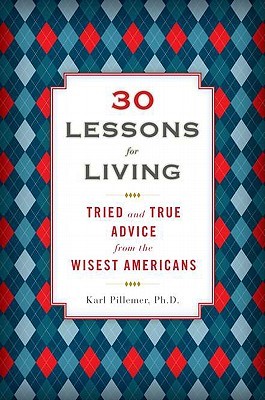
30 Lessons for Living: Tried and True Advice from the Wisest Americans

30 Lessons for Living: Tried and True Advice from the Wisest Americans Paperback

by Karl Pillemer Ph.D. (Author)

11376196

“Heartfelt and ever-endearing – equal parts information and inspiration. This is a book to keep by your bedside and return to often.” –Amy Dickinson, nationally syndicated advice columnist “Ask Amy” After a chance encounter with a remarkable ninety-year-old woman, renowned gerontologist Karl Pillemer decided to find out what older people know about life that the rest of us don’t. His quest led him to speak with a thousand Americans over the age of sixty-five—many of whom can remember the Depression and World War II. While some of their tales reaffirmed timeless wisdom, others surprised Pillemer with the unexpected. Now with a new preface by Jane Brody, 30 Lessons for Living distills their moving stories and hard-won advice. To learn how to live without regret, persevere through hard times, find fulfillment, and age fearlessly and well, there is no one better to ask than the people who have done it themselves. Read more of this post

How The Netherlands Became The Biggest Exporter Of Resilience

How The Netherlands Became The Biggest Exporter Of Resilience

For centuries, the Netherlands has suffered from catastrophic floods. As the rest of the world now reckons with the same fate, the Dutch are sharing–and selling–what they’ve learned.

Jeff Chu

November 1, 2013 | 9:40 AM

Huib de Vriend was five years old when the great flood of 1953 hit. It was a chilly Saturday night, and the local radio stations had gone off the air at their usual hour near bedtime, just before the full force of the storm blew in. What shook young Huib more than the whistle of the wind or the thrum of the rain was the panic in his grandmother’s voice. “She was yelling: ‘The water is coming! The water is coming!'” he recalls. That was when he knew something was wrong. His grandmother was usually a voice of calm in the family. Read more of this post

How to Save the Investment Research Industry

How to Save the Investment Research Industry

26 SEP 2013 – INDY SARKER

The investment research industry — both asset management and brokerage firms — has faced structural challenges for the past decade. Despite this, the industry has not wholeheartedly embraced innovation in its business processes. These hurdles encompass a combination of high costs, lack of significant productivity initiatives and declining value to the consumer. Today’s external customer environment of a shrinking commission pool, asset managers using fewer brokers and the rise of commission-sharing arrangements also illustrate the cost structure driving the brokerage industry. Read more of this post

Good Morning! Your Moral Fiber Is Eroding by the Minute; a person’s store of self-control is finite, and can be depleted. Like a muscle, our self-control weakens when we use it and is restored when we rest it

Good Morning! Your Moral Fiber Is Eroding by the Minute

By Drake Bennett November 01, 2013

Right now, as I write this, I am at peak integrity, but with every minute that passes, my moral fiber is weakening, like a cereal flake in milk. I don’t notice it, but if there are decisions or tasks requiring personal discipline, I should take care of them quickly—by this afternoon, I will be defenseless against my baser instincts. So say Maryam Kouchaki and Isaac Smith, researchers into organizational behavior, in a new paper in the journal Psychological Science. The idea that people can be more or less moral at different times goes back to the earliest recorded stories people told about each other: Achilles is both merciless killer and tender friend, Dr. Jekyll is Mr. Hyde. What’s notable about the hypothesis Kouchaki and Smith set out to  prove is that a person’s moral upstandingness erodes over the course of each day, broken down in a process as regular and as ineluctable as digestion. Read more of this post

Father of IBM’s first personal computer, which sold out in stores in 1981, dies of a heart attack aged 72

Father of IBM’s first personal computer, which sold out in stores in 1981, dies of a heart attack aged 72

Lowe joined IBM in 1962, when he finished college with a physics degree

He left the company in 1988 to work for Xerox

Lowe is survived by wife, Cristina Lowe, five children and 10 grandchildren

By ASSOCIATED PRESS

PUBLISHED: 21:06 GMT, 31 October 2013 | UPDATED: 22:09 GMT, 31 October 2013

article-2482131-191C090400000578-775_634x651 article-2482131-191C9D2A00000578-349_634x425

William C. Lowe (pictured in 1987 with an IBM computer) died of a heart attack in Illinois at age 72; The IBM personal computer introduced in 1984 was a massive hit and changed society

The man behind IBM’s first ever personal computer, which sold out in stores in 1981 for $1,565, has died at the age of 72. William C. Lowe died of a heart attack on October 19 in Illinois, his daughter Michelle Marshall confirmed. Marshall said she didn’t realize the magnitude of what her father helped accomplish until she was an adult.

Read more of this post

Bible-toting Gary Wang sentenced to prison for his involvement in the EMG and Rebar Group (力霸集團) embezzlement scandals

Bible-toting Gary Wang sentenced to prison

By Ashley Yen, Special to The China Post
November 2, 2013, 12:15 am TWN

p16c

TAIPEI, Taiwan — Former Eastern Multimedia Group (EMG, 東森集團) Chairman Gary Wang (王令麟) reported to the Taipei District Prosecutors’ Office yesterday with a Bible in his hands to begin serving his prison term. Wang was given a five-year, six-month sentence for his involvement in the EMG and Rebar Group (力霸集團) embezzlement scandals. Wang was escorted in handcuffs by his attorney and the police. He expressed his apologies to the public in front of the prosecutors’ office. Read more of this post

The Outsiders Who Saw Our Economic Future; In both America’s energy transformation and the financial crisis, it took a group of amateurs to see what was coming

The Outsiders Who Saw Our Economic Future

In both America’s energy transformation and the financial crisis, it took a group of amateurs to see what was coming

WSJ reporter Gregory Zuckerman, author of ‘The Frackers’, discusses how early pioneers of the fracking industry were seen as outsiders and ‘wildcatters’ by the established oil industry.

GREGORY ZUCKERMAN

Nov. 1, 2013 8:35 p.m. ET

The experts keep getting it wrong. And the oddballs keep getting it right.

Over the past five years of business history, two events have shocked and transformed the nation. In 2007 and 2008, the housing market crumbled and the financial system collapsed, causing trillions of dollars of losses. Around the same time, a few little-known wildcatters began pumping meaningful amounts of oil and gas from U.S. shale formations. A country that once was running out of energy now is on track to become the world’s leading producer. Read more of this post

An exclusive interview with Bill Gates

November 1, 2013 11:05 am

An exclusive interview with Bill Gates

By Richard Waters

The internet is not going to save the world, says the Microsoft co-founder, whatever Mark Zuckerberg and Silicon Valley’s tech billionaires believe. But eradicating disease just might. Bill Gates describes himself as a technocrat. But he does not believe that technology will save the world. Or, to be more precise, he does not believe it can solve a tangle of entrenched and interrelated problems that afflict humanity’s most vulnerable: the spread of diseases in the developing world and the poverty, lack of opportunity and despair they engender. “I certainly love the IT thing,” he says. “But when we want to improve lives, you’ve got to deal with more basic things like child survival, child nutrition.” Read more of this post

Speedy Lunches Urged at SEC as Union Decries Time-Clock Watching

Speedy Lunches Urged at SEC as Union Decries Time-Clock Watching

Add the ability to eat quickly to the list of skills needed to work at the U.S. Securities and Exchange Commission. In a dispute that has sent pangs of resentment — and perhaps hunger — across the agency, the SEC’s union chief has warned workers to keep lunch breaks to a half hour or risk being disciplined as “absent without leave.” “Despite the fact that most SEC employees are often told that they may take an hour for lunch, technically, we are only entitled to thirty minutes,” wrote Greg Gilman, president of the union, in an e-mail sent to SEC workers last week. “Do not fall into the trap of believing that because you are a ‘professional’ the rules do not apply to you.” Read more of this post

India 101: How to Make the Most of Your First Trip

November 16, 2012, 5:54 AM

India 101: How to Make the Most of Your First Trip

By Jennifer Chen

Travel Well is a column for Scene covering Asia-Pacific travel tips and trends. Got a question about travel in the region? Email us or tweet @WSJscene.

I will be traveling with a friend to India (New Delhi, Agra, Jaisalmer and Jaipur) for two weeks in December. This will be my first trip there. Do you have any tips on what to pack? Our main goal is to experience the culture, but we’re also interested in history and adventure. We want to see the forts, walk through bazaars, ride camels, take an overnight train and visit the Taj Mahal. Any food recommendations would be wonderful, too. Finally, how do I filter through online hotel reviews—which ones are legitimate?

—Sara, Los Angeles

What to pack: December is a great time to visit northern India thanks to the dry weather and comfortable daytime temperatures in the 70’s Fahrenheit (20′s Celsius) for New Delhi and Jaipur. The mercury, however, can dip down to the 30’s Farenheit (below zero Celsius) at night, so think layers when packing and make sure to bring a few warm items. Ashish Sanghrajka, the president of Big Five Tours and an India travel expert, recommends breathable cotton clothing as the best way to deal with the fluctuating temperatures. Read more of this post

How Investors Leave Billions on the Table

Nov 1, 2013

How Investors Leave Billions on the Table

JASON ZWEIG

Will investors ever stop underperforming their own investments? Consider Pimco Total Return, the giant bond mutual fund run by the renowned investor Bill Gross. In the year ended Sept. 30, its largest share class lost 0.74% — a respectable result, considering that the bond benchmark the fund seeks to beat, the Barclays U.S. Aggregate index, lost 1.89%. But the fund’s investors, who yanked out $7.3 billion in May and June, right before it rebounded, did worse. Pimco Total Return’s largest share class had $169.3 billion in assets as of Sept. 30, 2012. If no one had put in or taken out a dime (other than to reinvest interest income and other payouts), these shares would have ended September 2013 with $168.1 billion, or 0.74% less. Instead, it finished at $157.1 billion—$11 billion less. Read more of this post

Is Success Harder for Older Entrepreneurs?

Is Success Harder for Older Entrepreneurs?

Updated Oct. 30, 2013 7:18 p.m. ET

The image of an up-and-coming entrepreneur is often that of a college dropout with an affinity for technology—typically, a male in his 20s. Yet about half of last year’s new entrepreneurs were 45 or older, according to the Ewing Marion Kauffman Foundation, a nonprofit group focusing on entrepreneurship and education. Some entrepreneurs in their 40s, 50s and up say they often have to deal with “age bias” on the part of investors, clients and colleagues. But is it really harder for older entrepreneurs to succeed at building startups? And what, if anything, can they do about raised eyebrows, or snide remarks, about their age? This week mentors on The Accelerators, a Wall Street Journal blog on the challenges of starting a business, weighed in with their views on age bias. Read more of this post

Hedge fund wisdom, cut to the bone

November 1, 2013 7:20 pm

Hedge fund wisdom, cut to the bone

By Merryn Somerset Webb

Successful hedgies share top tips in the name of philanthropy

Iflew from Scotland to London with my children on Thursday. Everyone was in a remarkably good mood – possibly because they were either flying on or working for British Airways rather than Ryanair – and the captain asked us in to see the flight deck. It went well. No one pressed any buttons they weren’t supposed to and everyone was polite to the pilots. But I was not altogether thrilled to be reminded just how complicated a cockpit is – so many buttons, so much risk. Read more of this post

We Should Stop Telling Entrepreneurs To ‘Fail Fast’

We Should Stop Telling Entrepreneurs To ‘Fail Fast’

MAX NISEN NOV. 1, 2013, 6:05 PM 1,412 2

“Fail fast” has become standard entrepreneurial advice. Startups and small businesses are told they shouldn’t worry about messing up, because it’s better to quickly realize that something’s not working and move on.  That’s the right idea but very much the wrong attitude, according to Rob Shelton, the global innovation chief of PwC. When the professional services giant did a massive study looking at what separates the most innovative companies from the rest of the pack, one of the most important attributes was what Shelton calls a “Darwinian engine,” defined as a formalized process for innovation, and an ability to rapidly try and test out new ideas and discard the ones that don’t work. But don’t call it “failing,” he warns. Read more of this post

How Warby Parker Thrives On Brutal Honesty

How Warby Parker Thrives On Brutal Honesty

VIVIAN GIANG NOV. 1, 2013, 4:02 PM 1,880

Not wanting to be another failed partnership, the founders of eyewear company Warby Parker, who were former classmates at Wharton, decided early on that they would be able to criticize each other openly, honestly, and harshly, if needed. How would they do this without building resentment between one another? In an interview with Adam Bryant at The New York Times, co-founder Neil Blumenthal says that every month the four founders return to the bar where they originally came up with the idea, and one of them is placed in the hot seat. According to Blumenthal, during these “360 reviews,” a partner might say, “When you shoot me a 10-page email at 2 in the morning, I want to punch you in the face.” “That set the tone for the culture at Warby Parker, which would really be rooted in open and honest feedback,” says Blumenthal. Read more of this post

4 Terrible Pieces Of Career Advice You Should Ignore

4 Terrible Pieces Of Career Advice You Should Ignore

HIRANYA FERNANDOLUMIERE NOV. 1, 2013, 1:55 PM 3,820 6

I coach, teach, and mentor about work, jobs, and careers for a living. And I’m big on taking risks, making mistakes, living and learning, pushing boundaries. You may overhear me say things like “if something is worth doing, it’s worth overdoing.” I was never one for moderation, and still struggle to stay within the designated zone. So, when someone like me advises caution, it means something. My interest in other peoples’ wellbeing and success is deep and genuine. What follows is from the heart, even if it sounds harsh. Someone’s got to be the bad cop and call it like it is. I worry that good, well-meaning folks, and especially our youth, are being told things that are simply untrue and don’t stand up to any objective scrutiny—things that create impossible expectations, are incredibly misleading, and essentially lead people down the garden path full of unicorns and rainbows. Of course we want to inspire our clients, our students, and our mentees to pursue their dreams. Our garden and our path must have the occasional unicorn and rainbow to make us believe in beautiful things. But our path must also be true, real, and stable. To that end, there are a few things we need to stop saying. Here are four of them: Read more of this post

Why Starbucks Doesn’t Have An Express Line For Simple Orders

Why Starbucks Doesn’t Have An Express Line For Simple Orders

ASHLEY LUTZ NOV. 1, 2013, 12:46 PM 3,368 4

Starbucks customers who order black coffee wait in the same line as those who order labor-intensive lattes and Frappuccinos. Some black coffee enthusiasts view this as an injustice. If their order is much simpler, why must they wait? An express line would also free up baristas for complicated orders. We asked Adam Pressman, a principal in A.T. Kearney’s retail practice, why Starbucks doesn’t implement this policy. He provided a few reasons why black coffee customers will keep waiting in line with everyone else.  Read more of this post

Angel or Devil: Who’s Really Investing In Your Start-Up?

Angel or Devil: Who’s Really Investing In Your Start-Up?

by Nir Eyal  |   11:00 AM November 1, 2013

A friend called me heartbroken, crying. She had spent months looking for investors to fund her fledgling startup and now she had a big problem. Someone was ready to give her the money. Trouble was, the cash came with a catch. The only investor willing to pony-up the money was someone she didn’t like. She also got the feeling he did not like her much either, and yet, he wanted to invest. “If he was involved, I have the feeling I would quit my company down the road,” she told me over the phone. Time was running out; she needed the funds and with no other investor ready to commit, she feared she’d have to take the money from someone she couldn’t stand. The very thought made her sick in the stomach. I felt for her and her dilemma piqued my curiosity. What differentiates a great early-stage investor from someone no entrepreneur wants to take money from unless they absolutely have to? Read more of this post

Why do we feel such a strong desire to get a deal—even when we don’t need what we’re buying?

Book Review: ‘Bargain Fever’ by Mark Ellwood

Why do we feel such a strong desire to get a deal—even when we don’t need what we’re buying?

LAURA VANDERKAM

Nov. 1, 2013 4:42 p.m. ET

Sales racks were once muted offerings, tucked away in the back of stores. But they’ve become the main draw. In 2011, retailers sold 40% to 45% of their inventory at a promotional price, Mark Ellwood notes in “Bargain Fever: How to Shop in a Discounted World.” Only 10 years earlier, they had sold 15% to 20% that way. “In just a decade,” he writes, “sales of sales more than doubled.” Read more of this post

Great works of art aren’t just for show. Approached in the right frame of mind, they can help us to deal with life’s key challenges

Art for Life’s Sake

Great works of art can help us deal with life’s challenges

BN-AF948_1101ar_J_20131101130507

In ‘At the Linen Closet’, a modest domestic scene by the 17th-century Dutch painter Pieter de Hooch, we see a couple of women putting the household linens in order. His painting suggests that the big themes of life—the search for prosperity, happiness, good relationships—are always grounded in the way we approach little things and ordinary routine. Peter Horree/Alamy

ALAIN DE BOTTON

Nov. 1, 2013 8:16 p.m. ET

Art enjoys such financial and cultural prestige that it’s easy to forget the confusion that persists about what it’s really for. Questions like “What is this painting about?” or “Why should this old sculpture matter to me?” have a way of sounding impudent and crass. Nice people generally don’t ask such things, except in the privacy of their hearts, on their way down the concrete steps of white-walled galleries. Read more of this post

Mankind Turns to Understanding Himself; Jacob Burckhardt’s “The Civilization of the Renaissance in Italy” captures a dazzling era and its many contradictions

Mankind Turns to Understanding Himself

JOSEPH EPSTEIN

Nov. 1, 2013 7:10 p.m. ET

‘The most instructive of all the books on the Renaissance,” Lord Acton called Jacob Burckhardt’s “The Civilization of the Renaissance in Italy.” The book was one of the few modern works that Friedrich Nietzsche admired. Burckhardt (1818-1897) and Nietzsche (1844-1900) were colleagues at the University of Basel, in Switzerland. Nietzsche claimed that Burckhardt’s were the only lectures he ever enjoyed, and the model for the kind he himself hoped one day to deliver. Burckhardt recognized the younger man’s genius, yet was slightly wary of him, knowing how different were their intellectual methods and points of view. Nietzche was of course a philosopher, of literary bent, trained in the classics. Burckhardt called himself “a contemplative historian.” Read more of this post