‘Reshoring’ is all the rage as allure of ‘Made in China’ fades

‘Reshoring’ is all the rage as allure of ‘Made in China’ fades

Sunday, Feb 02, 2014

Jeremy Au Yong

The Straits Times

Mr Craig Wolfe, 61, has been in the rubber duck business for over a decade. And for all that time, the ducks – even those designed to resemble American sports stars and presidents – were made in Shenzhen, China. Read more of this post

The Ego and the Universe: Alan Watts on Becoming Who You Really Are; The cause and cure of the illusion of separateness that keeps us from embracing the richness of life

The Ego and the Universe: Alan Watts on Becoming Who You Really Are

by Maria Popova

The cause and cure of the illusion of separateness that keeps us from embracing the richness of life.

During the 1950s and 1960s, British philosopher and writer Alan Watts began popularizing Eastern philosophy in the West, offering a wholly different perspective oninner wholeness in the age of anxiety andwhat it really means to live a life of purpose. We owe much of today’s mainstream adoption of practices like yoga and meditation to Watts’s influence. In The Book: On the Taboo Against Knowing Who You Are (public library), originally published in 1966 and building upon his indispensable earlier work, Watts argues with equal parts conviction and compassion that “the prevalent sensation of oneself as a separate ego enclosed in a bag of skin is a hallucination which accords neither with Western science nor with the experimental philosophy-religions of the East,” exploring the cause and cure of that illusion in a way that flows from profound unease as we confront our cultural conditioning into a deep sense of lightness as we surrender to the comforting mystery and interconnectedness of the universe. Envisioned as a packet of essential advice a parent might hand down to his child on the brink of adulthood as initiation into the central mystery of life, this existential manual is rooted in what Watts calls “a cross-fertilization of Western science with an Eastern intuition. Read more of this post

Fixed vs. Growth: The Two Basic Mindsets That Shape Our Lives; How to fine-tune the internal monologue that scores every aspect of our lives, from leadership to love

Fixed vs. Growth: The Two Basic Mindsets That Shape Our Lives

by Maria Popova

How to fine-tune the internal monologue that scores every aspect of our lives, from leadership to love.

“If you imagine less, less will be what you undoubtedly deserve,” Debbie Millman counseled in one of the best commencement speeches ever given, urging: “Do what you love, and don’t stop until you get what you love. Work as hard as you can, imagine immensities…” Far from Pollyanna platitude, this advice actually reflects what modern psychology knows about how belief systems about our own abilities and potential fuel our behavior and predict our success. Much of that understanding stems from the work of Stanford psychologist Carol Dweck, synthesized in her remarkably insightful Mindset: The New Psychology of Success (public library), which explores the power of our beliefs, both conscious and unconscious, and how changing even the simplest of them can have profound impact on nearly every aspect of our lives. Read more of this post

Invest like a legend: Charles Brandes

Invest like a legend: Charles Brandes

BRIAN MILNER

The Globe and Mail

Published Thursday, Jan. 30 2014, 5:44 PM EST

Brandes, 70, has been spreading the gospel of disciplined investing in sound but undervalued companies since 1974. Like Warren Buffett, the San Diego billionaire counts Ben Graham as his mentor. The author of the widely read Value Investing Today, first published in 1989, regards investing as a long-term proposition. Anything else is just speculating. Read more of this post

Relax, Being Anxious Makes You A Good Leader

RELAX, BEING ANXIOUS MAKES YOU A GOOD LEADER

A NEW BODY OF RESEARCH PAINTS ANXIOUS BEHAVIOR IN A DIFFERENT LIGHT THAN YOU’D EXPECT. BUT WHEN IT COMES TO THE WORKPLACE, IT’S A FINE LINE TO TREAD.

BY JANE PORTER

Freedom of choice is a beautiful thing, but it also breeds anxiety. What if you choose wrong? What if you screw up? Often it’s the case that there isn’t such a thing as choosing “right” or “wrong,” so much as choosing what feels best given your circumstances. That doesn’t make decision making any easier. Read more of this post

America is no less socially mobile than it was a generation ago

America is no less socially mobile than it was a generation ago

Feb 1st 2014 | WASHINGTON, DC | From the print edition

AMERICANS are deeply divided as to whether widening inequality is a problem, let alone what the government should do about it. Some are appalled that Bill Gates has so much money; others say good luck to him. But nearly everyone agrees that declining social mobility is a bad thing. Barack Obama’s state-of-the-union speech on January 28th dwelt on how America’s “ladders of opportunity” were failing (seearticle). Paul Ryan and Marco Rubio, two leading Republicans, recently gave speeches decrying social immobility and demanding more effort to ensure poor people who work hard can better their lot. Read more of this post

Microfinance: Poor service; Tiny loans are getting more expensive

Feb 1st 2014 | From the print edition 

Microfinance: Poor service; Tiny loans are getting more expensive

INTEREST on the minuscule loans made by microfinance outfits has always been high, but over the past few years it has become even higher. A recent paper, using data on over 1,500 microfinance institutions (MFIs) from around the world, shows that for the smallest loans, typically less than $150, the average rate climbed steadily from 30% in 2004 to 35% in 2011.* Read more of this post

Emerging markets: Locus of extremity; Developing economies struggle to cope with a new world

Emerging markets: Locus of extremity; Developing economies struggle to cope with a new world

Feb 1st 2014 | HONG KONG | From the print edition

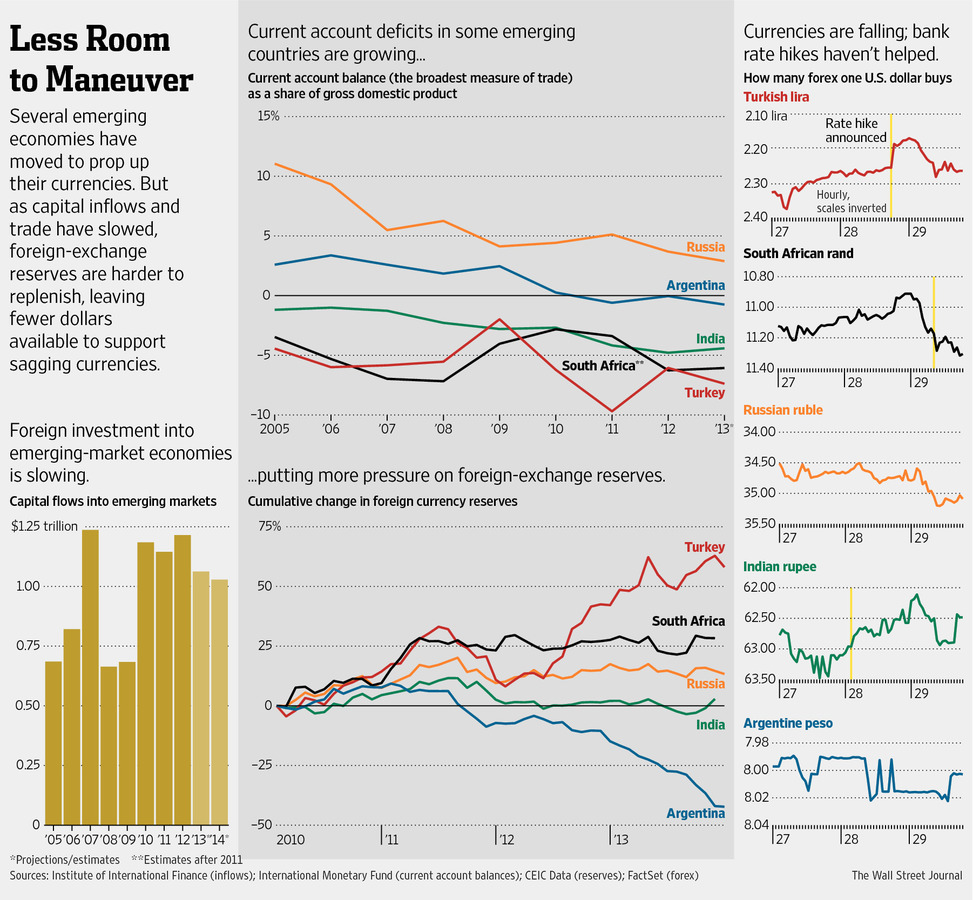
THE central bank of Turkey boasts an impressive art collection, including a canvas by Erol Akyavas entitled “Locus of Extremity”. That was pretty much where the central bank found itself at midnight on January 28th. Turkey’s currency, the lira, had fallen by 13% against the dollar in the previous six weeks, one of the worst casualties of a broader sell-off in emerging-market assets. Prices were rising (by 7.4% in the year to December) and yet the political pressure to suppress interest rates remained firm. At its unscheduled, nocturnal meeting, the central bank dramatically simplified and tightened monetary policy, raising what will henceforth be its key rate from 4.5% to 10%. Read more of this post

Despite their immense wealth, the Saudis are not happy

Despite their immense wealth, the Saudis are not happy

Feb 1st 2014 | RIYADH | From the print edition

MONEY can buy many things: luxury, influence, security—and even time. How frustrating, then, to be vastly rich but never quite to get what you want. Such is the dilemma faced by the world’s richest family, the Al Sauds of Saudi Arabia. Read more of this post

Making High-Speed Trains Work in the U.S. High-speed rail could work in the U.S., but planners need to follow some simple rules

Making High-Speed Trains Work in the U.S.

High-speed rail could work in the U.S., but planners need to follow some simple rules

TOM ZOELLNER

Jan. 31, 2014 9:40 p.m. ET

High-speed trains have always been a tough sell in the U.S. The technology is as old as Sputnik, but Congress and the states chose to keep the focus on interstate highways in the late 20th century. American critics still complain that bullet trains are too expensive, too underutilized and potentially unsafe. Read more of this post

A Height Gene? One for Smarts? Don’t Bet On It; Any given gene is likely to be unimportant, large-scale studies have found

A Height Gene? One for Smarts? Don’t Bet On It

Jan. 31, 2014 9:19 p.m. ET

As I skimmed my emails one morning—mostly Viagra ads and news of the three lotteries that I had won during the night—one stopped me in my tracks. “Is overeating in your genes? Take an online test.” I was curious—not about whether my genes prompted me to pig out, but about how the company’s test was supposed to determine that. Read more of this post

‘Frontier Markets’ Rope In Investors; Off-the-Beaten-Path Arenas Attract Fund Managers Hoping to Ride Their Years of Rapid Growth

‘Frontier Markets’ Rope In Investors

Off-the-Beaten-Path Arenas Attract Fund Managers Hoping to Ride Their Years of Rapid Growth

DAN KEELER

Updated Jan. 31, 2014 8:35 p.m. ET

Some investors are finding refuge from the recent emerging-markets turbulence in an unexpected place: even less-developed economies.

These “frontier markets” are luring money managers who are willing to delve into smaller markets with more difficult trading conditions in order to gain exposure to robust economic growth.

Because they are off the beaten path, frontier markets haven’t been swept up in the selloff that has pummeled emerging markets. Countries such as Nigeria, Pakistan and Bangladesh didn’t see much of the cash that poured into emerging markets after the financial crisis, when low-interest-rate policies in richer economies sent investors in search of better returns in the developing world.

Instead, frontier markets have seen a steady trickle of investment from fund managers hoping to ride years of rapid growth. As a result, these economies have come through relatively unscathed even as investors pull out of larger emerging markets such as Turkey and South Africa.

The MSCI Frontier Market Index is up 1.3% so far this year, compared with a 6.6% decline in the MSCI Emerging Market Index. Last year, frontier markets rose 16%, while emerging markets fell 12%.
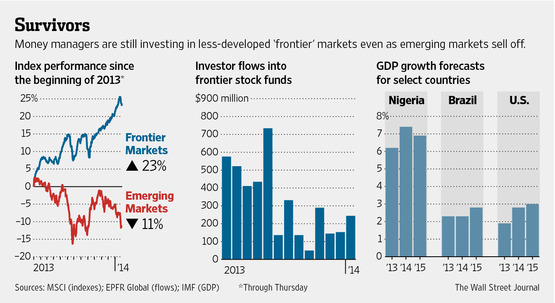
image001-31

Funds that buy frontier stocks in January drew in $244 million through Jan. 29, the most since October, according to EPFR Global. Over the same period, investors yanked $11.6 billion from emerging-market funds. Read more of this post
Escape from the Chronic Pain Trap: More than 100 million American adults live with chronic pain-most of them women. What will it take to bring them relief?

Escape from the Chronic Pain Trap

More than 100 million American adults live with chronic pain—most of them women. What will it take to bring them relief?

In a conversation with Gary Rosen, Judy Foreman, author of “A Nation in Pain,” discusses America’s chronic pain epidemic and why women suffer disproportionately.

JUDY FOREMAN

Jan. 31, 2014 9:09 p.m. ET

Several years ago, my neck suddenly went bonkers—bone spurs and a long-lurking arthritic problem probably exacerbated by too many hours spent hunching over a new laptop. On a subjective scale of zero to 10 (unfortunately, there is no simple objective test for pain), even the slightest wrong move—turning my head too fast or picking up a pen from the floor—would send my pain zooming from a zero to a gasping 10. Read more of this post

Investors Look Toward Safer Options as Ground Shifts

Investors Look Toward Safer Options as Ground Shifts

TOM LAURICELLA , KATIE MARTIN and TOMMY STUBBINGTON

Updated Jan. 29, 2014 10:37 p.m. ET

image001-30

Just one month into 2014, investors from Illinois to Istanbul are finding the tide going out fast for stocks and other riskier investments. Read more of this post

The Culture of Charade

The Culture of Charade

Posted on January 28, 2014

Robert P. Seawright

image001-29

We’ve all seen them, and they’re dreadful.

“Business television” – CNBC, Fox Business and the like – often bring on lower tier would-be experts from the hinterlands to fill time by opining on the latest news, the newest data release, or the ongoing market action in response to an anchor’s softball set-up.The interviewee typically ignores the set-up and plows ahead to pre-scripted and mundane (at best) talking points as quickly as possible. Such appearances are often arranged by PR firms, who brag about such “placements” and are paid well for doing so. These hits are worth doing for the networks because there is nothing like 24 hours per day of actual business and market news on offer. They have lots of time to fill. Read more of this post

The Absolute-Return Rip-Off

The Absolute-Return Rip-Off

By Larry Swedroe

January 30, 2014

How bad are absolute-return funds? Larry Swedroe counts the ways.

Investors would love to be able to achieve positive returns in both bull and bear markets, and that’s the “promise”—or at least the premise—of absolute-return funds. Read more of this post

Alibaba, Tencent spending big on taxi apps despite lack of profit model

Alibaba, Tencent spending big on taxi apps despite lack of profit model

Staff Reporter

2014-01-30

Alibaba Group and Tencent Holdings, China’s internet giants, are in a neck-and-neck fight in the taxi app market. On Jan. 20, Tencent’s Didi, its taxi hailing service, announced a plan to invest a further 200 million yuan (US$33 million) to benefit passengers. The very next day, Alibaba’s Kuaide swiftly announced it was investing 500 million yuan (US$82.5 million) for the good of passengers, Shanghai’s China Business News reports. Read more of this post

What an incredibly popular Lunar New Year’s gift – the Three Squirrels – tells us about China’s economy

What an incredibly popular Lunar New Year’s gift tells us about China’s economy

By Heather Timmons and Jennifer Chiu January 31, 2014

image001-28

What an incredibly popular Lunar New Year’s gift – the Three Squirrels – tells us about China’s economy

This year’s top Lunar New Year gift pack on China’s massive e-commerce website Tmall is a “Three Squirrels” brand nut assortment, which has racked up more than 150,000 sales.  A boxed set of seven packs of pecans and hazelnuts, decorated with a cartoon squirrel riding a horse, it weighs nearly 1,700 grams, or almost four pounds. Read more of this post

Why France is so afraid of Netflix

Why France is so afraid of Netflix

By Pascal-Emmanuel Gobry January 31, 2014

Pascal-Emmanuel Gobry is an entrepreneur, writer and analyst based in Paris.

Oh, France. You hate new things. You hate foreign things, particularly American things (or so you like to say). You hate business. Of course you’re going to hate Netflix.

Netflix is currently expanding around the world, and it wants to set up shop in France. The company has said it has aggressive expansion plans in Europe, and the French press has reported that executives from the company have met with President Hollande’s staff twice. To Reed Hastings I say: good luck, you’re going to need it. Read more of this post

Asia may not be able to fund its infrastructure needs without deeper credit culture: S&P

Asia may not be able to fund its infrastructure needs without deeper credit culture: S&P

The Jakarta Post, Jakarta | Business | Thu, January 30 2014, 4:06 PM

Asian governments in high-growth countries may face difficulties in maintaining growth and funding for all their infrastructure needs, Standard & Poor’s Ratings Services (S&P) said in its recently published report titled “Why Global Investors Aren’t Making Inroads Into Infrastructure Funding In Asia.” Read more of this post

Any Benjamin Franklins in Asia (Part 2)? Reflections from the Story of Linkabit-Qualcomm and the Inverted U-Curve of Singapore/Asia

Dear Friends and All,

Any Benjamin Franklins in Asia (Part 2)? Reflections from the Story of Linkabit-Qualcomm and the Inverted U-Curve of Singapore/Asia

Without Dr Irwin Jacobs, Sam Walton most probably cannot scale up Wal-Mart with the VSAT technology enabling Captain Sam to solve the inventory management problem that comes from scaling up at the VSAT-network of distribution centers and to video-call his managers to give pep talks for Saturday meetings; and San Diego will not be able to transform from a sleepy West Coast town to a successful innovation hub. That was one of the many insights that the Bamboo Innovator had gotten after hearing the presentation on Driving Growth Through Science and Innovation on 23 January at the Singapore Management University (SMU) by the billionaire inventor-entrepreneur of the CDMA technology that makes over 3 billion cell phones possible. Jacobs, Andrew Viterbi and five others have founded Qualcomm (Nasdaq: QCOM) (to deliver “QUALity COMMunications”), a super-compounder up over 130-fold to a market value of $125 billion or over 40% of the GDP of the country Singapore, and the fact of its scale and continued business model scalability has eluded most in the audience. Not surprisingly, Jacobs was told then that his big idea of CDMA digital wireless technology that creates a unique code for each call and so allows greater sharing of the airwaves simply violated the laws of physics. Thankfully he and his like-minded partners preserved. Qualcomm, through a combination of technological superiority, cunning business acumen to build an innovative business model that collects 3% of the price of virtually every handset sold in the world as royalty, and sheer tenacity, has become the undisputed standard by which telecom companies now measure themselves. Qualcomm’s rise mirrors that of the cell phone: Both are ubiquitous, both continue to evolve rapidly, and both turned the status quo on its head. Read more of this post

Nintendo desperate for a power-up Analysts and gamers worry company won’t recover mojo

Nintendo desperate for a power-up

Analysts and gamers worry company won’t recover mojo

BY KYOKO HASEGAWA

AFP-JIJI

JAN 31, 2014

There was a time when wherever Super Mario Brothers went, the gaming world followed, but an industry that has moved on in leaps and bounds since then just shrugged at the latest reset by Nintendo this week. Read more of this post

China’s internet vigilantes and the ‘human flesh search engine’; a Chinese official in charge of internet surveillance gave notice that mobs of web users who turn on individuals and make their lives a misery will not be tolerated

28 January 2014 Last updated at 20:07

China’s internet vigilantes and the ‘human flesh search engine’

By Celia HattonBBC News, Beijing

Last month a Chinese official in charge of internet surveillance gave notice that mobs of web users who turn on individuals and make their lives a misery will not be tolerated. In China it happens often and on a massive scale, earning the phenomenon the title of the “human flesh search engine”. Read more of this post

Have EM outflows only just begun?

Have EM outflows only just begun?

Izabella Kaminska

| Jan 31 10:01 | 9 comments Share

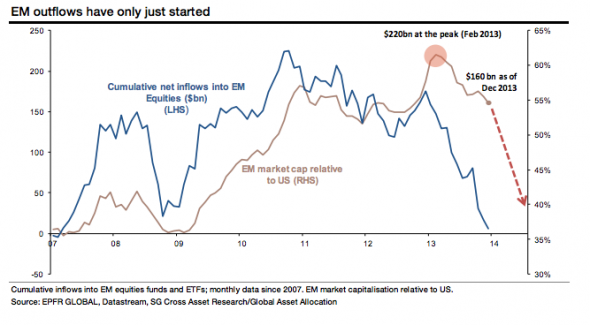
SocGen’s cross-asset research team believes that when it comes to EM outflows they may have only just begun:

image001-3

As the team notes on Friday, this is especially so given the Fed doesn’t appear to care about the EM sell-off: Read more of this post

Incidental Vs. Integral: Understanding your Emotions

Incidental Vs. Integral: Understanding your Emotions

by Karen Christensen | Jan 31, 2014

Stéphane Côté, a professor of Organizational Behaviour and HR Management talk about understanding emotions

Your recent research looks at emotionally-intelligent decision making. How do you define ‘emotional intelligence’?
Some of the most critical skills of emotional intelligence (‘EI’) include empathy, which is the ability to understand how other people feel; emotion understanding, which entails identifying the reasons for your own and other people’s emotions; and regulating your emotions, which involves coping with stress, modifying undesirable emotions and generating desired emotions. Getting rid of anger, for instance, and generating enthusiasm.   Read more of this post

Eight Essential Questions for Every Corporate Innovator

Eight Essential Questions for Every Corporate Innovator

by Scott Anthony  |   1:00 PM January 31, 2014

One of the first, and most lasting, pieces of career advice I received came from Linda Bush, my first project manager when I was a wee pup working at McKinsey & Company. “Ask a lot of questions,” Linda advised me. “You might think you are being annoying, but it’s the only way you learn. And trust me, people will tell you when you have crossed the line.” Read more of this post

Myer merger offer more about fear of future than great opportunity; The $3bn plan rejected by David Jones says much about the state of the department stores, though all may not yet be lost

Myer merger offer more about fear of future than great opportunity

The $3bn plan rejected by David Jones says much about the state of the department stores, though all may not yet be lost

Martin Farrer

theguardian.com, Friday 31 January 2014 08.08 GMT

One Citigroup analyst said Myer’s plan is basically a defensive move and doesn’t offer shareholders a big enough upside. Photograph: William West/AFP/Getty Images

If there was ever a sign that the glory days of Myer and David Jones were over, then it came with Thursday night’s merger story. Read more of this post

Strategic Humor: Cartoons from the March 2014 Issue

Strategic Humor: Cartoons from the March 2014 Issue

by Josh Olejarz  |   12:30 PM January 31, 2014

Enjoy these cartoons from the March issue of HBR, and test your management wit in the HBR Cartoon Caption Contest at the bottom of this post. If we choose your caption as the winner, you will be featured in the next magazine issue and win a free Harvard Business Review Press book. Read more of this post

All Quiet on the Amazon Front: Amazon is one of the most highly valued, most innovative and just plain most interesting companies in the country. It is also one that places a premium on saying nothing

JANUARY 31, 2014, 7:15 AM  11 Comments

All Quiet on the Amazon Front

By DAVID STREITFELD

Amazon is one of the most exciting companies in the country, redefining retail, web hosting, publishing and a bunch of other enterprises. When it says it is merely thinking of doing something — as it did Thursday with the first-ever price increase for Amazon Prime shipping service — it makes news. It also makes news when it talks about something that it is planning to do, maybe, a bunch of years from now, in the unlikely event everything works out. Yes, we’re talking drones. Read more of this post

We Are Giving Ourselves Cancer; Overused CT scans are exposing patients to dangerous levels of radiation

We Are Giving Ourselves Cancer

By RITA F. REDBERG and REBECCA SMITH-BINDMANJAN. 30, 2014

DESPITE great strides in prevention and treatment,cancer rates remain stubbornly high and may soon surpass heart disease as the leading cause of death in the United States. Increasingly, we and many other experts believe that an important culprit may be our own medical practices: We are silently irradiating ourselves to death. Read more of this post