Here’s The Weather Prediction That Won World War II
June 5, 2014 Leave a comment
Here’s The Weather Prediction That Won World War II
GUS LUBIN MILITARY & DEFENSE JUN. 2, 2014, 8:21 AM
German military leaders expected an Allied invasion on the Channel coast in late May, 1944, when there was high tide, a full moon, good visibility, and little wind. When it did not come, and when the weather turned dramatically in June with a depression bringing storms, they felt they could relax.
“There were all the less doubts that an invasion might happen in the meantime as the tides are very unfavorable in the following days and no air reconnaissance of any kind had given any hints of an imminent landing,” Field Marshall Erwin Rommel wrote on June 4, 1944, before leaving France for Germany to celebrate his wife’s birthday.
But while German weather forecasters saw no possibility for invasion, Allied forecasters were frantically looking for an opening. They found one on June 6 — and on the 7oth anniversary of the pivotal invasion, we’re looking at how they did it.
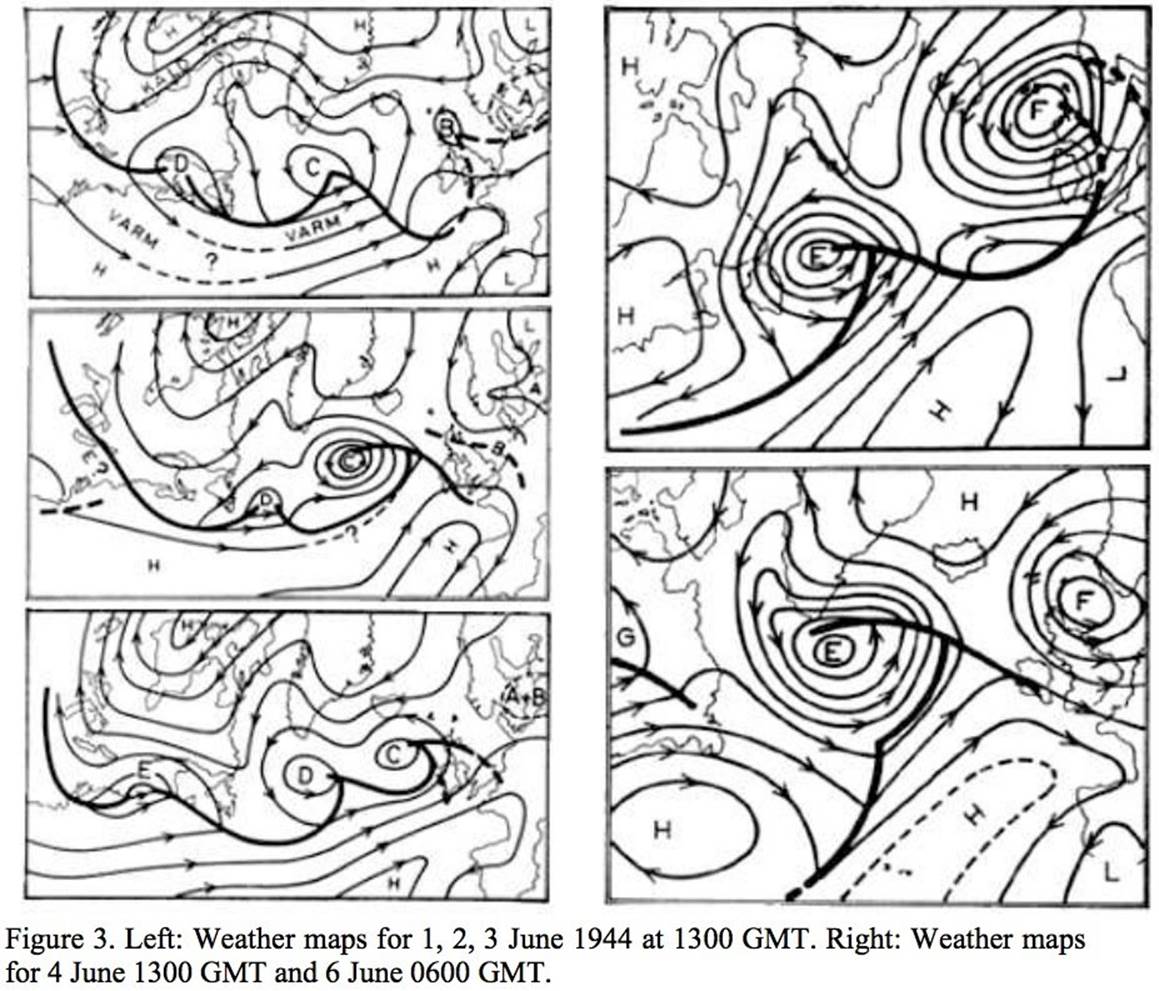
From “Proceedings of the International Commission on History of Meteorology 1.1 (2004)”
How the Allied forecasters found the opening for the invasion is a subject of controversy, and they almost screwed it up. For an authoritative account, we’ve sourced a 2004 article from James R. Fleming, professor of Science, Technology, and Society at Colby College.
Looking at the weather maps shown above on June 3, two meteorologists at U.S. base Widewing in England, Irving Krick and Ben Holzman, said the planned invasion on June 5 was possible. However, teams of meteorologists at the British Admirality and the British Meteorological office, including most notably the Norwegian Sverre Petterssen, said an attempted landing would be unsafe. Chief meteorologist James Fleming persuaded General Dwight D. Eisenhower at the last moment to cancel the June 5 invasion. It’s a good thing that he listened — stormy weather would likely have made the landing a disaster.
“With some justification I could have been criticized for not being sufficiently ‘gloomy,’ for the weather and winds during the night of June 4th-5th turned out to be even more severe than Douglas and I had predicted,” Petterssen wrote later.
But on June 4, the three teams spotted an opening for June 6 (at least according to Petterssen; according to Krick, Petterssen’s team still refused to clear an invasion).
“A sudden and major reorganization of the atmosphere over the Atlantic sector” on June 4 “threw the forecasters into confusion” but by the end of the day the three teams “reached a state of harmony that had hardly ever been attained since February when conference discussions began,” Petterssen wrote (as contextualized by Fleming).
Storm ‘F’ was leaving and storm ‘E’ appeared to have stalled, opening a window for the invasion.
Around midnight on the evening of June 5, the Allies began extensive aerial and naval bombardment as well as an airborne assault. The intricately coordinated attack continued in the early morning, as minesweepers cleared the channel for an invasion fleet comprising nearly 7,000 vessels. Allied infantry and armored divisions began landing on the coast of France at 06:30. By the end of that day, they had gained a foothold in German-occupied Western Europe that proved critical to winning the war.
 About bambooinnovator
 Bamboo Innovator