Australia’s Beach Burrito is surfing the Mexican trend without franchisees
June 9, 2014 Leave a comment
Caitlin Fitzsimmons Online editor
Beach Burrito is surfing the Mexican trend without franchisees
Published 03 June 2014 00:05, Updated 03 June 2014 14:18
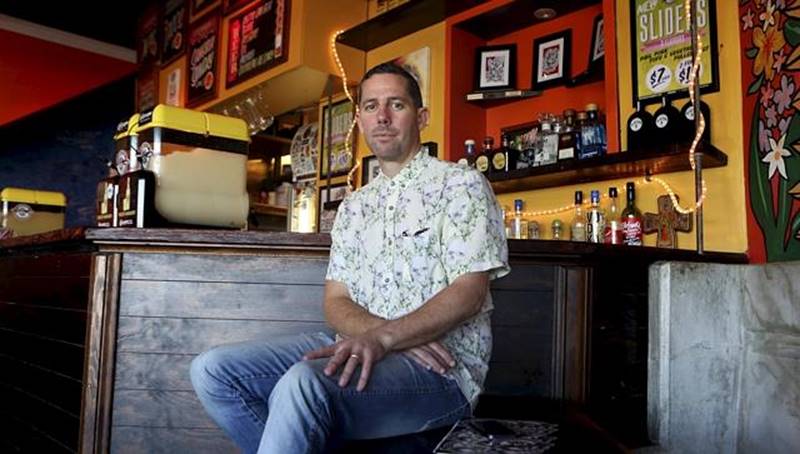
Blake Reed founder of Beach Burrito at his Bondi Beach store, Sydney. Photo: Sasha Woolley
When Blake Read founded Beach Burrito in 2006, he didn’t know he would be riding a wave of Mexican casual dining set to hit Australia.
Read returned to Australia after years working in restaurants in California. He spent summers surfing in Mexico and Costa Rica and winters snowboarding in Colorado and he fell in love with authentic Mexican food – quite different to the stodgy sour cream-laden fare available in Australia at the time.
His first store opened at Bondi Beach and the interior design was inspired by surf and skate culture – a community that Read loved and wanted to serve. Eight years on, the Mexican category is getting crowded. It is growing rapidly through the franchise model with chains such as Salsas Fresh Mex Grill, Guzman y Gomez, Mad Mex and Zambrero. Both Mad Mex and Beach Burrito made the BRW Fast 100 list of the fastest-growing companies in 2013.
Beach Burrito has nine restaurants, with three under construction, and is set to hit $10 million in revenue by the end of the financial year. Unlike the competitors, all stores are company-owned and Read says running a franchise business does not appeal to him. “I see it as more than a restaurant and if I handed that over to a franchisee, I would lose control of my brand,” Read says. “We have a very good operations team in the head office and we each take on three or four restaurants because we come from a similar background in the action sports and we all understand what the brand is. I don’t want to be seen in the community as a franchise.”
Read says the chain shares corporate systems, a common menu, kitchen and bar. However, it is “not a cookie cutter restaurant” and each has a different look and feel – for example, the Bondi store concentrates more on beach and skate culture, the store in Jindabyne is snow-themed, while others include more live music and art. This comes through both the decoration and the sponsorship of young skaters, snowboarders, surfers and artists.
RAPIDLY EXPANDING
The lack of a franchise model is not putting a brake on growth, argues Read. “We’re opening a store every three months and I don’t think I could do it any faster than that,” he says. Beach Burrito has been able to fund its rapid expansion because of a $5-million investment from Blue Sky Private Equity.
Blue Sky came in when there were five stores in the network and Read says the funding will get Beach Burrito up to about 15 stores, with expansion beyond that point funded by cash flow. Read was inspired by the success of US Mexican restaurant chain Chipotle, which runs more than 1500 company-owned stores. However, Read is likely to sell before the chain reaches this size.
“I don’t think there’s a limit but there’s a point in my future that I see myself being bought and the person who buys me would more than likely bring franchise experience to the table,” Read says. “I’d like to get to 20 stores and $20-million revenue and at that point evaluate where the company’s at and where it’s going. We’re not that far away – probably a year and half or two years max.”
To maintain the motivation of restaurant managers, Beach Burrito pays them well and pays regular incentives. Over the years, Read has figured out that managers don’t want a quarterly payment, they want to see an extra $200 in their pay packet each week, so he has tailored the perks accordingly.
PERSPECTIVES ON FRANCHISING
Retail Zoo, which is majority-owned by Bain Capital and part-owned by the Allis family, has more than 50 Salsas restaurants around Australia. Founder Janine Allis says the Mexican category is very competitive right now. Retail Zoo, which also owns Boost Juice, Cibo Espress and Hatch, is a big franchise business but maintains some corporate stores for all brands except Cibo.
“We’ll always have a company-owned strategy and a franchise strategy because that’s where you can test out the brand and have a lot more flexibility,” Allis says. “You’re making decisions for a franchise network but you’re also directly affected by that with your corporate stores and I think it’s healthy to do that. For this market, I think franchising is very strong particularly for that Australian entrepreneur thing in us.”
SumoSalad co-founder Luke Baylis also advocates a mix. The chain is at 106 stores globally, with plans to expand to 400-plus stores thanks to backing from the Maloney family. Baylis says he retains 10-15 per cent of the network as corporate stores “as a training and testing ground” and he believes you “need both”.
 About bambooinnovator
 Bamboo Innovator