Pension reforms gather pace as demands grow
June 13, 2014 Leave a comment
Pension reforms gather pace as demands grow
Tuesday, June 10, 2014 – 22:59
Jamie Lee
The Business Times
SINGAPORE – The search for retirement adequacy is a global one – the raging debate over Singapore’s Central Provident Fund (CPF) system comes amid recent reviews of pension systems by countries around the world that underscore themes of risk and return, personal responsibility, and macroeconomic prudence.
In Asia, Europe and the US, pension systems have been put in focus.
Japan this week completed a review of its public pension fund – the world’s largest – and is expected to boost returns by raising the risk taken by its nearly 130 trillion yen (S$1.59 trillion) pension fund.
Its targeted return will be lifted to 1.7 percentage points over long-term nominal wage increases, from 1.6 percentage points, media reports say.
The boost will be established through a shift in asset allocation, with more money put into stocks rather than bonds.
The pension fund could raise its allocation to domestic stocks to 20 per cent, up from 12 per cent. Japan’s Government Pension Investment Fund currently allocates the bulk of the investments, or 60 per cent, to Japanese government bonds.
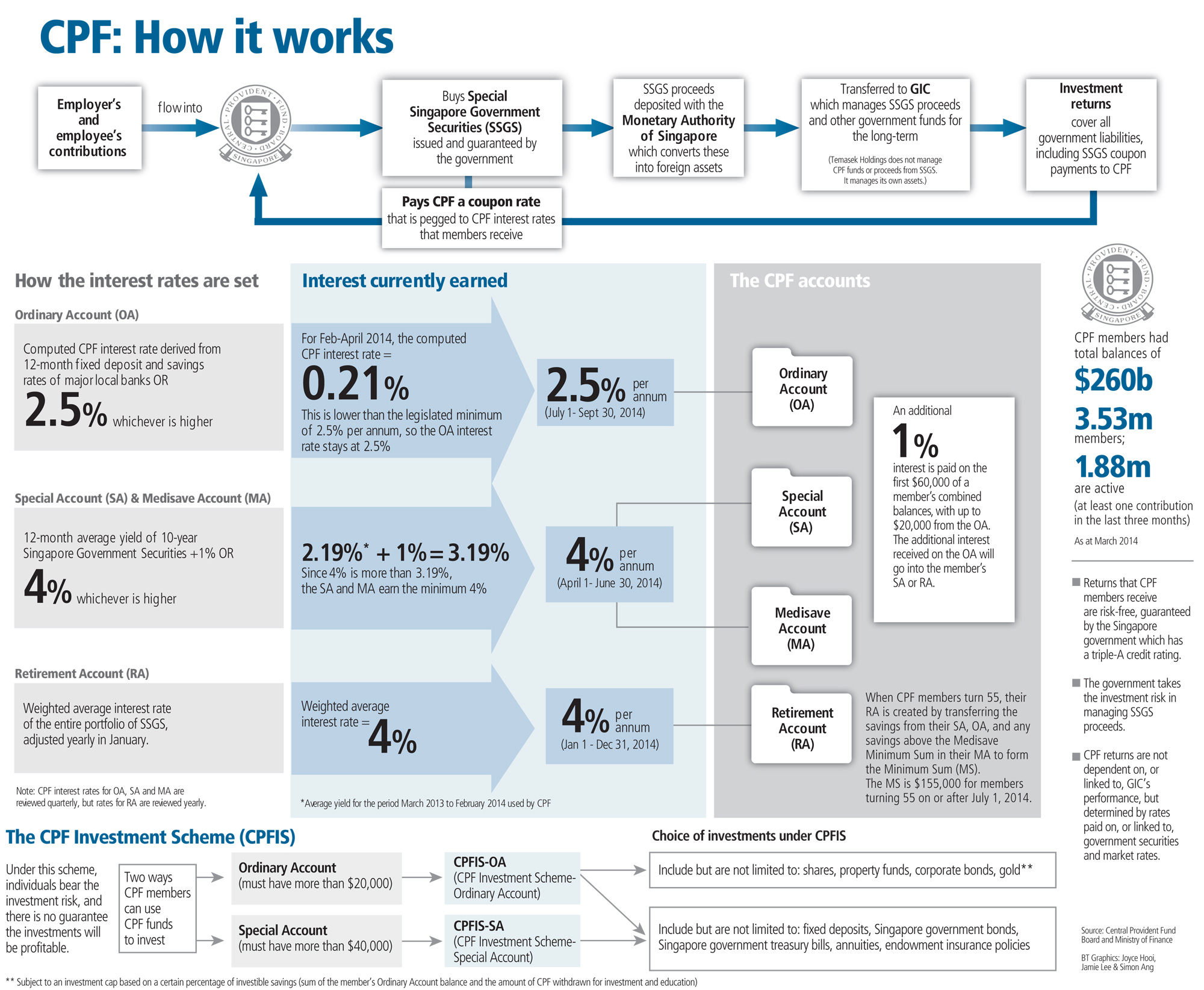
Singapore does not have a pension fund. Money in the savings accounts under CPF earn an interest rate that takes reference from Singapore government bonds and market rates, though there are legislated minimum rates to be earned by CPF account holders. This is critical in the current low interest-rate environment.
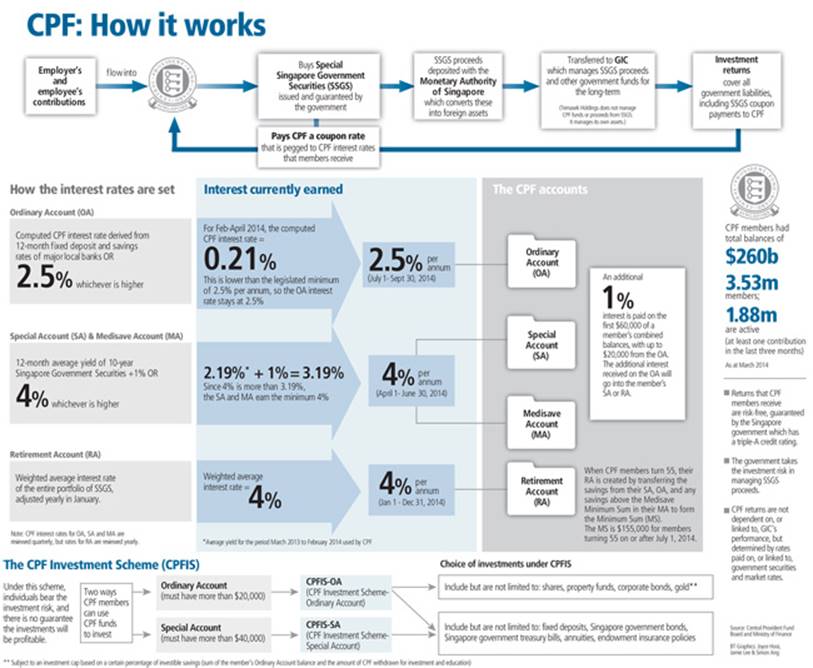
(Click here to see graphic in full size.)
The urgency for change in Japan comes as the country, with the world’s oldest population, found itself doling out more benefit payments than it receives in contributions to fund the eventual payouts.
Each Japanese household is entitled to pension payouts equivalent to over 50 per cent of the average income of the working generation, for all of the retirement years, with a couple making up a Japanese household expected to live through one century.
In Singapore, the net income replacement rate – a metric by the Organisation for Economic Co-operation and Development (OECD) that measures the rate at which a person’s CPF payouts can replace his pre-retirement income, after accounting for income taxes and other contributions to social security, where relevant – is about 40 per cent of the median income of a man here, a 2013 OECD pension report showed.
Pre-retirement income includes an individual’s average wage earning, and rent from housing, OECD said.
As a close-to-home reference, Malaysia’s Employees Provident Fund (EPF) had drastically cut its allocation to Malaysia’s sovereign bonds to about 25 per cent as at 2011, down from about 85 per cent in 1985, a report from Bank of America-Merrill Lynch showed.
In 2011, about 35 per cent of EPF was held in equities. This is up from 3 per cent in 1985.
The UK has also proposed reforms in recent months that effectively hand retirees much greater autonomy over their pension funds. Pensioners who come under the new scheme – which comes into force next year – will no longer be forced to buy an annuity.
This contrasts with Singapore’s move into annuities. Since last year, most Singaporeans have been put on an annuity programme, under which a stipulated minimum sum from the CPF retirement account is invested in return for a monthly payout for the retirement years.
There are now calls to ensure that payouts from Singapore’s annuity scheme – known as CPF Life – accounts for inflation.
With the UK scrapping its annuity scheme, most pensioners there should then be able to draw out all of their pension at a go.
The lump sum that can be drawn out at age 55 has been raised to £30,000 (S$63,000) from £18,000, and the size of the average pension in the UK is around the limit, according to media reports.
Over in Denmark, which topped the Melbourne Mercer Global Pension Index last year, the government had also reviewed its retirement package in a period of European austerity.
These included raising the age of early retirement to 62 from 60 – effectively shortening the gap with the official retirement age of 65 to three years.
In the US, there are calls to reform the Social Security scheme – funded by US payroll taxes – which is expected to exhaust its reserves by 2033 because spending has outpaced funding. There are suggestions from think tanks to cut the quantum of future benefit increases, especially for those who are not poor.
 About bambooinnovator
 Bamboo Innovator