UberBay: Dissecting Uber’s valuation case
June 13, 2014 Leave a comment
Dan McCrum Author alerts | Jun 10 10:29 | 11 comments | Share
An online service that matches buyers and sellers you say? Worth $18bn? Well, there are a lot of taxis in the world.
We have seen this one before though, so $18bn is entirely possible, if not necessarily sensible.
Consider this chart of the original dot com network effect superstar, eBay.
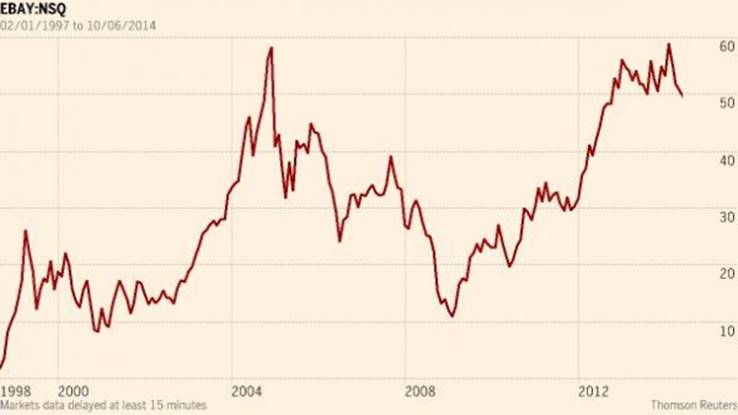

For context eBay has a $62bn market capitalisation after doubling revenues in the last five years to about $18bn. It trades on around 17 times the average forecast for earnings this year.
Back in 1998, when it took in just $30m in revenues eBay powered up to a market cap of $40bn. In the early stages of the second bout of dot com enthusiasm in 2004, at a time when eBay was doubling revenues just about every two years (see the next chart) the valuation peaked up around $80bn. So could Uber be worth $18bn plus? It is growing faster than eBay did, one of its investors said last year. Which you would expect, given that the number of smart phones sold every day in the world is a multiple of the number of PCs sold in the late 1990s.
That ecosystem of users, app stores and cheap technology might also mean that an Uber competitor could grow quickly also, but hey, first mover status counts when you are attracting consumers. So purely on the basis that at various times in the past rational people paid irrational valuations for eBay, Uber stock could easily change hands for $18bn. This is nuts passim, etc.
As an eBay-like end point, though? Lets get a napkin to write on and optimistically say Uber could ultimately earn $2 from every taxi fare, robot car ride or parcel delivery. If we thought 40 times earnings was plausible, it would need to earn $450m, post-tax. Say a 30 per cent tax rate, and no debt, means operating profits of $642m. For very optimistic simplicity, lets say Uber ultimately makes a 50 per cent operating margin, so it needs $1.3bn of revenues (ten times what it was reported to have taken last year).
That works out to a ball park of 650m Uber trips a year. Say each customer uses Uber once a month, the company only needs about 60m regular users. Which doesn’t sound much in the smartphone app stakes, but is a lot judged by Urban taxi using people: it’s equivalent to the entire populations of San Francisco, Los Angeles, New York, Chicago, London, Washington DC, Paris, Toronto, Tokyo and Hong Kong combined.
Assume the valuation is 20 times earnings, or the operating margin is a more Google like 25 per cent, or the average user takes 6 Uber trips a year instead of 12, or Uber will make a dollar from each one, and the number of users needed doubles each time.
Or just assume that Uber might be a part of the robot car future. The numbers will take care of themselves.
 About bambooinnovator
 Bamboo Innovator