Scrambling to Win China’s Auto Prize
June 17, 2014 Leave a comment
Scrambling to Win China’s Auto Prize
ABHEEK BHATTACHARYA
June 11, 2014 4:11 a.m. ET
When China’s car market was speeding up, it dragged everyone along for the ride. Now car makers have to fight among themselves to get ahead.
China sold 11% more passenger cars in the first five months of 2014 than the year before, a comedown from the nearly 15% growth over the same period in 2013. Some of the deceleration is because last year was in comparison to a weak year in 2012. It’s also possible that China’s broader economic problems are weighing down on consumption.
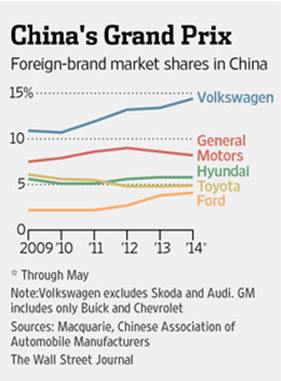
The clearest losers are domestic car makers. They sold 38% of all locally made cars this year through May, down from nearly 42% in the same period last year, according to the industry association. Hong Kong-listed Geely has sold 32% fewer cars these five months, as consumers shun its poor technology and marketing.
Not all foreign car makers gain at the locals’ expense, though. After nationalist protests in late 2012 saw marauding crowds literally beat up Japanese cars, Toyota, Honda and Nissan clawed back some market share partly by launching new models, says Macquarie’s Janet Lewis. But Toyota’s market share at 4.9% so far this year is still below the 2011 level of 5.5%, according to data compiled by Ms. Lewis. These brands have ample animosity to overcome. In a Sanford C. Bernstein-led survey of 40,000 Chinese consumers this year, half said they would never consider a Japanese car, mostly out of nationalism.
Other foreign laggards are General MotorsGM -0.77% ‘ main passenger-car brands. The 8.2% market share its Buick and Chevrolet brands command this year has slumped from 8.6% last year. GM’s latest SUVs haven’t sold as well as hoped. In contrast, Ford, a relative newcomer to China, has made inroads with SUVs and sedans. Ford sold 4.1% of the cars made in the country between January and May, compared to 3.8% last year and just 2.2% in 2011.
Volkswagen remains on top of the totem pole. One of the earliest entrants in the market, VW has consolidated its grip with a 14.4% market share so far this year, from 13.4% last year, by offering everything from low-end sedans to sporty SUVs—and that’s not including its Skoda or Audi units. VW brand and pricing are so compelling that dealers barely offer discounts and still sell to a higher proportion of visitors than other brands, according to Ms. Lewis.
Should China’s car market slow further, how each brand positions itself will matter more. China’s first generation of car buyers are moving on to second cars. Brand loyalty is developing. The recipe for success won’t be just about showing up.
 About bambooinnovator
 Bamboo Innovator