Why Chinese Booze Costs More Than Fine Wine at Auction

Jun 3, 2014

Why Chinese Booze Costs More Than Fine Wine at Auction

With its strong flavor and fiery aftertaste, Kweichow Moutai isn’t for everyone. With prices for vintage bottles of the liquor spiraling upwards, it’s now for even fewer people.

On Sunday, at an auction hosted by Chinese auction house Beijing Googut Auction Co., 540 milliliter bottles of Moutai produced in the 1980s sold for between 60,000 yuan ($9,700) and 70,000 yuan ($11,300). That was up from between 50,000 and 60,000 yuan last year, and around 30,000 yuan at the end of 2012. Read more of this post

China’s economic boom leaves a trail of ghost cities

China’s economic boom leaves a trail of ghost cities

by Rob Schmitz

Monday, June 2, 2014 – 16:09

Nearly a year ago, I visited a replica of New York City under construction outside the Northern Chinese city of Tianjin. Workers were constructing dozens of skyscrapers on a piece of swampland inside a bend in the river, giving it an uncanny resemblance to the island of Manhattan. There were plans for a Lincoln Center, a Rockefeller center, and much more. Read more of this post

Chinese port stops metal shipments due to probe – trade sources

Chinese port stops metal shipments due to probe – trade sources

Mon, Jun 2 2014

By Melanie Burton

SYDNEY, June 2 (Reuters) – China’s northeastern port of Qingdao has halted shipments of aluminium and copper due to an investigation by authorities, causing concern among bankers and trade houses financing the metals, trading and warehousing sources said on Monday. Read more of this post

The Lives and Times of the CEO: From 100 years back to a quarter century ahead, the evolution of the chief executive officer

May 30, 2014 / Summer 2014 / Issue 75

Strategy & Leadership

The Lives and Times of the CEO

From 100 years back to a quarter century ahead, the evolution of the chief executive officer.

by Ken FavaroPer-Ola Karlsson and Gary L. Neilson

Imagine a chilly mid-November afternoon in 1914, shortly following the outbreak of World War I. The place: a sumptuous fifth-floor salon in the new Beaux Arts Renaissance Hotel in Chicago. The salon’s electric lamps have just been turned on. The room is decorated with red velvet couches, a long mahogany table, and deep Persian carpets. A fire crackles in the marble fireplace. Read more of this post

100-year-old beggar celebrated as living saint in Bulgaria

100-year-old beggar celebrated as living saint in Bulgaria

Monday, June 2, 2014 – 14:52

image001-5

AFP

SOFIA – A 100-year-old beggar in a threadbare coat, “Grandpa” Dobri, is already celebrated as a saint in Bulgaria – a symbol of goodness in a country ravaged by poverty and corruption.

For over 20 years, Dobri Dobrev has been begging on the streets of Sofia, collecting alms worth tens of thousands of euros. And he has given it all to the Bulgarian Orthodox Church. Read more of this post

Election fever hits Indonesia as candidates polarize netizens

Election fever hits Indonesia as candidates polarize netizens

Tuesday, June 3, 2014 – 10:08

The Jakarta Post/Asia News Network

INDONESIA – For those Indonesians uninterested in politics, logging in to Facebook or Twitter is a frustrating experience these days.

“I’ve limited my newsfeed to close friends,” Ira Hairida, a blogger from Palembang, South Sumatra, wrote on her Facebook wall. She said she was tired of people posting political statuses and verbally attacking the presidential contenders. Read more of this post

Gratitude begins at home; Why go to say, Cambodia, to assuage middle-class guilt? Students parachuting in will not have the time nor capacity to comprehend complex issues there

Gratitude begins at home

Monday, June 2, 2014 – 08:04

Melvin Singh

The New Paper

SINGAPORE – Why go to say, Cambodia, to assuage middle-class guilt? Students parachuting in will not have the time nor capacity to comprehend complex issues there. Surely ‘poor’ is not measured by the lack of air conditioning. Read more of this post

SEC not to recommend action against IBM on cloud revenue

SEC not to recommend action against IBM on cloud revenue

Mon, Jun 2 2014

(Reuters) – The U.S. Securities and Exchange Commission has completed its probe on how International Business Machines Corp reports revenue from its cloud computing business and does not intend to recommend any enforcement action, the company said.

The company did not provide details or reasons for the investigation.

The company said last July that it was facing an investigation from the Division of Enforcement of the SEC as to how it reported its cloud computing business revenue.

IBM reported $4.4 billion in revenue from its cloud computing business in 2013.

IBM shares closed at $185.69 on the New York Stock Exchange on Monday.

The fear factor: Why Asian firms need to take on the world

The fear factor: Why Asian firms need to take on the world

May 31st 2014 | From the print edition

image001-4 image002-4


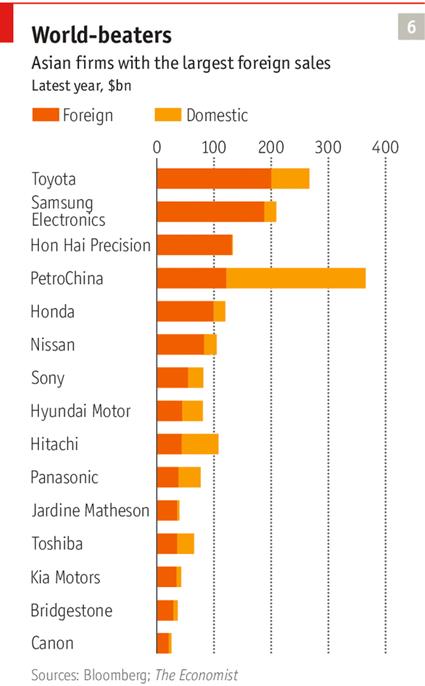
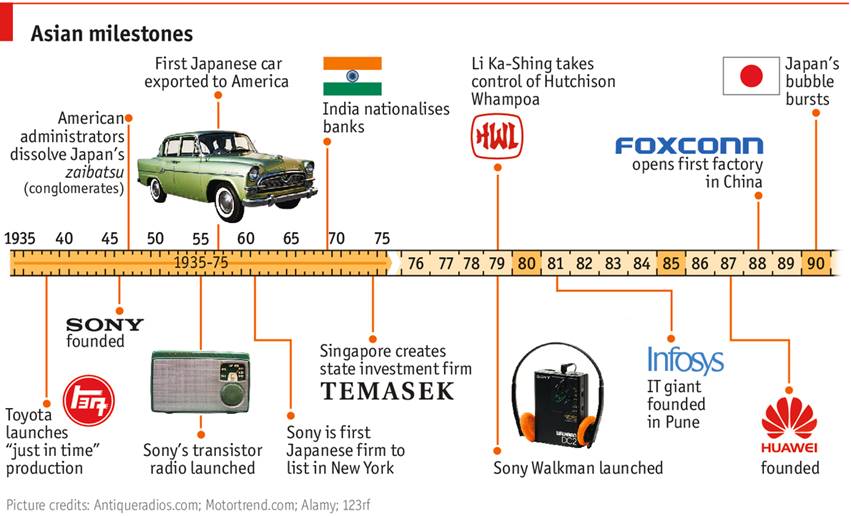
FUJIO MITARAI KNOWS more than most people about building a multinational. He is the 78-year-old boss of Canon, one of Japan’s biggest firms. Worth $43 billion, it makes everything from scanners to lenses for Hollywood. It first opened a New York office back in 1955, but breaking into America took 20 years of hard slog and an Apple-style innovation. In 1976 the company launched a cheap, automatic single-lens-reflex camera on the back of a massive advertising campaign. Mr Mitarai was in charge and the memory still makes him smile. “Our competitors thought I’d gone crazy.” Canon became America’s biggest camera firm. Today it faces competition from smartphones and low-cost rivals. Mr Mitarai insists innovation will keep the firm ahead of the pack. It is developing a raft of new products, from surveillance cameras to virtual-reality design studios and 3D printing materials. Read more of this post

Hutchison Whampoa: Now for the fat-cow years; Lessons in survival from an Asian corporate legend

Hutchison Whampoa: Now for the fat-cow years; Lessons in survival from an Asian corporate legend

May 31st 2014 | From the print edition

IF YOU WANT to hear some plain talk on the relative merits of family-controlled conglomerates, listen to Canning Fok, managing director of Hutchison Whampoa, one of the region’s biggest specimens with a value of $60 billion and a worldwide empire of ports, energy, property, telecoms and retail. “There’s a school of thought in America that widely held companies have better governance,” he says. “But if you look over the last ten years that has not happened. Just look at the big banks and all the chief executives going crazy.” Read more of this post

Get up and dance: China Mobile, a state-owned giant, is having to reinvent itself

Get up and dance: China Mobile, a state-owned giant, is having to reinvent itself

May 31st 2014 | From the print edition

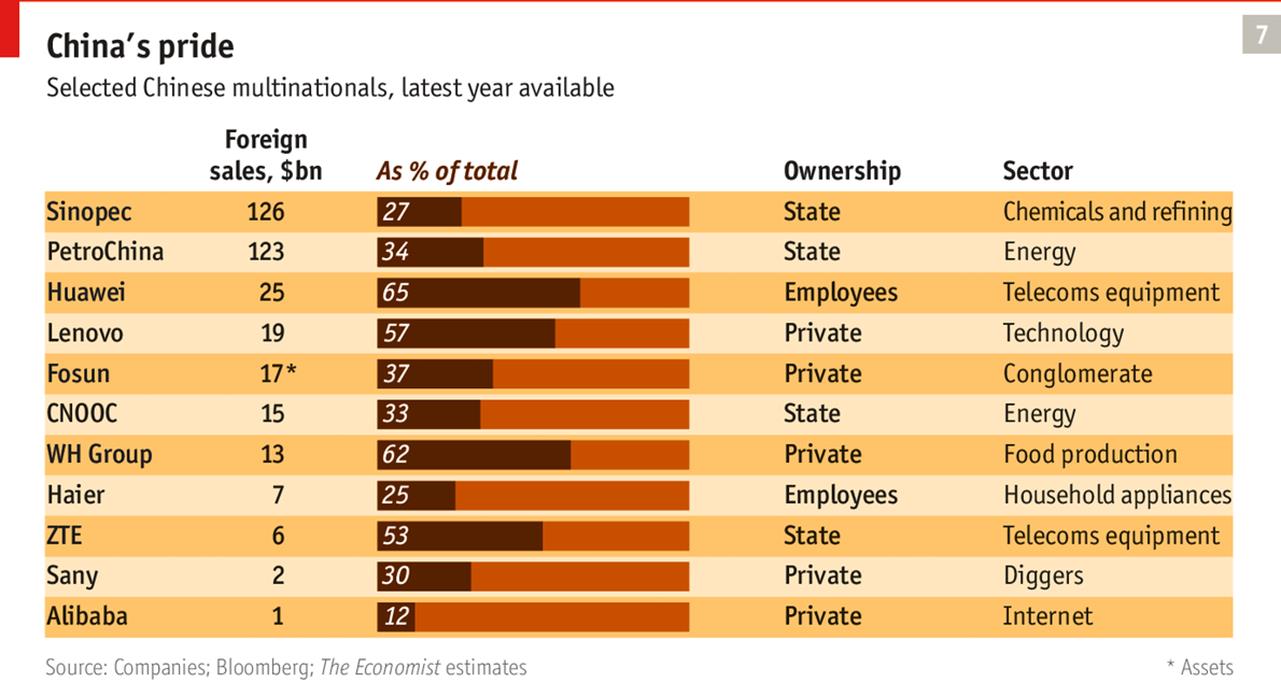
THROUGH THE SMOG in Beijing’s Financial Street you can see the glass-and-steel headquarters of many of China’s giant state-owned-enterprises (SOEs). The flash buildings are a statement of might, but inside them the mood is more of anxious self-reinvention. Most SOEs are in fast-changing industries, and since last year China’s government has made clear that it wants them to become more market-orientated and more competitive. As a result, some of these organisations now face the largest transformation in corporate history. Read more of this post

Governance: Avoiding the dinosaur trap; State firms and family conglomerates are Asia’s favourite kinds of companies. Both must change

Governance: Avoiding the dinosaur trap; State firms and family conglomerates are Asia’s favourite kinds of companies. Both must change

May 31st 2014 | From the print edition

ASIA IS A land never conquered by institutional shareholders. Only 28% of the region’s stockmarket consists of firms with diverse owners (see chart 4). Most of these are in Japan, where businesses are controlled by managers and employees who by long-established protocol politely listen to and then ignore what fund managers say. State-run firms make up 40% of Asia’s total and family-run firms, often conglomerates or “business houses”, account for 27%. The proportions vary from country to country (see chart 5). In China state-run firms dominate, whereas in South Korea and India business houses are prominent. All this has been true for a long time and it is tempting to think it will never change. That would be a mistake.

image001-2 image002-2 Read more of this post

How to keep roaring: Over the past two decades Asia’s companies have enjoyed huge success. But now they need to reform to become brainier, nimbler and more global

How to keep roaring: Over the past two decades Asia’s companies have enjoyed huge success. But now they need to reform to become brainier, nimbler and more global, says Patrick Foulis

May 31st 2014 | From the print edition

image001 Read more of this post

Convergence: Asian and Western business will become more alike

Convergence: Asian and Western business will become more alike

May 31st 2014 | From the print edition

ASIA PROSPERED OVER the past two decades by following a different economic model from the West’s. But if it wants to continue to do well over the next 20 years, it will have to reform. What that involves will vary from place to place. Myanmar, a big country with a difficult past, is beginning to pull itself out of the mire. India and Indonesia, two chaotic democracies, have to create enough order to attract factories and industrial jobs. In China the government needs to ease its grip on the economy. Japan is embarking on the world’s biggest experiment to see whether a society can shrink and still remain prosperous. Read more of this post

Megatrends Q & Asia: A handful of Asian conundrums the world’s boardrooms should chew over

Megatrends Q & Asia: A handful of Asian conundrums the world’s boardrooms should chew over

May 31st 2014 | From the print edition

OVER THE PAST decade innumerable PowerPoint presentations have condensed Asia into two bullet points. One is its rise as a vast consumer market. About 30% of the world’s middle-class spending is done by Asians, up from 20% in 2000, according to the Brookings Institution, a think-tank, which defines the middle class as those earning $10-100 a day at purchasing-power parity. The other is Asia as a production hub: 47% of world manufacturing is now in the region. But the world’s boardrooms have started to grapple with a much broader set of questions about Asia. The most immediate ones are higher labour costs and ageing populations, growing consumer expectations and the way the internet will affect business there. A rising risk of hostilities in the region is adding further complexity. And in the background looms the broader issue of whether, and if so how much, Asian companies need to globalise (which will be dealt with later in this special report). Read more of this post

What sets these self-driving vehicles really apart is the lack of controls that have been part of every car produced since the dawn of the horseless carriage

Self-driving cars

Handless carriage

Jun 2nd 2014, 11:28 by P.E. | DETROIT

IT HAS long been the stuff of science fiction, but autonomous driving is about to steer a lot closer to reality when Google begins testing a fleet of self-driving cars later this year. The move positions Google as one of the leaders in the field, but virtually every big car maker is now working on similar technology. Last year, for instance, Nissan announced it wants to put its first fully autonomous vehicle into production by 2020. Yet most of the incumbents take a more incremental approach than Google. Read more of this post

An international liquefied natural gas market is developing. Buyers will gain more than sellers

An international gas market is developing. Buyers will gain more than sellers

May 31st 2014 | From the print edition

SQUEEZING and cooling gas until it becomes a liquid, and then shipping it by tanker, is inherently costlier than sending it down a pipeline. But 50 years since the first shipment left Algeria, liquefied natural gas (LNG) is no longer exotic, complicated or marginal. For the past two years the global LNG trade has been in a flat spot, with little new supply. But on May 25th Exxon Mobil said it had shipped its first cargo from a $19 billion project in Papua New Guinea (pictured on the next page), the first in a wave of new LNG supplies that are about to come to market. Read more of this post

25 Books Billionaire Charlie Munger Thinks Everyone Should Read

25 Books Billionaire Charlie Munger Thinks Everyone Should Read

FARNAM STREET STRATEGY  JUN. 3, 2014, 12:46 AM

“In my whole life, I have known no wise people (over a broad subject matter area) who didn’t read all the time — none. Zero. You’d be amazed at how much Warren reads — and how much I read. My children laugh at me. They think I’m a book with a couple of legs sticking out.”

That comment is what really kickstarted my own reading habits. While my 161 books last year pales in comparison to the quality of Munger’s reading habits, it’s a start. Read more of this post

High-dividend-paying stocks tend to outperform all other equities during long time horizons, but they are the worst performers when interest rates increase

Dividends Great for Long Term, but Beware Rising Rates

High-dividend-paying stocks tend to outperform all other equities during long time horizons, but they are the worst performers when interest rates increase.

By Timothy Strauts | 05-29-2014 10:00 AM

Tim Strauts: Today we’re going to look at how dividend stocks have performed in different interest-rate periods. In this chart, you can see we’ve broken up the equity universe into four buckets. The highest 30% bucket is the 30% of stocks with the highest dividend yield, going all the way down to the no-dividend bucket of companies that pay no dividends. Read more of this post

Scientists Have Discovered A Planet They Thought Was Impossible

Scientists Have Discovered A Planet They Thought Was Impossible

image001-6

LESLIE BAEHR SCIENCE  JUN. 3, 2014, 9:04 AM

The “Godzilla of Earths!” is in the foreground. Behind it is the smaller ‘lava world’. Their sun, in the back, appears to have been created only 3 billion years after the Big Bang.

Based on what we know about how solar systems form, researchers thought that a giant rocky planet could not exist. But they just found one that’s 17 times Earth’s mass. They’ve dubbed it the “Mega-Earth.” Read more of this post

Indonesia: A True Tiger?

Indonesia: A True Tiger?

CONTRIBUTOR YOUR SAY  JUN. 3, 2014, 10:40 AM

The complexity of Indonesia’s culture is perhaps only outmatched by its economic and political workings.  This is a country and people with a history of battling colonialism, erupting in constant turmoil and political unrest.  Its democracy is a fairly young 15 years.  While Indonesia portrays itself to have a stable democracy, the tenseness surrounding the presidential elections this year tells a widely different story.  Political and economic “games” erupt, for which corruption is the most common explanation.  Corruption almost seems to be a way of life here in Jakarta, as it is acknowledged constantly in conflicts, with heads nodding in understanding and then dismissal, as “that is just the way it is.” Read more of this post

Malcolm Gladwell Explains What Everyone Gets Wrong About His Famous ‘10,000 Hour Rule’; natural ability requires a huge investment of time in order to be made manifest

Malcolm Gladwell Explains What Everyone Gets Wrong About His Famous ’10,000 Hour Rule’

DRAKE BAER STRATEGY  JUN. 3, 2014, 1:00 PM

In his 2008 book “Outliers,” Malcolm Gladwell wrote that “ten thousand hours is the magic number of greatness.”

His examples included:

Bill Gates, who was able to start coding as a teen since he attended a progressive Seattle high school

the Beatles, who played eight-hour gigs in German clubs long before they invaded America Read more of this post

São Paulo-based MCassab Group is the face of today’s prosperous, entrepreneurial Brazil. An 86-year-old Brazilian family-run conglomerate with interests spanning Lego distribution to fish farming, its revenues are expected to double to $1 billion b

FROM CHEMICALS TO COSMETICS (AND EVERYTHING IN BETWEEN)

ARTICLE | 2 JUNE, 2014 10:07 AM | BY PETER SHAW-SMITH

image013

Two miles north-west of the famous Interlagos Formula One racing circuit stands a group of offices, laboratories and warehouses that is the centre for one of the most successful family-run, and yet relatively unknown, conglomerates in Latin America’s biggest economy – MCassab Group. 

Outside the turnstile at the entrance to the complex, scores of afternoon-shift employees and delivery workers jostle to gain admittance, a process that takes at least 10 minutes. Security at every major Brazilian office is extremely tight. Behind a one-way screen, an invisible woman briskly repeats and confirms appointments via intercom, and the queue inches forward. It is a rare chance to step inside MCassab’s headquarters and to meet the company’s chief executive Fábio Cutait and his son-in-law, Alexandre Vasto.  Read more of this post

Whole Foods is suffering from an identity crisis

Whole Foods is suffering from an identity crisis

image001-5

By John McDuling @jmcduling June 2, 2014

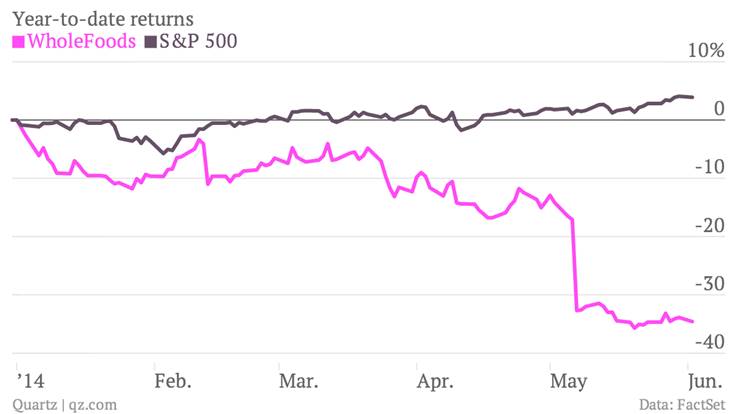
As of right now, Whole Foods is the worst-performing stock in the S&P 500 this year. Its shares are down about 35% in 2014, worse than the 31% fall the similarly besieged electronics retailer Best Buy has suffered, and below a 3.8% gain for the broader index. Read more of this post

McDonald’s has been eating Burger King’s lunch for more than a decade

McDonald’s has been eating Burger King’s lunch for more than a decade

By Matt Phillips @MatthewPhillips June 2, 2014

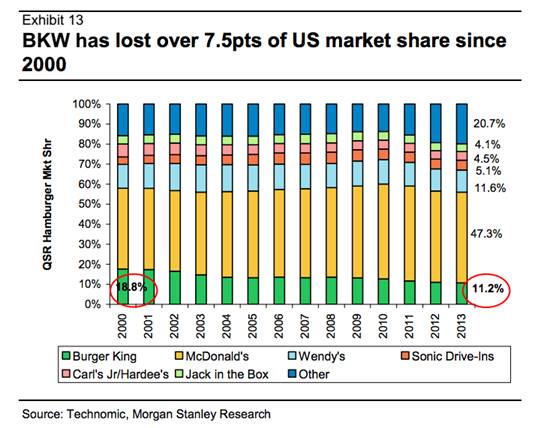
It’s been a tough decade for Burger King.

The long-time rival to McDonald’s has seen its share of the US fast-food burger market erode steadily since 2000, when it controlled nearly 19% of market. Last year, Burger King’s share had dwindled to 11.2%, according to data from market research firm Technomic, which was cited in a recent note from analysts at Morgan Stanley. Burger King’s market share loss amounted to gains for virtually every other fast-food burger joint, especially McDonald’s, which dominates the US burger market. McDonald’s controlled 47.3% of the market last year.

image001-4 Read more of this post

A View Inside Corporate Risk Management

A View Inside Corporate Risk Management

Gordon M. Bodnar 

Johns Hopkins University – Paul H. Nitze School of Advanced International Studies (SAIS)

Erasmo Giambona 

University of Amsterdam – Finance Group; Tinbergen Institute – Tinbergen Institute Amsterdam (TIA)

John R. Graham 

Duke University; NBER

Campbell R. Harvey 

Duke University – Fuqua School of Business; National Bureau of Economic Research (NBER)
May 16, 2014

Abstract: 
A number of theories have been proposed to explain why firms hedge. Unfortunately, these theories are hard to test: While we might observe the hedges, it is hard to answer the question of “why” hedging occurs. Our paper attacks the “why” by directly questioning the managers that make the risk management decisions. Our results present a fresh, inside view of corporate risk management. Rather than hedging being conducted solely by “firms”, our results suggest that personal risk aversion in combination with other executive traits plays a key role in whether a company hedges. As such, our results suggest an important deficiency in many modern theories of risk management which ignore the role of the individual manager.

Apple’s iOS updates were mostly evolutionary-tuck-in improvements and features “borrowed” from other companies, such as Snapchat-like self-destructing messages

Apple’s biggest news today is in the plumbing

By Dan Frommer @fromedome 10 hours ago

Apple didn’t announce any new, must-buy gadgets today at its Worldwide Developers Conference. And from a user’s perspective, the iOS updates it revealed were mostly evolutionary—tuck-in improvements and features “borrowed” from other companies, such as Snapchat-like self-destructing messages.

But Apple did show off several new, important behind-the-scenes technologies today—let’s call it app plumbing. These include:

Extensibility, so apps can talk to each other and borrow each others’ features. Read more of this post

Forget artisan bread and A2 Milk: Woolworths’ latest assault on ¬Australia’s wealthiest shoppers includes walk-in cheese rooms, a ¬gourmet pizza bar and resident chefs ready to dole out tips on their favourite recipes

Samantha Hutchinson Reporter

Woolworths Double Bay: it’s Woolies for the Prada set

Published 02 June 2014 10:03, Updated 03 June 2014 09:26

image001-3

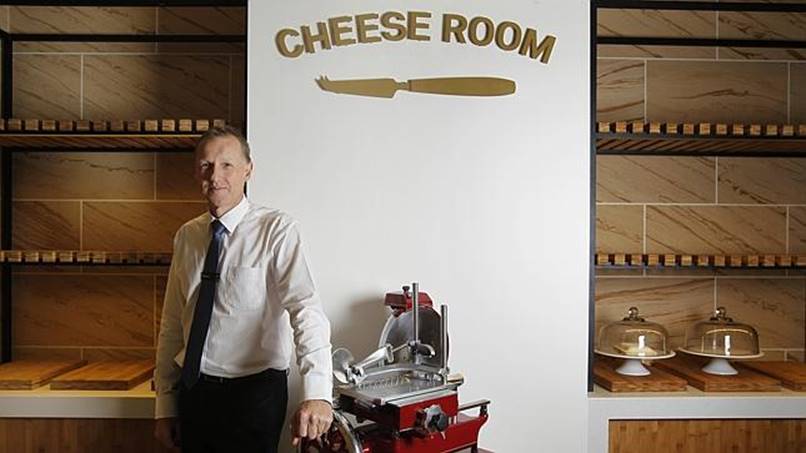
Woolworths state manager Danny Baldwin at the new Double Bay store. Photo: Louise Kennerley

Forget artisan bread and A2 Milk: Woolworths’ latest assault on ­Australia’s wealthiest shoppers includes walk-in cheese rooms, a ­gourmet pizza bar and resident chefs ready to dole out tips on their favourite recipes. Read more of this post

Jump in shareholder activism to hit Australian companies

Jump in shareholder activism to hit Australian companies

Published 29 May 2014 14:49, Updated 30 May 2014 11:17

Joyce Moullakis

Australian boards should brace for an uptick in shareholder activism, as lawyers and bankers urge preparedness and engagement with activists and proxy firms to navigate a typically disruptive process. Read more of this post

Australia’s Beach Burrito is surfing the Mexican trend without franchisees

Caitlin Fitzsimmons Online editor

Beach Burrito is surfing the Mexican trend without franchisees

image001-2

Published 03 June 2014 00:05, Updated 03 June 2014 14:18

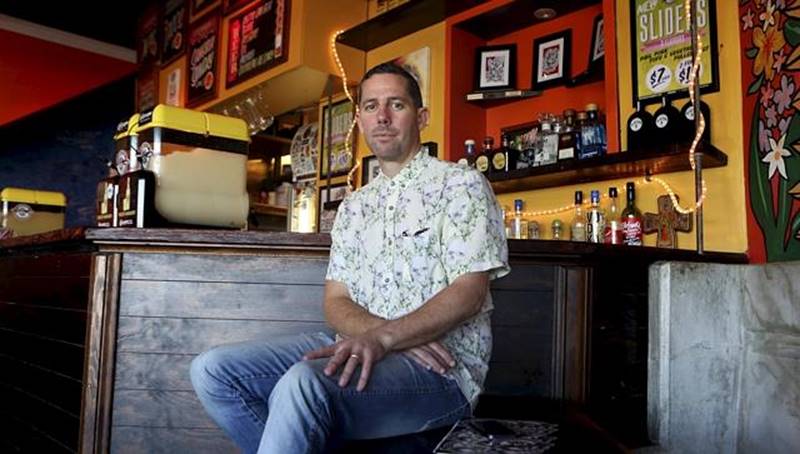
Blake Reed founder of Beach Burrito at his Bondi Beach store, Sydney. Photo: Sasha Woolley

When Blake Read founded Beach Burrito in 2006, he didn’t know he would be riding a wave of Mexican casual dining set to hit Australia. Read more of this post