Hedge funds profit from return of M&A

August 7, 2013 5:17 pm

Hedge funds profit from return of M&A

By Sam Jones

As developed world stock markets have surged this year, the corporate world has likewise seen a revival of deal-making, capital raisings and restructurings. And hedge funds – in particular, so-called event arbitrageurs – are looking for rich pickings from that trend. Event arbitrage is a catch-all term for the strategies by which hedge funds look to capitalise on corporate announcements. In a merger, a simplistic event arbitrageur bet would entail wagering on the price of the acquisition target rising, while shorting the acquirer in expectation of its price falling. Such strategies have outperformed all other hedge fund trading styles so far this year. Proof positive, say event arb traders, that their strategy is bearing fruit. According to HFR, the average event arbitrageur is up 5.7 per cent, compared with an industry-wide average of 3.6 per cent. Many individual managers have fared better. Read more of this post
Chic and cheap: China takes shine to South Korean cosmetics

Chic and cheap: China takes shine to South Korean cosmetics

5:06pm EDT

By Hyunjoo Jin

SEOUL (Reuters) – Cosmetics brand Laneige has a French name and luxurious blue-and-white packaging but its legions of fans in China, the world’s third-largest beauty products market, love it because it is South Korean and affordable. Laneige, or “the snow”, is one of about two dozen brands made by South Korea’s biggest cosmetics company Amorepacific Corp which is using its Asian cachet and pocket-friendly prices to give global firms like L’Oreal SA, and Procter & Gamble Co a run for their money. Other South Korea cosmetics manufacturers like LG Household & Healthcare and Able C&C are also using similar strategies to expand in China’s beauty and personal care market, which is estimated to be worth $34 billion this year. Read more of this post

Where Is Our Netflix for News or ITunes for Ideas?

Where Is Our Netflix for News or ITunes for Ideas?

If “Googlezon” is becoming a reality, as predicted in the dystopian Epic2014 video produced 10 years ago, should we users of Google and Amazon at least get some benefits? Shouldn’t we draw direct advantages from the real-life takeover of the Washington Post by Amazon.com Inc.’s chief executive officer? The sale offers the news industry another chance to fully join the technology revolution that it has long covered and envied. Can we dream of a Netflix for news? When the man who created the gold standard of customer satisfaction takes on an organization whose fortunes still depend on the 15th-century printing press, radical revolutionary technological transformation is in order. Read more of this post

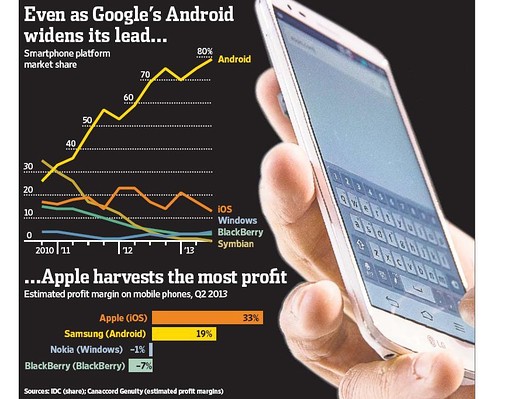
Even as Android Obliterates Smartphone Market and widens its lead, Apple harvests the most profit for now

Aug 7, 2013

Android Obliterates Smartphone Market

By Will Connors

OB-YL923_mobile_Q_20130807190929

While Google‘sGOOG -0.66% Android operating system continues to distance itself from the competition in the world-wide smartphone market, one-time market leaderBlackBerryBB.T -3.33% is reaching new lows. Android’s market share jumped to 79.3% in the second quarter, from 69.1% a year earlier helped in large part to a rush of new phones from Chinese handset makers. The only other operating system that gained was Microsoft’s Windows Phone, which still has a paltry 3.7% compared with 3.1% last year. But it overtook BlackBerry as the No. 3 smartphone operating system thanks in part to Nokia‘sNOK1V.HE -0.78% new lineup of Lumia phones. Read more of this post

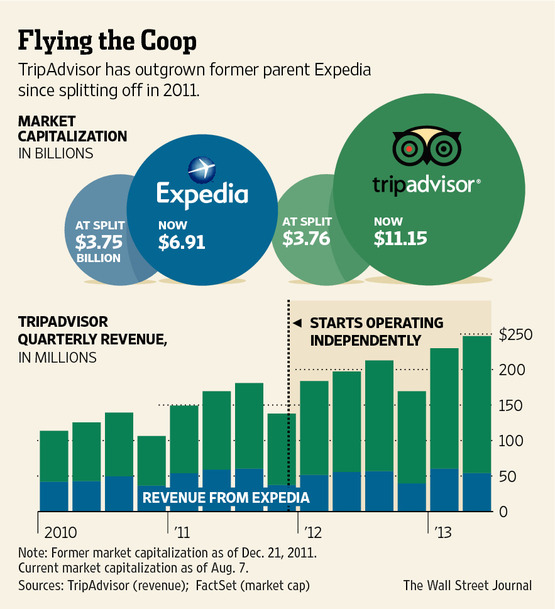
Out of Nest, TripAdvisor Soars Past Expedia; Former Subsidiary’s Success Shows How Swiftly Currents Can Shift Online. Expedia relies on bookings. TripAdvisor depends on ads. But both are vying to be travelers’ first stop online

August 7, 2013, 7:46 p.m. ET

Out of Nest, TripAdvisor Soars Past Expedia

Former Subsidiary’s Success Shows How Swiftly Currents Can Shift Online

DREW FITZGERALD

MK-CF307_TRIP_G_20130807180904

Expedia relies on bookings. TripAdvisor depends on ads. But both are vying to be travelers’ first stop online. Children often outgrow their parents by their teens. TripAdvisor Inc. TRIP -1.63% did it in less than 20 months. That milestone was crossed after Expedia Inc. EXPE -0.33% executives spent months warning analysts and investors that aggressive marketing tactics from old rivals like Priceline.com Inc. PCLN -0.83% could hurt profits this year. But a more painful and unexpected sting came last month from an old ally: TripAdvisor, the former subsidiary that still feeds Expedia many of its customers. Read more of this post

Samsung’s Phones Help Sell Home Appliances; Reputation and Advertising of Trendy Devices Boost Refrigerators and Washers in U.S.

August 6, 2013, 8:36 p.m. ET

Samsung’s Phones Help Sell Home Appliances

Reputation and Advertising of Trendy Devices Boost Refrigerators and Washers in U.S.

JAMES R. HAGERTY and MIN-JEONG LEE

MK-CF337_SAMAPP_G_20130806174504 MK-CF350_SAMAPP_P_20130806214413

Samsung’s U.S. market share for major home appliances has surged. Samsung Electronics Co.’s 005930.SE -0.57% global success in selling trendy smartphones is helping it win credibility in a more humdrum market: refrigerators, washers and other home appliances. The South Korean company over the past few years has rapidly gained market share in the backyard of U.S.-based Whirlpool Corp., WHR +0.73% the world’s largest maker of appliances. So has LG Electronics Inc., 066570.SE +1.08% another Korean company that makes both smartphones and appliances. “We hear it all the time: ‘Oh, I have one of their phones,'” says Rocco Perla, a third-generation appliance dealer in Pittsburgh who displays Samsung and LG products prominently in his showroom. Read more of this post

Unfolding Washington Post’s Inner Value; newspaper-publishing segment of Washington Post represented just 13% of revenue and an operating loss of $49 million

August 6, 2013, 5:11 p.m. ET

Unfolding Washington Post’s Inner Value

Company May Want to Consider Even Deeper Changes

MIRIAM GOTTFRIED

MI-BX676A_WAPOH_NS_20130806183310

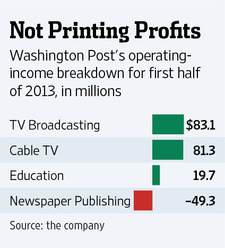
What is the Washington Post Co. WPO -0.91% without the Washington Post? Quite a lot, actually. The announcement Monday that Amazon.com Chief ExecutiveJeff Bezos will buy the Post for $250 million generated speculation about his intentions for the paper. But the sale is small in the context of Washington Post’s $4 billion enterprise value. What matters more for investors is the value, and future, of what is left. In the first half of 2013, the newspaper-publishing segment of Washington Post represented just 13% of revenue. But that segment reported an operating loss of $49 million. Selling it removes the overhang of a business in decline. Read more of this post

Green Mountain’s Buzz Poised to Wear Off; The Coffee Company’s Shares Have Had an Epic Comeback, but the Question Is How Much That Reflects Fundamentals

August 6, 2013, 7:26 p.m. ET

Green Mountain’s Buzz Poised to Wear Off

The Coffee Company’s Shares Have Had an Epic Comeback, but the Question Is How Much That Reflects Fundamentals

SPENCER JAKAB

MI-BX667A_AOT_NS_20130806184502

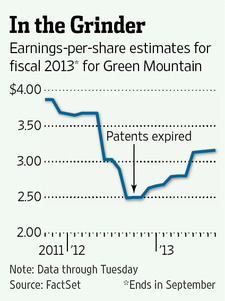
High praise has a way of preceding big stumbles. In earlier, headier times, Green Mountain Coffee Roasters Inc.’s GMCR -2.53%machines were occasionally referred to as the iPods of coffee. Then, in the fall of 2011, questions about its growth prospects sent its shares tumbling from nearly $116 to less than $18 by the next summer. Like Apple Inc.’s music players, competition and the onward march of technology was to blame.

Read more of this post

Small Businesses in Jiangsu Singing the Bank Loan Blues; Lenders burned by bad loans to giants in solar and shipbuilding industries are reluctant to extend loans to family businesses as ordered, forcing some to close

08.07.2013 19:38

Small Businesses in Jiangsu Singing the Bank Loan Blues

Lenders burned by bad loans to giants in solar and shipbuilding industries are reluctant to extend loans to family businesses as ordered, forcing some to close

By intern reporter Wu Hongyuran

Several textile company owners in southern Jiangsu gathered for a meeting on July 25 to figure out how to save their businesses. One of them said local banks had been unwilling to lend since April, making life extremely hard for her and others who also run a family business in Shengze, a silk town in Suzhou, the capital of the eastern province of Jiangsu. Shengze hosts more than 6,000 small and medium-sized textile companies and a great number of spinning mills in its 118 square kilometers. Having run a business there smoothly for five years, the businesswoman at the meeting said it had become very difficult to raise funds in the past few months. These sentiments were expressed by the other businesspeople who attended the meeting. Read more of this post

Japan’s Giant New Destroyer Sends A Clear Message To China, The World; Alarming signs of Japan’s rearmament

Japan’s Giant New Destroyer Sends A Clear Message To China, The World

GEOFFREY INGERSOLL AUG. 6, 2013, 4:04 PM 22,957 76

japan-new-carrier

The Izumo has been in construction since 2009. Sixty-eight years to the day of the Hiroshima bombing, Japan unveiled its new naval “destroyer” that happens to have a flat-top — dubbed “Izumo” — capable of carrying various rotary-wing aviation units, reports Eric Talmadge of ABC. Consequently, it’s also the biggest since WWII … and since Japan’s official army was disbanded. The new boat comes as Chinese officials say the country is in “no rush” to sign a code of conduct guiding military behavior in the contested South China Sea. Read more of this post

Nearly One-Third Of America’s Massive Federal Student Loan Debt Is Either Late Or In Default

Nearly One-Third Of America’s Massive Federal Student Loan Debt Is Either Late Or In Default

MANDI WOODRUFF AUG. 7, 2013, 11:49 AM 2,062 24

Student loan debt continues to swell, with more than $1.2 trillion worth of loans issued so far in the U.S.  The Consumer Financial Protection Bureau recently took a look at our student debt addiction to figure out exactly how well consumers are working at paying it down. It isn’t looking too good. Out of $1 trillion in federal loans, $214 billion are in deferment or forebearance and $89 billion are in default. It’s the 7 million borrowers in default that really have the CFPB worried.  “Defaulting on a federal student loan has serious consequences,” Rohit Chopra, the bureau’s student loan ombudsman, says. “Unlike other consumer credit, borrowers in default on a federal student loan might see their tax refund taken and their wages garnished without a court order.” Read more of this post

Why the luck is running out for Australia’s next leader; After two decades of growth, politicians should be prepared for changing fortunes

August 7, 2013 7:23 pm

Why the luck is running out for Australia’s next leader

By David Pilling

After two decades of growth, politicians should be prepared for changing fortunes

For two decades, Australia has deserved its reputation as a “lucky country”. Alone in the developed world, since 1991 it has been recession-free. It admirably weathered the global financial crisis thanks to a sound financial system and a made-in-China mining boom that has turbocharged the economy. As well as massive coal and iron ore deposits, it has huge reserves of natural gas ready to liquefy and ship to energy-starved Japan and South Korea. It continues to enjoy low public debt, low inflation and, for now, relatively low unemployment.

Read more of this post

Creative thinking out loud; New technology platforms such as Medium and Quora are helping executives to test their ideas

August 7, 2013 7:16 pm

Creative thinking out loud

By Ian Sanders

Len Kendall is at his desk in Chicago thinking through the sales strategy for his start-up CentUp, a business that facilitates donations to online content creators – such as bloggers, photographers and illustrators – and charities. Instead of waiting until his strategy is complete, Mr Kendall has chosen to outline his thinking and approach to selling in a blog post entitled This Blog Post Isn’t Free. He sees this approach as a way of testing his idea in public.

Traditionally, if an executive wanted to test an idea, they might consult their peers at an industry gathering or commission some research. Today, many are using the web to think out loud instead. While the internet has long been used by business people to broadcast their thinking to the world, what is new is their willingness to share thoughts-in-development rather than present polished opinions and press release-style communication. Read more of this post

Lobster industry squeezed by oversupply as demand for what has long been considered a luxury dish has not kept pace, especially since the global recession hit in 2008

Last updated: August 7, 2013 7:30 pm

Lobster industry squeezed by oversupply

By Neil Munshi in Chicago

The Maine lobster industry is being crippled by a glut of supply that many attribute to climate change, sending the price per pound plummeting and turning the crustacean into something it has rarely been before: affordable. According to figures from the Maine Department of Marine Resources, the volume of the state’s lobster harvests has skyrocketed from about 28m pounds in 1990 to 126m pounds last year as oceans have warmed, helping the shellfish and their larvae to grow faster. But demand for what has long been considered a luxury dish has not kept pace, especially since the global recession hit in 2008, even as fuel and equipment costs rise. Read more of this post

Children’s Advocacy Group Faults Learning Apps for Babies, saying that there was no rigorous scientific evidence that the apps taught infants what the companies claimed

AUGUST 7, 2013, 1:51 PM

Children’s Advocacy Group Faults Learning Apps for Babies

By NATASHA SINGER

Updated, 8:25 p.m. |

subBaby1-tmagArticle

Screen images of the Laugh & Learn mobile apps, which have been downloaded more than 2.8 million times.

The Walt Disney Company’s “Baby Einstein” videos do not turn babies into prodigies. And despite marketing claims by Fisher-Price, its popular “Laugh & Learn” mobile apps may not teach babies language or counting skills, according to a complaint filed on Wednesday with the Federal Trade Commission. As mobile devices supplant television as entertainment vehicles for younger children, media and software companies increasingly see opportunities in the baby learning app market. But the complaint to the F.T.C. by the Campaign for a Commercial-Free Childhood, the same nonprofit group that helped prompt “Baby Einstein” to backtrack from its educational claims, challenges the idea that such apps provide more than simple entertainment value. Read more of this post

Rare questions are being asked about the power of China’s state-owned corporations as details emerge about the purchase of three mines in Shanxi Province

August 7, 2013

Silence Underground

By KEITH BRADSHER and CHRIS BUCKLEY

ZHONGSHE, China — A moribund coal mine here descends deeply, more than 3,800 feet underground. But the deal in which a Chinese state-owned conglomerate bought it may be even darker and more labyrinthine. The Zhongshe mine and two others, in Shanxi Province in northern China, are at the center of unusually public accusations of mismanagement and corruption afflicting one of the nation’s flagship state conglomerates, China Resources. Critics say that the $1.6 billion purchase was vastly overpriced and illegal and that large sums may have been squandered or, as some are claiming, improperly diverted. Read more of this post

How Siemens Lost Its Way; Every success already contains the seed of failure

08/07/2013 07:06 PM

Peter and the Wolves

How Siemens Lost Its Way

By Dinah Deckstein, Martin Hesse and Thomas Tuma

Siemens is a massive global conglomerate, building everything from trains to power plants. In-fighting and last week’s ouster of CEO Peter Löscher are just a few indications of a German giant’s decline. The company must find new markets to regain success.

A few days before all hell breaks loose around him, Joe Kaeser is sitting in his Munich office, relating anecdotes about the big, wide world of Siemens. At the time, he’s still the company’s chief financial officer. A large, black-and-white photo of the striking cliffs of Big Sur, on the California coast, one of the 56-year-old executive’s dream destinations, is hanging on the wall behind his desk. Kaeser, with surprising openness, describes how almost everyone in the company “has recently come a little unhinged.” At some point, he says, even he began to feel like a rock in the surf. Read more of this post

One day you are hot, the next day you are not – and so it is with Mongolian Genghis bonds which have suffered a sharp market correction in the wake of June’s market rout

August 6, 2013 5:56 pm

Mongolian bonds suffer amid frontier correction

By Pan Kwan Yuk

One day you are hot, the next day you are not – and so it is with Genghis bonds which have suffered a sharp market correction in the wake of June’s market rout. Back in November, eyebrows were raised in the emerging markets debt investment community when Mongolia – a country that has been rescued five times in the past 22 years by the International Monetary Fund – managed to raise $1.5bn at a price below Spain’s borrowing costs. At the time, many took the sale, which was 10 times subscribed and attracted $15bn in bids – as yet another sign that investors who were flushed with cash and desperate for yields were jumping into markets that they did not fully understand. Read more of this post

38% of Groupon’s revenues now come from selling low-margin, discounted junk

Is Groupon Goods a Daily-Deal Savior or a Low-Margin Distraction?

Published on August 7, 2013
by Jason Del Rey

When Groupon recognized in 2011 that daily deals alone wouldn’t lead it to long-term success, the company started selling discounted products under the Groupon Goods banner. That business has continued to grow strongly since then, accounting for $151 million in revenue in North America in the first quarter, and $229 million globally. As the Chicago-based daily-deal company prepares to report second-quarter earnings on Wednesday, it’s clear that analysts will be paying close attention to this business segment. That’s because the Goods unit now represents 38 percent of Groupon’s sales, via discount sales of consumer electronics, jewelry, clothing and other such items from national companies. The rest of the company’s business, of course, focuses on selling discounted services from local merchants. Read more of this post

Sequoia’s Michael Moritz: Jeff Bezos has what it takes to become a bonafide media baron

Jeff Bezos has what it takes to become a bonafide media baron

By Michael Moritz August 7, 2013

Michael Moritz is chairman at Sequoia Capital, a large venture capital firm. He sits on the boards of LinkedIn, Sugar, and Kayak.

This originally appeared on LinkedIn. You can follow Michael Moritz here.

Word that Amazon Founder and CEO Jeff Bezos is buying The Washington Post might cause consternation in its newsroom, but uneasy journalists wondering about what lies in store might be reassured if they read the letters he has sent to shareholders since 1997. Most annual letters to shareholders are crammed with fatuous drivel. A few stand out. Warren Buffett’s commentaries on the performance of Berkshire Hathaway have long been compulsory reading for investors. Jeff Bezos’ reports on Amazon should be required reading—not just for the journalists who are about to become his employees—but also for anyone aspiring to build and lead a company. Read more of this post

Reality Check: Asia-Made Messaging Apps Are Not Taking Over The World

Reality Check: Asia-Made Messaging Apps Are Not Taking Over The World

August 7, 2013

by Steven Millward

Asian-messaging-apps-not-really-global

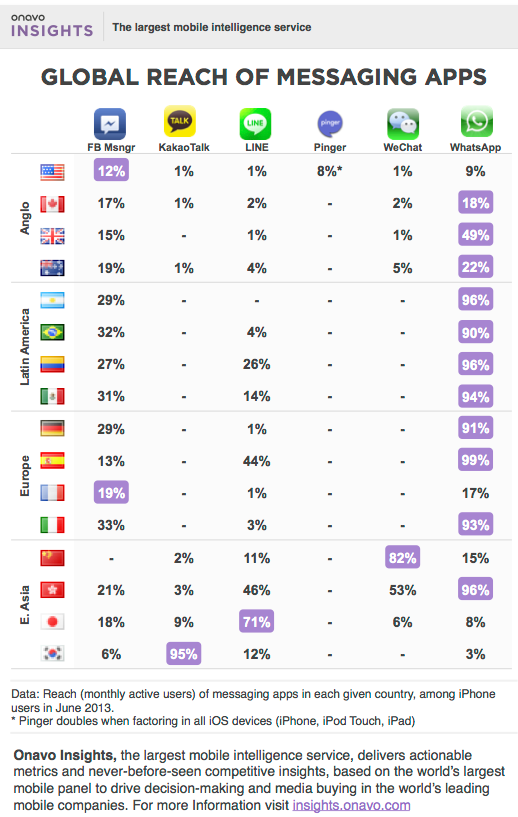
We’ve seen Asian messaging apps rocket to acquiring over half a billion collective users in the past couple of years, with most of them – like Line, WeChat, and KakaoTalk – keen to expand globally. But interesting new data from Onavo provides a useful reality check. As seen in the table below (hat-tip to TheNextWeb’s Jon Russell for spotting it), Onavo’s figures show that Whatsapp and Facebook Messenger have much greater global reach, with the Asia-made messaging apps only really dominating their home countries. One important caveat is that this covers iPhone data only. Nonetheless, it shows that WeChat’s 70 million overseas users, and the approximate 75 percent of Line’s users outside of Japan [1] are not sufficient to make those the leading apps in any country outside their home base. Line’s 44 percent reach among active iPhone users in Spain is fairly impressive, as is WeChat’s 53 percent reach in Hong Kong, but both are bested in those two markets by WhatsApp. Nonetheless, US-based WhatsApp must be somewhat worried, having copied its Asia-made rivals today by adding push-to-talk voice messaging(Editing by Anh-Minh Do, Enricko Lukman)


WeChat has nearly 400 million registered users in total; Line has over 200 million. But Whatsapp has 300 million active users.  ↩

Dairy Auction Shows Fonterra’s Premium Over Rivals Narrowing After Latest Scare

Updated August 7, 2013, 3:52 a.m. ET

Dairy Auction Shows Fonterra’s Premium Over Rivals Narrowing After Latest Scare

Sale Was Seen as First Big Test After Dairy Giant’s Bacteria Warning

REBECCA HOWARD

AI-CC735_FONTER_NS_20130807034505

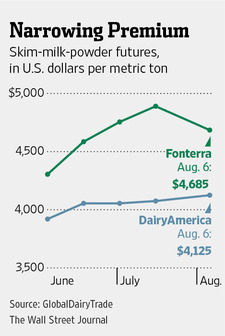
WELLINGTON, New Zealand—The dairy industry’s biggest auction signaled thatFonterra Cooperative Group Ltd.’s FCG.NZ +1.14% tainted-milk scare has eroded its ability to charge premium prices and led to a shift in consumer sentiment toward rival suppliers. New Zealand officials saw the overnight GlobalDairyTrade auction as the first big test of the country’s ability to weather food-safety concerns after Fonterra warned days earlier that three batches of one of its dairy products may contain harmful bacteria. Dairy accounts for about a quarter of New Zealand’s exports and Fonterra is its largest supplier. Lawmakers feared the company’s latest quality issue is hurting consumer confidence, especially after countries such as China and Russia banned imports of some Fonterra products. Read more of this post

Distressed-Debt Investors Look Toward Asia; Corporate debt in Asia now exceeds 2008 levels

Aug 7, 2013

Distressed-Debt Investors Look Toward Asia

By Isabella Steger

AM-AZ763_AMONEY_G_20130807040005

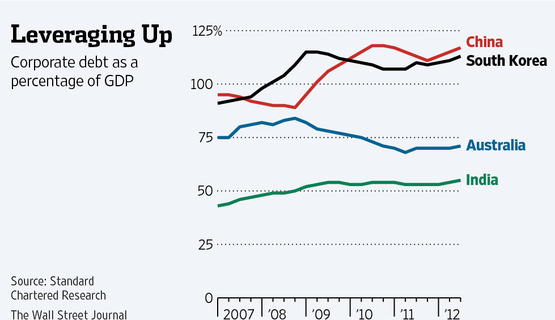
As Asia’s economic growth sputters and banks face the prospect of rising bad debts, credit-focused hedge funds and private-equity firms are seeking opportunities to buy distressed debt. While investors in distressed credit in the region have been most active in Australia, they are starting to spot signs of trouble in other markets such as China, South Korea and India, particularly after a recent boom in corporate-bond sales sent debt levels higher. Many of those bonds will be up for refinancing in a few years, said Michel Löwy, chief executive of Hong Kong-based hedge fund SC Lowy, which invests in distressed debt. Read more of this post

In China, Air Pollution Rules Spur Big Car Purchases; Buyers Trade Up Fearing They May Get Just One Shot at a Purchase

August 7, 2013, 4:13 p.m. ET

In China, Air Pollution Rules Spur Big Car Purchases

Buyers Trade Up Fearing They May Get Just One Shot at a Purchase

SHANGHAI—As more Chinese cities propose license-plate lotteries and other ways of limiting the number of cars on the road, consumers are responding by buying more expensive automobiles with bigger engines. In Shanghai, one of four major Chinese cities with policies designed to reduce car purchases to ease pollution and traffic congestion, between 9,000 and 10,000 plates are auctioned monthly, fetching an average of 82,000 yuan ($13,400) so far this year. That steep fee helped convince David Fu, a 26-year-old bank corporate finance manager, to buy an Audi NSU.XE +0.16% A4 in June for 300,000 yuan after looking at a dozen lower-cost models including those made by Volkswagen AGVOW3.XE -0.77% and China’s home grown car makers. Read more of this post

Foods that are decades past their expiry dates are too common in Asia

Foods that are decades past their expiry dates are too common

Nury Vittachi, Bangkok | Opinion | Sun, July 14 2013, 11:05 AM

When I heard last week that inspectors had found a shop selling food that was 43 years past its expiry date, I thought, wow, they go to the same supermarket I do.
I’ve seen food items there that aren’t just dried out, but are actually fossilizing. I sometimes visit just to show my children how mineralization works: “See how microstructural features are retained, so that people in 10 million years can trace the early evolution of the MSG pie?” Anyway, in my experience you’re fine as long as you stick to foods from the Holocene and Pleistocene eras: Avoid anything pre-Mesozoic. Later, I found the actual Xinhua report about the expired food. The shop was in the Guangxi region of China. But this problem happens all over Asia. A reader once sent me a package of food he bought from the most expensive delicatessen in Hong Kong. Under the expiry date sticker was another one. And another one beneath that. And another one beneath that, etc.  Read more of this post

In American Greetings Deal, Echoes of Larger Buyout for Dell

AUGUST 6, 2013, 6:34 PM

In American Greetings Deal, Echoes of Larger Buyout for Dell

By STEVEN DAVIDOFF

This is a tale of two management-led buyouts. The first is the headline-grabbing $24.4 billion bid by Michael S. Dell and the private equity firm Silver Lake Partners to buy the personal computer maker that Mr. Dell founded. The second is the lesser-known $612 million buyout by the Weiss family of the American Greetings Corporation, the greeting card company they control. Both deals illustrate the rising tide of shareholder power, as well as the devilish issues that emerge when management tries to buy a public company. And even though Dell’s board has changed the voting rules, both companies are being tested by shareholders who view the buyouts as undervaluing their companies. Read more of this post

Washington Post Co.’s Real Star Asset: A Massive Pension Fund

August 5, 2013, 6:45 PM

Washington Post Co.’s Real Star Asset: A Massive Pension Fund

By Tom Gara

oKU9Z32

The Washington PostWPO -0.91% Company is best known for its flagshipnewspaper title sold today to a company controlled by Amazon founder Jeff Bezos, but it makes its big money from less prominent sources: A for-profit education business, cable television, and local TV stations. But while all these assets have their merits, here is one asset that gets much less attention: its hugely over-funded pension. At a time when pension obligations are becoming giant financial drag on some of America’s best known companies – such a drag, in some cases, that the pension funds end up owning significant chunks of the business — having a hugely over-funded pension plan is a pretty sweet spot to be in. Here are the details, via the company’s 2012 annual report: That’s a pension plan that owes its recipients just under $1.47 billion, but has $2.07 billion in assets — in other words, it is over-funded by a cool $604 million. Read more of this post

A misleading model: Low bond yields have in the past been bad, not good, for equity returns

A misleading model: Low bond yields have in the past been bad, not good, for equity returns

Aug 3rd 2013 |From the print edition

20130803_FNC157

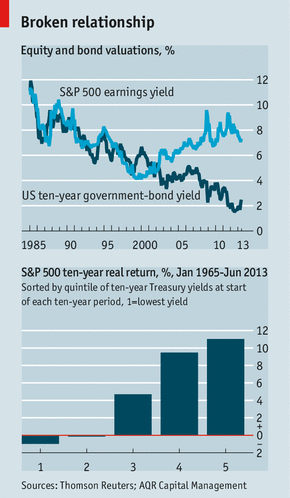
BULLS tend to find all sorts of reasons for forecasting a higher stockmarket. This is especially true of investment-bank strategists, whose bonuses are likely to get bigger when share prices are rising. Low bond yields are often seized on by equity bulls. A recent research note from Deutsche Bank, for example, suggested there was a straight trade-off between changes in bond yields and the valuation of shares, in the form of the price-earnings ratio or “multiple”. Lower bond yields mean a higher multiple; based on current yields, shares are cheap. It is all remarkably reminiscent of the so-called “Fed model”, much loved by bulls in the 1990s. The model was based on a reference in Alan Greenspan’s 1997 congressional testimony to the close relationship between the ten-year bond yield and the earnings yield (the inverse of the price-earnings ratio) on the S&P 500 index. If the earnings yield was higher than the bond yield, then equities were cheap. Bond yields and earnings yields did indeed seem to move in tandem for about 15 years, and then the relationship broke down completely at around the turn of the century (see top chart). Read more of this post

With wearable technology, a new measure of independence for people with disabilities

With wearable technology, a new measure of independence for people with disabilities

By Hayley Tsukayama, Published: August 6

It’s been 18 years since Tammie Lou Van Sant held a camera. But nearly two decades after a car accident left her paralyzed from the chest down, Van Sant is shooting again — thanks to a device that could be part of technology’s next big trend. Google’s Glass headset, which connects to users’ smartphones and displays information on a screen that hovers above one eye, is the first of what analysts say may be a new trend of wearable technology — headsets, watches, fitness trackers and other devices that are worn, rather than slipped into a pocket. Analysts say growing interest in wearable tech could translate into big money for technology firms, with projected sales of up to 9.6 million of such devices worldwide by the end of 2016. Read more of this post

UPS is going to test 3D printing in its stores. It could be the beginning of a whole new business for the delivery firm

3D printing: Out of the box

Aug 6th 2013, 18:39 by P.M.

ups

THE emergence of three-dimensional (3D) printing will have a revolutionary effect on manufacturing, but it may be equally disruptive for firms that make much of their living warehousing and delivering spare parts for companies. Now, one of the biggest delivery firms, UPS, is going to test 3D printing in its stores. Stratasys, a Minneapolis company which is one of the leading makers of 3D printers, will provide its uPrint SE desktop machines to six UPS Stores in America for a trial programme. These machines will allow customers to bring their designs to the store and have them printed out as objects—in much the same way as people take two-dimensional digital documents to the store and have them printed on paper. The uPrint machines can produce items in plastic in a range of colours and make bigger objects in finer detail than consumer-level 3D printers. UPS expects designers, entrepreneurs, start-ups and architects seeking models to be among its customers for 3D printing services. Some people might also be seeking spare parts: it is often small plastic items that break in products, but they can be difficult and expensive to find. Some industrial 3D printers can print metal components too.

Read more of this post