Asian Messaging Apps Challenge Silicon Valley; China’s WeChat and Korea’s Line Are Threatening the Global Growth of WhatsApp and Facebook
October 10, 2013 Leave a comment
October 9, 2013, 2:51 p.m. ET
Asian Messaging Apps Challenge Silicon Valley
China’s WeChat and Japan’s Line Are Threatening the Global Growth of WhatsApp and Facebook
JURO OSAWA And PAUL MOZUR
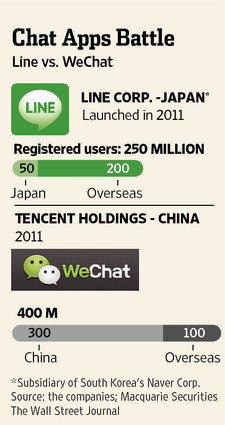
In the fiercely competitive market for smartphone applications, two Asian contenders are starting a trend from the Far East—and sending a message to Silicon Valley. China’s WeChat and Japan’s Line may be unfamiliar to most U.S. smartphone users. But the apps, which combine instant messaging with social networks, are well-known to hundreds of millions in Asia and other parts of the globe, challenging the global dominance of U.S.-based WhatsApp Inc. and even posing a potential threat to Facebook Inc. FB -0.78%and Twitter Inc. Line and WeChat’s prospects are far from assured in the fast-evolving world of mobile services, and how well they can prosper outside Asia is largely unknown. But their expansion is a marked change from the pattern of most social networks being born and gaining critical mass in the U.S. before spreading to other countries.WeChat, developed by Chinese Internet giantTencent Holdings Ltd., TCEHY -1.01% has about 300 million registered users in China and 100 million overseas, according to a recent estimate by Macquarie Securities. Tokyo-based Line said it has more than 250 million users world-wide, with about 80% of them outside Japan.
For many Chinese users, WeChat is more than just a text-messaging tool. “I can’t imagine my life without WeChat,” said Kevin Hung, a 31-year-old Taiwanese who works for an electronics maker in Beijing and spends up to two hours a day on WeChat. Mr. Hung says he likes WeChat’s “moments” feature, which somewhat resembles Facebook and allows users to share photos and status updates.
Line, developed by a Japanese subsidiary of Korean Internet portal operator Naver Corp.,035420.SE -1.57% offers text messaging and voice calls as well as photo-sharing, games and other Facebook-like social features. Line Corp. Chief Executive Akira Morikawa said the app is trying to become a gateway for various forms of online communication and entertainment—a role once played by sites like Yahoo Inc. and now, to some extent, by Facebook.
Line, like WeChat, is free to download and use. In the three months through June, Line generated revenue of about ¥10 billion ($103 million) from virtual items sold in free games and virtual stickers that users buy and send as messages. WeChat, meanwhile, hasn’t generated much revenue yet.
In the broader category of social networking services, Line and WeChat are still tiny compared with Facebook, which had 1.15 billion monthly active users in the second quarter. In that quarter, Facebook users in Asia increased 33% from a year earlier to 339 million, even though the service is largely blocked in mainland China. On top of its regular services, Facebook also offers its own instant messaging app.
Twitter, in its recent filing for an initial public offering, acknowledged that these Asian apps could stand in the way of its international expansion as they occupy more of smartphone users’ time. Line and WeChat have been adding some Twitter-like features, such as official accounts for companies and public figures that allow them to distribute promotional messages to followers.
Facebook and Twitter declined to comment.
Line and WeChat owe part of their success in Asia to strong demand for alternatives to costly text messages. Also fueling their growth is the increasing number of first-time smartphone users in emerging markets who are replacing feature phones with low-cost Android handsets.
In India alone, where only about 8% of 900 million mobile-phone users have smartphones, the untapped market is huge. Since Line started running television commercials in July, its registered users in the country have increased to 5 million from less than 1 million.
In Thailand, 33-year-old librarian Supinya Sritanaviboonchai loves sending the whimsical, humorous emoticons known as “stickers” on Line. “The stickers really spice up the conversation,” said Ms. Sritanaviboonchai, who is one of 18 million registered Line users in Thailand, the app’s second-largest market after Japan.
Both Line and WeChat have been ramping up marketing to extend their reach. Tencent is spending up to $200 million this year to advertise WeChat abroad, mainly in emerging markets such as Southeast Asia and Latin America. The company said in August that WeChat’s overseas users doubled to 100 million from 50 million in May.
Line and WeChat are also competing against fast-growing Asian messaging apps such as South Korea’s Kakao Talk, which has about 110 million users.
Similar to the early days of social networking, the stakes are high. Customers tend to gravitate to one or two networks used by the bulk of their friends. As Line and WeChat spread around the world, they will have to contend with WhatsApp. The Silicon Valley company has 300 million monthly active users and remains the most popular messaging app in many parts of the world.
“In many markets we enter, WhatsApp is already there,” said Jun Masuda, Line’s chief strategy and marketing officer.
People can download and use WhatsApp free for the first year, but the company then charges 99 cents per year as a way of securing a source of revenue while keeping the app free of advertisements.
The U.S., however, is a tricky market for them all. Mobile plans commonly offer unlimited text messaging, making messaging apps unnecessary for most users. But where WhatsApp has focused on messaging, Line and WeChat are hoping their wider features will keep attracting users.
WhatsApp declined to comment.
Spain has become one of the hot battlegrounds for these messaging apps. Line and WeChat have grown fast in recent months with aggressive ad campaigns, even though WhatsApp remains popular.
Pablo Lasso, a 39-year-old Argentine who lives in Madrid, started using Line in February, when his free trial period for WhatsApp was about to expire. He also uses Line to call his family and friends in Argentina. “Most people over there are still using WhatsApp, but some are already moving to Line,” he said.
For its global ad campaign, WeChat hired Argentine football star Lionel Messi, who plays for Spain’s FC Barcelona. Mr. Messi stars in a commercial in which he pacifies a crying baby by live-streaming his football skills over WeChat’s video call. The commercial has helped WeChat add new users in Europe and Latin America, according to Tencent.
While being a poster boy for WeChat, Mr. Messi is also playing for the other side as a virtual cartoon sticker for Line, as FC Barcelona recently agreed to open an official Line account and let Line offer virtual stickers of its popular players.
—Nopparat Chaichalearmmongkol and Warangkana Chomchuen in Bangkok, David Román in Madrid, Lorraine Luk in Hong Kong and Evelyn M. Rusli in New York contributed to this article.
 About bambooinnovator

