Mobile Advertising Begins to Take Off
October 10, 2013 Leave a comment
Mobile Advertising Begins to Take Off
Spending More Than Doubled in the First Half
SUZANNE VRANICA and CHRISTOPHER S. STEWART
Updated Oct. 9, 2013 9:11 p.m. ET
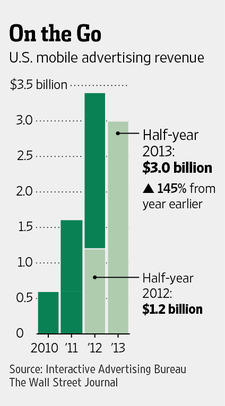
Marketers are finally convinced that there’s money to be made peddling everything from soap to salad dressing to the legions of consumers glued to their smartphones and tablets: Spending on mobile advertising more than doubled in the first half of the year. Mobile-ad spending in the U.S. totaled $3 billion in the first half, up from $1.2 billion a year earlier, the Interactive Advertising Bureau estimates.
Until recently, advertisers were reluctant to put much money into the mobile category, concerned about technological hurdles and the difficulties of measuring audiences. That hesitation is fading, ad executives say.
Shifting dollars to mobile is a “no brainer” when you look at the time consumers are spending on their devices, said Gail Tifford , Unilever ‘sUL -0.48% senior media director of the company’s North America business.
Unilever—whose massive stable of brands includes Dove soap, Vaseline, Hellmann’s mayonnaise and Slim-Fast—said it expects its mobile ad outlays to triple this year from last year. It declined to disclose spending figures. Unilever was one of the first companies to jump into AppleInc. AAPL +1.17% ‘s mobile-ad service, iAds, several years ago.
Mondelez International Inc., MDLZ -0.26% whose snack brands include Nabisco cookies and Trident gum, is one of the more aggressive mobile advertisers.
This year it will devote 10% of its global marketing budget to mobile.
Mondelez has struck several big mobile ad deals with companies such as Google Inc.GOOG +0.26% and Twitter Inc. A mobile ad campaign on Facebook Inc. FB -0.78% for its Nilla Wafers cookies over the summer helped lift retail sales of the cookie 13% in July, it said.
Since Apple introduced the iPhone in 2007 and the iPad in 2010, smartphones and tablets have increasingly supplanted laptops, desktop computers and television sets as the devices on which people surf the Web, communicate and watch video entertainment. Adults in the U.S. are expected to spend an average of two hours and 21 minutes a day on smartphones and tablets this year, excluding time spent talking on phones, according to a recent study by eMarketer. In 2010, adults spent only 24 minutes on mobile devices, not counting talk time.
“Consumers have been embracing mobile for the past three years and marketers are just catching up,” said Laura Desmond , chief executive officer of Starcom MediaVest, a big media buying firm owned by Publicis Groupe SA.
One big winner is Google, which anticipated the mobile advertising shift when it developed the Android mobile operating system in late 2007, offering it to phone makers free. Android now dominates the mobile market.
Google is expected to capture 46.8% share of the U.S. mobile ad market this year, estimates eMarketer, thanks largely to Web searches conducted on mobile devices.
Facebook, too, is benefiting. After initially lagging behind in mobile, the Menlo Park, Calif., company has worked to bolster its mobile-ad products, an effort that is now bearing fruit.
Mobile accounted for 41% of its advertising sales in the second quarter, Facebook said. Facebook will have about 14.9% of the mobile ad market this year, eMarketer estimates.
Unilever said that 50% of its spending on Facebook goes to the social-network’s mobile products.
Earlier this year, Mondelez did an ad push with Waze, a mapping and navigation app owned by Google. As people used the app to navigate traffic in California, they saw Stride gum branded pins on the map that pointed out the nearest Target Corp. store selling the gum. If the user clicked on the pin, coupons were sent to the smartphone. About 2.3% of the app users clicked on the pin and received the coupons, Mondelez said.
“Marketers who wait to jump into the mobile pool until the last minute will find their competitors swimming like Michael Phelps while they’re wearing water wings in the shallow end,” said Dana Anderson , Mondelez senior vice president of marketing strategy and communications.
Mobile’s share of total online ad spending in the U.S. more than doubled to 15% during the half, the IAB said. Overall U.S. online ad spending rose 18% to $20.1 billion during the period.
Spending on search and display ads continue to account for the bulk of the overall sector but their share of the total declined in favor of mobile advertising.
Although ad dollars are flowing to mobile, the amount pales in comparison with the dollars spent on TV ads, which continue to dominate most companies’ ad budgets.
Spending on TV ads in the U.S. will increase 2.8% to $66.35 billion this year, eMarketer predicts.
There remains a “big imbalance” between the large amount of time consumers spend on mobile and how much is being spent on ads, said Vik Kathuria , a managing partner at MediaCom, a media-buying arm of WPP WPP.LN -1.78% PLC.
Challenges remain for mobile advertising. Measuring audiences for mobile ads also remains a work in progress, ad executives say, and the sector has yet to establish a standard for tracking consumers. “Cookies”—code that enable advertisers to follow consumers around as the browse the Web—don’t work the same on mobile devices.
That has kept ad prices for mobile lower than ads online, analysts say.
“It’s still an emerging medium,” said Melissa Parrish , an analyst at Forrester ResearchInc. FORR -0.83%
Ms. Parrish said that once more established systems are in place, prices will climb. “There’s a learning curve and a technology curve,” she said.
Another vexing issue has been that marketers have been worried about annoying or alienating consumers by cluttering up their gadgets’ small screens with ads.
A study done last year by Forrester for mobile ad network TapJoy found that 70% of people it surveyed found in-app ads “interruptive” and two-thirds of them find them more “annoying” than TV ads, the study said.
 About bambooinnovator

