Weibo Can’t Retweet Twitter IPO; Twitter’s Plans May Run Into China’s Attitudes Toward the Internet
October 10, 2013 Leave a comment
October 9, 2013, 11:02 a.m. ET
Weibo Can’t Retweet Twitter IPO
Investors in Sina, Which Owns Chinese Twitter Rival Weibo, May Be Putting Too Much Faith in the U.S. Company’s Looming Stock-Market Debut
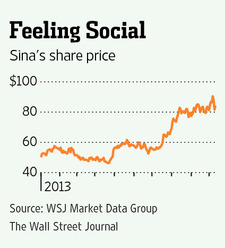
Sina SINA +3.28% has been sharing in the excitement over Twitter’s planned initial public offering. But investors may be getting ahead of themselves. Sina’s Weibo is the dominant microblog platform in China, where Twitter is blocked by Beijing’s firewall. The hope is that a handsome valuation for Twitter would imply even greater riches for Sina. Yet the two services may not be all that comparable. Twitter says it had 218 million monthly active users at the end of June. Weibo releases a different metric of 54 million daily active users, but Credit Suisse CSGN.VX -0.65% estimates in a note that its monthly number is 81 million.Private sales of shares by Twitter employees earlier this year valued the company at around $9 billion, according to The Wall Street Journal. Assuming a $12 billion IPO valuation would imply a value per active user for Twitter of around $55.
In April, e-commerce giant Alibaba Group bought a stake in Weibo that valued it at $3.26 billion, or around $40 per monthly active user. But Sina shares have risen by 48% since then, suggesting investors think Weibo’s users are worth substantially more. An even-more generous valuation for Twitter would help support that thesis.
Weibo has only just started to monetize traffic on a meaningful scale, though, so its moneymaking potential is untested. It had $37.7 million of revenue in the three months to June. That compares with $254 million for Twitter in the first half. Both are still loss-making.
On the positive side, Weibo is more than just a Twitter clone. It incorporates someFacebook FB -0.78% -like features, such as the ability to “like” and comment on posts. That is significant because Facebook has a better monetization track record.
But Twitter and Facebook are global platforms, while Weibo is confined to China. True, that gives it access to an enormous, expanding market. It is also one with big challenges. Weibo is a constant battleground between censors and netizens, suggesting huge regulatory risks for investors.
Like all Chinese Internet companies, Sina is forced to employ huge teams of internal censors. Some discount is needed to account for these drawbacks.
Twitter is coming to the market at a seemingly opportune time, when optimism on social-networking stocks has been running high. Sentiment can prove fickle, though, especially with dysfunction in Washington making investors increasingly nervous.
Earlier this week, market action carried a warning as debt-ceiling fears grew. Social-network stocks fell especially hard Tuesday—Facebook sank 6.7% and Sina slid 7.3%. While Sina staged something of a comeback Wednesday, the volatility suggests the sector has gotten frothy.
In other words, Sina investors shouldn’t count their tweets before they are sent
SEPTEMBER 16, 2013, 1:12 PM
Twitter’s Plans May Run Into China’s Attitudes Toward the Internet
By BILL BISHOP
Twitter disclosed last week that it had confidentially filed for an initial public offering. The secret filing means outsiders are left guessing about many details of the social media giant’s business.
We can be fairly certain, however, that Twitter has no meaningful financial contribution from China. Nor are more than a handful of its reported 240 million active users among the nearly 600 million people on the Chinese Internet. Twitter, like Facebook, YouTube and several other foreign Internet services and news Web sites deemed sensitive, is blocked by China’s “Great Firewall.”
Twitter, however, may still have opportunities to generate revenue from China.
While Google’s consumer Internet services have basically become irrelevant inside China since it refused in 2010 to censor its search results in China, the company earns several hundred million dollars a year selling advertising to Chinese firms that want to reach customers on the Internet outside China.
Facebook, which reportedly tried to enter China via a joint venture with Baidu in 2011 before eventually abandoning those plans, also generates revenue selling access to its global users to Chinese firms.
Sheryl Sandberg, Facebook’s chief operating officer, was in Beijing last week to promote her book “Lean In” and attend the World Economic Forum summer session in Dalian. Ms. Sandberg met in Beijing with Cai Mingzhao the head of State Council Information Office. The office posted on its Web site a photo of Ms. Sandberg and Mr. Cai along with a brief statement noting that the two sides discussed the “important role the Facebook platform plays in helping Chinese companies expand overseas.”
The government’s so-far successful approach in harnessing the Internet is another example of China’s long history of trying to use Western technology to strengthen China while limiting the impact of those developments on Chinese society and the political system.
Beijing allowed the development of a domestic Twitter-like service when it approved Sina’s plans to build a microblogging service. Weibo, which began in August 2009, quickly became the most important and disruptive social media service on the Chinese Internet. Sina, a Nasdaq-listed company with a $5.5 billion market capitalization, reported earlier this year that Weibo had 54 million daily active users.
Sina Weibo has increasingly challenged the Chinese government’s traditional control of the media, leading the government to try repeatedly to rein it in without completely neutering it. Those efforts have never fully worked, as the China Insider column of May 6 noted in discussing a coming crackdown on Weibo and online rumors:
On May 2, China’s State Internet Information Office declared war against online rumors because they “have impaired the credibility of online media, disrupted normal communication order, and aroused great aversion among the public.” One report suggests the regulators have some of the most influential users of Sina Weibo, those with millions or tens of millions of followers, in their sights. Online rumors have been a real problem, but crackdowns against them can be used for broader goals. …
There have been campaigns against online rumors before. The most concerted efforts to reign in Weibo began after the sixth plenum of the 17th Party Congress in October 2011 when official media declared that “Internet rumors are like drugs” and propaganda work should focus on “strengthening the channeling and control of social media and real-time communication tools.”…
The regulators may not always succeed the first time, but it would be a mistake to assume they will not keep pushing the issue, especially when propaganda work and ideology are so core to the party’s control.
This latest campaign is now in full swing, and its scope and intensity have exceeded the previous efforts. The government has issued judicial guidelines to provide a legal framework for prosecuting the crackdown and has arrested dozens.
Charles Xue, an American citizen, well-known venture capitalist and one of the most influential Weibo bloggers with over 12 million followers, is the poster child for the campaign. He was detained on prostitution charges in late August and over the weekend starred in an official media campaign aimed at intimidating those who speak too freely online.
So far, investors do not care about the moves to rein in social media. Sina shares are up nearly 50 percent since late April, and Tencent, operator of a lesser microblogging service as well as the fast-growing social messaging mobile app WeChat, on Monday crossed $100 billion in market capitalization for the first time.
Twitter has opportunities to sell advertising to Chinese enterprises, but it is probably under no illusions that it can expand into the Chinese Internet. The company, along with other global Internet firms, may do well to pay attention to the Chinese government’s efforts to win allies for its approach to managing the Internet.
Last week, Lu Wei, the head of the State Internet Information Office, gave the keynote speech at the fifth China-United Kingdom Internet Roundtable. In his speech, called “Liberty and Order in Cyberspace,” Mr. Lu presented a vision of the Internet as a medium to be managed. That vision is far different from the one articulated by then-Secretary of State Hillary Clinton in her speech in January 2010, “Remarks on Internet Freedom,” in which she argued that “it’s critical that its users are assured certain basic freedoms.”
The actions by the American government to exploit the Internet and use it for surveillance, as disclosed in some of the classified documents provided by the former National Security Agency contractor Edward Snowden, may help China sell its view of Internet governance to many countries around the world. And that would not help the efforts of Twitter and other American Internet firms that are increasingly looking to international growth.
Twitter and its plans for China
By Jon Russell, 13 hours ago
Media and analysts are still digesting Twitter’s S-1 registration form, and the information that the company — which is known to be shy on releasing statistics — has disclosed for potential investors, after it last month publicly announced plans for its upcoming IPO.
One interesting point of note is the subject of China, where Twitter.com and its services have been blocked by the government since 2009. Facebook, which is also blocked in China, mentioned the country and the prospect of it becoming available there in its S-1 filing, yet Twitter makes only a few passing mentions — most of which cite the country as an example of the business risk of government censorship.
Aside from references to Sina Weibo — the service commonly referred to as ‘China’s Twitter,’ which Twitter identifies as its key threat in China — the most substantial comment about Twitter’s plans for China is a line nestled within a section about international growth prospects:
We expect to face challenges in entering some markets, such as China, where access to Twitter is blocked, as well as certain other countries that have intermittently restricted access to Twitter.
This is an interesting admission, since, at face value at least, it could suggest that entry into China is something that Twitter is considering or would consider in the future.
Irrespective of the motivation behind such a move, an openness to China would be a significant departure from Twitter’s previous position on the country. At the time of Facebook’s S-1, we looked at the different approaches of Google, Facebook and Twitter on China, concluding that Twitter’s culture is firmly at odds with the censorship demands of the Chinese government — perhaps more so than either of its rivals:
Twitter has perhaps been the most defiant of the Chinese regime. CEO Dick Costolo famously called the microblogging service “the free wing of the free speech party” but the introduction of a feature to allow censorship has seen him forced to clarify that the move wasn’t a precursor to entering China.
Costolo recently labelled China as “not a place that we could operate in”.
Entry to China remains unlikely
The S-1 disclosure may have mentioned China, but it is likely more of a fleeting mandatory nod to the world’s largest smartphone market as the company shows investors it has thought about the issue. Indeed, the possibility of Twitter entering China has only become more remote over the past 18 months.
Lest we forget, China takes content on social media very seriously, though platforms like Weibo — which has over 500 million registered users — have caused it to ‘lose control of the message‘ to a large extent. Authorities use a range of draconian initiatives to bring some semblance of accountability to social networks and users, who can easily access, post and share socially and politically controversial content via the site.
In March 2012, the Chinese government took the landmark decision of disabling a number of Sina Weibo features for a weekend as ‘punishment’ for what it saw as the company’s failure to adequately manage rumors of a political coup, which had surfaced on the service and spread into local media.
Sina is far from a Twitter clone, and it is entirely complicit in much of the censorship. In fact, it is reported to have a team of 150 who are charged with actively deleting content that might cause it problems with authorities — each member is said to check 3 million posts per day — while it even introduced a ‘user contract’ to help it make its Weibo users more accountable for the messages that they post.
The state’s most recent introduction follows on from that accountability, and is frankly bordering on ridiculous. As of September, any Weibo messages that are deemed to be libelous and are clicked on more than 5,000 times, or forwarded (‘retweeted’) over 500 times, could land the user who wrote them in jail for a “severe” breach of the law, Quartz reports.
The likelihood of Twitter kowtowing to these demands is low, since it has long fought to hold governments to account — it was not among the companies named within the NSA’s Prism documents, which was seen as an important moment, given that Facebook, Yahoo and others were name-checked, although all companies have denied implicit cooperation.
How many Twitter users are in China?
It’s not currently clear how large Twitter’s user base is in China.
Twitter users rely on virtual private network (VPN) software to access and use the site, and that means that many millions of Internet users are probably unaware that it even exists, let alone able to use it. Authorities seem keen to shut down all Twitter options, and to that end workaround clients like social reader Flipboard have lost the ability to let users tweet from inside their services sans VPN — the cause of the shut off remains unclear, since Flipboard denies cooperating with the government.
Twitter itself has never provided a figure for China, and the most recent data is somewhat dated. The country failed to make a list of Twitter’s top twenty countries that was compiled by French analysts firm Semiocast in July 2012. Italy, ranked 20th, logged 7 million accounts — which in theory means China’s number was lower still.
Some reports are more rosy, however. Global Web Index last year claimed there are 35.5 million active Twitter users in China. We subsequently argued againstthe figures for both Facebook and Twitter since they contradict every report ever written and is based on sampling a comparatively small survey of China’s population. If nothing else, the data represents an angle for avid conspiracy theorists out there.
Make money in China from overseas
Although there’s no clear message behind Twitter’s motivations for China, the company doesn’t need to be physically located in China to draw revenue from the country. That certainly appears to be the immediate plan, since Twitter is hiring for a ‘Head of Media Partnerships – Greater China,’ who would be based out of one of its offices in Tokyo, Seoul, Singapore or San Francisco.
The tasks listed with the job description give a glimpse into how Twitter might look to boost its presence in China. It’s focused around recruiting high-profile individuals and valuable content partners — a strategy that has worked in the US:
Ensure that actors, athletes and other high-profile users are embracing tweeting best practices and incorporating Twitter into their craft
Collaborate with representatives of high-profile performers such as agents, managers, publicists and media executives
Work with TV stations and other media outlets to highlight and incorporate user accounts and hashtags into programming
Generate case studies and best practices
Develop strategies and approaches that scale Twitter’s reach and impact with high-profile performers
It may seem strange to gather content in a country where Twitter is blocked, but there is a model it could follow.
Google today offers advertising and content services within China despite relocating its Chinese search operations to Hong Kong. The company provides a platform through which Chinese firms can target overseas audiences, and Twitter could similarly offer Chinese companies, celebrities and others an avenue to the west via Twitter users — that could include westerners overseas as well as the Chinese diaspora, which is estimated at more than 50 million.
Even if it were to cooperate on government requests — and bear the aftereffects that cooperating with China could have on its business elsewhere in the world — it would come up against Sina Weibo and Tencent Weibo (the latter of which also has over 500 million registered users), and WeChat, the popular Facebook-style chat app that is increasing a threat to Weibo. These three services, and WeChat and Sina Weibo in particular, are deeply embedded in Chinese Web culture, and it isn’t clear exactly what it would take to dislodge them, if anything at all.
These Chinese service are the go-to platforms for company and celebrity promotion in China, but Twitter would do its local prospects and presence no harm if it were able to coax popular Chinese figures to its platform. That said, gaining traction among Internet users within China is unlikely to be the primary goal at this point, but the fact that Chinese companies are increasingly aiming to build international brands could equate to a new segment of advertising dollars for Twitter.
Untapped potential
Twitter did not respond to questions about its plans for its business in China when contacted by TNW. For a local opinion, we contacted the founders of Great Fire, an organization that monitors Internet censorship in China and the position of local and international tech companies.
Great Fire co-founder Charlie Smith told TNW that the Chinese Internet market — which is approaching 600 million people online — is large enough that Twitter will want some kind of presence there soon:
While Google has decided not to self-censor in China, it stills sells tons of advertising here. They are quite happy to be making money from the China market, even if Chinese netizens are not using their services. The same will hold true of Twitter — the people who they put on the ground here will work hard to find advertisers who want to reach their global market. Also, as that Tokyo vacancy suggests, the company will want to engage with Chinese celebrities who are maintaining high profile Twitter accounts despite the site being blocked in China. So, yes, I expect that Twitter will want to establish some sort of presence in China soon so that they can tap into potential Chinese global advertising accounts.
Smith doesn’t believe Twitter will enter China physically and cooperate with authorities, but he does concede that the demands of being a listed company could see it reevaluate its position on account of the potential of this untapped market:
Despite their best intentions (and we have always felt that the folks who run Twitter have had pretty good intentions up until now) their hand might be forced and who knows, they may decide to start self-censoring their own content in China if it means opening up to a vast new market.
For now, it certainly seems like business as usual for Twitter, with China not a focus, but it will be interesting to see how, and indeed if, the company’s approach to China does shift once it fills the vacant position and becomes a listed company. As we’ve said before, China is a hugely challenging market for international firms that pour resources and dedicated capital into it, let alone forthose that want to quietly expand with a small team.
 About bambooinnovator

