How to revive the Korean ginseng industry

How to revive the Korean ginseng industry

By Shin Wang-su, President of Korea Ginseng Research and a director of the Korea Ginseng Federation

Oct 07,2013

Korea’s ginseng industry is in a crisis. The farmland is diminishing, farmers are getting old and the costs of material and labor are going up, jeopardizing the production of ginseng. Repeated cultivation of ginseng drastically reduced its yield, and ginseng farmers need to find fresh land where ginseng was never planted before. Therefore, securing arable lands is the most pressing task. However, the average leasing price for 3.3 square meters (35.5 square feet) of land is about 3,000 won ($2.80), so producing six-year-old ginseng from a 330,000-square-meter field cost about 10.8 billion won. The leasing price is translated into the production cost, lowering price competitiveness of Korean ginseng. Read more of this post

Martin Hartono, one of the three sons of Indonesia’s richest man Robert Budi Hartono, said “technopreneurs” have a great opportunity to capture consumer-related sectors given the country’s young population

Focusing on Consumers With ‘Technopreneurs’

By Muhamad Al Azhari on 11:11 am October 10, 2013.

IMG_0643.jpg_0001

Martin Hartono speaking at a public lecture in Jakarta organized by the Tanoto Foundation in partnership with the economic faculty at the University of Indonesia. (GA Photo/Suhadi)

Martin Hartono, one of the three sons of Indonesia’s richest man Robert Budi Hartono, said “technopreneurs,” or entrepreneurs in technology in Indonesia, have a great opportunity to capture consumer-related sectors given the country’s young population. “Currently, young people who are in school will later get a job and spend… are the generation that is used to living with the Internet,” said Martin, whose father Budi and uncle Michael Hartono have a combined $15.5 billion net worth, according to Globe Asia calculations. Read more of this post

McDonald’s which entered India in 1996 and now runs 319 outlets, sacked Vikram Bakshi in July on the grounds that his diverse business interests were diluting his focus on McDonald’s

Vikram Bakshi’s attention divided, not to extend term as MD: McDonald’s tells CLB

ET Bureau Oct 4, 2013, 04.30AM IST

By Shubham Batra

NEW DELHI: US burger chain McDonald’s has told theCompany Law Board that it decided not to extend Vikram Bakshi’s term as the managing director of one of its joint ventures in India because he has not been devoting enough time for the business. Bakshi has not been able to devote substantial time in the development and performance of the business due to his association with 25 other companies promoted by him and his family, McDonald’s India said before the Company Law Board (CLB) on Thursday. Bakshi had approached the board after McDonald’s removed him as the managing director of Connaught Plaza Restaurants, the joint venture that runs McDonald’s outlets in north and east India, on August 6. Read more of this post

India-Made Fountain Pens Thrive On Global Demand

India-Made Fountain Pens Thrive On Global Demand

by Tushar A Amin | Oct 10, 2013

Steeped in history and tradition, Indian-made fountain pens—despite their relative anonymity—are thriving on global demand

topimg_22623_balaji_d_ache_600x400

A felt-lined tray is placed on the counter separating me from the gleaming shrines at the William Penn boutique store at High Street Phoenix Mall in Lower Parel, Mumbai. Slipping on a dark glove, the high priestess approaches a glass-enclosed shrine and turns the key. From a distance, you are already in awe of the fine craftsmanship of Japanese Maki-e artiste Kousen Oshita in creating this exquisite tribute to Lord Venkateswara. As the glass veil parts, the priestess delicately lifts the object of worship from its pedestal and rests it on a velvet bed. Read more of this post

India takes big step to internationalise the rupee

October 9, 2013 5:01 pm

India takes big step to internationalise the rupee

By Robin Harding in Washington and James Crabtree in Mumbai

India is making a big move to internationalise its currency through a deal with the World Bank to launch the first offshore rupee bond programme. The International Finance Corporation, an arm of the development lender, will vastly boost the size of the offshore rupee market by selling $1bn of bonds to international investors. The launch of the programme shows that India is trying to find ways to attract foreign capital after therupee plunged this summer, when the US Federal Reserve seemed ready to slow its asset purchases from $85bn-a-month. Read more of this post

Big Pharma braces for retirement of favorite FDA regulator

Big Pharma braces for retirement of favorite regulator

Woodcock, Director of the Center for Drug Evaluation and Research at FDA, speaks during the Reuters Health Summit in New York

1:06am EDT

By Toni Clarke

WASHINGTON (Reuters) – The retirement of Dr. Janet Woodcock as head of the Food and Drug Administration’s pharmaceutical division is at least a year away, but already the industry she regulates is worrying about who will replace her. Over the past 20 years Woodcock, who is 65, has reshaped the drug approval process, relaxing the criteria needed for certain drugs to reach the market – especially those that represent scientific breakthroughs. Last year, the agency approved 39 new drugs, the most since 1996. Read more of this post

Carl Icahn’s purchase of a 5 per cent stake in the Canadian company Talisman Energy marks the entry of activist shareholders into the energy business. Could it indicate the beginning of a revolution?

Shareholder activism arrives in the energy sector

October 8, 2013 7:10 pmby Nick Butler

Carl Icahn’s purchase of a 5 per cent stake in the Canadian company Talisman Energy marks the entry of activist shareholders into the energy business. Could it indicate the beginning of a revolution? Activist shareholders have a bad reputation, particularly in Europe where they are seen as asset strippers who pull apart good businesses for a short-term gain. That can happen but they can also be very productive in forcing companies to examine very hard what they are doing with their shareholders’ money. Read more of this post

Weibo Can’t Retweet Twitter IPO; Twitter’s Plans May Run Into China’s Attitudes Toward the Internet

October 9, 2013, 11:02 a.m. ET

Weibo Can’t Retweet Twitter IPO

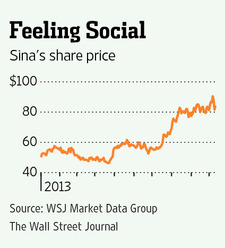
Investors in Sina, Which Owns Chinese Twitter Rival Weibo, May Be Putting Too Much Faith in the U.S. Company’s Looming Stock-Market Debut

AARON BACK

MI-BY995_WEIBOH_NS_20131009180307

Sina SINA +3.28% has been sharing in the excitement over Twitter’s planned initial public offering. But investors may be getting ahead of themselves. Sina’s Weibo is the dominant microblog platform in China, where Twitter is blocked by Beijing’s firewall. The hope is that a handsome valuation for Twitter would imply even greater riches for Sina. Yet the two services may not be all that comparable. Twitter says it had 218 million monthly active users at the end of June. Weibo releases a different metric of 54 million daily active users, but Credit Suisse CSGN.VX -0.65% estimates in a note that its monthly number is 81 million. Read more of this post

Why a graveyard owner in China is turning its cemeteries into a public company

Why a graveyard owner in China is turning its cemeteries into a public company

By Gwynn Guilford @sinoceros October 9, 2013

As plum real estate in China grows scarce and prices soar, it isn’t just luxury condo buyers who are paying out the nose to secure a plot of soil. Shrinking land supply and booming demand are driving a boom in China’s burial business. In Shanghai, for instance, a plot of land near its downtown sold for $3.5 billion in early September—about 37,300 yuan per square meter. Meanwhile, China’s population is aging fast; its 119 million citizens aged 65 and over as of 2010 will more than double by 2050.  Read more of this post

The new gas guzzler; China’s status as the top oil importer will push it to become more engaged in global security

October 9, 2013 7:07 pm

The new gas guzzler

By Ed Crooks and Lucy Hornby

China’s status as the top oil importer will push it to become more engaged in global security

The world has just passed a historic milestone: China has overtaken the US as theworld’s largest oil importer. After decades as the world’s biggest market for the international oil trade, America is ceding that position, the US Energy Information Administration said this week. The implications for international relations and global security are profound. The predictable element in the equation is the inexorable growth in Chinese oil demand, as the world’s most populous nation slowly approaches the standard of living of Europe, the US and its more prosperous Asian neighbours. Read more of this post

The collection and use of social maintenance fees have become a hotbed of rent-seeking and corruption in China

Audit Finds Rampant SMF Irregularities

10-08 14:47 Caijing

The collection and use of SMFs have become a hotbed of rent-seeking and corruption, and a convenient source of income for corrupt officials.

By staff reporters Shu Taifeng and Li Qiyan

The findings of a recent audit by the National Audit Office (NAO) of the management and usage of social maintenance fees (SMFs) were published Sept. 18, which is a first since SMF came into being 11 years ago. The partial audit of one municipality, eight provinces and 45 counties took stock of SMFs local governments collected from 2009 through May 2012, which totaled US$ 2.81 billion. Read more of this post

Sip of Death Plagues Cancerous River Villages; Polluted rivers in three provinces have been linked to high death rates in China’s ‘cancer villages’

10.09.2013 17:33

Sip of Death Plagues Cancerous River Villages

Polluted rivers in three provinces have been linked to high death rates in China’s ‘cancer villages’

By staff reporters Xie Haitao and Liu Hongqiao, and intern reporters Huang Jin and Zhang Xia

(Beijing) — Cancer is claiming fewer lives these days, and Dr. Wang Shiren says he’s been caring for a steadily declining number of patients suffering from gastrointestinal disorders. Yet a decades-long health calamity continues to grip Huangmengying, a Henan Province community of about 2,500 straddling the Huai River, where Dr. Wang practices and researchers have been monitoring conditions for at least eight years. Read more of this post

New version of Quotations from Chairman Mao, the world’s second most published book, to hit Chinese shelves in November

Mao’s Little Red Book to get revamp

New version of Quotations from Chairman Mao, the world’s second most published book, to hit Chinese shelves in November

Tania Branigan in Beijing

The Guardian, Friday 27 September 2013 15.54 BST

Chinese singers perform with their copies of the Little Red Book in hand

Chinese singers perform with their copies of the Little Red Book in hand in 1971. Photograph: Frank Fischbeck/Time & Life Pictures/Getty Image

It will not be especially little, and the cover will be only partly red. But a new version of the world’s second most published book is due to appear on Chinese shelves, decades after it fell from favour with the end of Maoism. The re-emergence of Quotations from Chairman Mao – better known as the Little Red Book – comes amid an official revival of the era’s rhetoric.China‘s leader, Xi Jinping, has embraced Maoist terminology and concepts, launching a “mass line rectification campaign” and this week even presiding over a televised self-criticism session. Read more of this post

China’s ChiNext Board, a Nasdaq-style index tailored for growth enterprises, is facing increasing bubble risk in a profit frenzy

ChiNext faces bubble risk

English.news.cn   2013-10-10 14:09:57

BEIJING, Oct. 10 (Xinhua) — China’s ChiNext Board, a Nasdaq-style index tailored for growth enterprises, is facing increasing bubble risk in a profit frenzy, the China Business News reported on Thursday. During Wednesday’s trading, the ChiNext Index hit a historical high of 1,418.48 points before retreating slightly to close 2.03 percent up at 1,415.83 points. Compared to the start of the year, the index has increased more than 98 percent. Read more of this post

China Shadow Banking Sector may Hit $3.35Trl, Says Govt. Think Tank; JPMorgan’s chief China economist estimates China’s shadow banking sector is as large as 36 trillion yuan ($5.86 trillion)

China Shadow Banking Sector may Hit $3.35Trl, Says Govt. Think Tank

10-09 14:23 Caijing

The figure equals to 40 percent of gross domestic products and 16 percent of total banking assets in China. China’s shadow banking sector could be valued at 20.5 trillion yuan ($3.35 trillion) at the least at the end of last year, compared with an official figure of 14.6 trillion yuan ($2.39 trillion), according to a government think tank report. The size of the shadow banking sector has been expanding quickly since 2010, said the report, released by the Chinese Academy of Social Sciences on Tuesday. Read more of this post

China is raising the hurdles for foreign banks, more than tripling the amount of capital that new entrants to the country must post and limiting the derivatives operations of those already on the ground

October 9, 2013 10:19 am

China raises hurdles for foreign banks

By Simon Rabinovitch in Shanghai

China is raising the hurdles for foreign banks, more than tripling the amount of capital that new entrants to the country must post and limiting the derivatives operations of those already on the ground. But at the same time, the Chinese regulator also has offered foreign lenders much-desired clarification about how they can sell bonds in the domestic market, issue credit cards and offer overseas investment products to their clients on the mainland. Read more of this post

China enters vaccine Premier League; A Chinese vaccine company has for the first time won international regulatory approval for one of its products, paving the way for its widespread distribution in other parts of the world

China enters vaccine Premier League

Oct 9, 2013 7:53pm by Peter Vanham

It’s a good day for global health – and a good day for China National Biotec group, a leading Chinese vaccine manufacturer. One of CNBG’s vaccines on Wednesday got “pre-qualified” by the World Health Organization for use all around the world, a first for a Chinese company. But more remarkable than the news itself was the way this was achieved. First, some background. The newly approved vaccine prevents Japanese encephalitis. That is a disease which can be found in vast parts of Asia, including India, Southeast Asia and China, and is a major cause of death there, especially among children. In all, about 4bn people live in JE affected areas. Read more of this post

Dating app Paktor chats up Southeast Asia

Dating app Paktor chats up Southeast Asia

October 9, 2013

by Phoebe Magdirila

paktor

Dating apps are gaining ground in Asia, but not many of them are homegrown. Singapore-based startupPaktor has arrived to fill the gap. Only a month after launching in Thailand, it now lands in Vietnam, Philippines, Hong Kong, Malaysia, Taiwan, South Korea and India. Paktor aims to be Asians’ go-to app when they want to make new friends – or better yet, find a date. Read more of this post

Myanmar Unrest Raises Stakes for Growing Tourist Industry

Myanmar Unrest Raises Stakes for Growing Tourist Industry

By Agence France-Presse on 5:12 pm October 7, 2013.
Thandwe. Recent anti-Muslim bloodshed close to Myanmar’s most popular tourist beach raises the stakes for an industry dependent on the former pariah state’s fluid transition to democracy. Several days of tension spilled into bloodshed on Tuesday in the western state of Rakhine, where Buddhist mobs killed six Muslims and burned dozens of homes in the latest outburst of violence in the strife-torn region. Read more of this post

Time to trim back the hedge funds

October 8, 2013 6:12 pm

Time to trim back the hedge funds

Thanks to institutional interest, the sector is too big

Astriking feature of the post-crisis period has been the resilience of the hedge fund industry. In spite of their exorbitant fee structure and less than stellar performance – the average fund has returned just 4.5 per cent per annum since 2009, according to Hedge Fund Research – these investment vehicles continue remorselessly to expand. They now boast some $2.4tn under management, more than on the eve of the crisis six years ago. Read more of this post

The great diversification bait and switch: We’ve been looking recently at the false promises of a zombie hedge fund industry

The great diversification bait and switch

Dan McCrum

| Oct 09 15:10 | 10 comments | Share

We’ve been looking recently at the false promises of a zombie hedge fund industry. Now let’s widen the lens a little to take in asset management more broadly, and the self-interested warping of a concept at the heart of investing. Start with this terrific piece from Bloomberg, about how investors have been gulled by the supposedly respectable brokers of Wall Street selling investment products known as managed futures. Read more of this post

Food stamp recipients fret as stimulus boost ends

Food stamp recipients fret as stimulus boost ends

This Tuesday, Oct. 8, 2013 photo shows Jennifer Donald, whose family receives money from the Supplemental Nutrition Assistance Program also known as food stamps, helping her sleeping son Donovan, 4, out of her minivan in Philadelphia. Families already buffeted by difficult economic times will see their food stamps benefits drop Nov. 1 as money allocated by the 2009 federal stimulus plan runs out. The average family of four will see benefits drop by $36 a month, a tough hit at a time when child poverty is climbing and Congress is debating a major cut to the Supplemental Nutrition Assistance Program. (AP Photo/Matt Rourke)

2 hours ago  •  By RIK STEVENS

A temporary increase in food stamps expires Oct. 31, meaning for millions of Americans, the benefits that help put food on the table won’t stretch as far as they have for the past four years. Food stamps _ actually the Supplemental Nutrition Assistance Program _ go to 47 million Americans a month, almost half of them children and teenagers. “Every week is a struggle as it is,” said Heidi Leno, 43, who lives in Concord with her husband, 9-year-old daughter and 5-year-old twins. “We hate living paycheck to paycheck and you have to decide what gets paid.” Read more of this post

Prominent US astronomers are boycotting a NASA meeting next month on exoplanets because Chinese scientists have been banned from attending

Ban on Chinese sparks scientists’ boycott of NASA meeting

October 10, 2013

nw-wd-space-20131009212603270852-620x349

The final frontier: China’s first female astronaut Liu Yang leaves the re-entry capsule of a Shenzhou-9 spacecraft in Inner Mongolia in June last year. Photo: Xinhua

Prominent US astronomers are boycotting a NASA meeting next month on exoplanets because Chinese scientists have been banned from attending, experts say. The restriction is based on a law passed in 2011 and signed by President Barack Obama that prevents NASA funds from being used to collaborate with China or host Chinese visitors at US space agency facilities. Among those leading the boycott are Debra Fischer, an astronomy professor at Yale University, and Geoff Marcy, an astronomy professor at the University of California, Berkeley. ”In good conscience, I cannot attend a meeting that discriminates in this way. The meeting is about planets located trillions of miles away, with no national security implications,” Professor Marcy wrote in an email to the organisers. Read more of this post

Jack Dorsey was 29 and unemployed … then he built Twitter

Jack Dorsey was 29 and unemployed … then he built Twitter

October 10, 2013 – 12:14PM

Will Oremus

Jack Dorsey: Turned down for a job at a shoe store shortly before Twitter. Photo: Flickr/Jack Dorsey

The New York Times has published an excerpt from tech reporter Nick Bilton’s forthcomingbook about the early days of Twitter. Those in search of juicy anecdotes and a Zuckerbergian anti-hero figure in the Twitter origin myth will not be disappointed. I won’t keep you in suspense: it’s Jack Dorsey. In the course of Bilton’s excerpt, Dorsey goes from a shiftless New York University drop-out with a nose ring to a backstabbing climber to a disastrous manager to being forced out of Twitter and considering a job at rival Facebook to … well, just read the thing. But what stuck out to me about Dorsey, amid the parallels to Steve Jobs and Mark Zuckerberg, was that his is a more quintessential Silicon Valley rags-to-riches story than either of theirs. And it’s a quintessentially millennial story at that. Jobs was out of Reed College just a couple of years before founding Apple at age 21. Zuckerberg founded Facebook from a Harvard dorm room at age 19. Dorsey, on the other hand “was a 29-year-old New York University drop-out who sometimes wore a T-shirt with his phone number on the front and a nose ring”, writes Bilton. “After a three-month stint writing code for an Alcatraz boat-tour outfit, he was living in a tiny San Francisco apartment. He had recently been turned down for a job at Camper, the shoe store.” Then Evan Williams, the Blogger co-founder and then chief executive of Odeo, the start-up that would become Twitter, walked into the coffee shop where Dorsey was blaring punk rock on his laptop headphones. “Dorsey, who was shy after battling a speech impediment as a child, was reluctant to introduce himself personally. Instead, he opened his resume on his computer, deleted any signs of his desire to work for Camper shoes, found Williams’ email address online and sent a message to see if Odeo was hiring. Williams, whose investment in Odeo had turned him into the company’s CEO, soon called him in for an interview. He and [co-founder Noah] Glass, both college drop-outs themselves, preferred rabble-rousers to Stanford grad students and Dorsey, with his nose ring and dishevelled hair, seemed like a perfect fit.” Dorsey was hired, worked with Glass to develop Twitter, brutally betrayed Glass, and eventually remade himself as the dashing public face of the hottest social-media start-up since Facebook. He’s now Twitter’s chairman and the CEO of Square, the mobile-payments company. When he tweets that he’s in New York, Michael Bloomberg tweets “Welcome back!” Good thing he didn’t get that gig at Camper shoes.

General Electric has announced partnerships with AT&T, Cisco and Intel to expand its industrial internet service that allows its customers to analyse data and predict outcomes

Corporate giants expand industrial internet

October 10, 2013 – 9:47AM

General Electric has announced partnerships with AT&T, Cisco and Intel to expand its industrial internet service that allows its customers to analyse data and predict outcomes. The service helps customers analyse industrial “big data” – data so large that it is difficult to process using traditional database and software. This would help customers minimise downtime, increase productivity, lower fuel costs and reduce emissions. By connecting machines to the network and the cloud, workers can track, monitor, and operate GE’s machinery wirelessly from anywhere through secure and machine-to-machine communications, GE Software’s corporate officer Bill Ruh said. GE has existing partnerships with Amazon Web Services, Accenture and Pivotal to support the service. GE said the ten “predictivity” products it launched last year have contributed revenue of $US290 million ($307 million) so far this year. The company said it has 14 new customers for the 14 products launched on Wednesday. According to technology research group Wikibon, industrial data is expected to grow at two times the rate of any other big data segment over the next decade.

Behind the Best Innovations: Obvious, Annoying Problems; Like Square and Uber, Nest Seeks to Reinvent the Mundane

October 9, 2013, 2:39 p.m. ET

Behind the Best Innovations: Obvious, Annoying Problems

Like Square and Uber, Nest Seeks to Reinvent the Mundane

FARHAD MANJOO

MK-CG933_HIGHDE_D_20131009191941 MK-CG932_HIGHDE_D_20131009191820

The Nest Learning Thermostat programs itself and automatically saves energy when you’re away. Nest’s ‘smart’ smoke detector

Two years ago, Nest, a start-up founded by a group of ex-Apple AAPL +1.17%engineers and designers, unveiled a “smart” home thermostat. Folks in the tech industry responded with a familiar, collective two-step. First, puzzlement: A thermostat? Who buys thermostats? And then, when they got a chance to see the Nest in action, there was respectful envy: A thermostat! Of course! There had been Internet-connected thermostats before Nest’s version, just as there had been digital music players before the iPod. But like Apple Inc.’s music player, the Nest thermostat was so much more clever than anything else on the market that it seemed a reinvention of the entire industry. Read more of this post

IMF: Premature Fed Exit Could Fuel $2.3 Trillion in Global Bond Losses

October 9, 2013, 8:59 a.m. ET

IMF: Premature Fed Exit Could Fuel $2.3 Trillion in Global Bond Losses

IAN TALLEY

WASHINGTON—A premature exit by the U.S. Federal Reserve from its easy-money policies could cause $2.3 trillion in global bond portfolio losses, the International Monetary Fund warned Wednesday. Although the IMF assumes in its latest economic forecasts that the U.S. central bank will unravel its policies at a tempered pace, the fund said the market’s volatile reaction to Fed exit comments earlier this year show there is still a risk of moving too fast. Read more of this post

How a Treasury Default Could Trigger a Money Market Meltdown

Oct 9, 2013

How a Treasury Default Could Trigger a Money Market Meltdown

MICHAEL J. CASEY

If, God forbid, the U.S. Treasury is forced to default on its obligations next week, the first ripples in a rapidly expanding financial crisis will be felt in an obscure but giant sector of the short-term credit markets. There, in the $5 trillion-a-day repo market – more formally known as the securities repurchase market – Treasury securities are treated as the equivalent of currency. In tapping it, large Wall Street dealer banks work on the assumption that they can turn their inventory of U.S. government bonds into cash at any given moment, simply by offering the bonds up as collateral to money-market funds and other lenders that participate in this giant short-term funding market. If for just one of those securities this liquidity is turned off, those assumptions go out the window. The ramifications are enormous. Read more of this post

Brazil hikes interest rates fifth time to 9.5%, no sign of stopping

Brazil hikes interest rates fifth time, no sign of stopping

7:43pm EDT

By Luciana Otoni

BRASILIA, Oct 9 (Reuters) – Brazil raised interest rates for the fifth straight time on Wednesday and gave no indication of backing off its battle with high inflation even as Latin America’s largest economy struggles to pick up speed. The central bank raised its benchmark Selic interest rate to 9.5 percent from 9.0 percent as expected by all but two of the 65 economists polled by Reuters last week. Read more of this post

How Going Free Can Bring Profits

October 9, 2013, 4:15 p.m. ET

How Going Free Can Bring Profits

BEN ROONEY

Here is a paradox. The most popular app in the Apple store, Candy Crush Saga, is free. The game’s maker, London-based King, hasn’t disclosed revenue numbers, but its holding company, Midasplayer International Holding Co., is widely reported to be planning an IPO soon—suggesting it thinks it can make money, or at least convince investors that it can. But if free can be so lucrative, why has the newspaper industry, large parts of which have been giving away content for years, been ravaged? Likewise, the music industry, which didn’t so much give its content away free as have it stolen, saw revenues more than halve in the decade from 1999, from $14.6 billion to just $6.3 billion, according to a Forrester Research Inc. report. Read more of this post