Who You Calling a BRIC?

Who You Calling a BRIC?

I spent last week in Indonesia, working on a series for BBC Radio about four of the world’s most populous non-BRIC emerging economies. The BRIC countries — Brazil, Russia, India and China — are already closely watched. The group I’m studying for this project — let’s call them the MINT economies — deserve no less attention. Mexico, Indonesia, Nigeria and Turkey all have very favorable demographics for at least the next 20 years, and their economic prospects are interesting. Read more of this post

Ex-Bank Executive May Face Death in Vietnam Fraud Trial

Ex-Bank Executive May Face Death in Vietnam Fraud Trial

A Vietnam court will consider the death penalty for two former executives if they’re convicted in a $25 million fraud scheme, signaling an aggressive stance as leaders seek to clean up the banking system. The People’s Court of Ho Chi Minh City may hand down the death penalty for Vu Quoc Hao, the former general director of Agribank Financial Leasing Co. (FLKO) No. 2, who is charged with embezzling 531 billion dong ($25 million) of state property, the official Vietnam News reported yesterday. Dang Van Hai, the former chairman of a construction company, also faces the death penalty in the case, the newspaper said. Read more of this post

Korean subcontractor of Singapore’s Downtown MRT line goes bankrupt

PUBLISHED NOVEMBER 12, 2013

SMEs stranded as rail sub-contractor goes bust

$2m cheques issued by Samdaiyang Development to local firms bounce

MINDY TAN TANMINDY@SPH.COM.SG

Just months after a Downtown line main contractor went bust, a sub-contractor working on another part of the rail network has also become insolvent – PHOTO: SPH

[SINGAPORE] Just months after a Downtown line main contractor went bust, a sub-contractor working on another part of the rail network has also become insolvent. This has left a handful of small and medium-sized enterprises (SMEs) in Singapore holding some $2 million in bounced cheques. Read more of this post

Indonesia Rate Rise Signals No Current-Account Relief for Rupiah

Indonesia Rate Rise Signals No Current-Account Relief for Rupiah

Indonesia’s surprise interest-rate increase signals a wider-than-anticipated current account gap that threatens to deepen the rupiah’s three-week plunge, according to United Overseas Bank Ltd. and Barclays Plc. The rupiah, Asia’s worst performing currency this year, has tumbled 5.7 percent to 11,596 per dollar since trading at a seven-week high Oct. 25. In a move that was predicted by only one of 25 analysts surveyed by Bloomberg, Bank Indonesia raised the reference rate to a four-year high of 7.5 percent yesterday, a day before officials are slated to release third-quarter current account figures. Read more of this post

M’sia lost nearly 2 trillion litres of water in 2012

M’sia lost nearly 2 trillion litres of water in 2012

Wednesday, November 13, 2013 – 10:26

Patrick Lee

The Star/Asia News Network

PETALING JAYA – Leaky, ageing pipes are taking a huge toll on the country, with close to two trillion litres of treated water lost to seepage, poor water quality and frequent disruptions at the consumer end. And it’s going to get worse. Much of the problem lies in the 43,890km of ageing pipes around the country. Made of asbestos-cement (AC), these pipes were installed in vast numbers decades ago. Read more of this post

Miner to Pay in Bitcoins for Work at Tungsten Project

Miner to Pay in Bitcoins for Work at Tungsten Project

A Canadian mining company agreed to pay a contractor in Bitcoins for exploration work to be carried out at a property that contains tungsten. Alix Resources Corp. (AIX) said today in a statement it will pay Ridge Resources Ltd. for the work at its Windy property about 15 kilometers (9 miles) north of Cassiar, British Columbia. Read more of this post

Venezuela Bonds Plunge as Military Takes Over Electronics Store to quell inflation that’s soared above 50 percent

Venezuela Bonds Plunge as Military Takes Over Electronics Store

Venezuelan bonds tumbled, sending yields to a 22-month high, after President Nicolas Maduro dispatched the military to take over a retail chain as part of his effort to quell inflation that’s soared above 50 percent. The country’s benchmark bonds due 2027 fell 3.9 cents to 72.1 cents on the dollar as Maduro’s seizure of electronics retailer Daka and his warnings to other businesses to cut prices to “fair” levels deepened investor concern that growth is being choked off by government controls. Yields on the bonds soared 0.79 percentage point to 13.82 percent, the highest since January 2012, at 3:19 p.m. in New York. Read more of this post

Buffett’s favorite market tool is flashing red

Buffett’s favorite market tool is flashing red

This little-known valuation metric has entered familiar territory. Here’s why investors should share the Oracle of Omaha’s concerns — and how they can protect themselves.

By David Sterman

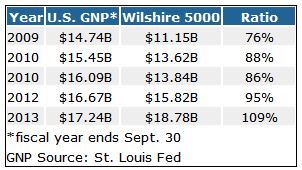
Sterman_Table_11-6-13

In the go-go days of 1999, Warren Buffett grew very concerned. Not because his value style of investing had grown unpopular, but because investors were becoming delusional in their zeal for further gains. In a speech he made to friends, as recounted in a 1999 article in Fortune magazine (that was published just a few months before the market peaked and then plunged), Buffett warned that “once you reach the point where everybody has made money no matter what system he or she followed, a crowd is attracted into the game that is responding not to interest rates and profits but simply to the fact that it seems a mistake to be out of stocks.” A simple test of how much stocks were loved: The aggregate value of the largest 5,000 U.S. companies (as measured by the Wilshire 5000) exceeded the GNP of the U.S. economy. In fact, a market melt-up took this ratio up to 150% by early 2000 (meaning the Wilshire 5000 was 50% larger than the U.S. economy), which set the stage for one of the most painful corrections ever for investors. Read more of this post

The rules of innovation can be flexible; For almost every insight, there is an opposite approach

November 11, 2013 3:44 pm

The rules of innovation can be flexible

By Andrew Hill

For almost every insight, there is an opposite approach

If a destination’s desirability is measured by the number of maps that claim to lead you to it, innovation is the corporate world’s Taj Mahal. Among the manuals on sale is an Innovator’s Guide, a Cookbook, a Toolkit, a Path, a Way, a Handbook and a Manifesto. My addition to the genre would be The Innovator’s Contradictions. Insights gleaned from last week’s FT Innovate conference suggest that, for almost every rule of innovation, there is an innovator who has made a breakthrough – and a fortune – flouting it. Here are seven examples. Read more of this post

‘Invisible’ Bike Helmets Are A Real Thing Now

‘Invisible’ Bike Helmets Are A Real Thing Now

THEJOURNAL.IE NOV. 11, 2013, 6:00 PM 15,669 10

Are you a cyclist who is also concerned about how you look while cycling around town? If so, then two Swedish industrial design students have solved your problem and have created an “invisible helmet” for cyclists. Bike helmets are a very important safety feature, especially for those who cycle around a busy city where both drivers and pedestrians can be a problem. But there is no denying that it can be difficult to find a stylish bike helmet and then there is the issue of the helmet hair. The idea for the invisible helmet came to life in 2005 as part of a Masters’ thesis, when Anna Haupt and Terese Alstin were studying industrial design at the University of Lund.The Hövding (invisible helmet) is actually an air bag, which uses a helium gas cylinder to inflate when its sensors detect a sudden jolt. The helmets are also CE labelled, which means they comply with EU safety standards and have undergone a variety of safety tests.

Machiavelli: A Renaissance Life; The often-vilified Renaissance politico and author of The Prince comes to life as a diabolically clever, yet mild mannered and conscientious civil servant

Machiavelli: A Renaissance Life Paperback

by Joseph Markulin  (Author)

download (31)
The often-vilified Renaissance politico and author of The Prince comes to life as a diabolically clever, yet mild mannered and conscientious civil servant. Author Joseph Markulin presents Machiavelli’s life as a true adventure story, replete with violence, treachery, heroism, betrayal, sex, bad popes, noble outlaws, deformed kings, menacing Turks, even more menacing Lutherans, unscrupulous astrologers, untrustworthy dentists—and, of course, forbidden love. While sharing the stage with Florence’s Medici family, the nefarious and perhaps incestuous Borgias, the artists Leonardo da Vinci and Michelangelo, and the doomed prophet Savonarola, Machiavelli is imprisoned, tortured, and ultimately abandoned. Nevertheless, he remains the sworn enemy of tyranny and a tireless champion of freedom and the republican form of government. Out of the cesspool that was Florentine Renaissance politics, only one name is still uttered today—that of Niccolo Machiavelli. This mesmerizing, vividly told story will show you why his fame endures. Read more of this post

A novelistic biography makes Machiavelli into a Renaissance Zelig. He cracks Leonardo’s code! He listens to Michelangelo kvetch!

Book Review: ‘Machiavelli’ by Joseph Markulin

A novelistic biography makes Machiavelli into a Renaissance Zelig. He cracks Leonardo’s code! He listens to Michelangelo kvetch!

DAVID POLANSKY

Nov. 11, 2013 6:50 p.m. ET

The life of a great thinker presents unique challenges to a would-be biographer. Actions and events are the stuff of biographies, yet thoughts, not deeds, are what chiefly make the thinker of interest to us. As Heidegger reportedly said of Aristotle: “He lived, he wrote, he died.” Niccolò Machiavelli is that rare exception. To paraphrase “The Princess Bride,” his story gives us fighting, torture, poison, revenge, bad men, good men, conspiracies and miracles. All of which is to say that Machiavelli is more suited than most great thinkers for the novelistic treatment he receives in Joseph Markulin’s “Machiavelli: A Renaissance Life.” That this format is less successful than Sebastian de Grazia’s similarly idiosyncratic biography, “Machiavelli in Hell” (1989), is largely due to Mr. Markulin’s inability to manifest the great man’s ideas—to which all the dramatic episodes are secondary. Read more of this post

Black gold: A hundred years after the first excavations, the asphalt pools at Rancho La Brea, in Los Angeles, are still filling in details of life in the Pleistocene

Black gold: A hundred years after the first excavations, the asphalt pools at Rancho La Brea, in Los Angeles, are still filling in details of life in the Pleistocene

Nov 9th 2013 | Los Angeles |From the print edition

20131109_STP002_0

TO A parched mammoth or giant sloth, they must have looked heaven-sent: mirror pools of water waiting to slake a thirst. Heaven, however, was not their progenitor, for the pools were traps. Below their siren surfaces lay not mud, but tar. For thousands of years they lured thirsty animals, and also hungry ones—carnivores attracted by the calls of those already stuck—to their doom. Read more of this post

Foreigners Share What They Find Most Surprising About America

Foreigners Share What They Find Most Surprising About America

MADELINE STONE NOV. 11, 2013, 3:12 PM 20,435 31

The U.S. has historically had a huge immigrant population. But what makes American culture different from the countries immigrants are leaving? Foreigners, as well as others who happen to know people who are new to the U.S., have been using this Quora thread to share what they think makes America unique. Their answers to the question “What facts about the United States do foreigners not believe until they come to America?” were pretty fascinating. We’ve picked out some especially interesting tidbits.  Read more of this post

Iran’s supreme leader built a real estate empire on seized property

Iran’s supreme leader built a real estate empire on seized property

By Tim Fernholz @timfernholz 6 hours ago

When we found out that Iran had secretly owned a Manhattan skyscraper for decades, we knew the country’s rulers had a talent for moving money, but a new Reuters investigation has revealed a $95 billion corporate empire controlled by Iran’s supreme leader, Ayatollah Ali Khamenei. At least some of that revenue comes from the confiscation of property from religious minorities and other presumed enemies of the state, Reuters reports, and the organization, known in Farsi as Setad Ejraiye Farmane Hazrate, provides Iran’s supreme leader with significant economic clout and independence from the elected government. Iran’s parliament even declared that it would be prohibited from exercising any oversight over the Khamenei’s business interests in 2008. Read more of this post

Pay writers or we’ll pull ads, National Library tells arts website

Pay writers or we’ll pull ads, National Library tells arts website

November 12, 2013 – 12:05PM

Ben Butler

The National Library of Australia has threatened to pull its advertising from a new arts website run by Eric Beecher’s Private Media group unless it starts paying its writers. The Daily Review, an offshoot of Private Media’s popular website Crikey, launched yesterday amid controversy over its decision not to pay for contributions. In an open letter, arts writers, many of whom already write for blogs run by Crikey, have asked others not to contribute to the new site for free. Read more of this post

Managing Complexity Is the Epic Battle Between Emergence and Entropy

Managing Complexity Is the Epic Battle Between Emergence and Entropy

by Julian Birkinshaw  |   11:00 AM November 11, 2013

The business news continues to be full of stories of large companies getting into trouble in part because of their complexity. JP Morgan has been getting most of the headlines, but other banks are also investigation. And many companies from other sectors, from Siemens to GSK to Sony, are under fire. It goes without saying that big companies are complex. And it is also pretty obvious that their complexity is a double-edged sword. Companies are complex by design because it allows them to do difficult things. IBM has a multi-dimensional matrix structure so that it can provide coordinated services to its clients. Airbus has a complex process for managing the thousands of suppliers who contribute to the manufacturing of the A380. Read more of this post

Myanmar princess lives ordinary life

Myanmar princess lives ordinary life

MYANMAR-ROYALS-HISTORY

Tuesday, November 12, 2013 – 03:00

The New Paper

MYANMAR – In a modest Yangon apartment, the granddaughter of Myanmar’s last king lives simply and unrecognised by her neighbours. Princess Hteik Su Phaya Gyi (above), 90, said the childhood days when her family retained some of its royal status were now a distant memory. The British colonial regime dethroned her grandfather, King Thibaw in 1885. The military junta, which ruled the country for decades, kept the family out of the public eye. Read more of this post

Goodbye to ‘Delhi belly’ with safe street food zone

Goodbye to ‘Delhi belly’ with safe street food zone

INDIA-ECONOMY-STREET-FOOD

Tuesday, November 12, 2013 – 08:15

Nirmala Ganapathy

The Sunday Times

India is known for its many beautiful tourist attractions, from Mughal-era tombs to colonial buildings and national parks. It is also known for a not-so- beautiful condition named “Delhi belly”, the tummy upset that has often befallen the unsuspecting traveller. Drinking only bottled water and avoiding street food are some tips that travellers are given to avoid getting sick. Read more of this post

Honesty That Benefits All

NOVEMBER 11, 2013, 10:55 AM

Honesty That Benefits All

By DOUG STEINER

It seems that headlines too often highlight the bad deeds of players in financial markets. There are insider trading scandals. Traders collude on interest rate manipulation. Executives backdate options. We often hear the excuse, “Everyone else was doing it, so I didn’t think it was wrong.” So if jail won’t keep people from committing illegal acts, what will? Economists of a newer breed say they believe they have some answers. Read more of this post

What’s Behind the Green Juice Fad? Carrying a bottle of vegetable juice has become a status symbol

What’s Behind the Green Juice Fad?

Carrying a bottle of vegetable juice has become a status symbol

Suja’s Annie Lawless, co-founder, and Jeff Church, CEO, at the cold-pressed juice company’s San Diego operation Sandy Huffaker for The Wall Street Journal

KATHERINE ROSMAN

Nov. 11, 2013 7:23 p.m. ET

OG-AA388_Juice2_G_20131111210402PJ-BR578_JUICEj_G_20131111172601

The price of vegetable, fruit and superfood juice is beginning to approach that of expensive liquor. Katie Rosman joins Lunch Break with a look at the growing market for premium juice, and whether the health claims hold up. Photo: BluePrint.

How much will consumers pay for healthy-in-a-bottle? As much as $10 and sometimes more. At least that’s the belief of high-end grocers likeWhole Foods Market WFM -1.28% and a spurt of small juice companies trying to move the cold-pressed-juice craze from small-batch to mass-produced. A 16-ounce bottle of BluePrint Red, containing beets, carrots and ginger, among other ingredients, goes for $10 at some retailers. And Whole Foods customers are paying $9 for a bottle of celery-based Twelve Essentials vegetable juice, one of the top-sellers from Suja, an 18-month-old juice brand based in San Diego. Suja co-founder Annie Lawless says customers understand the high cost of what goes into the bottle, including organic produce that is cold pressed and then preserved using a process that leaves most of the nutrients intact. “When you buy a bottle, you’re getting all the goodness without any of the effort,” says Ms. Lawless, a 26-year-old former law student and yoga instructor. The company says it generated $20 million in revenue in its first year. Read more of this post
Charterhouse Heirs Struggle to Maintain Bonnyman Legacy

Charterhouse Heirs Struggle to Maintain Bonnyman Legacy

Charterhouse Capital Partners LLP, Britain’s oldest buyout firm, posted some of the industry’s biggest returns after spinning out of HSBC Holdings Plc. (HSBA) Handing off that legacy to the new generation is proving harder. While its London-based competitors expanded across Europe, Charterhouse operated from a single office in the shadow of St. Paul’s Cathedral, betting that a tight-knit culture would produce stronger returns. The strategy worked, with results surpassing CVC Capital Partners Ltd., Europe’s biggest private-equity firm, according to data compiled by Bloomberg. Read more of this post

Privatization should occur ‘carefully’ in China

Privatization should occur ‘carefully’

Updated: 2013-11-12 02:53

By Mike Bastin ( China Daily) Read more of this post

Name Game in Shanghai Trade Zone; Supposed to Make Things Easier, a Reform Testing Ground Has Firms Lining Up for Days to Register

Name Game in Shanghai Trade Zone

Supposed to Make Things Easier, a Reform Testing Ground Has Firms Lining Up for Days to Register

JAMES T. AREDDY

Nov. 11, 2013 7:48 p.m. ET

SHANGHAI—On a recent morning, Kitty Zhang stood in high heels and a pink blazer poised to jump into China’s next big business opportunity. But first, she needed a company name—any name. The 21-year-old, hired to register a financial business, is part of a wave of tens of thousands of people over the past month or so seeking to stake a claim in the new Shanghai free-trade zone. Authorities inaugurated the “testing ground for new policies” in late September, identifying it as a reform hub for the 21st century. Read more of this post

Long silent, China’s entrepreneurs push for change

Long silent, China’s entrepreneurs push for change

Long silent, China’s entrepreneurs speak up for rights, reforms, criticize totalitarianism

By Gillian Wong, Associated Press16 hours ago

BEIJING (AP) — As Chinese career trajectories go, wealthy businesswoman Wang Ying’s has taken an unusual turn. She quit her job as head of a private equity fund to become a full-time political critic. Wang, who was a low-profile member of China’s business elite for years, is now a leading voice among entrepreneurs troubled by the growing ranks of business owners who have suffered under the government’s authoritarian excesses and by signs Beijing wants to further tighten its controls on society. Read more of this post

In China, Luxury Is About More Than High-End Labels

In China, Luxury Is About More Than High-End Labels

ASHLEY KINDERGANTHE FINANCIALIST NOV. 11, 2013, 6:15 PM 2,737 1

There was a time, not too long ago, when all a luxury goods maker had to do to make a sale in China was to make sure their label was prominent enough. Customers wanted quality, of course, but what they wanted as much or more was the caché that such a purchase conveyed. Those days are over. Like the Chinese economy itself, the country’s luxury goods sector has matured. What matters now is style—and it matters a whole lot more than you might think. Chinese buyers now account for about a quarter of all global luxury goods sales, a larger share than any other country, according to Credit Suisse’s luxury goods analyst Rogerio Fujimori. The success or failure of a high-end brand now depends as much on satisfying the whims of China’s increasingly discerning consumers as it does on the Fashion Week in New York or Milan. Read more of this post

How China’s Filthy Rich Use Macau To Launder Their Money

How China’s Filthy Rich Use Macau To Launder Their Money

MAMTA BADKAR NOV. 11, 2013, 2:51 PM 3,609 3

A stunning $202 billion in “ill-gotten funds are channeled through Macau each year,” according to The Congressional-Executive Commission on China Annual Report 2013. Diplomatic cables released by Wikileaks claimed that the casino and hospitality sector accounted for over 50% of Macau’s GDP but that, “its phenomenal success is based on a formula that facilitates if not encourages money laundering.” Read more of this post

Fraud at this Chinese bitcoin exchange cost clients $4.1M. Here’s why the broader market barely noticed

Fraud at this Chinese bitcoin exchange cost clients $4.1M. Here’s why the broader market barely noticed

BY MICHAEL CARNEY 
ON NOVEMBER 11, 2013

Bitcoin has come a long way in the last year, but it’s still the wild west in terms of regulation and market stability. China, too, has come a long way economically in recent decades, but remains largely unregulated and could be described as the wild east. So it’s not surprising that the recent surge in popularity (and price) of bitcoin in China would be accompanied by fraud. Read more of this post

Chinese cities investing in ‘skynet’ surveillance networks

Chinese cities investing in ‘skynet’ surveillance networks

Staff Reporter

2013-11-12

Various cities across China are building “skynet” networks that can achieve full coverage of a fixed area with real-time monitoring and recorded video surveillance, reports Duowei News, an outlet run by overseas Chinese. A recent slate of terror attacks, including a high-profile jeep crash in Tiananmen Square in Beijing late last month, has again highlighted the country’s plans to increase public surveillance under the banner of “maintaining social order and combating illegal activity.” Read more of this post

Chinese banks move online to cut out the middleman

Chinese banks move online to cut out the middleman

Staff Reporter

2013-11-12

To cope with the rise of online financial businesses, China’s commercial banks have introduced online platforms one after another, the Beijing-based China Securities Journal reports. Banks have felt the pressure of financial disintermediation brought about by the ocean of data available in the internet era, but at the same time they have been striving to be more competitive by digging deep into mounds of data. Financial disintermediation offers bank customers a means of directly engaging in financial activities without the guidance and support of bank personnel. Read more of this post