Will the emerging market rout get even worse? Watch corporate bonds

Will the emerging market rout get even worse? Watch corporate bonds

By Matt Phillips @MatthewPhillips 7 hours ago

Global investors have suddenly remembered that emerging markets have a rich, recent history of florid financial crises.

The cracks are starting to emerge everywhere: wobbly “wealth management products” in China, the Turkish lira’s tumble, the selloff in Brazilian bond markets and last summer’s mini-rupee crisis. Read more of this post

For Korean-listed companies, new ardor for paying dividends

For listed companies, new ardor for paying dividends

Factors include shift in dominant industries, owner-family issues

Jan 30,2014

image001-8

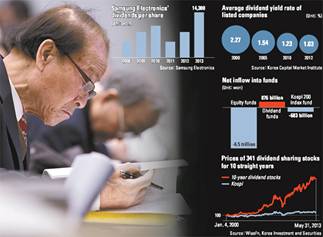
Samsung Electronics will pay dividends of 2.2 trillion won ($2 billion) for the financial year of 2013, a figure 79 percent higher than the previous year.
The company’s intention was to expand dividends to shareholders on a “significant level,” according to a Samsung investor relations manager.
Korean conglomerates are infamous for their stinginess in paying dividends; they have concentrated on growth and performance by reinvesting earnings. Investors didn’t ask for dividends because they also concentrated on corporate performance and higher stock prices.
But investors’ interest in dividends is increasing, and Samsung Electronics’ raising of its dividend rate from 0.5 percent to 1 percent of its annual average stock price is considered proof of that.
The interest in dividend income grew after the 2008-9 global financial crisis, and companies were expected to grow more slowly. As interest on bank deposits dropped to as low as 2 percent, dividends emerged as an alternate source of investment income. Aging investors are another factor.
“As society gets old, demand for stable incomes from dividends is increasing,” said Kang So-hyeon, a researcher at Korea Capital Market Institute.
Dividend funds are being recommended by fund experts, and local investors have bought about 876 billion won ($810 million) worth of these funds.
“Even those conservative investors wedded to bank deposits couldn’t endure the low interest rates anymore and moved on to the so-called income funds, which aggressively invest in overseas stocks with high dividends,” said Hwang Yoon-ah, a researcher from fund evaluator Zeroin.
About 310 billion won was poured into the dividend fund of Shinyoung Asset Management’s after last October, which took the lead among local equity funds. This fund invests in stocks that have been undervalued and offers high dividends. Another investment target is preferred stocks, which pay more dividends than regular stocks. As dividends were strong last year, the return on the Shinyoung fund was as high as 20 percent.
However, the dividend rate of listed companies in Korea averaged 1.03 percent in 2012 compared to 2.01 percent in the United States, 3.71 percent in the United Kingdom and 2.82 percent in Singapore. It is also significantly lower than China’s 3.64 percent.
In the 2000s, Korea’s average dividend rate for companies was 2.27 percent, but it started to drop. Conglomerates like Samsung Electronics and Hyundai Motor, whose profits expanded during the past decade, belong to the IT and consumer goods industries. Conventionally, they tend to pay smaller dividends, and those industries accounted for 52 percent of the stock market capitalization in 2012 compared to 30 percent in 2000.
Meanwhile, high-dividend-paying industries such as utilities accounted for 42 percent of stock market capitalization in 2000, which shrank to 16 percent in 2012.
After the global financial crisis, even those companies that once paid large dividends chose to pile up the profits in order to protect themselves from instability. The total corporate cash reserves of Korea’s top 10 conglomerates’ 82 affiliates that are listed in the stock market was 477 trillion won in 2013, up 44 percent compared to 2010.
Analysts say it will be difficult to ignore the investors’ demand for dividends going forward.
“When corporate growth slows, even those well-off IT companies tend to gradually expand dividends to comfort their investors,” said Oh Eun-soo, a researcher at Hyundai Securities. “Microsoft and Intel are two exemplary cases.”
Oh said that Apple, which just started to pay dividends last year, is in the same boat. When Steve Jobs was alive, Apple used to ignore shareholders’ dividend requests.
“An increasing proportion of institutional investors could also be a reason for growing dividend requests,” said Kang from the Korean Capital Market Institute. centered managements are another factor. “In the Western world, where CEO management is the norm, dividends are a significant tool for major shareholders to collect earnings,” said Park In-hee, securities manager at Shinyoung Asset Management. “In Korea, most conglomerates are directly run by the major shareholders, so they are mainly interested in expanding the corporate body by investing the profit internally, rather than sharing the cash with smaller shareholders.”
Korea’s tax system is also disadvantageous to dividend sharing. Smaller shareholders who profit from dividends are taxed, whereas they do not pay tax for profits gained on trading stocks. Analysts say another factor could accelerate the trend to greater dividends.
“As it is not easy for owner families to pass along their wealth, more families will do so by giving dividends to their children,” a security company head said.
Securities analysts recommend investors do their research into stocks that pay dividends.
“Investors have to distinguish [between] these two goals: obtaining higher dividends and investing in the brand itself,” said Jung Hoon-seok, a researcher at Korea Investment and Securities.
“Dividend stocks” refer to companies that generate constant and relatively high dividends.
According to a Korea Investment and Securities analysis over the past decade, the average stock price increase rate of 341 stocks that paid dividends for 10 straight years was 12 times higher than the index’s increase rate. The 126 dividend stocks in the Kosdaq market showed an increase of 16 times higher than the Kosdaq index’s.
Investors should think about dividend funds in a similar way. Dividend funds last year had high returns because those stocks were strong in the market, not because of large dividends.
“If utility stocks like Korea Electric Power Corporation, which is likely to give out dividends due to the ongoing public enterprise reform measures, make profits, then you could expect increases in the dividend rate,” said Park from Shinyoung Asset Management. “Dividend stocks are an alternative market that has emerged after the settling in of the low-growth trend,” said Oh Eun-soo of Hyundai Securities. “But you should be careful not to invest hastily because these stocks could languish for years as growth stocks are on the rise.”
BY CHO MIN-GEUN [jiyoon.kim@joongang.co.kr
Shanghai Zhenhua Heavy Industries, the world’s largest crane and steel structure manufacturer, supplied 250,000 incorrecly-sized bolts for the new eastern span of the San Francisco-Oakland Bay Bridge in California

Shanghai Zhenhua supplies the wrong bolts to California bridge

Staff Reporter

2014-01-30

Shanghai Zhenhua Heavy Industries, the world’s largest crane and steel structure manufacturer, supplied 250,000 incorrecly-sized bolts for the new eastern span of the San Francisco-Oakland Bay Bridge in California, reports the financial news website of financial market software developer Shanghai Great Wisdom. Read more of this post

Online investment products craze alerts China’s financial sector

Online investment products craze alerts China’s financial sector

Staff Reporter

2014-01-29

Several Chinese internet and fund companies recently launched investment products and promised a return higher than those available in the market by subsidizing investors, reflecting the impact of online operations on traditional banks, the Chinese-language Global Entrepreneur magazine reports. Read more of this post

The Temptation of the Central Bankers: Keeping global megabanks in business and highly profitable has become a key objective for policymakers. All too often, however, this means that central bankers defer to these firms’ executives

JAN 30, 2014

Simon Johnson, a former chief economist of the IMF, is a professor at MIT Sloan, a senior fellow at the Peterson Institute for International Economics, and co-founder of a leading economics blog, The Baseline Scenario. He is the co-author, with James Kwak, of White House Burning: The Founding Fathers, Our National Debt, and Why It Matters to You.
The Temptation of the Central Bankers

WASHINGTON, DC – The banking system has become most central bankers’ Achilles’ heel. This may seem paradoxical – after all, the word “bank” is in their job description. But most people currently at the top of our central banks built their careers during the 1980’s and 1990’s, when the threat of inflation was still very real, so this – rather than bank regulation and supervision – remains a major focus of their intellectual and practical concerns. Read more of this post

Malaysia’s capital city KL celebrates the 40th anniversary of the creation of the Federal Territory

Updated: Friday January 31, 2014 MYT 6:55:32 AM

A birthday wish for Kuala Lumpur

BY BRIAN MARTIN

The city has come of age and won accolades, but there is also room for improvement.

HAPPY Birthday Kuala Lumpur!

Our capital city celebrates the 40th anniversary of the creation of the Federal Territory tomorrow and boy has it come a long way. Read more of this post

Do High Interest Rates Defend Currencies During Speculative Attacks?

Do High Interest Rates Defend Currencies During Speculative Attacks?

by Tyler Cowen on January 29, 2014 at 12:01 am in Current AffairsEconomics | Permalink

That is the question posed by a paper (pdf) by Aart Kraay of the World Bank, written in 2001 and focusing mainly on fixed exchange rate scenarios.  It seems the high rates do not protect currency values, here is the abstract: Read more of this post

Devaluation stations: Et tu China?

Devaluation stations: Et tu China?

Izabella Kaminska

| Jan 30 13:50 | 6 comments Share

Part of the UP SHIBOR CREEK… SERIES

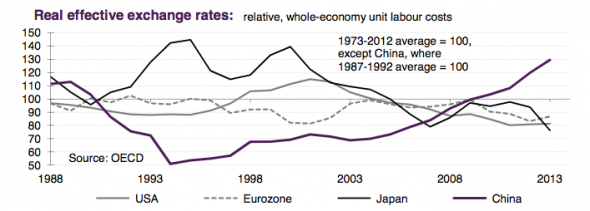
Lombard Street’s Charles Dumas charts the overvaluation of the Chinese currency:

image001-1

As he notes, 2011 was the first year that evidence for an overvalued yuan began to emerge: Read more of this post

What’s a chengyu for ‘subprime is contained’?

What’s a chengyu for ‘subprime is contained’?

Joseph Cotterill

| Jan 28 13:18 | 14 comments Share

There is a nice chengyu in the latest note from Bin Gao, BofAML’s China rates strategist: 居安思危, ‘be prepared’.

Oh yes, and the note also compares this week’s rescue of Credit Equals Gold No.1 to a Bear Stearns moment for China. Read more of this post

Every Leader’s Real Audience

Every Leader’s Real Audience

by Rosabeth Moss Kanter  |   2:53 PM January 30, 2014

You deliver a big public speech to a group of potential investors who can make or break your results. You prepare it knowing that it could be a milestone in the turnaround of your institution. But who else is listening most intently? Your own team of implementers. They couldn’t care less about ringing rhetoric quotable by future generations. They want to know whether to update their resumes or renew their commitment to the work. Read more of this post

Myanmar risk: Alert – Banking reform begins to take shape

Myanmar risk: Alert – Banking reform begins to take shape

January 28th 2014

FROM THE ECONOMIST INTELLIGENCE UNIT

Progress is being made toward opening up the country’s banking sector to foreign involvement, a reform that was first announced last year. However, it will be a challenging process, and one that will prove a tricky balancing act in order to ensure that the local banking system is also adequately developed. Read more of this post

Forget sports and dressing-up – it’s time to put the tea into team-building; The best way to learn to trust one’s colleagues is via daily interactions, such as a cuppa in cyberspace

Forget sports and dressing-up – it’s time to put the tea into team-building

The best way to learn to trust one’s colleagues is via daily interactions, such as a cuppa in cyberspace

By Graeme Archer

8:14PM GMT 17 Jan 2014

One of the most enjoyable aspects of my work can also be one of the most frustrating. My team is spread over four sites in two countries: from North Carolina to Pennsylvania to, er, Uxbridge and Stevenage. Working across the Atlantic is fun, but it can also – in this age of austerity, when air travel is discouraged – make team-building more difficult. Read more of this post

Lenovo CEO on Apple, Samsung: ‘Our mission is to surpass them’; In an interview with Fortune, Yuanqing Yang says that his company seeks to replicate its ThinkPad success with Motorola

Lenovo CEO on Apple, Samsung: ‘Our mission is to surpass them’

By Miguel Helft, senior writer January 30, 2014: 4:01 PM ET

In an interview with Fortune, Yuanqing Yang says that his company seeks to replicate its ThinkPad success with Motorola.

image001-7

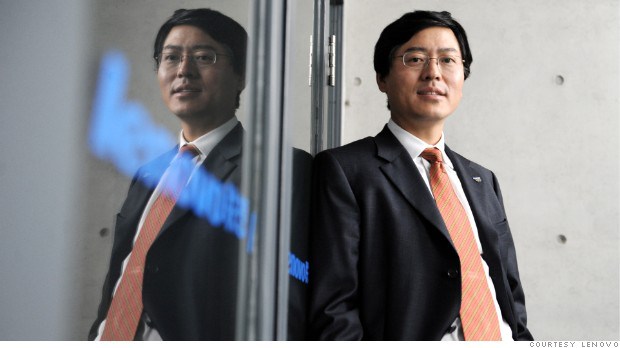
FORTUNE — Fresh from signing a $2.91 billion deal with Larry Page to acquire Google’s Motorola unit, Lenovo CEO Yuanqing Yang spoke to Motorola employees for 45 minutes at the latter company’s headquarters outside of Chicago on Thursday. Immediately after that meeting, Yang discussed the deal and Lenovo’s plans to compete in the smartphone market with Fortune. Read more of this post

5 Ways Great Writing Skills Can Help You Get Ahead

5 Ways Great Writing Skills Can Help You Get Ahead

LEIGH SHULMANCAREER ATTRACTION JAN. 30, 2014, 2:02 PM 1,351 7

Until recently, strong communication was considered a business soft skill, one that might be relegated to the end of your resume along with playing an instrument and speaking Farsi. Now, effective communication is key to business promotion, company marketing, team building and facilitating a healthy company environment. Read more of this post

Dark Side Of Capital In Emerging Markets

Dark Side Of Capital In Emerging Markets

JAN. 30, 2014

By FLOYD NORRIS

It is no fun to be a central banker in an emerging-market country when investors suddenly grow doubtful.

If you don’t do what the foreign investors say you should do, your currency and your markets will be punished. Read more of this post

As I Was Saying About Web Journalism … a Bubble, or a Lasting Business? Ezra Klein’s decision to leave The Washington Post for Vox Media reflects the growing influence of new players in online journalism

As I Was Saying About Web Journalism … a Bubble, or a Lasting Business?

JAN. 29, 2014

David Carr

Last week, it occurred to me that the departure of Ezra Klein, the creator of The Washington Post’s influential Wonkblog, to join the young company Vox Media was a bit of a moment — an inflection point in the emergence of a news economy online. When I pitched a column about it, my long-suffering editor said, “Please don’t explain the Internet to people, David.” Read more of this post

5 Reasons Disney’s ‘Frozen’ Is Killing It At Theaters

5 Reasons Disney’s ‘Frozen’ Is Killing It At Theaters

JEFF GOMEZSTARLIGHT RUNNER ENTERTAINMENT

JAN. 29, 2014, 7:21 PM 6,562 5

“Frozen” has already made more than $800 million at the box office worldwide.

Like the Polar Vortex, Frozen has swept across the world, whipping kids into a crystal frenzy, lightening parents’ wallets as of this past weekend by over $810 million. The Disney picture just surpassed “The Lion King” to become the second most successful original animated feature, and it has “Finding Nemo” in its sights. Read more of this post

13 Quotes That Show Why Libertarian Tech Billionaire Peter Thiel Is A Scary Genius

13 Quotes That Show Why Libertarian Tech Billionaire Peter Thiel Is A Scary Genius

JILLIAN D’ONFRO

JAN. 29, 2014, 9:28 PM 216,226 38

Peter Thiel, renaissance man.

It isn’t easy to pinpoint exactly what Peter Thiel is most famous for. His interests range from the mundane (online payments) to the fringes of scientific thought (immortality and floating cities).

He’s a libertarian. But he has also funded the secretive data-mining company Palantir, which works for the FBI and the CIA. Read more of this post

Investors encounter Fed stuck on autopilot

Last updated: January 30, 2014 9:12 pm

Investors encounter Fed stuck on autopilot

By Michael Mackenzie and Vivianne Rodrigues in New York

Equity and bond investors have long been accustomed to a plethora of information whenever the US Federal Reserve holds one of its policy meetings.

This week they encountered a central bank stuck on autopilot, with a circumspectpolicy statement confirming an expected $10bn reduction in its monthly bond purchases to $65bn and no follow-up press conference marking the final meeting chaired by Ben Bernanke. Read more of this post

9 Secrets Of Successful Entrepreneurs: They know exactly what motivates them, and it often starts with a big loss or other major event in their lives

9 Secrets Of Successful Entrepreneurs

KIMBERLY PALMERU.S. NEWS & WORLD REPORT
JAN. 30, 2014, 2:47 PM 1,427 1

Recent college grads increasingly build side businesses in addition to whatever full-time job they are able to land.

The 2011 Youth Entrepreneurship Study by Buzz Marketing Group and the Young Entrepreneur Council found that 36% of respondents, who were between the ages of 16 and 39, had started side businesses in order to bring in more income. Those businesses included freelance work, eBay shops, tutoring, baking and Web design. Read more of this post

Is Google-Samsung becoming the new Microsoft-Intel?

Is Google-Samsung becoming the new Microsoft-Intel?

January 30, 2014 12:54 pmby John Gapper

Are we seeing the emergence of a grand alliance between Google and Samsung for Android mobile devices, similar to the Microsoft-Intel alliance for Windows personal computers? It looks like that from events this week: Read more of this post

Interest in healthcare ‘big data’ grows

January 30, 2014 5:35 pm

Interest in healthcare ‘big data’ grows

By Andrew Ward

When Google announced last year that it was launching a medical venture calledCalico, to do “moonshot thinking around healthcare”, it appeared to mark a departure from the internet group’s core business. Read more of this post

Two-year construction boom in Philippines shows signs of slowing; ‘many middle class and ordinary people are already finding the prices too expensive.”

January 30, 2014 5:48 pm

Two-year construction boom in Philippines shows signs of slowing

By Roel Landingin in Manila

Despite a 30km commute to work that takes 90 minutes each way, Jun Siongson does not regret buying an 80 sq m apartment on the outskirts of Manila.

“My wife and I can now enjoy complete privacy,” says the 49-year old database developer who, until recently, had no choice but to live with his mother in an overcrowded flat in the capital. Read more of this post

Rating agencies criticise China’s bailout of failed $500m trust

January 30, 2014 8:32 am

Rating agencies criticise China’s bailout of failed $500m trust

By Josh Noble in Hong Kong

Global rating agencies – often among the more sanguine voices on China – have warned that this week’s bailout of a soured $500m trust loan was a wasted chance to address rising moral hazard in the country’s shadow banking sector. Read more of this post

Microsoft To Name Satya Nadella As CEO, May Remove Bill Gates As Chairman

Microsoft To Name Satya Nadella As CEO, May Remove Bill Gates As Chairman [Report]

STEVE KOVACH

JAN. 30, 2014, 5:37 PM 20,826 24

image001-6

Satya Nadella

Microsoft has chosen its next CEO and may remove Bill Gates as chairman, Bloomberg reports.

Bloomberg says Microsoft’s next CEO will be Satya Nadella, an executive vice president at the company. Nadella is in charge of Microsoft’s lucrative cloud and enterprise group. Read more of this post

Kicking footballs into the future: The head of soccer innovation at Adidas tries to anticipate how the sport is changing; Innovation is based on ideas “and we need a constant flow of them”

January 30, 2014 4:30 pm

Kicking footballs into the future

By Emma Jacobs

image002-4

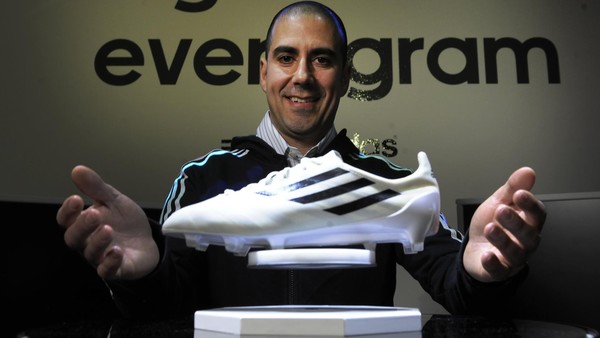
End goals: Antonio Zea’s job at Adidas involves developing the official match ball for the 2014 world cup

Employees in Antonio Zea’s department are encouraged to put interesting pictures up on the wall in the hope the surroundings will foster creativity and spark new ideas. On the whiteboard in his office it says, “Make cool s**t”. He likes to point to this mantra often. It “keeps things simple”, he says. Read more of this post

India is still a contender in the great Asian race; The chaos of democracy blunts the impulses that once held the threat of break-up

Last updated: January 30, 2014 7:19 pm

India is still a contender in the great Asian race

By Philip Stephens

The chaos of democracy blunts the impulses that once held the threat of break-up

India is rushing headlong into chaos – the chosen chaos that comes with holding national elections in the world’s most populous democracy. The promised political convulsions doubtless will tempt some to hold up China as proof positive that autocracy is the surer guardian of economic progress. There may be moments when this is hard to gainsay. It is mistaken for all that. Read more of this post

Why the Fed is under pressure to continue innovating; A business-as-usual course is starting to look dangerously complacent

January 30, 2014 6:30 pm

Why the Fed is under pressure to continue innovating

By Gillian Tett

A business-as-usual course is starting to look dangerously complacent

This week the US government delivered two pieces of noteworthy news. One caused a splash: on Wednesday the Federal Reserve announced another $10bn cut in its monthly bond purchases, the second time it has tapered. Cue Twitter alerts and headlines. Read more of this post

Emerging markets: Fear of contagion; “Guys who used to come and buy a case of beer will now by a pack of 12 or six. A guy who used to buy a case of wine will now just buy one or two bottles,”

January 30, 2014 7:50 pm

Emerging markets: Fear of contagion

By James Kynge

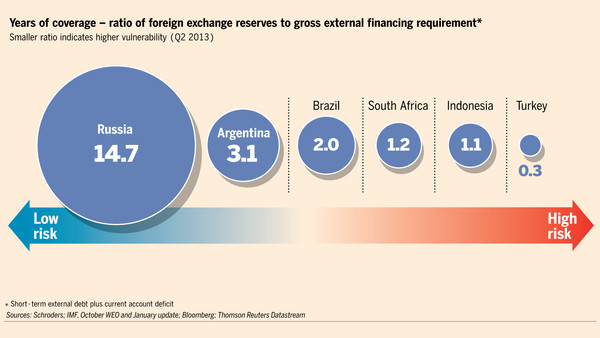
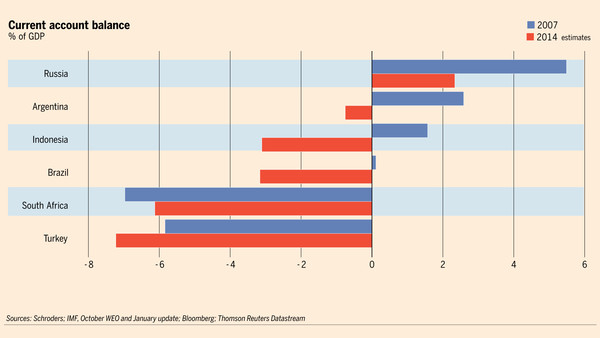
Policy makers from Argentina to Turkey are scrambling to defend their currencies

image001-5

image002-3

If every crisis has a defining precursor, then Argentina’s may have come in the shape of a Grammy statue. The trophy won in Las Vegas by the band Illya Kuryaki and the Valderramas, right, was impounded by customs, a victim of Buenos Aires’ aggressive import controls. Emmanuel Horvilleur, a band member, tweeted in frustration: “It is a prize, not a Rolex that I bought overseas!” Read more of this post

Facebook Mobilizes Its Ad Army

Facebook Mobilizes Its Ad Army

MIRIAM GOTTFRIED

Jan. 30, 2014 5:17 p.m. ET

image001-2

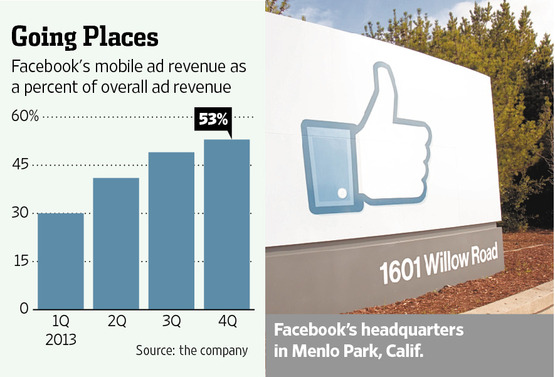
In the battle for mobile-advertising market share, Facebook‘s FB +14.10% army is advancing on multiple fronts. Read more of this post