Banks in China fear over-reliance on IBM information systems; Chinese banks ditch US providers for Alibaba’s Aliyun

Banks in China fear over-reliance on IBM information systems

Staff Reporter

2014-06-01

The issue of Chinese banks’ relying on core technology from overseas for their information systems has been a cause for concern for many in the regulatory and banking sectors.

It is estimated that 90% of China’s banking institutions use IBM for their core technology, and China is urging its banks to remove high-end servers made by IBM in favor of the servers made by local brands.

China Banking Regulatory Commission chairperson Shang Fulin spoke on the issue at a meeting held in late 2012.

Shang suggested a strategy for self-reliance in stages so as to gradually steer clear of reliance on foreign brands. Read more of this post

Thai coup protesters have adopted the Hunger Games’ three-fingered salute

Thai coup protesters have adopted the Hunger Games’ three-fingered salute

By Quartz Staff 7 hours ago

At demonstrations against Thailand’s military government continued this weekend, protesters unveiled their newest tactic: Appropriating the three-fingered salute from the Hunger Games, which the movies’ downtrodden citizens use as a silent rebuke to their dystopian government.

Ever since the Thai military seized power last month, protesters have been using social media to organize hit-and-run demonstrations in Bangkok, and on Sunday they made a last-minute change of venue, gathering at the downtown shopping district’s Terminal 21 mall. They were opposed by hundreds of soldiers and police, who have mobilized at possible protest sites around the city to pre-empt large-scale demonstrations. At least four people were arrested, including one woman who was dragged into a taxi by undercover police after giving the three-finger salute.

Thais are avid consumers of pop culture, including the Hunger Games movies, so it’s not surprising that they have chosen to use the salute favored by cinematic heroine Katniss Everdeen. Adding to the cultural mash-up, protesters on Sunday said the three fingers stand for liberty, brotherhood, and equality—a slogan associated with the French Revolution that is now the official motto of France.

image001-23

Inflation Prospect Changes Japan Stock Strategies; Some Investors Look for Companies Putting Their Cash Hoards to Work

Inflation Prospect Changes Japan Stock Strategies

Some Investors Look for Companies Putting Their Cash Hoards to Work

KOSAKU NARIOKA

June 2, 2014 7:31 a.m. ET

Some long-term investors are capitalizing on the recent weakness in Japanese stocks to scoop up shares of companies they believe will be winners in an emerging inflationary environment.

These investors are buying shares in companies that are positioning themselves for growth by ramping up capital spending, or putting cash in shareholders’ hands, because merely sitting on funds will no longer be a viable strategy if steady inflation returns to the economy.

The demand has helped the Nikkei Stock Average reach a nearly two-month high, although it is still down 8% since the start of the year. The average gained 2.1% Monday.

Government data released Friday showed consumer prices in April were up 1.5% from a year earlier, after stripping out the effects of an increase in the national sales tax at the start of the month. Generally speaking, signs of inflation are good news for Japan’s economy because they suggest stronger demand—consumers are less likely to hoard cash—after a deflationary spell dating to the 1990s. Read more of this post

Roche returns to antibiotic research as superbug threat grows

Roche returns to antibiotic research as superbug threat grows

10:29am EDT

By Caroline Copley

ZURICH (Reuters) – Roche is betting the same tools that made it the world’s largest producer of cancer drugs will help it tackle the growing public health crisis of antibiotic resistance as regulators and politicians encourage fresh research.

The Swiss drugmaker used its expertise in in vitro diagnostic tests to develop highly-targeted cancer medicines. Now it believes it can use those same skills to find out quickly which bugs cause which infections, and help doctors kill them.

Experts are currently warning that superbugs resistant to even the most powerful drugs threaten to undermine modern medicine – requiring a response on the same scale as efforts to combat climate change.

Infections that are resistant to antibiotics affect more than 2 million people in the United States every year and kill around 23,000 people as a result, according to the Centers for Disease Control and Prevention. Read more of this post

Remembering Tiananmen: The lessons of history

Remembering Tiananmen: The lessons of history

As our bureau chief leaves China, he reflects on the crushing of the protests he witnessed 25 years ago, and what has transpired since

May 31st 2014 | BEIJING | From the print edition

EVEN after the Chinese army moved into Tiananmen Square on the night of June 3rd 1989, and cleared it of the detritus left by the students who had occupied it for most of the previous seven weeks, it was several days before observers were certain who was in control of China. Your correspondent, looking down Beijing’s central boulevard, Chang’an Avenue, at a maze of still-burning barricades a day after the bloody operation, was not alone in wondering whether the Communist Party could ever heal. This newspaper, with which he was not then linked, summed up a common view: “This week China looked into the abyss of coup, counter-coup and civil war”. Foreign doomsayers were proved wrong. But even after 25 years of relative stability, it is still wise to be cautious about the cohesion of Chinese politics.

image001-21

It was not just foreign observers who were given to apocalyptic musings at the time. “If the rebels had had their way, there would have been a civil war,” Deng Xiaoping told a visiting Chinese-American physicist, Tsung-Dao Lee, three months after the army crackdown that left hundreds, if not thousands, dead. Thanks to strenuous efforts by the Communist Party to erase memories of what happened (see article), many in China now have only a dim understanding of the history of the protests in Tiananmen Square and the nationwide unrest they triggered. But Deng’s analysis is remarkably close to the mainstream among the generation of young urban residents who have grown up since: if they have heard of the 1989 protests, many feel that, though the killings may have been bad, the army’s resolute action helped to create the stability that allowed China’s economy to grow from one that was then smaller than Britain’s into the world’s second-largest. Read more of this post

Bad News for the Big Four Auditors in China

Bad News for the Big Four Auditors in China

Mainland ban on HK firms has little effect »

Paul Giles, 2 Jun 2014

The CICPA has issued their annual rankings of Chinese CPA firms for 2013. It is bad news for the Big Four. BDO’s Chinese affiliate Lixin jumped over both KPMG and EY to kick EY out of the Big Four in China. RSM and Crowe Horwath’s shared affiliate Ruihua pushed KPMG out when it passed both EY and KPMG last year. PwC continues to be the largest CPA firm in China, extending its lead over Deloitte. PwC’s growth was a modest 4%, while Deloitte actually shrunk by 5%.

Here are the top ten CPA firms in China in 2013:

image001-4

In most parts of the world the top accounting firms release information on their performance. Although they are private companies, they are public interest entities and the public deserves to look in their drawers just as they look into everyone else’s. In China and Hong Kong, however, the Big Four are intensely secretive about their operations. The CICPA data is the only look inside. I believe that the data are generally reliable. It is used by the CICPA to set dues, so cheating upward would be expensive, and cheating downward could risk their right to practice. The revenue includes only audit fees. The Big Four operate their consulting practices in WFOEs and local firms report consulting revenues separately. Read more of this post

Is Silicon Valley the Future of Finance?

Is Silicon Valley the Future of Finance?

By Kevin RooseFollow @kevinroose

Recently, after a long, drawn-out fight over an overdraft fee, I decided to break up with my bank. I withdrew my balance, closed my accounts, and began looking around. I wanted to find a ­disruptive bank, in the Silicon Valley parlance—one better than the opaque, fee-filled behemoths I’d dealt with in the past.

The problem, I quickly learned, is such a thing doesn’t yet exist. The big banks all offer basically the same bevy of services, and small banks and credit unions tend to skimp on the add-ons I need, like mobile-banking apps and spending trackers. All of them, big and small, run on the same outdated infrastructure—paper checks, debit cards that require punched-in pins, wire transfers that take days to clear. Despite Wall Street’s reputation for ruthless efficiency and staying ahead of the curve, the last truly important innovation in consumer banking might have been the ATM.

To listen to Silicon Valley tell it, that will change soon. “I am dying to fund a disruptive bank,” venture capitalist Marc Andreessen tweeted earlier this year. Financial start-ups—known collectively as “fintech”—are spreading like kudzu, each with a different idea about how to usurp the giants of Wall Street by offering better services, lower fees, or both. Bitcoin and other digital currencies are the tech scene’s infatuation du jour. But a number of other companies are finding success by innovating within the monetary system we already have. “When I go to Silicon Valley … they all want to eat our lunch,” lamented ­JPMorgan Chase CEO Jamie Dimon this year. Read more of this post

What Bruce Lee Can Teach You About Design; Bruce Lee’s fighting style was to let his opponent determine the approach–a mindset that helped shape the design philosophy of one of Nike’s former top shoe designers

WHAT BRUCE LEE CAN TEACH YOU ABOUT DESIGN

BRUCE LEE’S FIGHTING STYLE WAS TO LET HIS OPPONENT DETERMINE THE APPROACH–A MINDSET THAT HELPED SHAPE THE DESIGN PHILOSOPHY OF ONE OF NIKE’S FORMER TOP SHOE DESIGNERS.

BY REBECCA GREENFIELD

Bruce Lee didn’t know much about design, but he was not short on useful life philosophies. Which is why D’Wayne Edwards, who was design director for Nike’s Jordan line before starting Pensole Footwear Design Academy, counts the martial arts icon among his top inspirations. “Everyone knows him as a fighter,” Edwards, one ofFast Company‘s Most Creative People in Business this year, said. What Edwards finds inspiring, however, is Lee’s way of thinking. Read more of this post

New Spore: What good is Medisave if you can’t use it when needed?

What good is Medisave if you can’t use it when needed?

June 1st, 2014 |  Author: Contributions

My mother recently suffered a heart attack. She was hospitalised and a stent was inserted into her heart. The resultant hospital bill came up to about $18,400.

My brother and I have more than $90,000 in our Medisave accounts, but only $3,950 could be deducted from my brother’s account as this was the maximum amount allowed. We had to pay the remaining amount of more than $14,000 in cash.

Manpower Minister Tan Chuan-Jin said the money in our Central Provident Fund accounts is ours (“CPF money is your money, says Chuan-Jin”; Monday), so why could we not use our money to pay our mother’s hospital bill?

Even if the full amount were deducted from my Medisave, I would still have more than $27,000 remaining. Moreover, I am still working and can continue to contribute to build up the funds again.

Instead, we had to find a way to come up with the cash portion for the bill.

I understand that CPF and Medisave funds are to be used for retirement and medical emergencies. But what good is this money if we cannot use it when we need it? CPF usage policies should be reviewed and fine-tuned. The Government should always strive for continual improvements to better the lives of the people. Read more of this post

Samsung Is Working With Oculus On A ‘Shockingly Good’ Mobile Virtual Reality Product For Your Phone

Samsung Is Working With Oculus On A ‘Shockingly Good’ Mobile Virtual Reality Product For Your Phone

JIM EDWARDS TECH  MAY. 31, 2014, 12:57 AM

Samsung and Facebook’s Oculus VR unit are working together to create a virtual reality device powered by Samsung’s Galaxy S5 line of phones, Engadget reports. You literally plug your phone into the headset and you’re inside a “shockingly good” virtual world, the site reports.

Last week, a source familiar with Samsung’s plans confirmed the company is going to launch a virtual reality headset. However, the source warned, the gadget is mostly just a side project to test new display technologies.

The crazy thing — so crazy it just might work! — is that instead of having the phone attached to the Oculus headset through a jack and a cord, the phone slots directly into the headset and uses the phone’s cameras to over- or under-lay the real world and the virtual world. Here’s how Endgadget describes it:

Rather than having its own screen, Samsung’s VR headset uses your phone directly. It plugs in using an existing port on your phone (think: microUSB) and becomes the screen. The headset itself has built-in sensors — an accelerometer at very least — so any motion tracking functionality is offloaded from your phone’s processor. Read more of this post

Singapore-Taiwan cross-border contactless card in the works

Singapore-Taiwan cross-border contactless card in the works

By John Leong 
POSTED: 02 Jun 2014 12:10
EZ-Link and Taiwan company EasyCard will be developing the card to allow Singaporeans to pay for public transport or admission tickets to local attractions in Taiwan, and vice versa.

SINGAPORE: Singaporeans will soon be able to access public transport and retail options while in Taiwan, and the same is true for Taiwanese travellers visiting the city-state.

EZ-Link and its Taiwanese counterpart, EasyCard, signed a Memorandum of Understanding (MOU) on Monday (June 2) to jointly develop a cross-border, multi-functional contactless card.

The card, named Cross Border Combi Card, will allow people to pay for anything from public transportation to admission tickets to local attractions. It will contain separate “purses” to store both Singapore and Taiwanese currencies, according to the companies.

EZ-Link said it hopes the new card will be ready within a year.


Myanmar to launch stock exchange by Oct. 2015: media

Myanmar to launch stock exchange by Oct. 2015: media

YANGON, June 1 (Xinhua)– Myanmar is ready to launch stock exchange by October 2015 and the related plan is progressing on schedule, state media quoted a government’s financial official as saying on Sunday.

Deputy Minister of Finance Maung Maung Thein told a seminar in Yangon that the three components for emergence of a capital market are taking place simultaneously, which are formation of a securities and exchange commission, launch of Myanmar’s first stock exchange and preparation by companies to be listed.

He said the Yangon Stock Exchange will be operated by the Myanmar Economic Bank in partnership with Japan’s Tokyo Stock Exchange (TSE) and Daiwa Securities Group and the signing of a joint venture agreement will take place soon. Read more of this post

Why Yahoo Keeps Killing Everything It Buys

Why Yahoo Keeps Killing Everything It Buys

BY ISSIE LAPOWSKY

05.14.14  |

Another one bites the dust.

Yahoo has just acquired Meh Labs, the startup behind a self-destruct messaging app called Blink and a location check-in app called Kismet. And, as with so many Yahoo acquisitions before it, the tech giant intends to shut down both apps in the coming weeks.

As with so many Yahoo acquisitions before it, the tech giant intends to shut down both apps in the coming weeks.

Blink, which launched about a year ago, is a direct competitor to other mobile messaging products like WhatsApp and Snapchat, and the buyout is a strong sign that Yahoo CEO Marissa Mayer refuses to be left behind in the heated mobile messaging war being waged by competitors like Facebook. Just as Facebook did with its $19 billion acquisition of WhatsApp and $3 billion bid for Snapchat, Yahoo has been on a buying spree recently, snapping up small startups that are working on trendy new technology. But there’s a big difference between Mayer’s strategy and the one espoused by Facebook CEO Mark Zuckerberg. Read more of this post

China clampdown ahead of Tiananmen massacre anniversary

June 1, 2014 7:03 pm

China clampdown ahead of Tiananmen massacre anniversary

By Jamil Anderlini in Beijing

China has detained dozens of people and launched an unprecedented security operation in central Beijing to stop anyone commemorating the 25th anniversary of an event that has been virtually wiped from the collective memory of the nation.

A quarter of a century after the People’s Liberation Army turned its tanks and guns on the people and marched into Tiananmen Square on the night of June 3 and early hours of June 4, 1989, any mention of the massacre of hundreds, perhaps thousands, of people is banned from public life.

More than 50 people, including activists, lawyers, journalists and relatives of students killed in the massacre, have been detained, arrested or simply “disappeared” in recent weeks because of their efforts to commemorate the anniversary, according to human rights groups. Read more of this post

South Koreans drawn to unification-linked funds

June 1, 2014 5:41 am

South Koreans drawn to unification-linked funds

By Song Jung-a in Seoul

South Korean investors are pouring millions of dollars into unification-themed equity funds, reflecting local investors’ growing optimism over a unified Korea, although the chances of the two countries joining remain as remote as ever.

Such funds have emerged as an unlikely darling for Korean investors after President Park Geun-hye in her new-year speech compared unification to an economic “jackpot”, which has prompted an increase of discussion of national reunification in local media.

A combined net Won35bn ($35m) has flowed into two such funds over the past two and a half months in spite of volatile inter-Korean relations and Pyongyang’s warning of another nuclear test, while Won3.4tn has flowed out of the country’s other equity funds in the same period. Read more of this post

Appetite grows for Indonesia’s herbal remedies

June 1, 2014 5:45 am

Appetite grows for Indonesia’s herbal remedies

By Ben Bland in Jakarta

Whether suffering from headaches, a cold or flatulence, Indonesians have long sought relief in a range of cure-all herbal potions known as jamu.

By producing its signature Tolak Angin (“expel the wind”) herbal medicine in small, cheap-to-distribute sachets, Irwan Hidayat’s family took a cottage industry dominated by itinerant hawkers and petty stallholders and transformed it into a billion-dollar business.

“When I was small, I could not imagine that we could build a company such as this,” says the 67-year-old chief executive of Sido Muncul, the family’s herbal medicine company, which has seen its shares rise by 40 per cent since it listed in Jakarta in December, giving it a market capitalisation of more than $1bn. Read more of this post

Amazon helps small publishers survive the giants; Groups that have grown fat in a market they have dominated are unhappy

June 1, 2014 4:18 pm

Amazon helps small publishers survive the giants

By Martin Shepard

Groups that have grown fat in a market they have dominated are unhappy

When Jeff Bezos founded the company that has become synonymous with online shopping he initially thought of calling it Relentless.com. In the end he opted for something more serene, but that has not stopped some from seeing an insidious tinge in the retailer’s unrelenting advance.

Amazon now offers everything from bicycles to breadmakers, but it is still in the book trade that it is mightiest – selling perhaps half of all the tomes bought in America and 60 per cent of all ebooks. It has clout that your neighbourhood bookstore (if you still have one) can only dream of. And a public spat with Hachette, the Lagardère Group subsidiary that is the smallest of the top five New York publishers, has prompted accusations that the online retailer is using its might to extract unfair terms – enriching itself and impoverishing a once thriving literary scene.

It is easy to wax nostalgic for an era when bookshops were cultural amenities rather than serious businesses – even if, when it came to making a purchase, most of us preferred chains that offered keener prices and a bigger range. But that era is gone – erased, in America at least, not by Amazon but Borders (now bankrupt) and Barnes & Noble (for ever on the ropes). Among retailers, these are the real victims of Amazon’s success. They have not been mourned. Read more of this post

Tiananmen Square: the long shadow; The leaders of the Tiananmen Square protests have taken varied paths in the 25 years since the massacre

June 1, 2014 3:47 pm

Tiananmen Square: the long shadow

By Jamil Anderlini

The leaders of the Tiananmen Square protests have taken varied paths in the 25 years since the massacre

©AFP

image001

The massacre in which hundreds, perhaps thousands, of people died in Beijing on the night of June 3 and the early hours of June 4 1989 remains the most important and traumatic single event in modern Chinese history.

It was the moment the people’s army turned its guns on the people, shattering the legitimacy of the Communist party and ushering in an era of rapid capitalist-style reforms. Read more of this post

Here’s The Weather Prediction That Won World War II

Here’s The Weather Prediction That Won World War II

GUS LUBIN MILITARY & DEFENSE  JUN. 2, 2014, 8:21 AM

German military leaders expected an Allied invasion on the Channel coast in late May, 1944, when there was high tide, a full moon, good visibility, and little wind. When it did not come, and when the weather turned dramatically in June with a depression bringing storms, they felt they could relax.

image001-20

“There were all the less doubts that an invasion might happen in the meantime as the tides are very unfavorable in the following days and no air reconnaissance of any kind had given any hints of an imminent landing,” Field Marshall Erwin Rommel wrote on June 4, 1944, before leaving France for Germany to celebrate his wife’s birthday.

But while German weather forecasters saw no possibility for invasion, Allied forecasters were frantically looking for an opening. They found one on June 6 — and on the 7oth anniversary of the pivotal invasion, we’re looking at how they did it. Read more of this post

24 Rules Of Seduction

24 Rules Of Seduction

DINA SPECTOR HOME  JUN. 2, 2014, 12:20 PM

We’ve already shown you bestselling author Robert Greene’s 48 tips on becoming more powerful.

The master of persuasion has another book titled, “The Art of Seduction” which offers 24 techniques to get what you want by manipulating everyone’s greatest weakness — the desire for pleasure.

Greene also identifies 10 different types of seductive characters, including “The Siren,” “The Charmer,” and “The Natural.”

Greene gave us permission to republish these rules from his book.

Choose the right victim

“Everything depends on the target of your seduction. Study your prey thoroughly, and choose only those who will prove susceptible to your charms. The right victims are those for whom you can fill a void, who see in you something exotic. They are often isolated or unhappy, or can easily be made so—for the completely contented person is almost impossible to seduce. The perfect victim has some quality that inspires strong emotions in you, making your seductive maneuvers seem more natural and dynamic. The perfect victim allows for the perfect chase.”

Create a false sense of security — approach indirectly

“If you are too direct early on, you risk stirring up a resistance that will never be lowered. At first there must be nothing of the seducer in your manner. The seduction should begin at an angle, indirectly, so that the target only gradually becomes aware of you. Haunt the periphery of your target’s life—approach through a third party, or seem to cultivate a relatively neutral relationship, moving gradually from friend to lover. Lull the target into feeling secure, then strike.” Read more of this post

GE Puts Sensors in Hard-to-Reach Places With 3-D Inking; Air Travel Could Be Made Safer With Tiny Monitoring Devices Inside Jet Engines

GE Puts Sensors in Hard-to-Reach Places With 3-D Inking

Air Travel Could Be Made Safer With Tiny Monitoring Devices Inside Jet Engines

DEBORAH GAGE

June 1, 2014 4:48 p.m. ET

Making jet engines communicate their vital signs while they’re in flight has the potential to make air travel safer. It could signal when a stressed engine part needs replacing, or give clues to how engines could be better designed.

But first, those parts have to be made smarter.

A team of manufacturing engineers, materials scientists and testing experts at a General Electric Co. GE +0.19%lab in upstate New York is trying to make that happen. They’re using a robotically driven stylus—like a needle, no thicker than a sheet of paper—to create tiny sensors on parts that make up jet engines and other complex structures. The sensors can measure the stress on parts that are inside harsh environments—places that are too hot or have too many gasses for more conventional sensors—and transmit that data to GE. Read more of this post

U.S. Rubber-Band Maker Survives by Stretching Its Portfolio of Products; Alliance Rubber Finds Novel Uses for Rubber Loops; New Equipment Turns Out Customized Products

U.S. Rubber-Band Maker Survives by Stretching Its Portfolio of Products

Alliance Rubber Finds Novel Uses for Rubber Loops; New Equipment Turns Out Customized Products

JAMES R. HAGERTY

June 1, 2014 4:48 p.m. ET

Most of Alliance Rubber’s products now are rubber-band spinoffs, like the Eraselet, a wristband that doubles as an eraser. Alliance Rubber

Making rubber bands in the U.S. takes a lot of flexibility these days.

image001-19

Companies in Thailand and China, benefiting from lower labor costs, have grabbed much of the U.S. market for rubber bands. Meanwhile, some of the biggest traditional uses for the product—such as holding together newspapers and bundles of mail for home delivery—are withering away. Read more of this post

3-D Printing’s Promise-and Limits; So Far It’s Proving to Be Great for Prorotypes and Small Production Runs, but Not So Much for Bigger Jobs

3-D Printing’s Promise—and Limits

So Far It’s Proving to Be Great for Prorotypes and Small Production Runs, but Not So Much for Bigger Jobs

PETER S. GREEN

Updated June 1, 2014 4:49 p.m. ET

image001-18

Rest Devices used 3-D printing to make the “turtle” transmitter in its onesie monitor—until it got a big order and switched to injection molding. Mimo

Manufacturers are finding that a revolutionary technology has its limits.

According to enthusiasts, 3-D printing was supposed to rewrite the rules of how things get built. Forget building new factories, or outsourcing production to China. The compact devices would launch a manufacturing renaissance centered in people’s living rooms and garages.

It may yet do all that. But for now, here’s the reality: The technology works very well in some settings—but it doesn’t scale very well. Product designers and manufacturers say that 3-D printing beats traditional methods for jobs involving complex designs or limited production runs. But if companies need to crank out thousands of products in a short time, traditional methods are faster and more cost-effective. Read more of this post

Where New-Wave Manufacturing Is Headed; Carl Bass of Autodesk on How 3-D Printing Will Move Far Beyond Prototypes

Where New-Wave Manufacturing Is Headed

Carl Bass of Autodesk on How 3-D Printing Will Move Far Beyond Prototypes

DON CLARK

June 1, 2014 4:48 p.m. ET

Many people have now heard about 3-D printing. Carl Bass has been tracking it for 25 years.

As chief executive of Autodesk Inc., ADSK -0.61% a maker of design software for companies in manufacturing, construction, and media and entertainment, Mr. Bass pays close attention to manufacturing technology. So he waited eagerly during the long gestation of 3-D printing, which builds objects by depositing layers of plastic or other materials.

His company operates a workshop on San Francisco’s waterfront where 150 engineers and artists experiment with 3-D printers, milling machines and other tools. In May, Mr. Bass announced plans for Autodesk to sell its own printer—its first-ever hardware product—and related software. Read more of this post

How Robots Are Getting Smarter; New Models Bring Greater Skills to the Factory Floor, From Navigating on Their Own to Learning by Doing

How Robots Are Getting Smarter

New Models Bring Greater Skills to the Factory Floor, From Navigating on Their Own to Learning by Doing

June 1, 2014 4:48 p.m. ET

image001-17 image002-4 image003-3

ALL EYES | Baxter’s face shows his status (from left): on standby, confused and needing guidance, surprised, sad and awaiting instruction, and ready for training. Workers can train Baxter by moving his arms rather than writing digital prompts. HANDS ON | The KR Quantec can change its own tools to suit its tasks. THIS WAY | The Lynx maps the layout where it’s working and finds its way around obstacles it “sees” with a laser and ultrasonic detectors. It can also alert its fellow robots to any detours.  Read more of this post

Japanese Firm Uses a Single-Worker System to Make Its Products; With the Help of Digital Tools, Any Roland DG Employee Can Build Any Product; The computer even gives workers a pat on the back at the end of the day

Japanese Firm Uses a Single-Worker System to Make Its Products

With the Help of Digital Tools, Any Roland DG Employee Can Build Any Product

MAYUMI NEGISHI

image001-15

June 1, 2014 4:48 p.m. ET

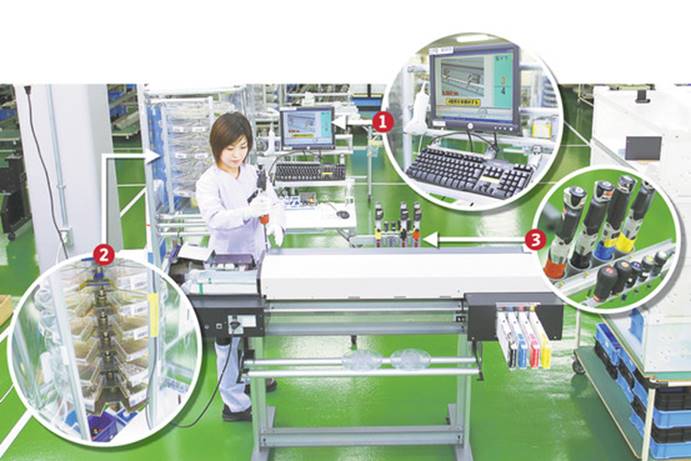
A Roland worker making an industrial printer follows prompts on the computer (1), pulling pieces from the rotating parts rack (2) and using digital screwdrivers (3) that track number of turns and torque. The Japanese manufacturer Roland DG has replaced it’s assembly line with single-person stalls call a D-Shop, inspired by Japanese noodle stands. The D-Shop can produce a wider variety of products in lower quantities than an assembly line. Read more of this post