Four Stand-Out College Essays About Money
June 6, 2014 Leave a comment
Four Stand-Out College Essays About Money
MAY 9, 2014
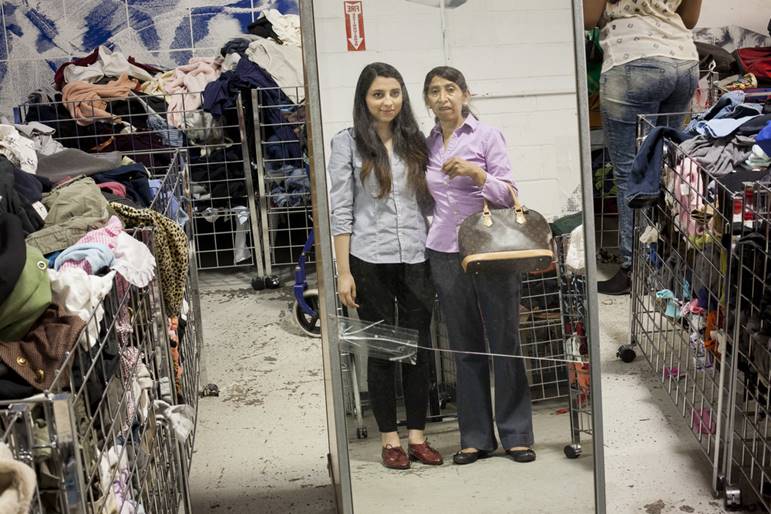
Clare Connaughton with her mother Maritza Vargas at a Housing Works thrift store in Sunset Park, Brooklyn. Clare Connaughton, a high school student from Mineola, N.Y., reads from her college application essay about how shopping at thrift stores with her mother has gone from necessity to cherished pastime.
Thrift Store Shame, Then Pride
Talking about money is hard. Writing well about yourself may be harder still. So trying to do both at once, as a teenager, while addressing complete strangers who control your future, would seem to be foolhardy.
But each year, plenty of high school seniors who are applying to college give it a go. Many skip the story of the sports team triumph or the grandparent’s death and write essays about weighty social issues like work, class and wealth, or lack thereof. Perhaps that’s what affects them most. Or maybe those are the subjects that they think will attract an admissions officer’s eye.
In any case, for the second year, we put out a nationwide call for the best college application essays about these topics. With the help ofJennifer Delahunty, the dean of admissions and financial aid at Kenyon College in Gambier, Ohio, and an accomplished essayist and editor herself, we picked four to share here. They are a diverse lot, touching on topics ranging from work at McDonald’s and thrift store shopping to homelessness and reckoning with a parent’s job loss. What they share, however, is a quality that admissions officers crave but don’t see as often as they’d like: The applicant’s brain, laid bare on the page, wrapping itself around a topic that most people don’t write enough about or don’t write about in a deep or moving way.
“It’s the one part of the application where they completely control the voice, and that makes it a really valuable document for us,” said Jeremiah Quinlan, Yale’s dean of undergraduate admissions. “When you’re applying to an institution with thousands of students who have the same general academic and testing credentials, those things only get you in the door. The rest of the application will separate you out.”
Mr. Quinlan accepted Viviana Andazola Marquez, who lives in Thornton, Colo., into the class of 2018. Her short, matter-of-fact essay about the logistics of homelessness was the most powerful one we read.
“There it sits, sullen in the passenger’s seat like a child in time out,” she wrote of her frequent attempts to get her homework done using borrowed computers. “Here we go again — someone else’s laptop to navigate, another Wi-Fi network to hack, another stubborn connection to overcome. After a frustrating drive through the neighborhood and careful identification of a network, success is stated simply: connected.”
Ms. Delahunty was struck by two things in this essay. The first was the language. “This is almost like a poem, it’s so laconic and compressed,” she said. “ ’I fill the cracks in the road to success made by forces beyond myself.’ What a beautiful line.”
The second was the lack of bitterness, which Mr. Quinlan picked up on as well. “She uses the story to her advantage but she doesn’t lament it,” he said. “Lots of people write about obstacles, but there is a forward-looking nature to this. It’s a look at what she’s overcome without her steeping in it.”
Clare Connaughton steeps readers in her financial struggles a bit in her essay, noting how hard her mother has worked cleaning houses to keep them in a middle-class neighborhood. But much of it is about the joy she eventually found in shopping at thrift stores with her mother near their home in Mineola, N.Y. “We woke up early and are now waiting on a long line behind Brooklyn hipsters,” she wrote. “Our beloved thrift store is now trendy and popular. My mom and I laugh about it all the time during dinner.”
Ms. Connaughton will attend the University of Pennsylvania in the fall. “There is a real sense of enlightened awareness in this one,” Ms. Delahunty said. “The idea that necessity became trendy is such an interesting perspective on how she lived her life.”
If there was an underdog in this group, it was Griffin Karpeck. The Darien, Ill., resident did a fair bit of telling and not quite enough showing in his essay about working at McDonald’s and what he learned from his colleagues. A job at McDonald’s is an ordinary thing, and teenagers tend to not make it a goal, let alone build a college application around it. So perhaps that’s why Ms. Delahunty, who has read over 15,000 application essays during her career, had never seen one about working under the golden arches before.
Neither had Laura Schutt, the assistant director of admission at Butler University, where Mr. Karpeck will matriculate this fall. She was thrilled to see it, however, given how often she tells prospective students that they shouldn’t be afraid to discuss their part-time jobs. “When I got this I thought ‘Oh my gosh, somebody finally wrote about something I talk about!’ ” she said. “It jumped out at me.”
I asked her whether this might be too big a risk, and said that a snooty admissions officer would wonder why an ambitious teenager would choose to write about selling hamburgers instead of literature. “No, it’s opening us up to him,” she said. “Him getting beyond that bubble of the suburbs and seeing how a job at McDonald’s is so important to various individuals and the meanings it has to them — he’s already dealing with the topics that you can carry forward onto a campus that was founded on liberal arts principles.”
Mr. Karpeck might have missed one big opportunity because of timing. One of the children of the chief executive of McDonald’s happens to be in one of his high school classes this school year. That would have made for a zinger of an opening line had it happened sooner, but he sent his application in before he realized who was sharing a class with him.
Andy Duehren, who will attend Harvard, took a different kind of risk, writing about his father’s job loss and depression and his own uncaring response to it.
“I became more critical, more attentive to his flaws and shortcomings,” he wrote of his father. “He lost his glasses, got linguini when we asked for rigatoni at the grocery store, and forgot my friends’ names. At family dinner he sat largely silent until he interrupted with a non sequitur or unrelated question. I promised myself, with all of my naïve bravado, that I would never make myself vulnerable like he did, that I would never wallow in past regrets or failures.”
In the essay, however, he makes himself plenty vulnerable. “I do love that, when a writer self-implicates,” Ms. Delahunty said. “And then comes this point of redemption. It’s a loving, honest portrait of a breadwinner that was operating on so many different levels.”
One thing that we’ve never seen in our two years of soliciting these essays is a great one about what it means to be rich. Bad ones abound at Kenyon, alas. “We see a lot of essays about students who have studied abroad and they recognize either their own privilege or that the poor brown people are happier than I,” she said. “That’s always the ending. I absolutely hate those essays, though I sound like a cynic.”
Ms. Delahunty allows, however, that it is hard for teenagers to write about privilege without sounding like they’re bragging. And it’s complicated, given how seldom affluent children are encouraged to acknowledge their class status and how few of them ever dislike the comfort and experiences that wealth can bring. Mr. Quinlan adds that given how hard many top colleges are working to attract the best lower-income students, applicants may be getting an implicit message that it’s better to write about struggling financially.
Still, plenty of parents are paying full freight at $60,000 a year or more. Here’s hoping that one of their children sends in an essay about an underexplored aspect of that life next year. We’ll be looking for them again in the mailbox at moneyessays@nytimes.comstarting next winter, and we’ll publish a new batch in the spring.
Students and Money, in Their Own Words
Four essays written as part of the college-application process reveal students and their families going through tough economic times — and emerging stronger. MAY 9, 2014
Andy Duehren
HOMETOWN
Needham, Mass.
CURRENT SCHOOL
Boston College High School
ESSAY FOR
Harvard University
My dad and I made the ascent together. We climbed the Precipice Trail, the Acadia National Park path of lore whose steep cliffs and trail-side signs warning of death convinced more prudent hikers to turn around before the halfway mark. Resting, I gazed out beyond the dizzying drop below to the green Maine foothills and blue Atlantic Ocean. I appreciated the slight strain in my step, ready to move onward. My dad also stood, his hat crooked and backward, his shirt soaked through, still panting for breath.
“I think we need a water break,” I said, looking him over.
“I think so, too,” he replied.
My relationship with my dad is a complicated one. In the halcyon days of my childhood, I remember our Saturday morning “dump runs” followed by a stop at McDonald’s, where, as soon as he let me, I would order the exact same “Big n’ Tasty” meal he would. Then, he took me hiking, camping, and skiing. His patient guidance and care on the trail stood in stark contrast to my frustrated, bumbling childhood clumsiness. I would whine and cry and yell on hikes too long or hills too steep; he would stop, listen and encourage me onward. With him, I was comfortable and secure. He could do no wrong.
In time, as we both grew older, this changed. He lost his job and fell into a depression and an absent-mindedness I found hard to understand. Despite his dealing with a mental illness, I became more critical, more attentive to his flaws and shortcomings. He lost his glasses, got linguine when we asked for rigatoni at the grocery store and forgot my friends’ names.
At family dinner he sat largely silent until he interrupted with a non sequitur or unrelated question. I promised myself, with all of my naïve bravado, that I would never make myself vulnerable like he did, that I would never wallow in past regrets or failures. I would be assertive, I told myself. I would be a man.
So when I scaled that trail with so much comparative ease, I initially relished the fact that I walked ahead, I carried the pack, I checked in on him. I thought I was being a man. Sitting down, my dad’s breathing slowed, and he asked me, like he had so many times, if I had read David Brooks’s column that week. I hadn’t.
So he filled me in. Listening to him discuss the necessity of imperfection in the democratic process, I felt a twinge of guilt. Guilt that I had fancied myself superior. Guilt that I had ever bought into facile standards of “manhood”; that I had imagined being a proper man meant unfailing vigor on a hiking trail, never dealing with switchbacks or setbacks, never losing your footing or your way.
I looked at my dad and knew all of those notions about employment, competent hiking or getting the right type of pasta at the grocery store, were false. I looked at my dad and I saw that being a man isn’t about any sort of superficial, external measure. As it was during my childhood misadventures, it’s about us, the imperfect son with the imperfect father, supporting each other up the proverbial mountain.
For me, the transition to manhood was not an external one: Fortunately, there was no rite of passage or singular circumstance that forced me to become a man. Rather, sitting there against a cliff with my father, I wondered if maybe adulthood simply meant looking beyond oneself, to the other, without any pretense or pomp. Maybe my father, with his unpretentious generosity and willingness to get back up and continue the trek, is the best example of a man I have.
He finished up his thoughts about the Brooks article, his breathing still audible.
“How about we get that water,” I said, reaching back into the pack.
Griffin Karpeck
HOMETOWN
Darien, Ill.
CURRENT SCHOOL
Hinsdale South High School
ESSAY FOR
Butler University
I work at McDonald’s. This is not a job that inspires envy from my friends, and I usually see people smirk when I tell them where I work. I had submitted dozens of applications without so much as a call back, and when the phone finally did ring it was McDonald’s. I reluctantly accepted the position. Little did I know, I would come to value the knowledge and life experience that I would gain there much more than the $8.25 an hour.
I’ve always known that I live a pretty good life. I live in a quiet upper-middle-class neighborhood with my parents, both of whom work, and my younger brother. Though my family had its own share of tough times during the most recent economic recession, and we had to cut back on a lot of extras, my parents continued to provide for us and they shielded us from the worst of it. However, I attend a very affluent high school and many of my friends and other classmates I know have the kind of wealth that I could only imagine before. Suddenly I found myself having to go through guard gates to get to the houses of my friends. I watched them drive to school in luxury cars. I started to feel like my family didn’t have enough, that my parents should be able to give me more. Working at McDonald’s completely changed this perception of mine.
I knew that not everyone lived like my family does, and that there were people who struggled, but I never saw first hand what that means until I began working at McDonald’s. I’ve made great friends who come from families much different than my own. In telling me about their lives, they’ve helped me understand just how difficult life can be.
A co-worker my age who has become one of my best friends not only rides his bicycle several miles to work, but gives his entire paycheck to his mother so they can pay the rent. I was shocked when I learned this. I soon realized that for him college is just a dream. One of my favorite managers opened up to me and told me that by her 19th birthday she had 3 kids and was struggling to support them. She works the night shift and watches her kids during the day. How is that even possible? I tried to imagine what she was going through and just couldn’t.
There are many more stories like these. I felt guilty for thinking the life that I was living and the things I had weren’t enough and began to realize just how lucky I really am. I was born on third base in life, and most of the people I’ve met at McDonald’s are starting at home plate with two strikes and have very little chance of scoring a run in life, let alone winning the game. I understand now that for many, it is hard enough just to survive, let alone save up for an education that costs tens of thousands of dollars per year. Their stories stay with me and make me think about my own life differently.
In life, it is really easy to get caught up in your own bubble and never really look outside of it. My time at McDonald’s has made me see the world in a completely different way. I am different as a result. I am grateful for the things my parents have provided and the opportunities I’ve had, and I let them know. I’m more open to people who are different than I am and have made friends that I wouldn’t have been open to before. I also have a newfound respect for anyone in hard situations similar to those I’ve met along my journey. I know now that there are a lot of good people who just need a chance in this world. In fact, I do what I can to help them get that chance, even if it’s as small as helping them research community college or find a higher paying job.
My journey is not over. What better place than a college campus to continue to meet interesting people whose life experiences are different than my own? In admitting me to Butler University, you will be adding a student not only serious about academics but one looking to make a positive impact on the campus and community of students.
Viviana Andazola Marquez
HOMETOWN
Thornton, Colo.
CURRENT SCHOOL
York International School
ESSAY FOR
Yale University
There it sits, sullen in the passenger’s seat like a child in time out. Here we go again — someone else’s laptop to navigate, another Wi-Fi network to hack, another stubborn connection to overcome. After a frustrating drive through the neighborhood and careful identification of a network, success is stated simply: Connected. It is a brief moment of victory, but short-lived as I race against the clock to complete my stack of assignments. Sure, it would be ideal to have my own Wi-Fi, but I’d be satisfied if my family obtained a home first. Every day there is a new challenge; it is a game of adaptation: I beat each situation before it beats me.
Just as in any game, I endure losses and gains. I can never forget the classic motel stays. The countless notes that stated in all capitals “MUST EVACUATE BY 4PM” were my cues to negotiate with the manager to give us one more day to make our payments. I learned where $5 would buy enough food to feed a family of 5, bus routes, which neighbors were willing to give me rides to the college for my 7 a.m. class, which teachers were able to pick me up. I moved myself around the game board. I carried my family on my back.
During the bitter winter of 2012, I reached a dead end. My family was denied residence in a homeless shelter due to my mother’s legal status. Finally, a stranger offered us refuge. Every night, my mother, sister, toddler brothers and I arranged ourselves on her kitchen floor and turned on the oven, hoping the warmth would embrace us through the night. What were we going to do? Surely, we couldn’t live in front of an oven forever, but I couldn’t see my next move.
My mother agreed it would be best for me to stay with a friend for a few days. I would have meals and a ride to school. I avoided the thought of what would happen to my brothers, and I made my way out to temporary stability. For a few moments, the weight of my family slid off my back, just long enough for me to regain my concentration and my faith in the future. I continually struggle with balancing my family’s needs and my own, even though I know that in the end they are one and the same.
My whole existence is devoted to maximizing my potential. By tapping into a stranger’s Wi-Fi, negotiating with hotel managers, accepting the kindness of strangers, and sometimes, just for a short time, putting my own needs before my family’s, I fill the cracks in the road to success made by forces beyond myself. I won’t let these circumstances victimize me. I won’t let guilt paralyze me. I remain in control, making my moves, winning the game. Attending college is the surest path to victory, and I am prepared to play along until I reach the end.
Clare Connaughton
HOMETOWN
Mineola, N.Y.
CURRENT SCHOOL
Mineola High School
ESSAY FOR
Princeton University and
Yale University
We’ve got it down to a science at this point. That stain can be washed off. That hole can be sewn. That looks really comfortable! Wait, doesn’t every girl in your school have those shoes over there? Don’t pick that, it looks like it’s from when I was your age.
Going thrift shopping with my mom is one of my most cherished pastimes now that I am older. Growing up, it felt so dirty. Why can’t we just buy clothes at the mall? I would incessantly ask my mother that every single time she brought me with her to Goodwill. Our shoes, jackets, pants, shirts and even appliances were from thrift stores. It annoyed me to no end.
But what I didn’t understand at that age was that as a single parent, my mom could barely make ends meet. Working multiple housecleaning jobs to afford to pay rent for us to live in a safe, middle-class neighborhood and put food on our table meant that my mom had to rely on local thrift shops to get me the clothing I needed for school.
As a child, it never occurred to me that my family was different from others. Sure, I only saw my dad once a week, but that was normal to me. I didn’t notice how difficult it was for my mother to go to work and also be able to pick me up from school, or drive me to various activities. My mom also never conveyed to me the gravity of our economic situation, which is why I didn’t understand why we would have to go to thrift stores. My mom didn’t even tell me about us getting evicted from our apartment, she simply told me that we had to move, and that was that.
Reflecting back on my childhood, I understand how hard my mom worked in order to provide as close to a stable home for me as possible, so I could focus on being a kid and focus on school. But my mother’s example of hard work has not been lost on me. As I grew up and began to fully grasp my mom’s efforts, I attempted to reflect her efforts, and in a way, give back to her what she’s given to me by pushing myself harder in my academic and extracurricular pursuits.
We woke up early and are now waiting on a long line behind Brooklyn hipsters. Ourbeloved thrift store is now trendy and popular. My mom and I laugh about it all the time during dinner. My eight-year-old self wouldn’t believe what I’m seeing. Today, going to the thrift store is a way for me to spend time with my mom when she is free from her busy work schedule. It’s fun to see who can find the nicest shirt or the fanciest designer shoes for the lowest price. My mom, the inventor of “shabby chic”, my mom, my mentor.
Ms. Connaughton will be attending the University of Pennsylvania.
 About bambooinnovator

