Book Review: ‘The People’s Republic of Amnesia’ by Louisa Lim & ‘Tiananmen Exiles’ by Rowena Xiaoqing He

Book Review: ‘The People’s Republic of Amnesia’ by Louisa Lim & ‘Tiananmen Exiles’ by Rowena Xiaoqing He

For younger Chinese today, the Tiananmen Square massacre is a story ‘made up’ by the Americans—or if anything did take place it was ‘a CIA conspiracy.’

BENJAMIN L. READ

May 30, 2014 5:47 p.m. ET

A quarter-century has passed since the 1989 movement that shook Beijing and almost brought down the ruling Chinese Communist Party. Yet the passage of time has not necessarily made it easier to grasp the full dimension of the six weeks of protests around the country and the brutal suppression that began on June 3. Read more of this post

Would You Believe It? Miami Has a Real Tech Scene Now; Tech companies flock to Miami to reach Latin America

Would You Believe It? Miami Has a Real Tech Scene Now

Tech companies flock to Miami to reach Latin America.

ARIAN CAMPO-FLORES

May 30, 2014 6:59 p.m. ET

MIAMI—This city is well known for its coastline, club scene and condo-building crazes. Now it is adding a new distinction: tech hub.

A startup scene is stirring here, driven in part by U.S. companies seeking to tap Latin America’s expanding technology market and a growing crop of Latin American entrepreneurs hoping to gain a foothold here. Read more of this post

Rice, Wheat and the Values They Sow

Rice, Wheat and the Values They Sow

ALISON GOPNIK

May 30, 2014 6:38 p.m. ET

Could what we eat shape how we think? A new paper in the journal Science by Thomas Talhelm at the University of Virginia and colleagues suggests that agriculture may shape psychology. A bread culture may think differently than a rice-bowl society.

Psychologists have long known that different cultures tend to think differently. In China and Japan, people think more communally, in terms of relationships. By contrast, people are more individualistic in what psychologist Joseph Henrich, in commenting on the new paper, calls “WEIRD cultures.” Read more of this post

The Great Swindlers: Some of history’s biggest scam artists ran Ponzi schemes decades before Ponzi

The Great Swindlers

Some of history’s biggest scam artists ran Ponzi schemes decades before Ponzi.

AMANDA FOREMAN

May 30, 2014 7:19 p.m. ET

Great swindles used to have a face or at least a name to vilify. By contrast, our current financial scandals seem diffuse, transnational and as incomprehensible as their acronyms. Libor, ISDAfix and now HFT, or high-frequency trading—all were once regarded as harmless instruments that facilitated the movement of capital. But there was more to them than met the eye. As the best-selling financial writer Michael Lewis, author of the recently published “Flash Boys,” recently said on “60 Minutes,” “The United States stock market, the most iconic market in global capitalism, is rigged.” Read more of this post

No Free Lunch in Dividend Funds

May 30, 2014

No Free Lunch in Dividend Funds

image001

JASON ZWEIG

There’s no such thing as a free lunch, but there is an inexhaustible supply of investors who will trip all over themselves in pursuit of it. Read more of this post

Thai General Maps Return to Democracy

May 30, 2014, 1:29 p.m. ET

Thai General Maps Return to Democracy

By Jake Maxwell Watts and Warangkana Chomchuen

BANGKOK–Thailand’s army chief Friday asked the international community for time to repair what he described as a flawed democratic system and laid out a tentative road-map for returning an elected government to power after last week’s coup.

Gen. Prayuth Chan-ocha has come under growing pressure to outline a return to democracy in this country of 66 million people following May 22’s putsch, which saw Thailand’s army briefly detain key leaders of rival protest groups, censor media and tear up its constitution. Read more of this post

How China Hides Its Tumbling Housing Market: It Simply Ignores It

How China Hides Its Tumbling Housing Market: It Simply Ignores It

Tyler Durden on 05/30/2014 17:12 -0400

Recently we showed that in order to goose its fading all-important housing market (to China housing is like the stock market to the US: both mission-critical bubbles designed to give a sense of comfort and boost the “wealth effect”), China has first resorted to zero money down mortgages across various markets, and secondly to such gimmicks as “buy one floor, get one free.” However, that’s only part of the story. Even worse is what is not being disclosed to the general public: such as the true state of the housing market in China. Because according to a recent report on Sina, quoted on Investing In Chinese Stocks, when it comes to revealing just how bad things are domestically, Chinese developers are simply pulling a page out of biotech ETF playbooksand simply not reporting price drops greater than 15%! Read more of this post

FBI, SEC Probe Trading of Carl Icahn, Billy Walters, Phil Mickelson; Insider-Trading Investigation Began in 2011 With Unusual Trades in Clorox

FBI, SEC Probe Trading of Carl Icahn, Billy Walters, Phil Mickelson

Insider-Trading Investigation Began in 2011 With Unusual Trades in Clorox

SUSAN PULLIAM and MICHAEL ROTHFELD

Updated May 30, 2014 7:58 p.m. ET

Federal investigators are pursuing a major insider-trading probe involving finance, gambling and sports, examining the trading of investor Carl Icahn, golfer Phil Mickelson and Las Vegas bettor William “Billy” Walters. Read more of this post

Integrated resorts could be key to Japan’s economic strategy: Abe

Integrated resorts could be key to Japan’s economic strategy: Abe

Japanese Prime Minister Shinzo Abe said casino resorts could become a pillar of his country’s future economic growth as he toured Singapore’s two integrated resorts yesterday.

MAY 31

Japanese Prime Minister Shinzo Abe said casino resorts could become a pillar of his country’s future economic growth as he toured Singapore’s two integrated resorts yesterday.

Mr Abe, who until now has remained silent on the issue of casinos, gave a strong endorsement to legislation that would legalise casino gambling in Japan. Read more of this post

Chengguan are the most hated govt officials in China

Chengguan are the most hated govt officials in China

BEIJING — China’s urban management officers, or chengguan, regularly make the news, at home and abroad, usually for unpleasant encounters with members of the public. It is not especially surprising, then, that a new report ranks them as the country’s least popular officials.

MAY 31

BEIJING — China’s urban management officers, or chengguan, regularly make the news, at home and abroad, usually for unpleasant encounters with members of the public. It is not especially surprising, then, that a new report ranks them as the country’s least popular officials. Read more of this post

A nine-point checklist for value investors

A nine-point checklist for value investors

GEORGE ATHANASSAKOS

Special to The Globe and Mail

Published Thursday, May. 29 2014, 3:14 PM EDT

Last updated Friday, May. 30 2014, 2:24 PM EDT

Two fundamental tenets of modern portfolio theory are the notion of diversification and that the only risk that matters is beta. Rather than holding one or a few stocks, investors instead should hold a large basket of stocks. According to the theory, diversification helps investors minimize risk as most of the company-specific risk evaporates in a well-diversified portfolio. Read more of this post

JPMorgan Reading List

JPMorgan Reading List

by VW StaffMay 29, 2014, 3:24 pm

Following are the book recommendations from JPMorgan as seen on their website.

JPM states:

The Reading List began as a way for us to share timely, thoughtful and relevant titles that piqued our interest – and that we thought would excite our clients as well. The original list quickly grew to two annual selections, and this year we have reached the 15-year mark.

JPMorgan reading list: Things a Little Bird Told Me Read more of this post

Value Investing in Sanrio vs the Hello Kitty Premium

Value Investing in Sanrio vs the Hello Kitty Premium

by Guest PostMay 29, 2014, 3:46 pm

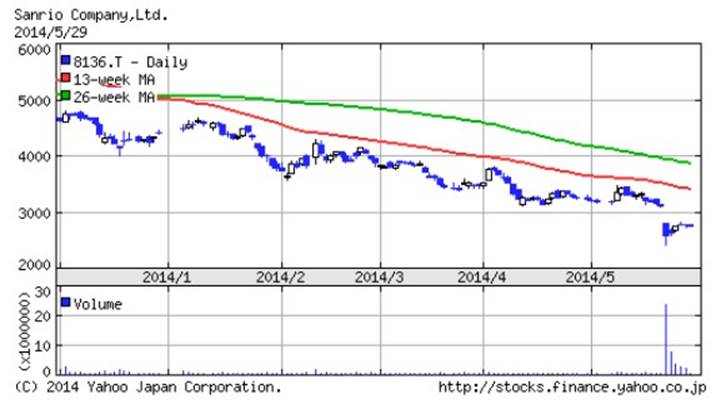
Sanrio Company, Ltd. (TYO:8136) (OTCMKTS:SNROF) shares have taken a beating the past several months and really got hammered last week — “blame” Goldman Sachs Group Inc (NYSE:GS) for the latter, as it appears that its post-earnings report casting undue pessimism and uncertainty on Sanrio’s business model fueled the selloff and compelled Morgan Stanley (NYSE:MS) -MUFG Securities to publish a copycat note. (Sanrio’s statement emphasizing profit-focus and no plans to abandon lucrative licensing business.) Attracted to Sanrio’s high ROE, a weakening yen, and “Cool Japan” marketing in overseas markets that only solidifies the popularity and brand recognition of flagship character, Hello Kitty, I had the fortunate timing of building a position in Sanrio’s ordinary shares in Q4’12 ahead of a sizable run up in 2013. Following are some lessons learned from that profitable investment and the intraday 23% drop Sanrio’s shares suffered last Thursday.

image002-1 Read more of this post

Beyond Agency Theory: The Power of Integrity (PDF of PowerPoint Slides)

Beyond Agency Theory: The Power of Integrity (PDF of PowerPoint Slides)

Michael C. Jensen 

Harvard Business School; Social Science Electronic Publishing (SSEP), Inc.; National Bureau of Economic Research (NBER); European Corporate Governance Institute (ECGI)

Werner Erhard 

Independent
May 1, 2014
Harvard Business School NOM Unit Working Paper No. 10-068
Barbados Group Working Paper No. 10-02

Abstract: 
There is far too much concern today about the conflicts of interest between people; for example, agency theory (the conflicts of interest between agents and owners) — a favorite topic of Jensen — and not enough attention paid to the damage caused by an individual’s conflict of interest with himself or herself.
We argue here that a large amount of the damage inflicted on people and organizations is caused by actions of individuals that are not in their own self interest. That is, people consistently impose costs on themselves, their loved ones, friends, associates, partners, employers and the public by actions that are not in their own self interest. Read more of this post

A key reason for Taiwan Semiconductor Manufacturing Company’s (TSMC) success is that the company has never competed with clients, company president and co-CEO CC Wei

TSMC never competes with clients, says co-CEO

Josephine Lien, Taipei; Adam Hwang, DIGITIMES [Thursday 29 May 2014]

A key reason for Taiwan Semiconductor Manufacturing Company’s (TSMC) success is that the company has never competed with clients, company president and co-CEO CC Wei said at the TSMC 2014 Technology Symposium in Taiwan on May 29. Read more of this post

Developments in agriculture have helped a big British tractor-maker

Developments in agriculture have helped a big British tractor-maker

May 31st 2014 | BASILDON | From the print edition

DO NOT underestimate the political significance of tractors. In the Soviet era, Communist officials cited rising production as evidence of the superiority of a centrally planned economy. And in 2012 David Cameron, the Conservative prime minister, and Nick Clegg, his Liberal Democrat deputy, used a visit to the New Holland tractor factory in Basildon to reaffirm their commitment to the coalition. The pair doubtless hoped that the firm’s success would send an optimistic message about British manufacturing. Read more of this post

Truthful top lines: New global rules aim to make it harder for firms to fib about their revenues

Truthful top lines: New global rules aim to make it harder for firms to fib about their revenues

May 31st 2014 | NEW YORK | From the print edition

WHEN companies should recognise revenues on their books is one of the most contentious and consequential issues in the staid profession of accounting. For simple sales of goods the timing is usually straightforward, but in the areas of services and long-term contracts it gets murky fast. Companies may manipulate the “top line” of their accounts—their revenues—say, by booking sales they are not yet sure of (to boost their reported profits) or not booking sales that they are certain of (to postpone profits, and the taxes on them). Read more of this post

Driverless cars: Google is miles ahead of its rivals in the race for autonomous motoring

Driverless cars: Google is miles ahead of its rivals in the race for autonomous motoring

May 31st 2014 | From the print edition

TO GOOGLE is now in broad usage as a verb for retrieving information from the internet. If the tech giant has its way, “I Googled” will become a standard reply to the question, “How did you get here?” On May 28th Google said it would build 100 prototype driverless cars devoid of pedals, steering wheel or controls save an on/off switch. It is the next stage in its apparent quest to be as ubiquitous on the road as on computer screens. Read more of this post

Technationalism: China uses a cyber-security row with America to boost national champions

Technationalism: China uses a cyber-security row with America to boost national champions

May 31st 2014 | SHANGHAI | From the print edition

WESTERN fashion models have long been in high demand for catwalk shows and photo shoots in Shanghai and Beijing. However, dozens of them were rounded up recently on alleged visa infractions and chucked out of the country. Leggy beauties are not the only foreign models now under threat in China. Unsourced rumours are swirling of a forthcoming ban on state-owned enterprises (SOEs) buying Cisco telecoms equipment and IBM computer servers. This week the Financial Times reported that American consulting firms like McKinsey and Bain would be blocked from working for SOEs. Read more of this post

SABMiller in Africa: A long-established African firm went global, only to find the fastest-growing market was on its doorstep

SABMiller in Africa: A long-established African firm went global, only to find the fastest-growing market was on its doorstep

May 31st 2014 | KITWE AND ONITSHA | From the print edition

ON A Friday evening in Onitsha, as the beer market is closing, a man carefully straps six cases of Hero lager and two cases of Pepsi to the pannier of his moped. Another rolls away his purchases by wheelbarrow. Coaches parked nearby will soon be filled with day-trippers and their cases of booze. Each day a vast quantity of beer is sold from this closely packed warren of stores. It is part of a sprawl of specialist markets in the city, a commercial hub on the Niger river, which draws in traders from across southern Nigeria.

It was the bustle of Onitsha that persuaded SABMiller, the world’s second-largest beer company, to set up a brewery here. The market takes a slice of SAB’s local production and sells it on to small traders who are otherwise hard to reach. The company had been late in coming to Nigeria. First it acquired a rundown brewery in Port Harcourt in 2009 and then another in Ilesha before it built a brand-new plant in Onitsha in 2012. Already, its capacity is being increased, to slake locals’ ever-growing thirst. Read more of this post

Daum and KakaoTalk merge: Getting the message; The latest tie-up between messaging apps and broader online firms

Daum and KakaoTalk merge: Getting the message; The latest tie-up between messaging apps and broader online firms

May 31st 2014 | From the print edition

IN THEORY Daum, an internet portal in South Korea, is acquiring Kakao, a startup whose messaging app, KakaoTalk, is on most of the country’s smartphones. In practice, it is the other way around: the merger unveiled on May 26th gives Kakao’s shareholders the lion’s share of the new company, although Daum has more revenue, profits and staff, plus a stockmarket listing. The deal, valuing Kakao at $3 billion-odd, shows that messaging apps are still hot property. Read more of this post

The impossible dream: The surprisingly successful president of the Philippines

The impossible dream: The surprisingly successful president of the Philippines

image001-2

May 31st 2014 | From the print edition

IN 1987, when he was 27, Benigno “NoyNoy” Aquino was in Manila when plotters attempted a coup against the president, his mother Corazon Aquino. Recalling a promise to his late father to look after his mother and sisters, he rushed towards Malacanang, the presidential palace, to join them. He and his four guards were ambushed. Three were killed and one lost his eyesight. Mr Aquino himself still carries a bullet, along with his guilt. Read more of this post

Thailand’s coup: In for the long haul; As crackdown follows coup, the generals may stick around for as long as they think it takes to restructure politics and the economy, and manage the royal succession

Thailand’s coup: In for the long haul; As crackdown follows coup, the generals may stick around for as long as they think it takes to restructure politics and the economy, and manage the royal succession

May 31st 2014 | BANGKOK | From the print edition

IT IS official. On May 26th General Prayuth Chan-ocha secured the royal imprimatur for his coup four days earlier. Dressed in a white army uniform, sword at his side, General Prayuth knelt before a portrait of King Bhumibol Adulyadej as he formally took up his royal appointment as head of the National Council for Peace and Order, the junta that now runs the country. That the frail 86-year-old king was not there in person hinted at anxieties over the royal succession that have played their part in recent political ructions as well as in the coup itself. Read more of this post

Regenerating teeth: It may be possible to stimulate decayed teeth to repair themselves

Regenerating teeth: It may be possible to stimulate decayed teeth to repair themselves

May 31st 2014 | From the print edition

REGENERATIVE medicine is a field with big ambitions. It hopes, one day, to repair or replace worn-out hearts, livers, kidneys and other vital organs. Many people, though, would settle for a humbler repair—of their teeth. Read more of this post

Mitochondria and male lifespan: Women outlive men. An evolutionary curiosity may explain this

Mitochondria and male lifespan: Women outlive men. An evolutionary curiosity may explain this

May 31st 2014 | From the print edition

WHY past generations regarded women as the weaker sex is a mystery to anyone who has examined the question objectively, for they are far stronger than men—outliving them in pretty well every society in the world. Partly that is because men are more violent, and their violence is largely directed at other men. But partly it is physiological. Men seem to wear out faster than women do. Yet no one knows why. Read more of this post

Brawn v brain: Muscled out; Human beings are brainy weaklings

Brawn v brain: Muscled out; Human beings are brainy weaklings

May 31st 2014 | From the print edition

THAT swots are weedy and jocks are stupid is a high-school cliché. But a paper just published in PLOS Biology by researchers at the Chinese Academy of Sciences and the Max Planck Institutes in Germany suggests there may be an evolutionary grain of truth in it. When Katarzyna Bozek and her colleagues looked at how quickly human tissues have evolved, compared with those of other mammals, they found that as the human brain has got stronger, so the species’s muscles have got weaker. Intriguingly, in a demonstration of the importance of serendipity in science, this was not a hypothesis they had set out to prove. Read more of this post

Tiananmen Square: Ageing rebels, bitter victims; Twenty-five years after the bloodshed in Beijing, new details keep emerging

Tiananmen Square: Ageing rebels, bitter victims; Twenty-five years after the bloodshed in Beijing, new details keep emerging

May 31st 2014 | From the print edition

The People’s Republic of Amnesia: Tiananmen Revisited. By Louisa Lim. Oxford University Press; 248 pages; $24.95. Buy from Amazon.comAmazon.co.uk

ON THE night of June 3rd-4th 1989 the Chinese army unleashed its tanks in the centre of Beijing to crush a protest that had begun seven weeks earlier against the Communist Party’s autocratic rule. Ever since, Chinese officials grow nervous in the run-up to the anniversary of the crackdown. This year they are especially jittery, fearful that the symbolic passage of a quarter of a century might encourage some dissidents to be more daring than usual in their public remembrance of the hundreds, perhaps thousands, who were killed. Security forces around the country are on heightened alert, particularly in Tiananmen Square, the plaza that has become synonymous with the unrest. Read more of this post

South Korea’s household debt: Hole in won; Korean households are struggling under mounting debt

South Korea’s household debt: Hole in won; Korean households are struggling under mounting debt

May 31st 2014 | From the print edition

THE Asian financial crisis of 1997 hit Mr Lee hard. His interior-design firm folded and he was officially branded a bad debtor. But the ensuing boom in household credit hit him harder. As banks were newly deterred from lending to businesses, they turned to individuals instead. Credit cards were peddled everywhere, on televisions and from street corners, and to everyone—including Mrs Lee. She racked up a debt of 7m won ($6,900), much of it interest owed. When she divorced him, Mr Lee, jobless, was left to foot the bill. Read more of this post

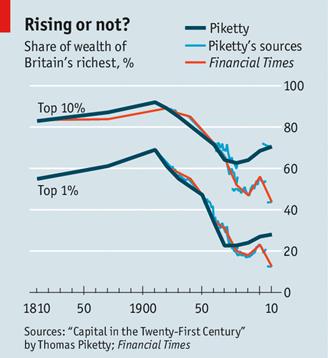
Picking holes in Piketty: The latest controversy around Thomas Piketty’s blockbuster book concerns its statistics

Picking holes in Piketty: The latest controversy around Thomas Piketty’s blockbuster book concerns its statistics

May 31st 2014 | From the print edition

image001-1

FEW economics books have been as popular or as controversial as “Capital in the Twenty-First Century”. The blockbuster analysis of wealth and income distribution has been a publishing sensation, turning its French author, Thomas Piketty, into a household name. The book’s thesis, that wealth concentrates because the returns to capital are consistently higher than economic growth, has spawned furious debate. Mr Piketty’s preferred remedy (a progressive wealth tax) even more so. But amid the argument most commentators have agreed on one thing: “Capital” is an impressive piece of scholarship. Read more of this post

Health-care fraud in America: How to hand over $272 billion a year to criminals

Health-care fraud in America: How to hand over $272 billion a year to criminals

May 31st 2014 | From the print edition

MEDICAL science is hazy about many things, but doctors agree that if a patient is losing pints of blood all over the carpet, it is a good idea to stanch his wounds. The same is true of a health-care system. If crooks are bleeding it of vast quantities of cash, it is time to tighten the safeguards. Read more of this post