Radical Buddhism Threatens Myanmar’s Path to Democracy

Radical Buddhism Threatens Myanmar’s Path to Democracy

Two years into its transition from dictatorship to democracy, Myanmar is finding out how dangerous freedom can be. Since June 2012, when fighting broke out between Buddhists and Muslims in western Arakan state, attacks against Myanmar’s tiny Muslim minority have spread throughout the country. More than 200 people have been killed in Buddhist-Muslim riots, and more than 150,000 rendered homeless — most of them Muslims.

Many Burmese think that former regime figures are stoking the attacks, hoping to create an excuse for the military to reassert its influence. Perhaps. Another set of Burmese leaders, however, have quite openly fueled sectarian tensions. Monks associated with the 969 movement — named after the attributes of the Buddha and Buddhism — have promoted a boycott of Muslim businesses and a ban on interfaith marriages. Some have been accused of egging on followers as they torched Muslim homes and shops. Read more of this post

Abenomics Leaves Japan’s Hinterland Behind as Budget Cuts Bite

Abenomics Leaves Japan’s Hinterland Behind as Budget Cuts Bite

Japanese Prime Minister Shinzo Abe’s cuts to local-government subsidies are like trying to “wring water from an old rag that’s been squeezed dry,” says Kazuya Yoshida, a 27-year veteran of Shijonawate City’s municipal staff.

Abe pared payments to local authorities by 392 billion yen ($3.9 billion), or 2.3 percent, deepening decade-long cutbacks for city and prefectural budgets hurt by falling populations and dwindling revenues. While Abe has deployed fiscal stimulus at the national level to revive Japan’s economy, a drop in wages for provincial civil servants risks prolonging deflation. Read more of this post

Gaming the Float: How Managers Respond to EPS-Based Incentives

Gaming the Float: How Managers Respond to EPS-Based Incentives

Alan D. Crane Rice University – Jesse H. Jones Graduate School of Business

Andrew Koch University of Pittsburgh – Finance Group

Chishen Wei University of Texas at Austin

June 27, 2013

Abstract: 
We show that the likelihood of meeting earnings per share (EPS) forecasts is mechanically positively related to the number of shares outstanding. As a result, managers can affect the long run probability of meeting future EPS forecasts without managing earnings or affecting analysts’ forecasts. We find that firms with unpredictable earnings and firms with managers that have compensation more sensitive to EPS outcomes have more shares outstanding. To address causality, we find that an exogenous drop in the likelihood of meeting a forecast causes managers to increase shares outstanding, primarily through stock splits. Following an increase in shares, accounting and real earnings management drop, and the firm meets EPS forecasts more frequently going forward. Our results also offer a new explanation for stock splits; and provide evidence of a channel that relates EPS incentives to analysts’ forecast errors, stock liquidity, and price levels.

Sentiment, Earnings Co-Movements and Earnings Manipulation

Sentiment, Earnings Co-Movements and Earnings Manipulation

Andrew B. Jackson University of New South Wales (UNSW) – School of Accounting

Brian Rountree Rice University – Jesse H. Jones Graduate School of Business

June 11, 2013

Abstract: 
This paper provides an empirical validation of the theoretical model in Strobl [2013]. Our results are consistent with the model, which document the greater co-movement of earnings with the market the less likely a firm is to manipulate earnings. Furthermore, we find evidence that the probability of manipulation and the importance of earnings co-movements in determining that probability increase as the state of the economy improves. This means earnings management is more prevalent during expansions relative to recessions. Additionally, we provide evidence that firms which are more sensitive to market sentiment are more likely to have managed earnings with a stronger effect during the best economic times. Overall, our results are helpful in understanding the time varying nature of earnings management.

An Analysis of the Financial Schemes to Defraud People in the Garb of Sound Investment

An Analysis of the Financial Schemes to Defraud People in the Garb of Sound Investment

Sujoy Kumar Dhar Sr. Icfai Business School (IBS)

June 15, 2013

Abstract: 
Different conventional financial schemes are prevalent in the market such as bank deposits, post office schemes. Life Insurance products, Public Provident Fund, Government and Corporate Bond, equity share, mutual fund schemes, real estate, gold, bullion, derivative products, paintings and antiques which offers a certain rate of return depending on the riskiness of the scheme. Apart from these traditional players, , there are Nidhi companies, Chit fund players, Non Banking Financial Companies as well as Financial intermediaries which are alluring the layman retail investors by making a promise of offer a super normal rate of return. Due to the lack of adequate financial literacy and the greed of appropriating above average return, a major section of the retail investors are being trapped by those unscrupulous lenders. As a result, they have to lose their hard earned money and this creates a keen jerking effect to the all stakeholders of the nation. The RBI and SEBI has already conducted different financial awareness program to protect the depositors as well as investors from these ponzi schemes. The objectives of the research paper is to focus on the major threats imposed by the shadow bankers, to analyze the unholy nexus of the media business and chit fund players, to interpret the interdependence between the banks, micro finance institutions, chit fund payers. The methodology of the paper is collecting the secondary data from the different research articles of various national and international reputed journals which are available in Ebscho and Emerald. Simultaneously analysis and collection of secondary data is performed from the Annual Reports of Reserve Bank of India, Security Exchange Board of India, website of the Ministry of Finance, Government of India etc. This paper will give a new dimension in the literature of investment strategies of the Individual Investors

Bernanke May Want to Hint At July Tapering Move Now: Scotiabank

Bernanke May Want to Hint At July Tapering Move Now: Scotiabank

07/10/2013 15:32 -0400

Via Guy Haselmann of Scotiabank,

What Bernanke Might Want to Say

In past speeches, Bernanke has said that central banks should not surprise markets.  However, he has also said that central banks should not threaten action, because the threat is then counter-productive to what they are trying to achieve under current policy.  Therefore, waiting 2.25 months until the September meeting seems impractical to me and counter to earlier speeches. Bernanke can use his speech today to bring clarity to the market, while limiting market damage.  For the reasons mentioned, he may want to hint at an earlier-than-expected tapering (say at the July meeting rather than the September meeting).  At the same time, he may want to emphasize asset purchases may continue for longer than expectations.   Of course, he will also emphasize that tapering is merely a slowing of the rate of purchases (slower easing) and that a rate increase in a long way off.  Trying to extend forward guidance at the same time that he moves forward the initial timing of tapering will help limit an adverse market reaction. One reason the Treasury market priced in a Q4 2014 rate hike – moving the first hike forward by 6 months after the June FOMC – was because the FOMC central tendencies lowered the low end of its unemployment rate forecast for end-2014 to 6.5%, which is the Fed’s target for the first rate hike.  Bernanke may wish to verbally lengthen this assessment. Bernanke may wish to say something about the revised exit strategy guidance paper (from January) that is likely to be released at the July meeting.  The original paper said that QE will likely end 6 months after the first taper and rates will be hiked 6 months after QE ends.  Bernanke may wish to hint that both of these time frames are likely to be extended.   In addition, the FOMC noticed (likely with angst) the rise in mortgage rates.  Bernanke can use this opportunity to emphasize that no Fed mortgage assets will ever be sold (but rather allow to run-off).  The first paper discussed asset sales, but Bernanke said at the June FOMC press conference that the Fed does not intend to sell any mortgages.

Background, Reasoning, and Justification

Bernanke gives a speech today in Boston beginning at 4:10 PM entitled “The First 100 Years of the Federal Reserve: The Policy Record, Lessons Learned, and Prospects for the Future”.  There will be a post-speech ‘Question & Answer’ period.  This is an ideal time for him to fine-tune the Fed’s complicated message to markets.  He can use this opportunity to send up a trial balloon for next week’s semi-annual report to Congress.  I suspect Bernanke could even have his staffers leak questions to ask to those in the audience in order to frame and direct the conversation. I believe the Fed has drifted toward acceptance of tapering because of concerns about: 1) financial instability, 2) asset bubbles and 3) amassing difficulties for its exit strategies, not because economic nirvana has been reached.  The FOMC likely recognizes that economic strength is not ideally where they would like it to be, but they understand that $85 of monthly asset purchases has a greater impact on asset prices than it does on lowering the Unemployment Rate (UR).   Therefore, I believe the decision to taper at one of the next two meeting is almost a certainty.  “Data dependency” will dictate the length and pace of QE, but will no longer delay the tapering start date past the next few months. Bernanke can site “progress” as the reason for tapering.  The UR has fallen from 8.2% to 7.6% and employment has expanded by over 200k jobs per month on average over the last 6 months.  A tapering announcement would afford the FOMC the opportunity to get all members on the same, increase their flexibility going forward, and remove it as an uncertainty overhanging markets.
Avoid the Deadly Temptations that Derail Innovators

Avoid the Deadly Temptations that Derail Innovators

by Rosabeth Moss Kanter  |   9:00 AM July 11, 2013

Any promising new initiative — a stand-alone business venture or an innovation in an established organization — hits roadblocks and unexpected obstacles. Recently I’ve advised entrepreneurs and innovators about a different, seemingly better, dilemma: pop-up opportunities that look like short cuts to success. Too often, these turn out to be deadly temptations.

Consider these cases (with names disguised to protect confidentiality):

Bill’s venture capital-backed business concept was to operate a new revenue-producing service for large U.S. professional organizations. In its first year, the venture landed two almost-committed pilot sites and a prospect pipeline for a multi-billion-dollar market. But almost at the same time, Bill was offered a lucrative deal to build a similar service for an English-speaking country outside the U.S. Feeling that the money was good and the chance to show credibility to U.S. customers even better, Bill took the deal, brushing aside numerous challenging differences and departures from his model. Then he was offered an even bigger international site in a developing country eager for American know-how, in partnership with a U.S. organization that could also be a customer. His financial backers urged him to take it — it would mean more revenue, fast. Suddenly Bill was in a different, less appealing business, jeopardizing building the U.S. business. Read more of this post

NASA telescope to probe long-standing solar mystery to determine how the sun heats its atmosphere to millions of degrees, sending off rivers of particles that define the boundaries of the solar system

NASA telescope to probe long-standing solar mystery

Thu, Jun 27 2013

By Irene Klotz

CAPE CANAVERAL, Florida (Reuters) – A small NASA telescope was launched into orbit on Thursday on a mission to determine how the sun heats its atmosphere to millions of degrees, sending off rivers of particles that define the boundaries of the solar system. The study is far from academic. Solar activity directly impacts Earth’s climate and the space environment beyond the planet’s atmosphere. Solar storms can knock out power grids, disrupt radio signals and interfere with communications, navigation and other satellites in orbit. Read more of this post

Investable vs. employable: Which startup founder are you?

Investable vs. employable: Which startup founder are you?

Guest 11, Jul 2013Featured 

John Fearon is a lifelong entrepreneur. His 35 years have taken him from selling sweets as a child, to global digital marketing, to founding Dropmyemail.com, one of the fastest growing cloud companies today. Follow him on Twitter at @JohnFearon.

As a startup founder, would you consider yourself to be investable or employable? There’s a big difference in terms of being nice, consistency, passion and attitude. After going through a few rounds of raising funds with numerous startups, I’ve come to realize that investors use two universal, yet unspoken, categorization of founders pitching to them: “Investable” or “Employable”. The terms are quite self-explanatory and are antonyms of each other. That being said, it doesn’t mean that an investable founder will definitely get funded or that an employable founder cannot. I believe that the fundamental differences between these two are their characters and the different end results they get. This is especially so when investors encounter a startup is in the twilight zone – where everything (i.e., traction, revenue model, target markets, etc.) is unknown yet intriguing. At this early stage of funding, investors can’t determine anything from the data, so they base their decision on the person who is doing the pitch. Here, the investors need to feel a connection before parting with their money to the founders. Read more of this post

Unraveling the Pollinating Secrets of a Bee’s Buzz

July 11, 2013

Unraveling the Pollinating Secrets of a Bee’s Buzz

By CARL ZIMMER

Now is the time of year when bees buzz from flower to flower. And for many plants, the very survival of their species depends on that buzz. The flowers and the insects are joined together in a partnership of sound.

Bumblebees and other insects use buzzing to shake pollen out of flowers for food — and they fertilize flowers along the way. Scientists are exploring this acoustic feat to figure out how it has evolved, and how it helps sustain our own food supply. Read more of this post

Hong Kong Horse Bets Hit Record as Races Draw Young Punters

Hong Kong Horse Bets Hit Record as Races Draw Young Punters

Horse racing bets in Hong Kong reached a record HK$93.8 billion ($12.1 billion) in the past season as the race organizers poured wine and hosted concerts to attract younger punters to its events.

Revenue in the 2012/13 season rose 9 percent from a year earlier, surpassing the previous record set in the 1996/97 season, Hong Kong Jockey Club said in a statement on its website. The 83 races drew over two million attendees, according to the statement. Read more of this post

Cosco Shipping Loss Triples in Latest Sign of Weak China Profits

Cosco Shipping Loss Triples in Latest Sign of Weak China Profits

Cosco Shipping Co. (600428), a listed unit of China’s biggest shipping group, said first-half net loss tripled, the latest sign that slowing growth in the world’s second-biggest economy is eroding corporate earnings.

The shipping company’s loss in the first six months was 78 million yuan ($12.7 million), widening from 23.6 million yuan a year earlier, it said in a statement to Shanghai’s stock exchange yesterday. Gold miner Zijing Mining Group Co. (2899), sportswear maker Peak Sport Products Ltd. (1968) and winemaker Dynasty Fine Wines Group Ltd. (828) are among others to report sliding profits or losses this month. Read more of this post

Heads to roll as curbs bite HK property agents; largest property agency Centaline sent letters to a staggering 1,400 of its agents – more than one-third of the total – warning they could be fired

Heads to roll as curbs bite property agents
Karen Chiu
Thursday, July 11, 2013
Property agents may face another round of layoffs as major agencies launch fresh efforts to slash costs.

Centaline Property Agency yesterday sent letters to a staggering 1,400 of its agents – more than one-third of the total – warning they could be fired as they have made deals worth less than HK$60,000 in the past six months.  Read more of this post

Hong Kong regulators are reportedly investigating allegations of fraud against Zoomlion Heavy, China’s second-largest construction machinery maker

Probe into Zoomlion 
Thursday, July 11, 2013
Hong Kong regulators are reportedly investigating allegations of fraud against Zoomlion Heavy Industry Science and Technology (1157). Guangzhou-based Southern Metropolis Daily and Yangcheng Evening News received two documents showing Hong Kong Exchanges and Clearing (0388) and the Securities and Futures Commission accepted complaints against the Changsha-based machinery maker on June 7. They allege the firm is involved in manipulating profit and misleading investors by making false statements. The anonymous complaints also noted similar allegations against Zoomlion were presented to the China Securities Regulatory Commission on Tuesday.Both the HKEx and SFC declined to comment on the issue. Zoomlion shares fell 1.78 percent yesterday to HK$4.98. Since allegations first surfaced in January, the stock has declined 57 percent. NATALIE NGAN

Glut of shopping malls in China could create realty bubble

Glut of shopping malls in China could create realty bubble

Staff Reporter

2013-07-11

Compared with the residential market, the commercial real estate market is more likely to face bubbles, a vice chairman of a Hong Kong-listed realty firm has told Shanghai’s First Financial Daily. According to real estate services company DTZ, the total floor area for new shopping malls slated to open in Shanghai during the second half of this year will reach 2.49 million square meters. In comparison, the total floor area of retail property transactions from the year 2000 to June 2013 was pegged at 10.9 million square meters. Read more of this post

Muddy Waters: Adventures Abroad Could Hurt U.S. Companies

JULY 10, 2013, 3:06 PM

Adventures Abroad Could Hurt U.S. Companies

By CARSON C. BLOCK

Carson C. Block is the director of research for Muddy Waters, an investment firm.

Analysts across Wall Street are just beginning to warn investors about trouble brewing in emerging markets. The International Monetary Fund this month downgraded its global growth forecast for the rest of 2013 and next year, citing a big slowdown in emerging market economies because of higher interest rates, asset price volatility, weaker domestic activity and currency depreciation. Read more of this post

Financial fraud investigation into Chinese wind energy giant Sinovel after a few years of explosive growth

07.11.2013 18:48

Post-Boom Blowdown for Wind Energy’s Sinovel

A wind energy giant is in trouble with regulators, customers and investors after a few years of explosive growth

Pu Jun and Yu Ning

(Beijing) — Wei Wenyuan’s sudden resignation stunned his colleagues at Sinovel Wind Group but started making sense two weeks later when securities regulators announced a financial fraud investigation targeting the company. Wei’s departure May 13 after just two months as chairman and eight months as acting president also mirrored the turbulent atmosphere at Sinovel, one of China’s largest wind turbine manufacturers as well as a developer of wind farms locally and overseas. Read more of this post

1,000 hopeful borrowers overran a branch of China’s central bank as a rumor spread that it was handing out zero-interest loans, illustrating how Chinese financial know-how badly lags growth in banking products

China central bank office mobbed by borrowers seeking free loans

5:43am EDT

BEIJING (Reuters) – About 1,000 hopeful borrowers overran a branch of China’s central bank as a rumor spread that it was handing out zero-interest loans, media said on Thursday, illustrating how Chinese financial know-how badly lags growth in banking products.

Police were called in on Tuesday to disperse the crowd, which had gathered for days outside the central bank in Beihai in the southern province of Guangxi, the Global Times said. Read more of this post

Cash for copper in China (or whack-a-mole financing)

Cash for copper in China (or whack-a-mole financing)

FT Alphaville | Jul 10 15:06 | 13 comments | Share

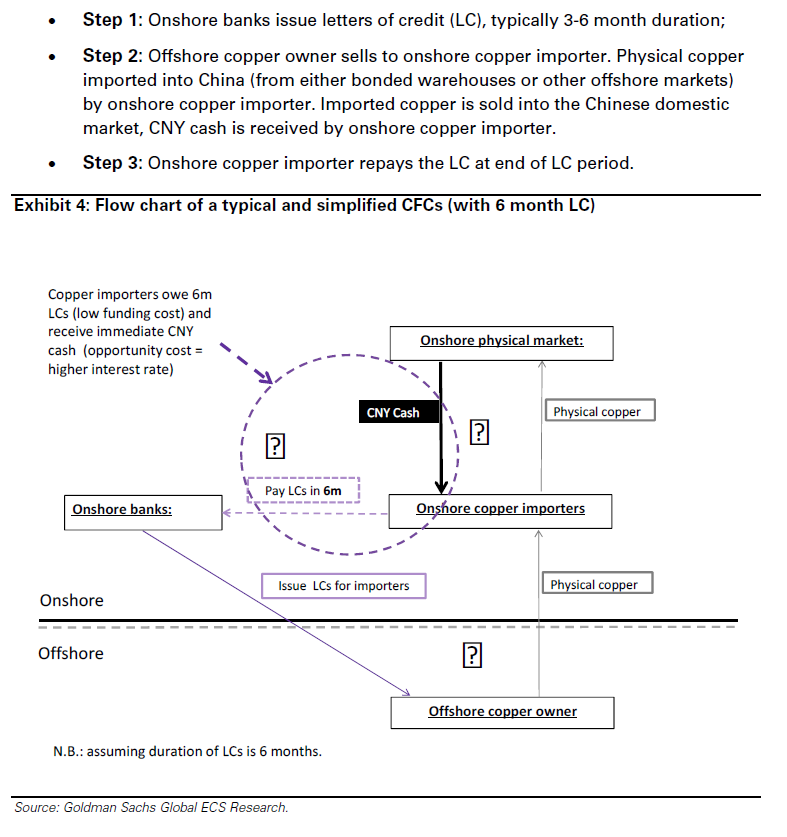
Kate’s post on the June China trade data mentions that commodities imports were the only bright spot (although it’s a somewhat dubious bright spot if it indicates a resurgence in investment). It turns out that copper imports were particularly strong, recording a 9.7 per cent year-on-year increase in June, a rather large change compared to a 14.6 per cent decline in May. Goldman point us to one compelling reason why that might be the case. It’s basically another case of whack-a-mole financing in China. Hit over-invoicing over the head and up pops ‘Cash For Copper’ (CFC) financing. This differs from more traditional Chinese Copper Financing Deals in that CFC financing involves moving physical copper from offshore to onshore; and there is no circulation of warrants. But the point of the two mechanisms is the same — getting access to CNY through cheap FX funding. A CFC financing deal looks a little something like this (click to enlarge):

Goldman-July-9-2 Goldman-July-9-1 Read more of this post

China faces tug-of-war over growth strategy; “We can’t rule out the possibility that the situation will be different from what leaders expect and that the economy will suffer a hard landing”

July 10, 2013 12:37 pm

China faces tug-of-war over growth strategy

By Simon Rabinovitch in Shanghai

Is this the end of the ‘Beijing put’? Over the past five years whenever China’s growth slipped below 8 per cent, global investors could count on the government to unleash stimulus and re-energise the world’s second-largest economy, boosting demand for everything from Audis to iron ore.

China is now sliding toward 7.5 per cent growth and likely lower. But the country’s new leaders are refusing to ride to the economy’s rescue, as they did most spectacularly in late 2008 when the global financial crisis struck. There is virtual unanimity among analysts that China has entered an era of slower growth, and that the government, far from panicking, welcomes this change, believing it will give rise to a more sustainable economic model. Read more of this post

Penang is as famous for being the nation’s jeans centre as it is for its char kway teow; and Yen Global is believed to command about 10% of the Malaysian market share for jeans

Updated: Tuesday July 9, 2013 MYT 8:39:21 AM

Sky-high demand for denim

STORY AND PHOTOS BY GRACE CHEN

doc6aucd3sbcs4num5xagq

Dynamic team: (From left) Kok Beng, Yen Global group marketing director Goh Kok Peng and Yeoh. ]

It may not be common knowledge, but Penang is as famous for being the nation’s jeans centre as it is for its char kway teow,says Goh Kok Beng, group executive chairman of Yen Global Bhd. The company manufactures and distributes the Edwin, Mustang and GA Blue brands from the company’s factory headquarters in Bayan Lepas. The genesis of the island’s denim history can be traced back to the late 1960s when a large Hong Kong-based garment factory began manufacturing jeans under license for Levi’s. “They were not big, they were huge!” recalls Goh, who was still in school then. From Goh’s vivid recollections, they had close to 1,000 skilled workers earning a base salary of RM300 a month stationed in three areas – Rifle Range, Parit Buntar and Balik Pulau in the early 1970s. The production rate was believed to number 100,000 pairs a month. Read more of this post

Is top-down culture to blame for Asiana crash?

2013-07-11 17:23

Is culture to blame for Asiana crash?

Experts say evidence is ‘inconclusive’ to ‘stereotypical’
By Kim Young-jin
Did culture contribute to the crash of Asiana Airlines Flight 214?
Western media speculation appears itchy to point out that Korea’s top-down hierarchal ways caused communication problems in the cockpit, leading to the fatal crash at San Francisco International Airport last Sunday.
“Despite changes, including an improved safety record, Korea’s aviation sector remains rooted in a national character that’s largely about preserving hierarchy ― and asking few questions of those in authority,” an article by CNBC said. Read more of this post

Robots on the Brain: The merging of human surgical experience with machines and computerized technologies is driving neurosurgical advancement

Robots on the Brain

09 July 2013

Garnette Sutherland is Professor of Neurosurgery in the Department of Clinical Neurosciences at the University of Calgary, Canada.

CALGARY – When Harvey Cushing and William Bovie introduced electrocautery (which uses a high-frequency current to seal blood vessels or make incisions) in 1926, their innovation transformed neurosurgery. Given the precision required to operate on an organ as delicate as the brain, the convergence of mechanical technologies with the art of surgery catalyzed progress in the field. Read more of this post

Byron Wien’s Firsthand Impressions of Asian Markets; “In past years there was a sense of optimism everywhere you went. Now you get a feeling of uncertainty touched by apprehension.”

WEDNESDAY, JULY 10, 2013

Byron Wien’s Firsthand Impressions of Asian Markets

By BYRON WIEN | MORE ARTICLES BY AUTHOR

“In past years there was a sense of optimism everywhere you went,” writes the Wall Street veteran. “Now you get a feeling of uncertainty touched by apprehension.”

I spent almost two weeks in Asia in June and in some ways it was an eye-opener. In past years there was a sense of optimism everywhere you went. Now you get a feeling of uncertainty touched by apprehension. My trip covered a great circle starting in Singapore and going on to Kuala Lumpur, Taipei, Hong Kong, Beijing, Seoul and Tokyo. Spending only one day in each city, my observations were more impressionistic than analytical. I talked with sovereign wealth fund managers and other major investors. Most concerns related to China’s outlook and whether the financial system there was overextended. As we all know, China is the engine of growth for the region and any problems there are felt everywhere else. In contrast to last year, Japan was also a major topic of interest. Read more of this post

Commodity Traders Face New Squeeze as Storage Congestion Spreads

Commodity Traders Face New Squeeze as Storage Congestion Spreads

Commodity traders are facing another supply squeeze as stockpiles concentrate in fewer cocoa depots, mirroring congestion at metals warehouses that means some buyers are paying record premiums for deliveries.

Warehouses in Antwerp, Belgium, held 61 percent of cocoa certified for delivery by the NYSE Liffe exchange on June 24, compared with 36 percent a year earlier, bourse data show. That mirrors the trend in metal stockpiles, with 73 percent of aluminum and 90 percent of copper tracked by the London Metal Exchange now held in three locations. Read more of this post

The panic that rippled through Asia’s markets in May and June might just be a prelude to a more serious capital flight when the U.S. Federal Reserve starts winding down its stimulus measures for real

Asian stress points unveiled as Fed tapering looms

5:07pm EDT

By Nachum Kaplan and Umesh Desai

Singapore (Reuters) – The panic that rippled through Asia’s markets in May and June might just be a prelude to a more serious capital flight when the U.S. Federal Reserve starts winding down its stimulus measures for real.

How quickly the U.S. Federal Reserve reduces its $85 billion a month of bond purchases, which keep interest rates low, will determine how quickly money is pulled out of Asia. Read more of this post

New-breed bosses rev up Indonesia’s state enterprises

New-breed bosses rev up Indonesia’s state enterprises

Wednesday, Jul 10, 2013

John McBeth

The Straits Times

SINGAPORE – Don’t say it too loudly because it might upset the bureaucrats, but over the past five years, go-ahead private sector executives have been changing the corporate culture and turning around the fortunes of a clutch of Indonesia’s state-owned enterprises.

Pertamina oil company president-director Karen Agustiawan, 54; Garuda Airlines chief executive officer Emirsyah Satar, 53; and Kereta Api national railway boss Ignasius Jonan, 49, have all made an impact on organisations previously known for their leaking budgets and tardy public service. Read more of this post

Trouble Looms for Japan’s Once-Mighty DPJ; Beleaguered Party Projected to Lose Last Grasp on Power in Upper House Race

Updated July 10, 2013, 1:26 p.m. ET

Trouble Looms for Japan’s Once-Mighty DPJ

Beleaguered Party Projected to Lose Last Grasp on Power in Upper House Race

TOKO SEKIGUCHI

TOKYO—Four years after its historic overthrow of the entrenched one-party rule of the Liberal Democratic Party, the Democratic Party of Japan is set to lose its last grasp on power with polls predicting a catastrophic loss for the beleaguered party in the coming upper house race.

The DPJ, led by Banri Kaieda is projected to lose half its 44 seats up for election in the July 21 race, according to surveys by Japan’s major dailies. The DPJ, which for now is the largest single voting bloc in the upper chamber, will be giving up its presence as the dominant opposition force, as the governing LDP-New Komeito coalition’s bicameral control of parliament all but eliminates the DPJ’s tactical recourse against the enactment of government-proposed bills. Read more of this post

Corporate Insiders Shift From ‘Buy’ to ‘Sell’ as Bankruptcy Nears

July 10, 2013, 11:02 p.m. ET

Corporate Insiders Shift From ‘Buy’ to ‘Sell’ as Bankruptcy Nears

SUSAN PULLIAM and ROB BARRY

P1-BM252B_Tradi_G_20130710184829

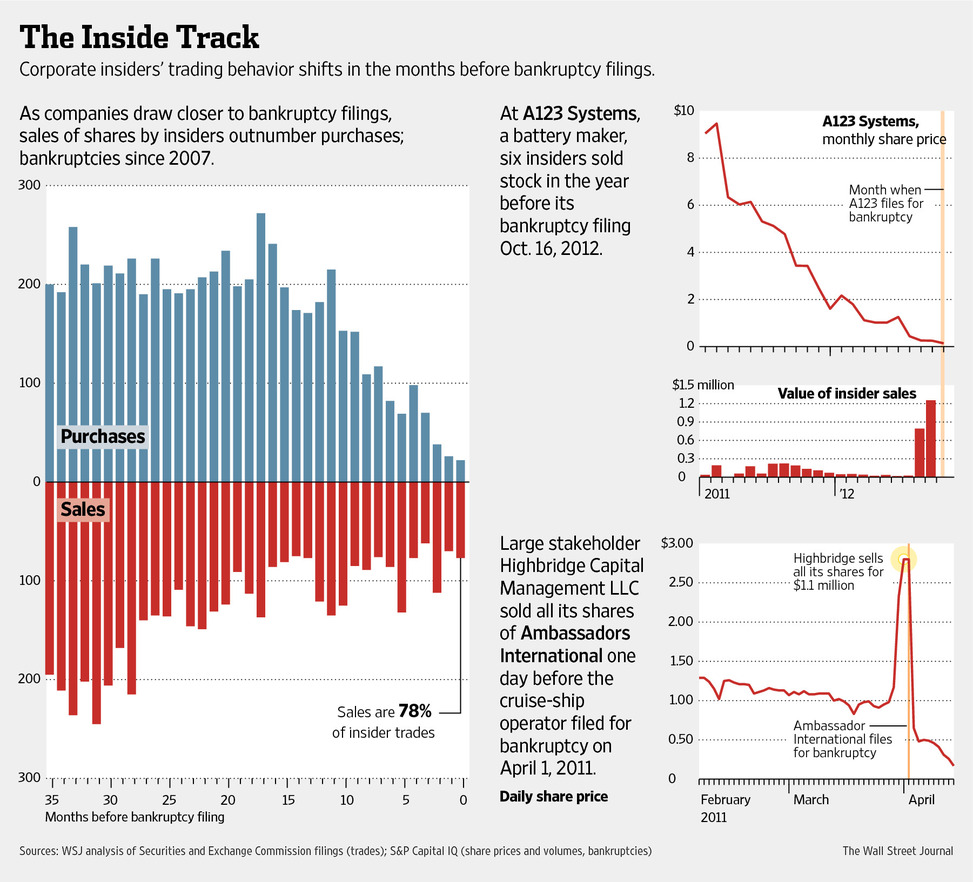
One day in September 2011, Wall Street analysts trundled into the spacious lobby at the Livonia, Mich., plant of a company called A123 Systems Inc. to view a slide presentation describing a rosy outlook for the maker of lithium batteries. “They stood up in front of investors and painted a very bullish picture,” said Andrea James, an analyst at Dougherty & Co., who took pictures of the lobby’s two-story floor-to-ceiling window. “It looked like the lobby of a company that was making money hand over fist.” Thirteen months later, it filed for bankruptcy protection. But not before insiders unloaded a total of $2.5 million of its stock. The company said the sales conformed to its policy for insider transactions. The episode suggests how corporate insiders’ trading can shift in the months before their companies file for bankruptcy. A Wall Street Journal review of thousands of trades by insiders in their own company’s stock found the trades veering heavily toward selling rather than buying as bankruptcy filings drew nearer. Read more of this post

Dividend Stock Investors Should Really Consider How CEOs Are Paid

MORGAN STANLEY: Dividend Stock Investors Should Really Consider How CEOs Are Paid

SAM RO JUL. 11, 2013, 7:39 AM 844 1

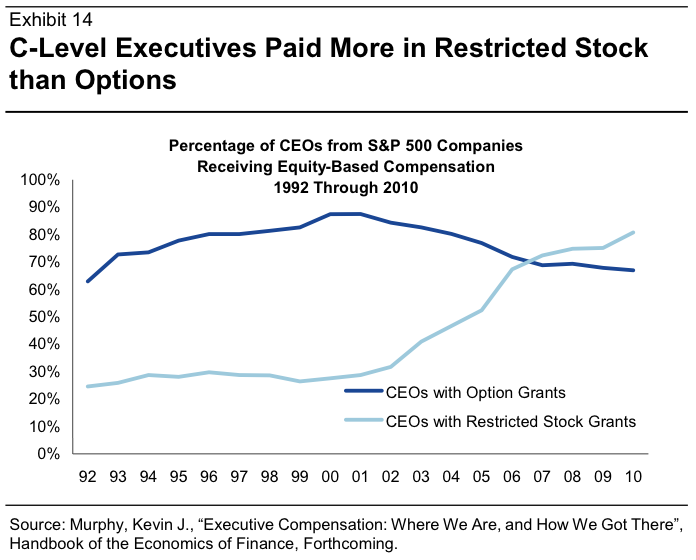
Adam Parker, Morgan Stanley’s Chief U.S. Equity Strategist, is on Bloomberg Surveillance with Tom Keene this morning. While discussing dividend paying stocks, Parker noted that we should consider executive compensation structures. Parker addressed this in a recent report to clients: Management teams are paying themselves more in restricted stock units (RSUs) than in options. In recent years, more CEOs of S&P 500 companies have received compensation in the form of restricted stock than as options (Exhibit 14). It is important that fundamental analysts understand how the senior management teams of the companies they are analyzing are variably compensated, as those with restricted stock and not options are much more likely to increase dividends. The principle? People rarely intentionally damage their own net worth. The shift toward equity-based compensation was designed to align executives’ interests with shareholders. However, we have to wonder if corporate decision-makers will pass up better uses of cash to enrich themselves in the form of dividends. Regardless, this decision to pay out an increasing dividend is crucial to investors. Since 1930, dividends have accounted for 42 percent of stock market investment returns.

screen shot 2013-03-18 at 8.41.33 pm