China’s cautious land-reform tests cast doubt on big urban vision

China’s cautious land-reform tests cast doubt on big urban vision

4:13pm EST

By Kevin Yao

CHENGDU, China (Reuters) – Tan Yingyu is one of China’s 200 million migrant workers and like many he is stuck: he does not want to return to his village but also cannot become a legal resident in the city of Chengdu, where he has worked for nearly 20 years. His dilemma highlights a key issue for China’s reformist leaders as they look for ways to encourage more people to move to cities to help turn a credit- and investment-driven economy into a consumer-powered one. Read more of this post

China’s Building Push Goes Underground

China’s Building Push Goes Underground

Party Leaders Signal Subway Expansions Are About Urbanization, Not Infrastructure Binging

JAMES T. AREDDY

Nov. 10, 2013 7:57 p.m. ET

KUNSHAN, China—Twenty years ago, China’s Communist Party leadership earmarked money for an expressway network modeled on the U.S. interstate highway system. A decade ago, they spent big on bullet trains. As a fresh team of Chinese leaders gathers this week in Beijing to lay out broad economic goals, the effort to keep China moving has shifted underground, with dozens of cities spending billions of dollars on subway systems. Read more of this post

Nokia’s Ollila had been surrounded by “sycophants who had no competence to address software challenges.”; Nokia’s fall should be a cautionary tale

Nokia’s fall should be a cautionary tale

Monday, November 11, 2013 – 09:04

AFP

HELSINKI – In just five years Nokia fell from dominating the mobile phone industry to abandoning the handset business, a swift fall from grace with lessons for market leaders. The story of Nokia, now at the toughest stage of the restructuring cycle, is a particularly salutary business case about the fast-moving, high-risk, high-reward, tech sector for hip consumer goods. Read more of this post

Twitter Puts Spotlight on How Firms Burnish Results

Twitter Puts Spotlight on How Firms Burnish Results

MICHAEL RAPOPORT

Nov. 9, 2013 7:06 p.m. ET

Twitter Inc. TWTR -7.24% lost money in the first nine months of the year. But when the company used a different set of measurements, it posted a profit. The strong interest in Twitter’s initial public offering brought back to the fore the accounting methods that companies can use to burnish otherwise lackluster results. Twitter has recorded a loss of more than $130 million this year using traditional accounting measures. But after stripping out several costs, Twitter posted a nine-month profit of almost $31 million. Read more of this post

Amazon and J&J Clash Over Third-Party Sales; J&J Complained Damaged or Expired Products Were Sold on Site

Amazon and J&J Clash Over Third-Party Sales

J&J Complained Damaged or Expired Products Were Sold on Site

SERENA NG and JONATHAN D. ROCKOFF

Updated Nov. 10, 2013 8:22 p.m. ET

P1-BN948_JJAMAZ_NS_20131110190011

Johnson & Johnson JNJ +1.47% and Amazon.com Inc. AMZN +1.96% are clashing over complaints that Amazon isn’t doing enough to prevent people from selling damaged or expired J&J products—Tylenol painkillers and Rogaine baldness treatments, among others—on its website. The behind-the-scenes dispute is a prime example of a widening fear among consumer-products companies: On the Internet, it is easier to lose control over a brand image. Read more of this post

Cameras Succumb to Smartphone Juggernaut

Cameras Succumb to Smartphone Juggernaut

FARHAD MANJOO

Nov. 10, 2013 7:16 p.m. ET

Smartphone cameras traditionally have been better in theory than reality. Start with the shutter lag: Nearly every phone camera I’ve ever used has had an annoying split-second delay between the time you hit the button to snap your shot and the time the shot gets snapped. The lag is just long enough for your kid’s adorable smile to turn into a nightmarish frown. Read more of this post

Social Media in China; Sina Weibo and Tencent’s WeChat dominate social media in China. But the landscape is shifting—and this week they will offer investors a glimpse of how well they are keeping their footing

Social Media in China: Sina, Tencent to Report Results

PAUL MOZUR

Nov. 10, 2013 12:58 p.m. ET

BEIJING—Two companies dominate social media in China. But the landscape is shifting—and this week they will offer investors a glimpse of how well they are keeping their footing. Beijing-based Sina Corp. SINA -2.64% runs the country’s most popular public microblogging service, the Twitter-like Sina Weibo, which for the past three years has served as the closest thing China has for a national forum. It is facing increasing pressure from Tencent Holdings Ltd. TCEHY +0.56% ‘s WeChat, a mobile app similar to WhatsApp and Line that allows users to post status updates, share photos and even strike up quick romantic encounters. Read more of this post

Abenomics Faces Emerging Pressures

Abenomics Faces Emerging Pressures

Trouble in Developing Markets Blurs Growth Picture

TAKASHI NAKAMICHI

Updated Nov. 10, 2013 5:31 p.m. ET

NA-BY843_OUTLOO_G_20131110170307

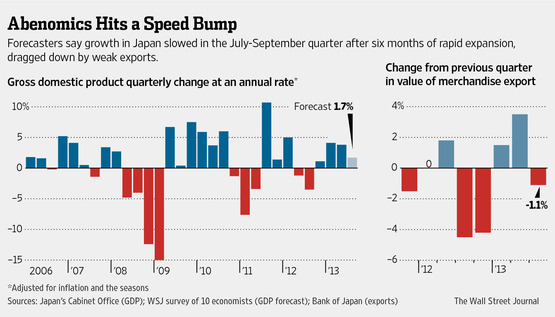
Japan is expected to report this week that its economic-revival experiment hit a speed bump over the summer, with growth for the three months through September likely slowing to less than half the pace recorded in the first half of the year. That doesn’t necessarily mean Abenomics—Prime Minister Shinzo Abe’s master plan involving weakening the yen and temporarily boosting infrastructure spending—is faltering. Read more of this post

Japan Inc Weighing Pay Hikes? Little Sign So Far

November 11, 2013, 9:34 AM

Japan Inc Weighing Pay Hikes? Little Sign So Far

By Yumi Otagaki

In what are perhaps the world’s biggest, most public, and protracted labor negotiations, Japan’s top policymakers – from Prime Minister Shinzo Abe and Bank of Japan Gov. Haruhiko Kuroda on down – have for weeks been pressing the country’s executives to give employees their first base pay increases in years next spring. How’s it going so far? If weekend reports are any sign, not so good. Read more of this post

Kospi Rally Leaves Brokers Behind as Profits Drop: Korea Markets

Kospi Rally Leaves Brokers Behind as Profits Drop: Korea Markets

South Korean brokers are missing out on a rally that sent the nation’s benchmark stock index to its highest level since 2011, as slumping trading volumes contribute to the weakest profits in eight years. Samsung Securities Co. (016360), the country’s biggest brokerage by market capitalization, and five of its local peers are valued at the lowest levels since at least 2007 after falling an average of 15 percent in Seoul this year. Industry earnings have shrunk to the smallest since the first half of 2005, while trading on the Korea Exchange (KOSPI) fell to a six-year low, data compiled by Bloomberg and the Financial Supervisory Service show. Read more of this post

‘Long-Only’ Funds Lose Their Hedge’Long-Only’ Funds Lose Their Hedge

‘Long-Only’ Funds Lose Their Hedge’Long-Only’ Funds Lose Their Hedge

JULIET CHUNG

Nov. 10, 2013 7:02 p.m. ET

What do you call a hedge fund that doesn’t hedge? The latest growth area for the industry. On the heels of a multiyear market rally, a slew of hedge-fund firms are launching “long-only” funds betting that at least some stocks have further to climb. The moves come amid a brutal stretch for short bets against companies, traditionally a key strategy for hedge funds. Read more of this post

Flurry of Stock, Bond Issuance Is a Danger Sign for Markets

Nov 10, 2013

Flurry of Stock, Bond Issuance Is a Danger Sign for Markets

E.S. BROWNING

MI-BZ597_ABREAS_G_20131110175104

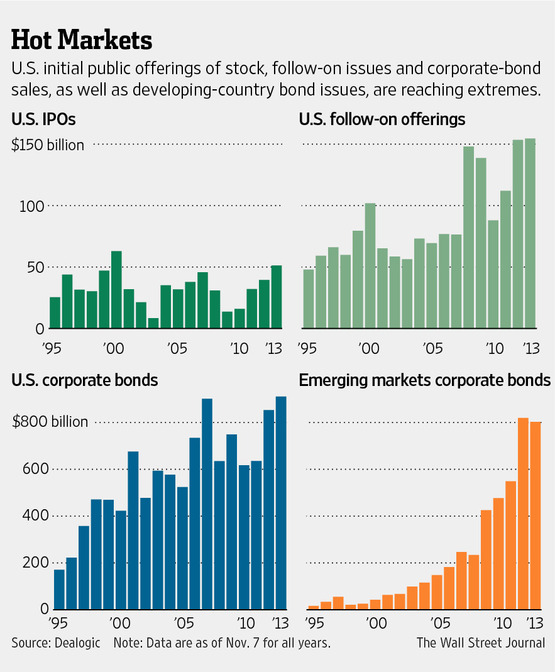
Just as financial markets were recovering from the Washington turmoil, a new danger signal has started blinking, in the form of a flood of stock and bond issues. Many people see no problem. They find the new-issue action exciting, as the hoopla over last week’s $2.1 billion offering by Twitter Inc.TWTR -7.24% showed. The process fuels entrepreneurship and securities issues are mother’s milk for brokerage firms, generating enormous profits. Read more of this post

Signs Multiply That Sentiment Is Too Upbeat; Surveys of Retail Investors, Advisers, Point to Froth

Signs Multiply That Sentiment Is Too Upbeat

Surveys of Retail Investors, Advisers, Point to Froth

SPENCER JAKAB

Nov. 10, 2013 5:44 p.m. ET

MI-BZ598_AOT_NS_20131110171203

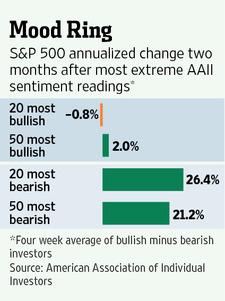
For those worried that irrational exuberance is back, Twitter Inc. TWTR -7.24% ‘s hyped initial public offering provides yet another bit of anecdotal evidence. More quantifiable measures of investors’ mood going into the end of 2013 may support that view, too. A particularly worrisome one is the Investors Intelligence gauge of adviser sentiment. Its last reading showed that 55.2% of respondents were bullish and just 15.6% bearish, tying the highest difference between the two this year. The last time the gap was bigger was April 8, 2011, which preceded the sharpest stock-market correction of the current bull market. Read more of this post

Big Law Mergers Turn Off Clients; Amid a Wave of Megamergers, Legal Experts Say Expertise—Not Size—Matters Most

Big Law Mergers Turn Off Clients

Amid a Wave of Megamergers, Legal Experts Say Expertise—Not Size—Matters Most

JENNIFER SMITH

Updated Nov. 10, 2013 7:42 p.m. ET

When it comes to law firms, bigger may not always be better. A wave of legal tie-ups has created a fleet of supersize law firms with offices around the world, and more are in the works this fall. Partners at cross-border entity Dentons and U.S. firm McKenna Long & Aldridge LLP, for example, are poised to vote on a union that would produce one of the top three global law firms by head count. Recent merger talks between two big U.S. firms—Orrick, Herrington & Sutcliffe LLP and Pillsbury Winthrop Shaw Pittman LLP—could lead to the creation of another big player. But law firms with the urge to merge might check with their clients first. Read more of this post

GM Labels Lose, But So Does Big Food

GM Labels Lose, But So Does Big Food

For the second time, blue-state voters have defeated a ballot initiative to require labeling of genetically modified foods. In 2012, it was California; this week, it was Washington, where a labeling referendum lost 55 percent to 45 percent. Advocates of labeling may as well suspend similar efforts in other states, because it’s clear that, when it comes to persuading voters, they’re no match for Big Food. In Washington, the Grocery Manufacturers Association, Monsanto Co., DuPont Co. and others raised $22 million to fight the measure, almost triple the $8.4 million collected by Whole Foods Markets Inc., Dr. Bronner’s Magic Soap, the Center for Food Safety and other advocates of labeling. In California, the food industry similarly outspent its opposition $46 million to $9 million. Read more of this post

The Prize is the Pleasure in Finding Things Out, the kick in the discovery, the observation that other people use it. Those are the real things

The Prize is the Pleasure in Finding Things Out

by SHANE PARRISH on NOVEMBER 3, 2013

Canadian filmmaker Reid Gower created the Feynman Series, a trilogy of physicist Richard Feynman’s penetrating insight into domains outside of physics. Consider the first, Richard Feynman on Beauty. Honours, the second part, shows Feynman’s healthy disrespect for authority. I don’t like honors. I’m appreciated for the work that I did, and for people who appreciate it, and I notice that other physicists use my work. I don’t need anything else. I don’t think there’s any sense to anything else. I don’t see that it makes any point that someone in the Swedish Academy decides that this work is noble enough to receive a prize. I’ve already got the prize. The prize is the pleasure of finding the thing out, the kick in the discovery, the observation that other people use it. Those are the real things. The honors are unreal to me. I don’t believe in honors. It bothers me, honors. Honors is epilets, honors is uniforms. My poppa brought me up this way. I can’t stand it, it hurts me. When I was in High School, one of the first honors I got was to be a member of the Arista, which is a group of kids who got good grades. Everybody wanted to be a member of the Arista. I discovered that what they did in their meetings was to sit around to discuss who else was worthy to join this wonderful group that we are. OK So we sat around trying to decide who would get to be allowed into this Arista. This kind of thing bothers me psychologically for one or another reason. I don’t understand myself. Honors, and from that day to this, always bothered me. I had trouble when I became a member of the National Academy of Science, and I had ultimately to resign. Because there was another organization, most of whose time was spent in choosing who was illustrious enough to be allowed to join us in our organization. Including such questions as: ‘we physicists have to stick together because there’s a very good chemist that they’re trying to get in and we haven’t got enough room…’. What’s the matter with chemists? The whole thing was rotten . Because the purpose was mostly to decide who could have this honor. OK? I don’t like honors.

20-Year-Old Hunter S. Thompson’s Superb Advice on How to Find Your Purpose and Live a Meaningful Life

20-Year-Old Hunter S. Thompson’s Superb Advice on How to Find Your Purpose and Live a Meaningful Life

As a hopeless lover of both letters and famous advice, I was delighted to discover a letter 20-year-old Hunter S. Thompsongonzo journalism godfather, pundit of media politics, dark philosopher – penned to his friend Hume Logan in 1958. Found in Letters of Note: Correspondence Deserving of a Wider Audience (public library) – the aptly titled, superb collection based on Shaun Usher’s indispensable website of the same name – the letter is an exquisite addition to luminaries’ reflections on the meaning of life, speaking to what it really means to find your purpose. Cautious that “all advice can only be a product of the man who gives it” – a caveat other literary legends have stressed with varying degrees of irreverence – Thompson begins with a necessary disclaimer about the very notion of advice-giving:

To give advice to a man who asks what to do with his life implies something very close to egomania. To presume to point a man to the right and ultimate goal – to point with a trembling finger in the RIGHT direction is something only a fool would take upon himself.

And yet he honors his friend’s request, turning to Shakespeare for an anchor of his own advice:

“To be, or not to be: that is the question: Whether ’tis nobler in the mind to suffer the slings and arrows of outrageous fortune, or to take arms against a sea of troubles…” And indeed, that IS the question: whether to float with the tide, or to swim for a goal. It is a choice we must all make consciously or unconsciously at one time in our lives. So few people understand this! Think of any decision you’ve ever made which had a bearing on your future: I may be wrong, but I don’t see how it could have been anything but a choice however indirect – between the two things I’ve mentioned: the floating or the swimming.

He acknowledges the obvious question of why not take the path of least resistance and float aimlessly, then counters it: Read more of this post

Fighting Your Business Battles: 6 Lasting Lessons From Sun Tzu’s Art Of War

FIGHTING YOUR BUSINESS BATTLES: 6 LASTING LESSONS FROM SUN TZU’S ART OF WAR

YOU’LL PROBABLY NEVER READ THE ENTIRE BOOK MANY CONSIDER A BUSINESS STRATEGY BIBLE. SO READ THIS INSTEAD.

BY MARK MCNEILLY

Business has always been tough, but it has gotten even more difficult as competition has become more global, faster-paced and increasingly technology-dependent. So why in the 21st century would it make sense to look to The Art of Warby Sun Tzu for business advice, a book on ancient warfare written centuries before the birth of Christ? Read more of this post

Reason is the Enemy of Greatness

Reason is the Enemy of Greatness

by SHANE PARRISH on NOVEMBER 5, 2013

“There can be no great genius without a touch of madness.”
— Seneca

This is a beautiful passage from Giacomo Leopardi’s Zibaldone on the conflict between reason and nature.

Reason is the enemy of all greatness: reason is the enemy of nature: nature is great, reason is small. I mean that it will be more or less difficult for a man to be great the more he is governed by reason, that few can be great (and in art and poetry perhaps no one) unless they are governed by illusions. Read more of this post

Organizational Complexity: The hidden killer

Organizational Complexity: The hidden killer

by Michael Wade | Nov 8, 2013

Four steps to reduce complexity

There’s no questioning the fact that companies today are faced with growing complexity. Environmental, political, and competitive changes conspire to create a challenging and complex operating environment. In response to these ever evolving pressures, companies often try to mirror external complexity in their internal environments. For example, they may respond to more sophisticated customer demands by creating tailored products and services. They may address the need for cost cutting and innovation by building matrix organizational structures. They may attempt to add new processes to address evolving market needs. In isolation, each of these responses makes sense, but in combination, they can significantly affect organizational performance.  Read more of this post

A Cure for the Allergy Epidemic? When we left farming life, we lost the microbes that kept our immune systems in check

November 9, 2013

A Cure for the Allergy Epidemic?

By MOISES VELASQUEZ-MANOFF

WILL the cure for allergies come from the cowshed? Allergies are often seen as an accident. Your immune system misinterprets a harmless protein like dust or peanuts as a threat, and when you encounter it, you pay the price with sneezingwheezing, and in the worst cases, death. What prompts some immune systems to err like this, while others never do? Some of the vulnerability is surely genetic. But comparative studies highlight the importance of environment, beginning, it seems, in the womb. Microbes are one intriguing protective factor. Certain ones seem to stimulate a mother’s immune system during pregnancy, preventing allergic disease in children. Read more of this post

Con Men Prey on Confusion Over Health Care Act

November 9, 2013

Con Men Prey on Confusion Over Health Care Act

By JESSICA SILVER-GREENBERG and SUSANNE CRAIG

To the list of problems plaguing President Obama’s health care law, add one more — fraud. With millions of Americans frustrated and bewildered by the trouble-prone federal website for health insurance, con men and unscrupulous marketers are seizing their chance. State and federal authorities report a rising number of consumer complaints, ranging from deceptive sales practices to identity theft, linked to the Affordable Care Act. Read more of this post

Ender’s Game, its controversial author, and a very personal history

November 1, 2013 12:00 AM ET
Stranger in a Strange Land

Ender’s Game, its controversial author, and a very personal history

By Rany Jazayerli
The Ender’s Game movie premieres today, nearly 30 years after Orson Scott Card’s science fiction classic was published. The film, in development for almost half that time, does not lack star power. The story is about a dystopian future in which pubescent boys and girls are recruited to lead armies against aliens who nearly destroyed humanity a generation earlier, and the film necessarily casts teenagers1 in the lead roles. Asa Butterfield, who plays the title role of Andrew “Ender” Wiggin, was last seen displaying his talents as the lead in Martin Scorsese’s beautifully rendered (albeit interminably boring) Hugo. Abigail Breslin, who plays Ender’s sister Valentine, and Hailee Steinfeld, who plays Ender’s Battle School mentor, both earned Oscar nominations before they were 15. The adult leads, Harrison Ford, Ben Kingsley, and Viola Davis, are even more decorated. If the movie flops, it won’t be because the actors can’t act. Read more of this post

Is Silicon Valley Arrogant? Not by My Definition

Is Silicon Valley Arrogant? Not by My Definition

The tech world is all atwitter over accusations of arrogance. In an essay in the Wall Street Journal headlined “Silicon Valley Has an Arrogance Problem,” Farhad Manjoo decried the industry’s “superiority complex” and wrote: “For Silicon Valley’s own sake, the triumphalist tone needs to be kept in check.” He probably intended his piece as a friendly warning, but not everybody in the Valley took it that way. (Just peruse the comment threads.) What sparked Manjoo’s column was a speech last month by Stanford University lecturer Balaji Srinivasan titled “Silicon Valley’s Ultimate Exit.” Srinivasan proposed that techies should think about leaving the U.S., in part to escape from regulators who stifle progress but also because, even though the tech industry is the nation’s only reliable creator of wealth, Americans will eventually “try and blame the economy on Silicon Valley.” Read more of this post

Earnings, but Without the Bad Stuff; Managers of companies that have generated only losses, like Twitter, are happy to suggest metrics that they think are better suited for assessing their operations

November 9, 2013

Earnings, but Without the Bad Stuff

By GRETCHEN MORGENSON

Twitter’s red-hot stock offering last week makes clear that, as in the first Internet bubble, investors will pay up for a company even if it hasn’t turned a profit. And managers of companies that have generated only losses, like Twitter — and even those that are profitable — are happy to suggest metrics that they think are better suited for assessing their operations. Managements’ recommended measures, typically not found in generally accepted accounting principles, have an uncanny way of burnishing a company’s results. They do so by eliminating some pesky costs of doing business. As such, these benchmarks are also known as earnings without the bad stuff. They were central to the valuations that propelled Internet stocks skyward in the late 1990s. Then, the higher the market climbed, the kookier the metrics became. Read more of this post

Sitting on farm fence in global bidding war for Warrnambool Cheese & Butter; While big business battles for control of the Warrnambool dairy producer, farmers are undecided.

Sitting on farm fence in global bidding war for Warrnambool Cheese & Butter

While big business battles for control of the Warrnambool dairy producer, farmers are undecided.

November 9, 2013

Jared Lynch

353ButterBattle-300x0

Nick Renyard’s farm is far from the clang and clatter of city traffic and investment bankers’ offices. Bush and bird song line the road to the third-generation dairy farmer’s property nestled in the rolling green hills south of Timboon, in Victoria’s Western District. Mr Renyard’s association with Warrnambool Cheese & Butter is more than just that of a supplier and processor. His father John was director at the company, and Mr Renyard, 39, has owned WCB shares longer than he can remember. ”I’ve had them since I was a little kid,” he said. ”I can’t remember exactly how long I’ve had them but when I got them they were $2 ordinary shares and there were 500.” Almost all of Australia’s main milk processors, including NSW’s Bega Cheese and the country’s biggest milk processor, Murray Goulburn, have entered a global bidding war for WCB, which until recently was little known outside its home base in south-west Victoria. Read more of this post

New China Cities: Shoddy Homes, Broken Hope

November 9, 2013

New China Cities: Shoddy Homes, Broken Hope

By IAN JOHNSON

HUAMING, China — Three years ago, the Shanghai World Expo featured this newly built town as a model for how China would move from being a land of farms to a land of cities. In a dazzling pavilion visited by more than a million people, visitors learned how farmers were being given a new life through a fair-and-square deal that did not cost them anything. Today, Huaming may be an example of another transformation: the ghettoization of China’s new towns. Read more of this post

Forest Misuse Costs Indonesia $7 Billion in Revenue, Report Says

Forest Misuse Costs Indonesia $7 Billion in Revenue, Report Says

Illegal logging and mismanagement of Indonesia’s forestry industry may have prevented more than $7 billion flowing to state coffers from 2007 to 2011, costing the government more than its health budget, Human Rights Watch said. In contrast, the Indonesian government’s 2011 revenue from timber royalties and reforestation fees was $300 million, said Emily Harwell, the lead author of a report released by Human Rights Watch. Read more of this post

‘Western concept’ Chinese shares see US resurgence

‘Western concept’ Chinese shares see US resurgence

Staff Reporter

2013-11-10

Chinese companies seeking a stock listing in the US have seen a resurgence in 2013, but most US investors are not pursuing China concept shares but rather seeking Chinese companies with an “American shadow,” the Shanghai-based First Financial Daily reports. On Oct. 31, 58.com, a Chinese local classified-ad website, launched an IPO with a price of US$17, giving it a market value of more than US$1.4 billion. The company’s share price jumped 42% on debut. Read more of this post

Only 6% of employees in China ‘engaged’ in their work, less than half the average of 13% in other countries

Only 6% of employees in China ‘engaged’ in their work: poll

Staff Reporter

2013-11-10

Only 6% of people in China’s workforce are fully engaged in their jobs, less than half the average of 13% in other countries, according to a Gallup poll which surveyed 142 countries and regions between 2011 and 2012. The company asked employees to answer 12 questions including whether they learned new things on the job, whether their efforts were recognized and whether they made friends in the workplace. The employees were divided into three categories: “actively disengaged, “not engaged” and “engaged.” The report suggests engaged employees will bring benefits and innovation to their companies but their efforts could be sabotaged by those that are actively disengaged. Read more of this post