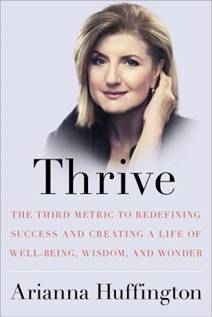
Thrive: The Third Metric to Redefining Success and Creating a Life of Well-Being, Wisdom, and Wonder by Arianna Huffington

Thrive: The Third Metric to Redefining Success and Creating a Life of Well-Being, Wisdom, and Wonder Hardcover

by Arianna Huffington (Author)

In Thrive, Arianna Huffington makes an impassioned and compelling case for the need to redefine what it means to be successful in today’s world.
image001-17

Arianna Huffington’s personal wake-up call came in the form of a broken cheekbone and a nasty gash over her eye — the result of a fall brought on by exhaustion and lack of sleep. As the cofounder and editor-in-chief of the Huffington Post Media Group — one of the fastest growing media companies in the world — celebrated as one of the world’s most influential women, and gracing the covers of magazines, she was, by any traditional measure, extraordinarily successful. Yet as she found herself going from brain MRI to CAT scan to echocardiogram, to find out if there was any underlying medical problem beyond exhaustion, she wondered is this really what success feels like? Read more of this post

Small Move, Big Change: Using Microresolutions to Transform Your Life Permanently

Small Move, Big Change: Using Microresolutions to Transform Your Life Permanently Hardcover

by Caroline L. Arnold  (Author)

image001-16

A Wall Street tech leader explains how small behavioral changes lead to major self-improvement
Whether trying to lose weight, save money, or get organized, we’re always setting goals and making resolutions but rarely following through on them. Determination and willpower aren’t strong enough to defeat our mass of ingrained habits; to succeed we have to learn how to focus our self-control on precise behavioral targets and overwhelm them, according to longtime Wall Street technology strategist Caroline Arnold. Read more of this post

Ten Types of Innovation: The Discipline of Building Breakthroughs

Ten Types of Innovation: The Discipline of Building Breakthroughs Paperback

by Larry Keeley  (Author) , Helen Walters  (Author) , Ryan Pikkel  (Author) , Brian Quinn  (Author)

Innovation principles to bring about meaningful and sustainable growth in your organization

Using a list of more than 2,000 successful innovations, including Cirque du Soleil, early IBM mainframes, the Ford Model-T, and many more, the authors applied a proprietary algorithm and determined ten meaningful groupings—the Ten Types of Innovation—that provided insight into innovation. The Ten Types of Innovation explores these insights to diagnose patterns of innovation within industries, to identify innovation opportunities, and to evaluate how firms are performing against competitors. The framework has proven to be one of the most enduring and useful ways to start thinking about transformation. Read more of this post

Alan Watts: In My Own Way: An Autobiography

In My Own Way: An Autobiography Paperback

by Alan W. Watts (Author)

image001-15

In this new edition of his acclaimed autobiography — long out of print and rare until now — Alan Watts tracks his spiritual and philosophical evolution from a child of religious conservatives in rural England to a freewheeling spiritual teacher who challenged Westerners to defy convention and think for themselves. Read more of this post

Eastern Wisdom, Modern Life: Collected Talks: 1960-1969

Eastern Wisdom, Modern Life: Collected Talks: 1960-1969 Paperback

by Alan W. Watts (Author)

Alan Watts introduced millions of Western readers to Zen and other Eastern philosophies, but he’s also recognized as a brilliant commentator on Judeo-Christian traditions as well as a celebrity philosopher who exemplified the ideas and lifestyle of the 1960s counterculture. In this compilation of controversial lectures, delivered at American universities throughout the decade, Watts challenges readers to reevaluate Western culture’s most hallowed constructs. Watts treads familiar ground, interpreting Eastern traditions, and also covers new territory, exploring the counterculture’s basis in the ancient tribal and shamanic cultures of Asia, Siberia, and the Americas. In the process, he addresses some of the era’s most important questions: What is the nature of reality? And how does an individual’s relationship to society affect this reality? Filled with his playful, provocative style, the talks show the remarkable scope of a philosopher in his prime, exploring and defining the ’60s counterculture as only Alan Watts could. Read more of this post

Professors, We Need You! Academics are some of the smartest minds in the world. So why are they making themselves irrelevant?

Professors, We Need You!

FEB. 15, 2014

Nicholas Kristof

SOME of the smartest thinkers on problems at home and around the world are university professors, but most of them just don’t matter in today’s great debates.

The most stinging dismissal of a point is to say: “That’s academic.” In other words, to be a scholar is, often, to be irrelevant. Read more of this post

Start-Up America: Our Best Hope

Start-Up America: Our Best Hope

FEB. 15, 2014

Thomas L. Friedman

PALO ALTO, Calif. — THE most striking thing about visiting Silicon Valley these days is how many creative ideas you can hear in just 48 hours.

Jeff Weiner, the chief executive of LinkedIn, explains how his company aims to build an economic graph that will link together the whole global work force with every job being offered in the world, full-time and temporary, for-profit and volunteer, the skills needed for each job, and a presence for every higher education institution everywhere offering a way to acquire those skills. Read more of this post

Magic of Impromptu Speaking: Create a Speech That Will Be Remembered for Years in Under 30 Seconds

Magic of Impromptu Speaking: Create a Speech That Will Be Remembered for Years in Under 30 Seconds Paperback

by Andrii Sedniev  (Author)

image001-14

Magic of Impromptu Speaking is a comprehensive, step-by-step system for creating highly effective speeches in under 30 seconds. It is based on research of the most powerful techniques used by winners of impromptu speaking contests, politicians, actors and successful presenters. The book is entertaining to read, has plenty of examples and covers the most effective tools not only from the world of impromptu speaking but also from acting, stand-up comedy, applied psychology and creative thinking. Once you master the system, you will grow immensely as an impromptu public speaker, become a better storyteller in a circle of friends and be more creative in everyday life. Your audience members will think that what you do on stage after such short preparation is pure magic and will recall some of your speeches many years later. Read more of this post

How to Deliver a Great TED Talk: Presentation Secrets of the World’s Best Speakers [Paperback]

How to Deliver a Great TED Talk: Presentation Secrets of the World’s Best Speakers [Paperback]

Akash Karia (Author)

Book Description

Publication Date: March 1, 2013 | ISBN-10: 1484021851 | ISBN-13: 978-1484021859 | Edition: 1

image001-13

“How to Deliver a Great TED talk” is a complete public speaking system for delivering highly effective presentations and speeches.
If you’ve watched TED talks before, you’ve no doubt been inspired and electrified by speeches by figures such as Sir Ken Robinson, Jill Bolte Taylor, Simon Sinek and Dan Pink.  Read more of this post

Start: Punch Fear in the Face, Escape Average and Do Work that Matters

Start: Punch Fear in the Face, Escape Average and Do Work that Matters Hardcover

by Jon Acuff (Author)

image001-11

Wall Street Journal best-selling author Jon Acuff reveals the steps to getting unstuck and back onto the path of being awesome.

Over the last 100 years, the road to success for most everyone has been divided into predictable stages. But three things have changed the path to success: Read more of this post

The First 20 Hours: How to Learn Anything . . . Fast!

The First 20 Hours: How to Learn Anything . . . Fast! Hardcover

by Josh Kaufman  (Author)

image001-10 image002-1

Forget the “10,000 hour rule”… what if it’s possible to learn any new skill in 20 hours or less?

Take a moment to consider how many things you want to learn to do. What’s on your list? What’s holding you back from getting started? Are you worried about the time and effort it takes to acquire new skills – time you don’t have and effort you can’t spare?

Research suggests it takes 10,000 hours to develop a new skill. In this nonstop world when will you ever find that much time and energy?

To make matters worse, the early hours of practicing something new are always the most frustrating. That’s why it’s difficult to learn how to speak a new language, play an instrument, hit a golf ball, or shoot great photos. It’s so much easier to watch TV or surf the web…  Read more of this post

Simple: Conquering the Crisis of Complexity Hardcover

Simple: Conquering the Crisis of Complexity Hardcover

by Alan Siegel (Author) , Irene Etzkorn  (Author)

image001-9

For decades, Alan Siegel and Irene Etzkorn have championed simplicity as a competitive advantage and a consumer right. Consulting with businesses and organizations around the world to streamline products, services, processes and communications, they have achieved dramatic results. Read more of this post

Solving Problems with Design Thinking: Ten Stories of What Works (Columbia Business School Publishing) Hardcover

Solving Problems with Design Thinking: Ten Stories of What Works (Columbia Business School Publishing) Hardcover

by Jeanne Liedtka  (Author) , Andrew King (Author) , Kevin Bennett (Author)

Design-oriented firms such as Apple and IDEO have demonstrated how design thinking can affect business results. However, most managers lack a sense of how to use this new approach for issues other than product development and sales growth. Solving Problems with Design Thinking details ten real-world examples of managers who successfully applied design methods at 3M, Toyota, IBM, Intuit, and SAP; entrepreneurial start-ups such as MeYou Health; and government and social sector organizations, including the City of Dublin and Denmark’s The Good Kitchen. Read more of this post

Red Thread Thinking: Weaving Together Connections for Brilliant Ideas and Profitable Innovation

Red Thread Thinking: Weaving Together Connections for Brilliant Ideas and Profitable Innovation Hardcover

by Debra Kaye  (Author)

image001-7

Create products and services your consumers can’t pass up–without the high cost of development

Success is all about connections.

Debra Kaye explodes conventional thinking about innovation and provides an approach that anyone or any business can use to expose the crucial links among observations, experiences, facts, and feelings that on the surface do not seem related–but are–to uncover fresh, brilliant insights. In Red Thread Thinking, Kaye shows you how to weave originality from disparate information and turn it into a product or service that can shake up the marketplace–and your business. Read more of this post

Own the Room: Discover Your Signature Voice to Master Your Leadership Presence Hardcover

Own the Room: Discover Your Signature Voice to Master Your Leadership Presence Hardcover

by Amy Jen Su  (Author) , Muriel Maignan Wilkins  (Author)

Find your signature voice
People are drawn to and influenced by leaders who communicate authentically, connect easily with people, and have immediate impact. So how do you become one of them? How can you learn to “own the room”? This book will help you develop your leadership presence.
According to Amy Jen Su and Muriel Maignan Wilkins, leadership presence is the ability to consistently and clearly articulate your value proposition while influencing and connecting with others. They offer a simple and compelling framework, as well as practical advice about how you can develop your own personal presence. Read more of this post

Be Excellent at Anything: The Four Keys To Transforming the Way We Work and LivePaperback

Be Excellent at Anything: The Four Keys To Transforming the Way We Work and LivePaperback

by Tony Schwartz  (Author) , Jean Gomes (Author) , Catherine McCarthy (Author)

This book was previously titled, The Way We’re Working Isn’t Working.
Be Excellent at Anything is one of those rare books with the power to profoundly transform the way we work and live.
Demand is exceeding our capacity. The ethic of “more, bigger, faster” exacts a series of silent but pernicious costs at work, undermining our energy, focus, creativity, and passion. Nearly 75 percent of employees around the world feel disengaged at work every day. Be Excellent at Anything offers a groundbreaking approach to reenergizing our lives so we’re both more satisfied and more productive—on the job and off.  Read more of this post

The Untouchable Profits of Fannie Mae and Freddie Mac

The Untouchable Profits of Fannie Mae and Freddie Mac

FEB. 15, 2014

Fair Game

By GRETCHEN MORGENSON

Would you buy stock in a company that barred you from sharing in its future earnings? Of course not. Participating in the upside is what stock ownership is all about.

And yet, as of December 2010, holders of Fannie Mae and Freddie Maccommon stock were subject to such a restriction by the United States government. They didn’t know it at the time, though, because the policy was not disclosed.

This month, an internal United States Treasury memo that outlined this restriction came up at a forum in Washington.

The memo was addressed to Timothy F. Geithner, then the Treasury secretary, from Jeffrey A. Goldstein, then the under secretary for domestic finance. In discussing Fannie and Freddie, the beleaguered government-sponsored enterprises rescued by taxpayers in September 2008, the memo referred to “the administration’s commitment to ensure existing common equity holders will not have access to any positive earnings from the G.S.E.’s in the future.”

The memo, which was produced in a lawsuit filed by Fannie and Freddie shareholders, was dated Dec. 20, 2010. Securities laws require material information — that is, information that might affect an investor’s view of a company — to be disclosed. That the government would deny a company’s shareholders all its profits certainly seems material, but the existence of this policy cannot be found in the financial filings of Fannie Mae. Neither have the Treasury’s discussions about the future of the two finance giants mentioned the administration’s commitment to shut common stockholders out of future earnings. Freddie Mac’s filings do refer, albeit incompletely, to the administration’s stance, noting that the Treasury “has indicated that it remains committed to protecting taxpayers and ensuring that our future positive earnings are returned to taxpayers as compensation for their investment.” Note that this reference does not say all earnings.

Lewis D. Lowenfels, a securities law expert in New York, found this statement insufficient. “If there is disclosure regarding future Fannie and Freddie earnings and the administration has a commitment that existing Fannie and Freddie common equity holders will never receive any future positive earnings,” he said, “this commitment would be material to investors and should be disclosed.”

When the memo was written, plenty of people held these stocks. Regulatory filings show that 18,000 investors held 1.1 billion shares of Fannie Mae common stock, while just over 2,100 investors held 650 million Freddie Mac shares.

Back in 2010 and 2011, of course, common stockholders of Fannie and Freddie had little hope of making much money. During those days of rampant mortgage defaults and losses, investors were warned about the uncertainty of their companies’ prospects. Fannie and Freddie shareholders were repeatedly told that the preferred and common stock would have value only if anything remained after taxpayers were fully repaid for the rescue. With the amount of that rescue peaking at $189.5 billion, that was a very big “if.” On the day the Treasury memo was written, the price of Fannie Mae shares closed at 34 cents.

But the companies staged a turnaround; in mid-2012, they began earning billions. With interest rates low and banks not lending, Fannie and Freddie became the only mortgage game in town. By Sept. 30 of last year, the companies had returned $185 billion to the Treasury.

Failing to disclose the administration’s hard line on the companies’ shareholders is disturbing for another reason. In bailing out Fannie and Freddie, the Treasury received warrants — optionlike securities that rise in value when the shares underlying them do. When investors, hoping for a housing recovery, flocked to the shares and pushed them higher, the value of the warrants increased. Fannie’s common stock now trades at $3.06 a share.

Given Treasury’s interest in a rising stock price, depriving common equity holders of future earnings was especially important for investors to know, Mr. Lowenfels said.

A spokesman for the Treasury declined to comment. Mr. Geithner did not respond to an email, and Mr. Goldstein, now a managing director at Hellman & Friedman, a private equity firm, did not return a phone call. (After the deadline for publication of this column had passed, spokespeople for the Treasury Department and Mr. Geithner offered comments.)

All of this has come to a boil because Fannie and Freddie have become so profitable. Yet because of a change in the repayment process dictated by the Treasury in 2012, the $189.5 billion debt technically remains outstanding. The profits generated by Fannie and Freddie have instead gone to the general treasury.

I have been critical of these companies, but this change in the bailout terms seems punitive, especially when considering how other bailout recipients were treated. And it has led to lawsuits against the government from Fannie and Freddie shareholders, including insurance companies, a mutual fund and a hedge fund. The plaintiffs contend that the government’s 2012 decision to take all the companies’ profit — just as it was starting to balloon — was illegal under the 2008 law that rescued them.

After all, back in 2008, the companies were not put into receivership, the equivalent of bankruptcy. Rather, they were placed under the care of a conservator — the Federal Housing Finance Agency. That conservator was supposed to put the companies “in a sound and solvent condition” and “preserve and conserve the assets and property” of each entity.

Siphoning off the entities’ profits is the opposite of conserving their assets and property, the plaintiffs contend. And they point to a 2009 Treasury memo stating that the conservatorship of Fannie and Freddie “preserves the status and claims” of preferred and common shareholders. One of those claims is surely having access to future earnings.

A spokeswoman for the Federal Housing Finance Agency declined to comment, citing the litigation. A spokesmen for Fannie declined to comment as well. A Freddie Mac official did not elaborate beyond pointing to the language in its filings.

Perry Capital, a hedge fund, is one of the plaintiffs suing the government. Its lawsuit seeks no damages, but asks that the government follow the 2008 law. The 2010 memo was produced by the Treasury in response to this lawsuit.

Do the Treasury’s actions amount to a backdoor nationalization of the companies? A full-fledged takeover would have required Treasury to put all the companies’ obligations — $4.9 trillion at the time — on the government’s balance sheet. A nonstarter.

Furthermore, nationalization would have required the government to provide compensation to shareholders for what it took. Now the government gets the benefits of the companies’ profits while avoiding any compensation payments.

“People disagree about what should happen to the G.S.E.’s,” said Matthew D. McGill, a lawyer at Gibson, Dunn & Crutcher in Washington who represents Perry Capital. “But if the plan is to wind them down, Congress provided a means to do that in the 2008 law — it’s called receivership, and it provides a host of procedural protections to claimants. What the Treasury cannot do is abuse its conservatorship powers to nationalize the companies and then, when it deems convenient, wind them down without the protections enacted by Congress.”

 

The Case for Swapping Roles With China; A new book by Stephen Roach says it’s time for the United States to be more of a producer and for China to be more of a consumer

The Case for Swapping Roles With China

FEB. 15, 2014

By FRED ANDREWS

Stephen Roach proposes to remake the two largest economies on the globe, ours and China’s. For decades, he writes, the United States and China relied too much on a “marriage of convenience” that guaranteed China a huge market for its exports. In exchange, China gave American consumers a cornucopia of inexpensive products, while creating a willing buyer of the United States government’s swollen debt. But that marriage has played out, Mr. Roach says; it has warped the two economies, leaving them ill-equipped for further growth. Read more of this post

More Reflection, Less Action: The more complex and demanding the work we do, the wider, deeper and longer the perspective we require to do it well

FEBRUARY 14, 2014, 12:52 PM  1 Comment

More Reflection, Less Action

By TONY SCHWARTZ

Earlier this week, I found myself talking with the chief of staff to the chief executive at a large company. The two of them had been on the road together for four consecutive weeks. I asked how that felt. “It’s brutal,” he said. “But it’s typical. My boss essentially has no openings on his schedule for the next three months.”

Think about that for a moment: Read more of this post

Intel’s Sharp-Eyed Social Scientist; Genevieve Bell, an anthropologist at Intel who leads a globe-trotting team, is trying to learn what consumers want most in their future electronics

Intel’s Sharp-Eyed Social Scientist

By NATASHA SINGERFEB. 15, 2014

image001-6

Genevieve Bell, as a cultural anthropologist at Intel Labs, runs a team of about 100 researchers. The team studies how consumers interact with electronics and develops new technology experiences for them.  Behind the gray, noise-absorbing cubicle walls at the Intel Corporation in Hillsboro, Ore., researchers who forecast the future of computing can sense her arrival. Read more of this post

Comcast vs. the Cord Cutters

Comcast vs. the Cord Cutters

By FARHAD MANJOOFEB. 15, 2014

The typical American household pays about $90 a month for cable television service, according to the NPD Group, the market research firm. But according to the research firm of You and Pretty Much Everyone You Know, when you click on your TV and browse the guide, what you often find hardly seems worth $90 a month. Read more of this post

Are S’pore public hospitals on track to meet future healthcare needs?

Are S’pore public hospitals on track to meet future healthcare needs?

By Sara Grosse 
POSTED: 16 Feb 2014 01:03
By 2020, there will be six new public hospitals, which are part of the Health Ministry’s plan to boost infrastructure to deal with the rise in demand for healthcare services.

SINGAPORE: By 2020, there will be six new public hospitals, which are part of the Health Ministry’s plan to boost infrastructure to deal with the rise in demand for healthcare services. Read more of this post

It Takes Teams to Solve the Data Scientist Shortage

February 14, 2014, 3:27 PM ET

It Takes Teams to Solve the Data Scientist Shortage

By Jeanne G. Harris, Nathan Shetterley, Allan E. Alter and Krista Schnell

If you are looking for data scientists to take your company to Big Data nirvana, we have news for you. Unless you run a hotshot Silicon Valley company, chances are enough of them aren’t going to walk through your door. There’s a more realistic approach for the rest: divide up the job and conquer. Read more of this post

Accounting ‘Dumping Ground’ Headed For Clean Up; International accounting rulemakers may focus on cleaning up rules for “other comprehensive income,” a category that can obscure the true profit and loss picture

February 13, 2014, 5:36 PM ET

Accounting ‘Dumping Ground’ Headed For Clean Up

EMILY CHASAN

Senior Editor

International accounting rulemakers may focus on cleaning up rules for “other comprehensive income,” a category in a company’s earnings statement that can obscure the true profit and loss picture, the chairman of the International Accounting Standards Board said this week. Read more of this post

Lexmark CFO: Reinventing a Company

February 14, 2014, 12:14 AM ET

Lexmark CFO: Reinventing a Company

The invention of the iPhone and iPad meant the decline, and eventual sale, of the consumer inkjet printing business for Lexmark International Inc. Over the past three years, Chief Financial Officer John Gamble has played a key role in reinventing the Lexington, Ky.-based company through strategic acquisitions and divestitures.  He spoke with CFO Journal Editor Noelle Knox about Lexmark’s transition into a solution, services and software company. Read more of this post

The High Cost of Avoiding Conflict at Work: As More Companies Seek Feisty Leaders, An Eagerness to Please Could Kill Your Career

The High Cost of Avoiding Conflict at Work

As More Companies Seek Feisty Leaders, An Eagerness to Please Could Kill Your Career

JOANN S. LUBLIN

Feb. 14, 2014 10:05 a.m. ET

It’s time to kill a common myth: Executives who avoid workplace conflicts get ahead. Instead, their advancement often stalls.

A well-liked senior vice president at a big health-care company lost a key promotion and left in 2012 because he never disagreed with colleagues during meetings. The man’s failure to manage conflict derailed his career, recalls David Dotlich, a leadership and succession coach. His research has identified “eagerness to please” as one of the top reasons that executives fail. Read more of this post

Why You Are Spending More and Enjoying It Less; Why? Because we’re bored or we want to keep up with our neighbors.

Why You Are Spending More and Enjoying It Less

Financial Advisers Agree—Americans Spend Way Too Much

VERONICA DAGHER

February 16, 2014

When a taco shop opened across the street from Stefanie O’Connell’s New York City apartment, she figured it would be harmless to go there a few times a week and grab a quick dinner.

But before she knew it, the actress and freelance writer was dropping $10 to $15 a week on tacos—that comes to more than $500 a year, or just about enough to pay for a round-trip ticket for her dream trip to Amsterdam. Read more of this post

Knowing When It’s Time to Sell Your Favorite Stock: It can be as important as deciding to buy.

Knowing When It’s Time to Sell Your Favorite Stock

It can be as important as deciding to buy.

MARK HULBERT

Updated Feb. 14, 2014 7:19 p.m. ET

Investors spend far more time searching for stocks to buy than thinking about when to sell. That is a potentially costly shortcoming, especially in a bull market that is approaching its fifth birthday, which is how old its predecessor was when it ended in 2007. Read more of this post

Canberra Goes Private: Selling off state-owned enterprises benefits Australians

Canberra Goes Private

Selling off state-owned enterprises benefits Australians.

Feb. 13, 2014 12:01 p.m. ET

Finance ministers from the G-20 converge on Australia next week, and they might learn something from their host government in Canberra. Prime Minister Tony Abbott’s government has set out to privatize public assets worth up to 130 billion Australian dollars ($117 billion). Read more of this post

As David Tepper Was Pitching A 20x P/E, He Was Selling (And Buying) These Stocks

As David Tepper Was Pitching A 20x P/E, He Was Selling (And Buying) These Stocks

Tyler Durden on 02/14/2014 18:00 -0500

On October 15, well into the fourth quarter, David Tepper appeared on CNBC for his semi-annual stock pumpfest, most memorable for his suggestion that a 20x P/E multiple on the S&P was perfectly acceptable. Which would suggest Tepper was very bullish on risk. Which would suggest buying more stocks, not selling. Yet selling is precisely what he did between September 30 and December 31 for the vast majority of his top holdings according to his just released 13F. So what did he sell or liquidate? Read more of this post