China Sees Citic Listing as Model for State-Firm Overhauls; Skeptics Cite Government’s Continued Control, Even After Hong Kong Listing

China Sees Citic Listing as Model for State-Firm Overhauls

Skeptics Cite Government’s Continued Control, Even After Hong Kong Listing

SHEN HONG and YVONNE LEE

June 1, 2014 3:25 p.m. ET

China is poised this week to complete plans for one of the world’s biggest mergers of the year, a $37 billion deal that could be a blueprint for overhauling massive, inefficient state-owned enterprises.

Beijing is using Citic Group, a conglomerate created under Deng Xiaoping as China’s first capitalist enterprise, to change the way the country’s biggest state-owned companies, known as SOEs, are controlled by investors. The merger will essentially list Citic Group’s assets in Hong Kong, where they will be subject to tougher rules and disclosure requirements than they face in mainland China. Read more of this post

Just Babies: The Origins of Good and Evil

Just Babies: The Origins of Good and Evil

May 28, 2014 by Shane Parrish

“Children are sensitive to inequality, then, but it seems to upset them only when they themselves are the ones getting less.”

Morality fascinates us. The stories we enjoy the most, whether fictional (as in novels, television shows, and movies) or real (as in journalism and historical accounts), are tales of good and evil. We want the good guys to be rewarded— and we really want to see the bad guys suffer.

So writes Paul Bloom in the first pages of Just Babies: The Origins of Good and Evil. His work, proposes that “certain moral foundations are not acquired through learning. They do not come from the mother’s knee … ”

***
What is morality?

Even philosophers don’t agree on morality. In fact, a lot of people don’t believe in morality at all. Read more of this post

Beauty ≠ truth: Scientists prize elegant theories, but a taste for simplicity is a treacherous guide. And it doesn’t even look good

Beauty ≠ truth

Scientists prize elegant theories, but a taste for simplicity is a treacherous guide. And it doesn’t even look good

by Philip Ball 3,000 words

Theoretically beautiful; geometrically pruned trees, Leer, Germany. Photo by Karl Johaentges/Getty

Philip Ball is a British science writer, whose work appears in Nature,New Scientist andProspect, among others. His latest book is Serving the Reich: The Struggle for the Soul of Physics Under Hitler (2013).

Albert Einstein’s theory of general relativity is a century old next year and, as far as the test of time is concerned, it seems to have done rather well. For many, indeed, it doesn’t merely hold up: it is the archetype for what a scientific theory should look like. Einstein’s achievement was to explain gravity as a geometric phenomenon: a force that results from the distortion of space-time by matter and energy, compelling objects – and light itself – to move along particular paths, very much as rivers are constrained by the topography of their landscape. General relativity departs from classical Newtonian mechanics and from ordinary intuition alike, but its predictions have been verified countless times. In short, it is the business.

Einstein himself seemed rather indifferent to the experimental tests, however. The first came in 1919, when the British physicist Arthur Eddington observed the Sun’s gravity bending starlight during a solar eclipse. What if those results hadn’t agreed with the theory? (Some accuse Eddington of cherry-picking the figures anyway, but that’s another story.) ‘Then,’ said Einstein, ‘I would have been sorry for the dear Lord, for the theory is correct.’ Read more of this post

The Skills of Leonardo Da Vinci

The Skills of Leonardo Da Vinci

May 26, 2014 by Shane Parrish

Italian polymath Leonardo da Vinci sought a job at the court of Ludovico Sforza, then the ruler of Milan. Leonardo’s application letter, found in the amazing Letters of Note, included a ten-point list of his abilities. Keep in mind that Sforza was looking for military engineers.

My Most Illustrious Lord, Read more of this post

In China, managers are the new labor activists

In China, managers are the new labor activists

Sat, May 31 2014

By Alexandra Harney and John Ruwitch

SHANGHAI (Reuters) – Behind China’s biggest strike in decades last month was a new player in Chinese labor activism: management.

A previously unpublished account from inside the strike at Taiwanese shoe manufacturer Yue Yuen obtained by Reuters shows that supervisors were the first to challenge senior plant leaders about the social insurance contributions that became the focus of the dispute. Yue Yuen Industrial Holdings declined to comment. Read more of this post

The Surge in Investing by Conscience: Investment funds that take into account environmental, social and corporate governance criteria have experienced explosive growth in the last five years

The Surge in Investing by Conscience

By ANNA BERNASEKMAY 31, 2014

Financial risk and return may be the main focus of most investments. But strategies with an explicit social component are growing rapidly, according to the most current data from the industry association that supports and tracks this field: US SIF — the Forum for Sustainable and Responsible Investment.

image001-4

Investment funds incorporating environmental, social and corporate governance criteria in their decisions had net assets of $1 trillion in 2012, up from $202 billion in 2007, according to US SIF. That was the value of such investments in mutual funds, annuity funds, closed-end funds, exchange-traded funds, alternative investment funds and other pooled products. Read more of this post

Palantir Technologies’ intelligence software is gaining fans worldwide, and some investors want to cash in

Unlocking Secrets, if Not Its Own Value

By QUENTIN HARDYMAY 31, 2014

Alex Karp, chief of Palantir Technologies, has resisted calls for it go public. Despite a growing number of private clients, he says an I.P.O.’s emphasis on stock price would be “corrosive to our culture.”CreditPeter DaSilva for The New York Times

image001-3

Palantir Technologies will not help you share, message, pin, post or chat. It does not exist to make you more social or connected, or even to help advertisers get to you. Its technology is deeply geeky, its work secretive. Nonetheless, it’s one of the most valuable private tech companies in Silicon Valley. Read more of this post

In moving into online education, Harvard Business School discovered that it isn’t so easy to practice what it teaches

Business School, Disrupted

By JERRY USEEMMAY 31, 2014

If any institution is equipped to handle questions of strategy, it is Harvard Business School, whose professors have coined so much of the strategic lexicon used in classrooms and boardrooms that it’s hard to discuss the topic without recourse to their concepts: Competitive advantage. Disruptive innovation. The value chain.

But when its dean, Nitin Nohria, faced the school’s biggest strategic decision since 1924 — the year it planned its campus and adopted the case-study method as its pedagogical cornerstone — he ran into an issue. Those professors, and those concepts, disagreed. Read more of this post

Hopes for cancer cures offer comfort for battered pharma

May 30, 2014 12:07 pm

Hopes for cancer cures offer comfort for battered pharma

By Andrew Ward, Pharmaceuticals Correspondent

It is the Holy Grail of medical science. Ever since Hippocrates, the Greek physician, first described the disease more than 2,000 years ago, generation after generation of doctors have searched in vain for a cure for cancer. Read more of this post

‘India is a Price-Sensitive Market’: Andreas Barner, Boehringer Ingelheim

‘India is a Price-Sensitive Market’: Andreas Barner, Boehringer Ingelheim

by Prince Mathews Thomas | May 31, 2014

Andreas Barner, the chairman of the board of managing directors, Boehringer Ingelheim, tells Prince Mathews Thomas that it’s important for the German pharma company to strengthen its presence in India

Andreas Barner
Career: 
Assistant professor at the Federal Institute of Technology; Ciba-Geigy AG; joined BI in 1992
Education: Medicine from University of Freiburg, Germany; Mathematics from Federal Institute of Technology, Zurich Read more of this post

Risk Savvy: How to Make Good Decisions

Risk Savvy: How to Make Good Decisions Hardcover

by Gerd Gigerenzer  (Author)

An eye-opening look at the ways we misjudge risk every day and a guide to making better decisions with our money, health, and personal lives
In the age of Big Data we often believe that our predictions about the future are better than ever before. But as risk expert Gerd Gigerenzer shows, the surprising truth is that in the real world, we often get better results by using simple rules and considering less information. Read more of this post

A Dozen Things I’ve Learned about Great CEOs from “The Outsiders”

A Dozen Things I’ve Learned about Great CEOs from “The Outsiders” (Written by William Thorndike)

25iq

Many very smart people (e.g., Warren Buffett, Michael Mauboussin) are recommending William Thorndike’s book The Outsiders. Thorndike’s book describes certain attributes/methods of “top performing” CEOs. (page IX)  What does the author mean by a “great” CEO?  In short: “return relative to peers and the market” measured by “compound annual return to shareholders during their tenure.” (page IX) Read more of this post

Certainty Is an Illusion

Certainty Is an Illusion

May 29, 2014 by Shane Parrish

We all try to avoid uncertainty, even if it means being wrong. We take comfort in certainty and we demand it of others, even when we know it’s impossible.

Gerd Gigerenzer argues in Risk Savvy: How to Make Good Decisions that life would be pretty dull without uncertainty.

If we knew everything about the future with certainty, our lives would be drained of emotion. No surprise and pleasure, no joy or thrill— we knew it all along. The first kiss, the first proposal, the birth of a healthy child would be about as exciting as last year’s weather report. If our world ever turned certain, life would be mind-numbingly dull. Read more of this post

The Untold History of Ramen: How Political Crisis in Japan Spawned a Global Food Craze

The Untold History of Ramen: How Political Crisis in Japan Spawned a Global Food Craze (California Studies in Food and Culture) Paperback

by George Solt  (Author)

A rich, salty, and steaming bowl of noodle soup, ramen has become an international symbol of the cultural prowess of Japanese cuisine. In this highly original account of geopolitics and industrialization in Japan, George Solt traces the meteoric rise of ramen from humble fuel for the working poor to international icon of Japanese culture. Read more of this post

Pearl River Delta Economic Zone reports GDP of nearly 10 trillion yuan

Pearl River Delta Economic Zone reports GDP of nearly 10 trillion yuan

Staff Reporter

2014-05-31

Compared with the Beijing-Tianjin-Hebei region and the Yangtze River Economic Zone, the Pearl River Delta Economic Zone is the mostly likely to be elevated to the national level of economic planning.

The Pearl River connects Guangdong, Hong Kong and Macau in the east and links Yunnan, Guizhou and Guangxi in the west, and is an extensive river system in southern China with a total length at 2,197 kilometers. Read more of this post

Lenovo to move away from Chinese market

Lenovo to move away from Chinese market

Staff Reporter

2014-05-31

Wong Wai-Ming, CFO of Lenovo Group, said that the company plans to refocus its business on the international arena instead of China, reports the official website of the China’s nationalistic Global Times. China, Wong said, is no longer the most profitable market for Lenovo, according to the report. Read more of this post

BlackRock’s Fink jolts ETF business with ‘blow up’ warning

BlackRock’s Fink jolts ETF business with ‘blow up’ warning

10:46am EDT

By Tim McLaughlin and Jennifer Ablan

(Reuters) – BlackRock Inc Chief Executive Larry Fink this week dropped a stink bomb on a small corner of the $2.5 trillion global market for exchange-traded funds.

Fink, who runs the world’s largest asset manager and ETF provider, said structural problems with leveraged ETFs have the potential to “blow up the whole industry one day.” Sponsors of leveraged ETFs and related products, which make up only about $60 billion of global industry assets, called his remarks an exaggeration. Read more of this post

Is Management Due for a Renaissance?

Is Management Due for a Renaissance?

by David K. Hurst  |   2:00 PM May 30, 2014

Every now and then, a thinker calls for a renaissance in some field of work – a rebirth, or return to classic roots after a period of straying from them. Is management – not yet a very old discipline – due for one? When Richard Straub, President of the Peter Drucker Society of Europe, recentlydeclared so, it got me thinking by analogy about how one might come to pass. Read more of this post

Investors want to ban ‘junk’ companies from London; Call for changes after poor treatment of minority shareholders at Bumi and ENRC

Investors want to ban ‘junk’ companies from London

Call for changes after poor treatment of minority shareholders at Bumi and ENRC

By Louise Armitstead

8:15PM BST 31 May 2014

A group of powerful institutional investors has demanded that City regulators tighten the UK’s listing rules to ban sub-standard foreign companies floating in London.

In the wake of concerns over the treatment of minority shareholders at a number of companies, including Bumi, the investors demanded changes in the way overseas companies are allowed to list on the London Stock Exchange. Read more of this post

27 Tips For Mastering Anything

27 Tips For Mastering Anything

JENNA GOUDREAU STRATEGY  JUN. 1, 2014, 1:30 AM

Tony Hisgett/Flickr

What does it take to become a master at your craft? Is genius innate, or can it be learned?

In his book, “Mastery,” Robert Greene draws from the latest research, interviews modern masters, and examines the lives of former greats like Albert Einstein, Leonardo da Vinci, and Mozart to discover what it takes to achieve excellence.

He argues that success is within anyone’s reach, if they have discipline, patience, and follow a number of important steps. Read more of this post

Ginni Rometty: Reinventing Big Blue; Naysayers are ganging up on IBM CEO Ginni Rometty. But her plan to turn around the 103-year-old company just might work

Ginni Rometty: Reinventing Big Blue

Naysayers are ganging up on IBM CEO Ginni Rometty. But her plan to turn around the 103-year-old company just might work.

LESLIE P. NORTON

May 31, 2014 1:40 a.m. ET

Ginni Rometty likes to say that there’s no such thing as a bad day if you learn from it. And since taking over as chief executive of International Business Machines in January 2012, she has learned a lot. Big Blue’s revenue has fallen for eight straight quarters, reaching the lowest level in five years in the first quarter of this year.

image001-2

IBM (ticker: IBM) is still hugely profitable, of course, earning $18 billion last year on revenue of $100 billion. But in many ways, it faces its biggest challenge since the early 1990s, when it was on the verge of bankruptcy. Read more of this post

Super Mario Gets A Mercedes In This Awesome Ad

http://www.youtube.com/watch?v=Sc59X7xS2ts

Super Mario Gets A Mercedes In This Awesome Ad

RICHARD FELONI ADVERTISING  MAY. 31, 2014, 12:34 AM

If you’ve ever played a Super Mario game, you’re going to love the new Japanese commercial for the Mercedes-Benz GLA SUV.

In it, an 8-bit Mario smashes blocks, collects coins, and runs over Goombas in a pixelated Benz. When he wraps up the level, the NES game turns live-action, and a tough looking Mario in Batman-esque armor emerges from the SUV. Read more of this post

A Study Being Passed Around Silicon Valley Shows That Raising Tons Of Money Can Hurt Startups

A Study Being Passed Around Silicon Valley Shows That Raising Tons Of Money Can Hurt Startups

ALYSON SHONTELL TECH  MAY. 31, 2014, 9:49 PM

When startups raise large rounds of financing from investors, it’s often praised in the press. And in Silicon Valley, founders are often encouraged to raise as much money as possible. But a new study shows that most startups shouldn’t strive to raise gobs of cash, and they can actually exit for more money if they take less funding.

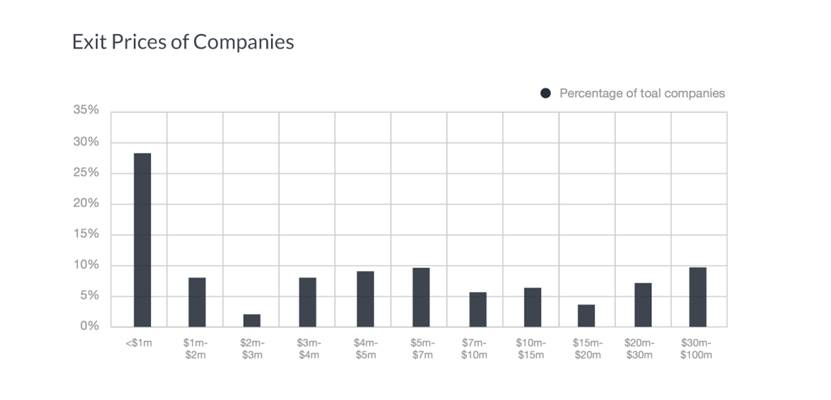
Exitround, a startup that matches early stage companies with potential acquirers,analyzed the sales of 200 startups. It worked with startup accelerator programs Y Combinator, Techstars and SoftTech VC to compile the data and only looked at companies with sale prices under $100 million. Exitround says 88% of all startups are sold for less than that price. The study has been

The study found that startups with the most lucrative exits raised either $2-3 million or $5-10 million. They also tend to be about four years old.

From the study:

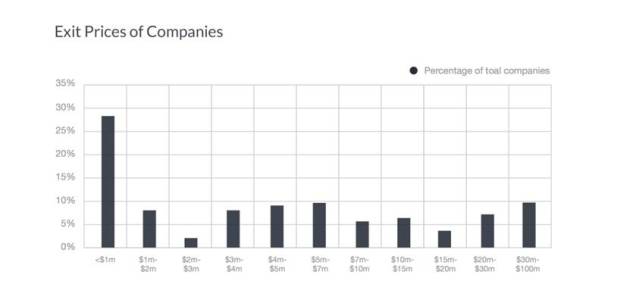
image001-1

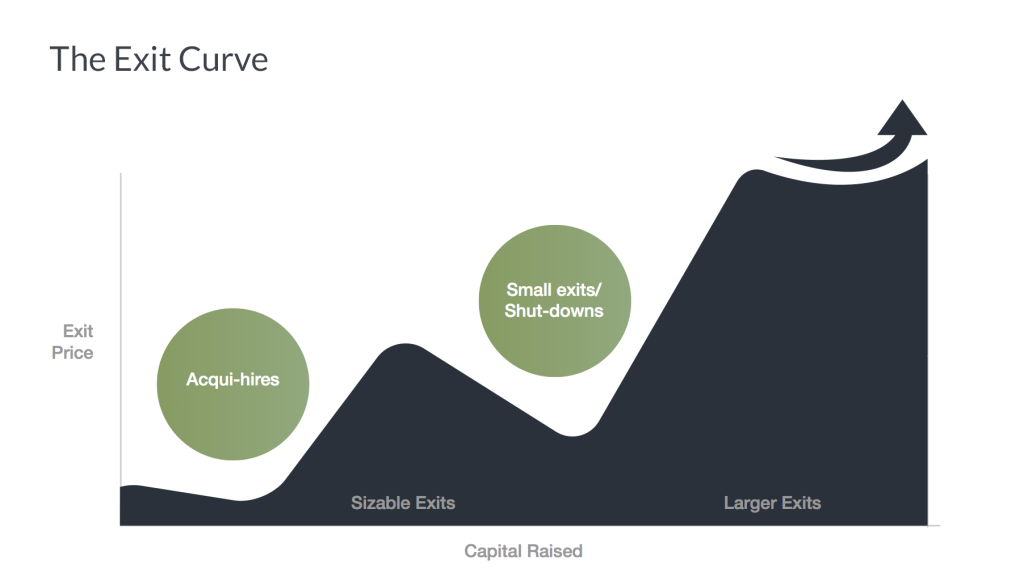
In Exitround’s analysis, companies that raised $5 million to $10 million actually generated larger average exits than those that raised $10 million to $50 million. And those companies that raised $3 million to $5 million had a lower average exit price than those that raised $2 million to $3 million.

Here’s a chart that supports the data.

The Exit Curve: Exitround’s Report On Tech M&A

Exitround NewsMarket Analysis

By Tomio Geron on May 30, 2014
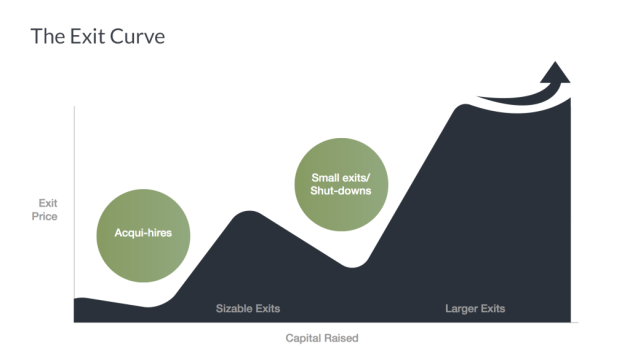
image002-1

inShare54

image003-1

Raising as much capital as possible is often seen as a badge of honor in Silicon Valley. And there are many great reasons for startups to raise as much capital as possible. But raising more capital may not always be the best option. Exitround’s analysis of proprietary exit data has found that there are good reasons to remain cautious.

There’s a sweet spot for how much capital to raise for startups that want to get the most money out of their sale. Exitround determined these particular exit ranges based on data we analyzed covering more than 200 companies acquired since 2006 for less than $100 million. The best exits from a return-on-capital perspective form a pattern, which we call the Exit Curve. The best average exits tend to cluster around companies with total capital raises of between $2 million to $3 million and between $5 million to $10 million. But exit prices drop after companies raise more than $3 million and $10 million, respectively.

The information in the report will be of particular interest to entrepreneurs and investors seeking to understand the trajectories of startups and what possible outcomes are for their companies–particularly since 88% of tech M&A deals happen below $100 million. Determining potential outcomes is a useful baseline to have in mind as entrepreneurs and investors think about how much to invest or raise, and at what valuations. Knowing the market is also important when entrepreneurs and investors go through an acquisition process.

Here are some other key findings from the Exitround report:

– Raising more capital does not necessarily result in a larger exit price. Exitround’s analysis of proprietary exit data has found that exit prices do not always get larger as companies raise more capital. They sometimes go down.

– Companies that generate substantial exits are usually at least four years old. Companies below four years old on average did not show a substantial variation in price, but those more than four years old increased substantially in price. In other words, companies are not built overnight.

– Exit prices varied among companies in different sectors. Some sectors, such as cloud and mobile showed the best return on invested capital.

David Cohen founder & CEO of TechStars, a contributor to the study, said, “I was excited to participate and contribute data to Exitround’s report because for the first time we’ll have a broad-scale industry look into the long tail of tech M&A activity, which will help me make more informed decisions as an investor, and generally contribute to increased transparency within our industry.”

Seed Investing

The emergence of the seed investing has become a key part of the startup and venture investing landscape. The data in Exitround’s report shows that companies that have raised relatively small amounts of capital can generate substantial returns for those investing at the seed stage.

Michael Kim, founder and managing partner of fund of funds Cendana Capital, which invests in seed funds and is a contributor to the Exit Report, said, “The findings help support our thesis—with real data—that seed VC funds have potentially higher alpha with lower beta (risk) because meaningful returns can be generated by capital efficient start ups early in their life.”

Other topics covered in the report:

The Data Behind The New Seed/Venture Investing Landscape

What Size Exits Have The Best Returns?

Which Size Exits Have The Best Multiples?

How Long Does It Take to Build a Successful Startup?

Which Generates Better Return Multiples: Consumer or Enterprise?

How Does Team Size Affect Price? (or vice versa)

Who Pays More: Public Or Private Buyers

How Are Investors Paid?

How Much Of A Deal Is Held Back For Earn-out/Retention?

Which Sectors Have The Best Outcomes?

Methodology

Information on tech M&A is difficult to find, particularly for exits below $100 million. For founders this can make anacquisition process difficult, particularly for those who have not gone through it before or who do not have strong advisors to help them.

Typically, most M&A reports analyze already-available public data. The Exitround Exit Report is different because it is based on Exitround’s data, which is previously undisclosed data, and which we are presenting in an aggregate anonymized form. Read more of this post

Thoreau on the Greatest Gift of Growing Old

Thoreau on the Greatest Gift of Growing Old

“Living has yet to be generally recognized as one of the arts,” Karl De Schweinitz wrote in his 1924 guide to the art of living, and as with any art, genius-level mastery at it is only accomplished through hours upon hours of deliberate practice. It’s a truth that Henry David Thoreau, one of the great masters of the art of living, illustrates in a particularly beautiful passage from The Journal of Henry David Thoreau, 1837–1861 (public library) – the same treasure trove of wisdom that gave us Thoreau on what success really meansfriendship and sympathy, and why not to quote Thoreau.

Writing in the afternoon of October 20 of 1857, shortly after his fortieth birthday, Thoreau does what he does best, drawing from an everyday encounter a profound existential parable: Read more of this post

Tweedy Browne: Graham’s Teachings A firewall Between Investor And Bad Biases

Tweedy Browne: Graham’s Teachings A firewall Between Investor And Bad Biases

by VW StaffMay 30, 2014, 2:21 pm

We are aware that many investors have an expectation that their financial advisor in his or her client letter will provide not only fresh insights into a complicated investment landscape, but a well conceived plan to successfully navigate any difficulty the world might throw in their path. Ideally, this missive would also provide a unique perspective on current events. However, these communications are frequently packaged within a time frame (quarterly/semiannually) that we believe is not terribly helpful when it comes to defining investment goals, i.e., what am I investing for and how do I achieve those goals? If the expectation is that we can, on a regular basis, lay out a new roadmap on how to get to a “better financial place” over the next three to six months, you likely will be disappointed. Frankly, we are often stumped when it comes to offering a new plan to address the “current” environment. We have written frequently over the years about the how and why of what we at Tweedy Browne do and the strengths that we believe are inherent in an investment process focused on the longer term. One client went so far as to say he admired our “belligerent consistency” when it comes to our investment approach. We guess, but are not completely sure, that he was paying us a compliment. Read more of this post

Charles Brandes Explains Why He Invested In IEX

Charles Brandes Explains Why He Invested In IEX

by VW StaffMay 29, 2014, 4:32 pm

Trading Value – Pursuit of Best Execution and Innovation

This edition of the Brandes Quarterly Commentary offers an inside look at our trading team, and how its commitment to efficient, positive change in the marketplace helps serve our clients’ long-term interests. An important part of the firm’s commitment to best execution is our investment in The IEX Group (IEX), which we describe in detail below i .

More investors are now aware of the industry challenges created by high frequency trading, mostly due to the intense interest in the new book by best-selling author Michael Lewis, Flash Boys: A Wall Street Revolt . Read more of this post

P/E Versus The EV/EBITDA

P/E Versus The EV/EBITDA

by Rupert HMay 30, 2014, 4:46 pm

I have noticed, that with merger mania in full swing, Wall Street is turning to increasingly disjointed and exotic valuation metrics in order to justify the high valuations, (by value investing standards) that are now being placed on many stocks. None of these is more prevalent and suspect than the EV/EBITDA ratio. Read more of this post

Maya Angelou on Identity and the Meaning of Life; The kindnesses . I never forget them. And so they keep one from becoming bitter. They encourage you to be as strong, as volatile as necessary to make a well world

Maya Angelou on Identity and the Meaning of Life The light of the world has grown a little dimmer with the loss of the phenomenal Maya Angelou, but her legacy endures as a luminous beacon of strength, courage, and spiritual beauty. Angelou’s timeless wisdom shines with unparalleled light in a 1977 interview by journalist Judith Rich, found in Conversations with Maya Angelou (public library) – the same magnificent tome that gave us the beloved author’s conversation with Bill Moyers on freedom – in which Angelou explores issues of identity and the meaning of life. Read more of this post

Thailand’s Junta Turns Its Attention to State Enterprises; Company Heads Told to Submit Reviews, Business Plans and Get Option to Resign

Thailand’s Junta Turns Its Attention to State Enterprises

Company Heads Told to Submit Reviews, Business Plans and Get Option to Resign

JAKE MAXWELL WATTS And NOPPARAT CHAICHALEARMMONGKOL

May 31, 2014 11:06 a.m. ET

Thailand’s ruling military on Saturday gave the heads of the country’s largest state enterprises, many of them affiliated with the ousted civilian government, a two-day deadline to submit a review of their operations and invited them to resign if they wished.

Just over a week since the army ousted Thailand’s caretaker government and suspended the constitution, military chief Gen. Prayuth Chan-ocha has been under pressure to lay out plans for reviving a spluttering economy in which state enterprises play a significant role in sectors ranging from banking to transport and energy. Read more of this post

Apple’s emphasis on the human angle of Beats provides an intriguing peek into how Apple sees itself – and how executives wants customers to think of Apple

What the Beats Deal Says About Apple: It Loves Tastemakers

By FARHAD MANJOO

MAY 30, 2014 1:47 PM 7 Comments

There’s one thing executives at Apple would like you to know about their decision to buy Beats Music: Apple really loves humans. It loves us in the general sense — the company believes we’re better than computers are at deciding what kinds of music we like — and it loves the specific humans who run Beats, especially the firm’s founders, the music impresarios Dr. Dre and Jimmy Iovine. Read more of this post