Cosmetics Seller Sephora Is Driving Growth at Luxury House LVMH; “Their business model is very clever”; Stocking exclusive products means Sephora can limit discounts, while private-label merchandise yields high profit margins
June 7, 2013 Leave a comment
Cosmetics Seller Sephora Is Driving Growth at Luxury House LVMH
By Andrew Roberts on June 06, 2013
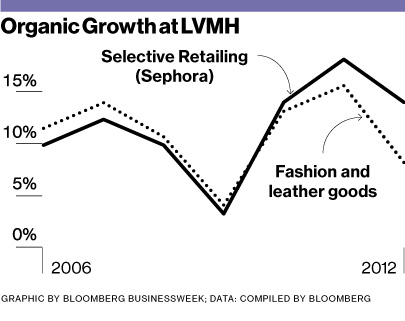
Justine Le Sassier wouldn’t be caught dead buying a Louis Vuitton handbag. “They don’t have any appeal,” the 18-year-old art student says while shopping on the Champs-Elysées. Happily for Vuitton’s owner, LVMH Moët Hennessy Louis Vuitton (MC), even if Le Sassier won’t shell out $1,300 for a purse, she’s crazy about the €13.90 ($18) foundation sold by Sephora, LVMH’s fast-growing international fragrance and cosmetics chain. “I love their makeup,” she says. “And it’s reasonably priced.”With Vuitton’s sales growth slowing from Barcelona to Beijing, catering to beauty product buyers such as Le Sassier is becoming more important for LVMH. That’s where Sephora—a glitzy one-stop shop for cosmetics and fragrance lines such as Lancôme, Bobbi Brown, Acqua di Parma, and many more—shines. A host of accessible items like $31 Dior Addict Lipsticks from Sephora will help LVMH’s Selective Retailing unit overtake fashion and leather as its biggest business by 2018,Sanford C. Bernstein (AB) estimates. Last year the division, which also includes the Paris department store Le Bon Marché Rive Gauche and two duty-free shop operators, accounted for 28 percent of sales, leaving LVMH better set than rivals such as PPR (PPR) to weather stagnating luxe demand. “Sephora is a category killer,” says Sanford C. Bernstein analyst Mario Ortelli.
Sephora is introducing services such as mobile payments and enlarging its selection of house-brand goods to keep shoppers spending. It’s expanding in Latin America and Asia to tap into the growing middle class there. Selective Retailing will see 13 percent compound annual revenue growth by 2018, Bernstein predicts, almost double the brokerage’s estimate for LVMH’s fashion and leather goods business and about three times Euromonitor International’s forecast for luxury sales growth.
Paris-based LVMH, owner of more than 60 luxe brands including Dom Pérignon champagne and Bulgari jewelry, in April reported its weakest fashion and leather goods sales in more than three years. After PPR’s Gucci brand this spring booked its slowest sales growth since 2009, Chief Financial Officer Jean-Marc Duplaix attributed the results to China not being “as buoyant as it was two years ago.”
Sephora’s new stores in Shanghai and Hong Kong fueled a 17 percent gain in first-quarter comparable sales at Selective Retailing. Providing a broad range of skin care and fragrances has been key to Sephora’s success since it was founded in 1969. Acquired by LVMH in 1997, it has become the world’s biggest beauty retailer, with about 1,300 shops in 27 countries. Sephora plans to open some 120 stores a year through 2017, Bernstein estimates. LVMH declined to make executives available to discuss the business.
At Sephora’s outlet on the Champs-Elysées, products such as €30.30 Dior “Iconic” false eyelashes sit a row down from the retailer’s house-label €9.90 lashes. Top brands, a customer loyalty program, and services such as nail bars near the entrance of some stores lure shoppers inside, while arranging some of the merchandise by category allows clients to choose from similar products at a wide range of prices. “Their business model is very clever,” says Joël Palix, president of Clarins Fragrance Group, which distributes its Thierry Mugler scents through Sephora. Stocking exclusive products means Sephora can limit discounts, while private-label merchandise yields high profit margins, he says.
As luxury goods sales slow, beauty products are the primary tool for attracting aspirational consumers, says Exane BNP Paribas analyst Luca Solca. Since lipstick costs a hundredth the price of a Vuitton handbag and a thousandth of a Hublot watch, he says, “fragrances and cosmetics are the luxury of the masses.”
The bottom line: LVMH’s Selective Retailing unit is growing twice as fast as its luxury business and could be bigger than fashion in five years.
 About bambooinnovator
 Bamboo Innovator