Lab-Grown Blood Vessel Used for First Time in the U.S.

Lab-Grown Blood Vessel Used for First Time in the U.S.

A 62-year-old Virginia man with kidney failure received the first genetically engineered blood vessel in the U.S., a vein that may improve his dialysis treatments and pave the way for future tissue transplants.

The operation at Duke University Hospital in Durham, North Carolina, yesterday marked the first time doctors have implanted an “off-the-shelf” tissue graft in the U.S. The vessel, grown with human cells on a mesh tube, has the potential to be widely used since it was cleansed of any lingering cells that may trigger an immune reaction, said the doctors who performed the surgery. Read more of this post

Buffett’s former Iron Mountain and Equinix, two technology companies planning to convert to real estate investment trusts, plunged after saying that the U.S. Internal Revenue Service is scrutinizing their eligibility

Iron Mountain, Equinix Fall as IRS Scrutinizes REIT Plans

Iron Mountain Inc. (IRM) and Equinix Inc. (EQIX), two technology companies planning to convert to real estate investment trusts, plunged after saying that the U.S. Internal Revenue Service is scrutinizing their eligibility.

The IRS is weighing whether to revise the legal definition of real estate for the purposes of converting to a trust, the companies said in separate regulatory filings.

As more businesses from data centers to prisons make the switch to REITs — which are subject to lower taxes and pay higher dividends than other companies — the IRS is considering whether to narrow the types of enterprises that should qualify. Recent examples of REIT applications in the technology industry include Equinix, which operates data centers for companies such as AT&T Inc. and Amazon.com Inc., and Iron Mountain, which rents businesses storage and maintains paper documents as well as electronic files, medical data and e-mail. Read more of this post

Russian retailing: A Magnit for investors; A retailer doing well in a business-unfriendly country by catering to the needs of price-sensitive shoppers in the country’s regions. That makes him not only the rare Russian oligarch whose wealth has nothing to do with natural resources, but also the only one who does not make his home in Moscow or in one of Europe’s fancier cities but in Krasnodar, a regional capital in south-western Russia

Russian retailing: A Magnit for investors; A retailer doing well in a business-unfriendly country

Jun 8th 2013 | KRASNODAR |From the print edition

images (14)

STANDING in front of a bank of display screens in Krasnodar, Alexander Barsukov, an executive at the Russian grocery chain Magnit, can see that a hypermarket in Nizhnekamsk, a town of 230,000 people 1,900km (1,200 miles) away, is running low on “Group A” products—ones such as bread and milk that account for 20% of stock but 80% of sales. Mr Barsukov has the store manager notified to restock the shelves; a “control call” will follow up in 40 minutes. The point is to “catch mistakes fast,” he says.

It is this combination of advanced IT systems and efficient logistics that has propelled Magnit to the top of the Russian food-retail industry, a fast-growing, $300-billion-a-year market that is now Europe’s largest. In April, for the first time in its 15-year history, Magnit bested its competitors by posting $4.3 billion in quarterly sales. Long the underdog, Magnit has become an investors’ favourite: its share price has nearly doubled over the past 12 months. Read more of this post

Shocks and ores: Short-term gyrations in commodity prices may do more damage than long-run trends

Shocks and ores: Short-term gyrations in commodity prices may do more damage than long-run trends

Jun 8th 2013 |From the print edition

20130608_FNC741_0

HUMANITY harbours a lingering fear that Thomas Malthus might just have been right. The dour reverend first warned in 1798 that population growth would lead to soaring resource prices, leaving workers destitute. Two centuries of growth later, the worry that the world’s natural resources are finite remains.

Paul Ehrlich, a biologist of Malthusian disposition, argued in “The Population Bomb”, a 1968 book, that rising populations would inevitably exhaust those resources, sending prices soaring and condemning people to hunger. That pitted him against economists who argued that rising prices should mitigate the squeeze by calling forth more supply. In a famous 1980 wager Julian Simon, an economist, bet Mr Ehrlich that commodity prices would be lower a decade later. He won, as the effects of rising prices in the 1970s showed up in energy conservation and more oil exploration. But when exuberance returned to commodity markets in the 2000s, so did the old arguments. Jeremy Grantham, a money manager, wrote in 2011 that “price pressure and shortages of resources will be a permanent feature of our lives.” Read more of this post

Advertising hedge funds: Bull marketing; Alternative-investment firms are preparing to pitch to the public

Advertising hedge funds: Bull marketing; Alternative-investment firms are preparing to pitch to the public

Jun 8th 2013 |From the print edition

20130608_FND002_0

TOBACCO and alcohol brands face heavy restrictions when it comes to advertising. Hedge funds and other purveyors of alternative investments have suffered similar prohibitions on marketing their products. That ban may soon be lifted in America. (Europe’s pending new regime for alternative investments is stricter, although it has lots of loopholes.) Long consigned to silence, the money men are starting to practise their sales pitches.

Change is expected as part of the JOBS act, a 2012 bill designed to make it easier for smaller American businesses to raise cash. Hedge funds, private-equity firms and others piggybacked on the reforms in the hope of widening the pool of investors they can pitch to. The Securities and Exchange Commission (SEC) is busy writing the rules that would put the bill into practice. That process has been bedevilled by delays but it seems inevitable it will overturn a Depression-era ban on “general solicitation”. Read more of this post

Can You Trust Private-Equity Returns? In the best of times, the true value of a private-equity fund is a mystery. At other times, the value might be manipulated to entice prospective investors

June 7, 2013, 6:26 p.m. ET

Can You Trust Private-Equity Returns?

By JOE LIGHT

BF-AF112_UPSIDE_NS_20130607154503

In the best of times, the true value of a private-equity fund is a mystery. At other times, the value might be manipulated to entice prospective investors, according to new research. Private-equity funds are partnerships that own companies or other assets that aren’t typically traded on a public exchange. Before selling fund holdings, private-equity firms have to rely on recent sales of similar companies and other variables to guess at what the assets are worth. When the sales do happen, some research has found, private-equity-fund performance can be quite good. But in the meantime, it turns out that some firms might be using the ambiguity to make their returns look better than they really are, right before trying to raise capital for a new fund, according to recent research. Read more of this post

What’s Eating Munis? Municipal bonds are beginning to look tempting — but investors who buy munis in haste can unwittingly hand over their first year’s worth of income to their broker

Jun 7, 2013

Intelligent Investor: What’s Eating Munis?

By Jason Zweig

BF-AF125_INVEST_G_20130607173911

Illustration by Christophe Vorlet

Municipal bonds are beginning to look tempting — but investors who buy munis in haste can unwittingly hand over their first year’s worth of income to their broker.

Fortunately, with a few simple steps, you can control that risk and maximize your net return.

Intriguingly, the health of many municipalities is improving even as tax-free bonds offer relatively attractive returns. Yields on the highest-quality, widely traded munis, triple-A-rated, 10-year “general obligation” bonds, have risen by 0.45 percentage point since May 1, according to Daniel Berger, senior market strategist at Municipal Market Data. Read more of this post

Europe’s banking union: Till default do us part; A half-hearted banking union raises more risks than it solves

Europe’s banking union: Till default do us part; A half-hearted banking union raises more risks than it solves

Jun 8th 2013 |From the print edition

20130608_FNC747

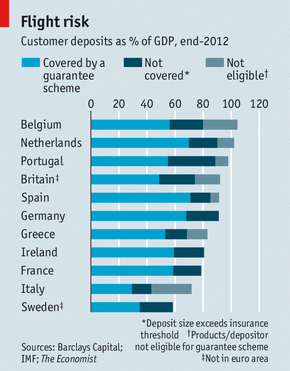
PENNY-PINCHING lovers can always turn to Las Vegas, where wedding-chapel packages start at just a couple of hundred dollars (wedding music included, rose bouquets extra) and annulments are fast and cheap. The architects of the euro zone’s banking union are planning something similarly cut-price. Almost a year ago, as the euro crisis raged, Europe’s leaders boldly pledged a union to break the dangerous link between indebted governments and ailing banking systems, where the troubles of one threatened to pull down the other. Yet the agreement that seems likely to emerge from a summit later this month will be one that does little to weaken this vicious link. If anything it may increase risks to stability instead of reducing them. Almost everyone involved agrees that in theory a banking union ought to have three legs. The first is a single supervisor to write common rules and to enforce them uniformly. Next are the powers to “resolve” failed banks, which is a polite term for deciding who takes a hit; these powers also require a pot of money (or at least a promise to pay) to clean up the mess left by bust lenders and to inject capital into those that can get back on their feet. The third leg is a credible euro-wide guarantee on deposits to reassure savers that a euro in an Italian or Spanish bank is just as safe as one in a German or Dutch bank. National insurance schemes offer scant reassurance to savers when sovereigns are wobbly and insured deposits make up a big chunk of annual GDP (see chart). Read more of this post

A Bond Market Plunge That Baffles the Experts

June 7, 2013

A Bond Market Plunge That Baffles the Experts

By JAMES B. STEWART

Bond Turmoil

As if it wasn’t bad enough for the millions of Americans scraping by on paltry interest payments, now they face another threat: the loss of principal on their bonds and other fixed-income assets.

The month of May, and this first week of June, were terrible for many fixed-income investors who have spent the last few years reaching for higher yields.

If there was an index for fixed income with the status of the Dow Jones industrial average or Standard & Poor’s 500 index for stocks, the carnage in fixed-income markets would have been a big story and we’d all be talking about a bear market in bonds. Read more of this post

Dundee Shows REIT No Haven as Bond Yields Rise

Dundee Shows REIT No Haven as Bond Yields Rise

Dundee Real Estate Investment Trust (D-U) and Calloway REIT (CWT-U) are bearing the brunt of a rout among real estate, utility and telecommunications shares as rising bond yields reduce demand for high-dividend stocks.

Dundee and Calloway are the two worst-performing REITs this year through yesterday among 14 stocks in the Standard & Poor’s/TSX Capped REIT Index. The index has slid 8.5 percent since reaching a record high on April 30, three days before a stronger-than-expected U.S. jobs report sparked a rise in bond yields and speculation the Federal Reserve may begin to slow monetary stimulus. The index dropped seven straight days through June 5, the longest skid in three years. Read more of this post

How America Lost Its Way; It is getting ever harder to do business in the United States, argues Niall Ferguson, and more stimulus won’t help: Our institutions need fixing

June 7, 2013, 7:02 p.m. ET

How America Lost Its Way

It is getting ever harder to do business in the United States, argues Niall Ferguson, and more stimulus won’t help: Our institutions need fixing.

The decline of America’s institutions, and the related rise in red tape that hinders business, may spell the nation’s economic doom. Harvard’s Niall Ferguson talks to WSJ’s Charles Forelle about the theory outlined in his new book “The Great Degeneration.”

By NIALL FERGUSON

Not everyone is an entrepreneur. Still, everyone should try—if only once—to start a business. After all, it is small and medium enterprises that are the key to job creation. There is also something uniquely educational about sitting at the desk where the buck stops, in a dreary office you’ve just rented, working day and night with a handful of employees just to break even.

As an academic, I’m just an amateur capitalist. Still, over the past 15 years I’ve started small ventures in both the U.S. and the U.K. In the process I’ve learned something surprising: It’s much easier to do in the U.K. There seemed to be much more regulation in the U.S., not least the headache of sorting out health insurance for my few employees. And there were certainly more billable hours from lawyers. Read more of this post

Currency-focused hedge funds performed poorly, hurt by volatile dollar

June 7, 2013, 3:35 p.m. ET

Hedge Funds Hurt by Volatile Dollar

By MATTHEW WALTER and CLARE CONNAGHAN

Currency-focused hedge funds performed poorly as the dollar swung back and forth in May and even worse during the greenback’s fall this past week, according to a widely watched barometer of these investors’ returns.

The Parker Global Currency Managers Index, which tracks the performance of 17 funds in which Parker Global Strategies LLC invests, fell 0.58% last month, according to a preliminary figure provided by the company. Read more of this post

Golden Parachutes of $100 Million for Fired CEOs Outlive Outrage

Golden Parachutes of $100 Million for Fired CEOs Outlive Outrage

Corporate governance advocates and shareholder activists have long complained that chief executive officer pay, which has jumped by a third since 2007, is sometimes way out of line with the CEO’s on-the-job performance.

Severance packages for executives fired by their boards are often far bigger than those corner-office salaries. At least a dozen executives of companies in the Standard & Poor’s 500 Stock Index (SPX) stand to receive more than $100 million if they’re dismissed, according to a Bloomberg review of proxy data.

The potential payouts show that golden parachutes live on – – even after the uproar over Jack Welch’s $417 million farewell kiss from General Electric Co. more than a decade ago. At the top of the list compiled by Bloomberg are three executives who each would receive almost a quarter of a billion dollars or more if they were sent packing: McKesson Corp. (MCK) CEO John Hammergren, eligible for $303.4 million; CBS Corp. (CBS) chief Les Moonves, with $251.4 million; and Discovery Communications Inc. (DISCA)’s David Zaslav, with $224.7 million. Read more of this post

Brazil shifts course after Rousseff’s interventionist economic management bet goes bad

Brazil shifts course after Rousseff’s bet goes bad

1:02pm EDT

By Brian Winter and Silvio Cascione

SAO PAULO (Reuters) – President Dilma Rousseff’s big gamble for 2013 was that Brazil had matured enough for investors to accept permanently lower interest rates, looser fiscal policy, and lower returns on big infrastructure projects like new highways.

Six months in, it is clear she was wrong and, in typically pragmatic fashion, her government is rapidly shifting course to avert even bigger trouble.

Thursday’s warning by ratings agency Standard & Poor’s of a possible downgrade on Brazilian government debt was only the latest example of the financial world lashing out against Rousseff’s interventionist economic management. Read more of this post

Moody’s Casts Doubt Over Nordic Havens Amid Housing Risks

Moody’s Casts Doubt Over Nordic Havens Amid Housing Risks

Scandinavia’s mortgage model is adding risk to the region’s economies as too few homeowners pay down their debt, Moody’s Investors Service said.

While interest-only mortgages in Sweden and Denmark helped households keep up payments during the crisis, consumers now rely too much on the loans, according to Oscar Heemskerk, vice president and senior credit officer at Moody’s.

“We see vulnerability in that model,” he said in a June 5 interview in Stockholm.

At the current pace of amortization, Swedish households will need 140 years on average to repay their home loans, the Financial Supervisory Authority estimates. In Denmark, interest-only loans make up more than half the country’s $490 billion mortgage market, central bank figures show. Danes carry the world’s highest debt burden relative to disposable incomes, at more than 300 percent, the Organization for Economic Cooperation and Development estimates. Debt by that measure in Sweden and Norway hit record levels this year, central bank figures show. Read more of this post

Fed’s $5.7 Trillion Gift Imperiled on Yield Rise: Credit Markets

Fed’s $5.7 Trillion Gift Imperiled on Yield Rise: Credit Markets

The most relentless surge in borrowing costs for U.S. corporate debt in four years is threatening to derail this year’s record pace of sales as concern deepens the Federal Reserve will curtail unprecedented stimulus.

Yields are climbing for a sixth week from last month’s record lows and yesterday touched 3.78 percent, the highest level since September, according to the Bank of America Merrill Lynch U.S. Corporate & High Yield index. U.K. oil-and-gas services provider Petrofac Ltd. (PFC) cited market conditions for canceling its issue of investment-grade dollar-denominated notes as sales fell below the 2013 average for a second week. Read more of this post

Exit strategies, spillovers vex G20 finance officials

Exit strategies, spillovers vex G20 finance officials

1:05pm EDT

By Maya Dyakina

ST PETERSBURG, Russia (Reuters) – The Group of 20 nations is intensifying its debate on how to withdraw the fiscal and monetary stimulus measures that developed nations have used to counter economic recession, Russia said on Friday.

So-called “spillover effects” from expansive policies have also risen to the top of the agenda, Finance Minister Sergei Storchak said on Friday, after G20 finance talks held against a backdrop of sharply increased global market volatility. Read more of this post