Embracing your Dragon Boat Festival holiday which commemorates the death of Qu Yuan, an upright minister who found it impossible to put into practice those ambitions and ideals in a corrupt era
June 10, 2013 Leave a comment
Embracing your Dragon Boat Festival holiday
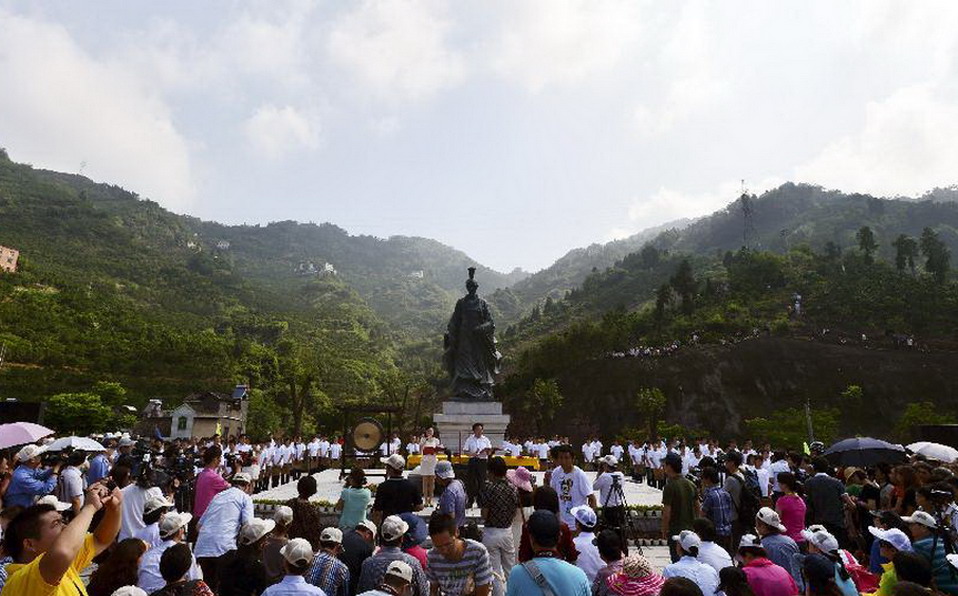
Hometown of Qu Yuan prepare to mark upcoming Dragon Boat Festival
The 5th day of the 5th month of the lunar year is an important day for the Chinese people. The day is called Duan Wu Festival, or Dragon Boat Festival, celebrated everywhere in China. This festival dates back to about 2,000 years ago with a number of legends explaining its origin. The best-known story centers on a great patriotic poet named Qu Yuan.Tale of Qu Yuan
14:51, June 18, 2012
The Dragon Boat Festival, also called the Duanwu Festival, is celebrated on the fifthday of the fifth month according to the Chinese calendar. For thousands of years, thefestival has been marked by eating zong zi (glutinous rice wrapped to form a pyramidusing bamboo or reed leaves) and racing dragon boats.
The festival is best known for its dragon-boat races, especially in the southernprovinces where there are many rivers and lakes. This regatta commemorates thedeath of Qu Yuan , an honest minister who is said to have committed suicide bydrowning himself in a river.
Qu was a minister of the State of Chu situated in present-day Hunan and Hubeiprovinces, during the Warring States Period (475-221BC). He was upright, loyal andhighly esteemed for his wise counsel that brought peace and prosperity to the state.However, when a dishonest and corrupt prince vilified Qu, he was disgraced anddismissed from office. Realizing that the country was now in the hands of evil andcorrupt officials, Qu grabbed a large stone and leapt into the Miluo River on the fifthday of the fifth month. Nearby fishermen rushed over to try and save him but wereunable to even recover his body. Thereafter, the state declined and was eventuallyconquered by the State of Qin.
The people of Chu who mourned the death of Qu threw rice into the river to feed hisghost every year on the fifth day of the fifth month. But one year, the spirit of Quappeared and told the mourners that a huge reptilein the river had stolen the rice. Thespirit then advised them to wrap the rice in silk and bind it with five different-coloredthreads before tossing it into the river.
Duanwu’s cultural message
09:38, June 04, 2013
What does Dragon Boat Festival mean?
That may be of little concern to those who spend this traditional festival in their ownparticular way.
But it will concern those who have taken part in online discussions about the culturalconnotation of the festival, known as duanwu.
Strange as it may seem, globalization has diluted the cultural flavor of traditionalfestivals in the increasingly globalized world.
It is only natural that the way people look at traditional festivals will change with time.Nevertheless, a festival will still stand testimony to the messages it conveys.
That explains why the State Council designated this festival as a national holiday andlet people have enough time to enjoy it and, if possible, to reflect on its culturalmeaning.
Some say that all that remains of the festival’s many traditions is eating pyramid-shaped dumplings with glutinous rice and fillings like dates and meat wrapped inbamboo or reed leaves. But most people would associate the festival with historicalfigures such as Qu Yuan (340-278 BC) and Wu Zixu, who died about 484 BC
This is where the power of culture lies.
In online discussions, some have debased both historical heroes by saying theirsuicides were worthless since the courts and kings they were loyal to were corrupt, sosome question the cultural connotation of this festival.
As naive and nihilistic as such remarks may be, it is not bad for people to have suchdiscussions, which suggests they are keen to know about the festival’s origins.
Both historical figures are objects of worship not because they showed their loyalty totheir kings and states by committing suicide.
Rather it is because they committed totheir own ambitions and ideals, and both preferred to die when they found it impossibleto put into practice those ambitions and ideals.
Traditional festivals such as this appeal less to young people as they do to oldergenerations. That is a worldwide phenomenon.
Yet there is always something in traditional festivals that young people can draw on ascultural nutrition so that they better understand the life path that lies before them.
Dragon Boat Festival introduction
13:10, June 14, 2010
Email | Print | Subscribe | Comments | Forum
The Dragon Boat Festival, also called the Duanwu Festival, is celebrated on the fifth day of the fifth month according to the Chinese calendar. For thousands of years, the festival has been marked by eating zongzi (glutinous rice wrapped to form a pyramid using bamboo or reed leaves) and racing dragon boats.
The festival is best known for its dragon-boat races, especially in the southern provinces where there are many rivers and lakes. This regatta commemorates the death of Qu Yuan , an honest minister who is said to have committed suicide by drowning himself in a river.
Qu was a minister of the State of Chu situated in present-day Hunan and Hubei provinces, during the Warring States Period (475-221BC). He was upright, loyal and highly esteemed for his wise counsel that brought peace and prosperity to the state. However, when a dishonest and corrupt prince vilified Qu, he was disgraced and dismissed from office. Realizing that the country was now in the hands of evil and corrupt officials, Qu grabbed a large stone and leapt into the Miluo River on the fifth day of the fifth month. Nearby fishermen rushed over to try and save him but were unable to even recover his body. Thereafter, the state declined and was eventually conquered by the State of Qin.
The people of Chu who mourned the death of Qu threw rice into the river to feed his ghost every year on the fifth day of the fifth month. But one year, the spirit of Qu appeared and told the mourners that a huge reptile in the river had stolen the rice. The spirit then advised them to wrap the rice in silk and bind it with five different-colored threads before tossing it into the river.
During the Duanwu Festival, a glutinous rice pudding called zong zi is eaten to symbolize the rice offerings to Qu. Ingredients such as beans, lotus seeds, chestnuts, pork fat and the golden yolk of a salted duck egg are often added to the glutinous rice. The pudding is then wrapped with bamboo leaves, bound with a kind of raffia and boiled in salt water for hours.
The dragon-boat races symbolize the many attempts to rescue and recover Qu’s body. A typical dragon boat ranges from 50-100 feet in length, with a beam of about 5.5 feet, accommodating two paddlers seated side by side.
A wooden dragon head is attached at the bow, and a dragon tail at the stern. A banner hoisted on a pole is also fastened at the stern and the hull is decorated with red, green and blue scales edged in gold. In the center of the boat is a canopied shrine behind which the drummers, gong beaters and cymbal players are seated to set the pace for the paddlers. There are also men positioned at the bow to set off firecrackers, toss rice into the water and pretend to be looking for Qu. All of the noise and pageantry creates an atmosphere of gaiety and excitement for the participants and spectators alike. The races are held among different clans, villages and organizations, and the winners are awarded medals, banners, jugs of wine and festive meals.
 About bambooinnovator
 Bamboo Innovator