Tamil Nadu: Can eccentric politics continue to deliver prosperity? Why are so many Tamil politicians ex-film stars?
June 12, 2013 Leave a comment
Tamil Nadu
A successful show begins to pall
Can eccentric politics continue to deliver prosperity?
Jun 8th 2013 | CHENNAI |From the print edition
IMAGINE a place run by film stars—vain, power-hungry, paranoid, adored. Imagine they had been in charge not for the duration of a reality television series but for decades in a territory containing 72m people and one of the world’s largest cities. It would be a disaster zone, wouldn’t it? Think again, and welcome to Tamil Nadu, one of India’s great success stories—and a state run by actors. It is the ultimate celebrity experiment.
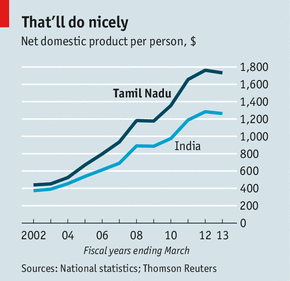
Tycoons and foreign bosses are infatuated by Gujarat, a hard-charging western state where the trains run on time. Policy wonks admire Bihar, an eastern badland that is getting its act together. But India’s most consistent economic performer is in its deep south (see chart). Tamil Nadu has the third-biggest GDP of any state and has grown faster and richer than most.
It is as industrialised as Gujarat—Hyundai, Ford and Renault, among others, churn out a third of all cars made in India there, while the state’s looms dominate the national textile industry. It is also as socially progressive as famously lefty states like Kerala. Compared with the Indian average, more people can read, fewer babies die, and fewer folk are poor in Tamil Nadu.Those achievements sit alongside a political scene that makes Brazilian soap-operas look prim. The personality cults seen across India today, which lead some to despair, gripped Tamil Nadu decades ago. Power swings between two parties: the DMK and its offshoot, AIADMK.
They have roots in a hardline secessionist movement in the 1930s that disliked north India, defied high-caste Brahmins and rejected the Hindi language (Tamil is the local tongue). In an election in 1967 Tamil Nadu became the first big state to boot out the dominant Congress Party in favour of local groups.
Time has taken the edge off its politics. Tamil culture is now celebrated more than asserted. Few want to split from India any more. Politicians now give rhetorical support and not guns to fellow Tamils in neighbouring Sri Lanka.
Amateur dramatics
But as it has mellowed, the Tamil political scene has got seedier and sillier. Most bigwigs are ex-luvvies of some kind (see article). Parties are little more than fan clubs. The props of office include theatrical arrests of opponents, censorship, defamation suits and giveaways to voters. The chief minister, now in her fourth term, is a Brahmin starlet turned autocrat called Jayaram Jayalalitha, leader of the AIA-DMK party. She has faced several corruption investigations—all unjustified, she insists. “In India the party needs a charismatic leader,” argues Cho Ramaswamy, a confidant who says he both seduced and murdered her on stage in his acting days.
Those looking for a mainstream alternative will struggle. The opposition DMK is run by an 89-year-old playwright and four-times chief minister, M. Karunanidhi, and his son, Stalin. A former DMK minister in the central government is being prosecuted for a telecoms licensing scam in 2008.
“Tamil Nadu is the first state in India that has decoupled politics from economic progress,” declares a big Indian business figure. Like many he argues that the state’s economic success is down to two factors. First, good genes. Tamils have traded across Asia for centuries. The state capital, Chennai, then called Madras, was a hub for assembling tanks and artillery during the second world war, giving it an industrial edge, says S. Muthiah, a historian. A knack for administration dates back to colonial times, when Madras ran south India. Brainy Tamil Brahmins no longer dominate the bureaucracy—they are more likely to be in Silicon Valley. But the civil service still works, say businessmen. It is probably why the public finances look passable.
Second, when they weren’t checking their hair, the politicians did some good in the 1970s and 1980s. Free school lunches raised enrolments. Affirmative action in state-run higher education broke down caste hierarchies and inadvertently “created a new ecosystem of private colleges and universities,” says Lakshmi Narayanan of Cognizant, one of the many IT firms that like the state for its education. The work ethic, loyalty and trust many firms say they find in Tamil Nadu owes something to policies from decades ago that spread the benefits of growth.
Some hope that all this has given Tamil Nadu a self-sustaining momentum and that its politics are but a side show, as relevant to progress as Broadway is to Wall Street. But decades of eccentric governance are catching up with Tamil Nadu.
Graft is endemic. Infrastructure, with its long-term benefits, has been neglected—the state has been spending about 5% of GDP a year on it compared with 7-8% in India as a whole. Carmakers must truck new vehicles through Chennai at night to get to its cramped port. A new airport terminal is opening, a metro is being built and new ports are being readied. But this is all a little late. Most worryingly, electricity supply is 20-30% less than peak demand. Small firms without political clout suffer most.
Political neglect is hurting the economy. Tamil Nadu’s share of manufacturing investment has dropped. GDP growth slowed to 4.6% in the year to March 2013, below the Indian average. Ms Jayalalitha has launched a furious campaign to build power stations and attract investment.
But her eye may also be on a bigger stage: national politics. Tamil parties ally opportunistically with national ones (in March the DMK withdrew from India’s ruling coalition after disagreements over policy on Sri Lanka). Ms Jayalalitha may ally her AIADMK with Narendra Modi, the chief minister of Gujarat, and a likely candidate for prime minister for the opposition Bharatiya Janata Party in the election due by 2014. She may even dream of a leading role herself in a national coalition.
That is unlikely, but it won’t prevent Ms Jayalalitha trumpeting her state as an example to the rest of the country. Tamil Nadu is one of India’s most prosperous places. But it also shows how the neglect of long term problems can catch up with you. Even an actress cannot hide that.
Politics in Tamil Nadu
Lights, camera, election
Why are so many Tamil politicians ex-film stars?
Jun 8th 2013 | CHENNAI |From the print edition
WHEN the film “Parasakthi” was released in Tamil Nadu in October 1952, it played for over 100 days to rapt audiences. Yet “Parasakthi” was not your usual all-singing, all-dancing Indian hit: it was a propaganda vehicle for a new political party, written by M. Karunanidhi, who would go on to enjoy four stints as the state’s chief minister. The film marked the start of cinema’s starring role in Tamil politics.
During the past 50 years, five of Tamil Nadu’s eight chief ministers have been film stars or scriptwriters. To this day, power still ricochets between Mr Karunanidhi’s party, the DMK, and the AIADMK, a breakaway faction started by M.G. Ramachandran, another film star. Jayaram Jayalalitha, the 65-year-old current chief minister, was one of Mr Ramachandran’s former leading ladies.
Some of the state’s newer parties have starry credentials too. Vijayakanth, a former action hero nicknamed “Captain”, launched a party in 2005 that now has the second-largest showing in the state assembly. R. Sarath Kumar, a bodybuilder turned actor, has an assembly seat and a small party.
South Indians’ devotion to their film stars forms a good base for any aspiring politician. “The first thing is the recognisability of the face,” says the mustachioed Mr Kumar. His and Mr Vijayakanth’s tens of thousands of fan clubs have been converted into party branches. Tamil stars, who command millions of dollars per film, also have the cash to bankroll their entry into politics.
While Tamil Nadu’s “Kollywood” industry produces politicians (the K comes from Kodambakkam, the suburb where most films are made), television is increasingly the medium for propaganda. Rising incomes and party freebies mean even many poor families own a gogglebox. The main parties (or their supporters) all run their own channels too. But biased news bulletins do not rouse the public like the old films.
Ms Jayalalitha has other ways to try to ensure favourable coverage. One is defamation cases. She has filed several against her critics. Another tactic is perhaps more surprising for an ex-film star: making herself inaccessible to the press. “It’s my democratic right,” she said in a rare interview in 2004 with the BBC.“I don’t have to answer every question you put to me.”
 About bambooinnovator
 Bamboo Innovator