Bank Indonesia raised its benchmark interest rate by a quarter of a percentage point to 6%, the second time in two days the central bank has surprised market participants
June 14, 2013 Leave a comment
June 13, 2013, 3:36 a.m. ET
Bank Indonesia Raises Benchmark Rate Again
By FARIDA HUSNA And I MADE SENTANA
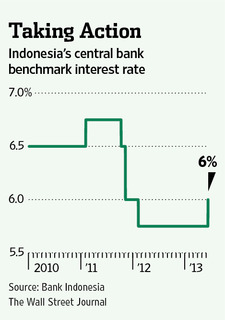
JAKARTA—Bank Indonesia raised its benchmark interest rate by a quarter of a percentage point to 6%, as it works to rein in inflation expectations and support a weakening rupiah following recent outflows.
It is the second time in two days the central bank has surprised market participants as it is widely perceived to be dovish, after having kept the benchmark rate at a historic low since February 2012.
Late Tuesday, the bank raised its overnight deposit rate by 0.25 percentage point to 4.25%, effective Wednesday, to improve sentiment toward the rupiah. The currency has fallen against the U.S. dollar to its lowest since 2009 as foreign investors pulled money from emerging markets, and as domestic investment decisions are influenced by the prospect of slowing growth.The overnight deposit rate, known as the Fasbi, is the interest Bank Indonesia pays on money deposited with it by commercial banks, which directly affects the interbank money market rate but has significantly less impact on the greater economy than the benchmark BI rate.
Raising the benchmark rate “is clearly directed at boosting confidence in the rupiah, especially noting that the central bank is indeed concerned about growth prospects,” said Gundy Cahyadi, economist at Oversea-Chinese Banking Corp.
Nine economists polled by Dow Jones Newswires had expected the bank to hold its benchmark rate and to raise it only after the government raises subsidized fuel prices. The decision on fuel prices may come as early as next week.
Bank Indonesia projects inflation of up to 7.8% at year-end if the government increases fuel prices, above its 3.5% to 5.5% target range. The Consumer Price Index—Indonesia’s primary gauge of inflation—rose 5.47% in May from the same month a year earlier, compared with 5.57% in April.
 About bambooinnovator
 Bamboo Innovator