Brick by Brick: How LEGO Rewrote the Rules of Innovation and Conquered the Global Toy Industry
June 14, 2013 Leave a comment
Brick by Brick: How LEGO Rewrote the Rules of Innovation and Conquered the Global Toy Industry
by David Robertson (Author) , Bill Breen (Author)
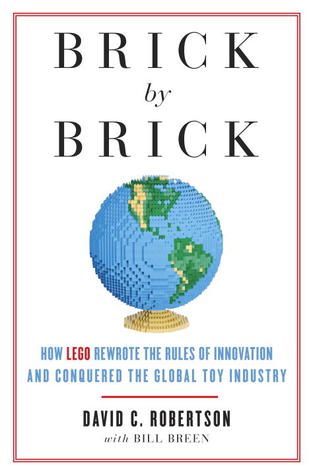
Brick by Brick takes you inside the LEGO you’ve never seen. By following the teams that are inventing some of the world’s best-loved toys, it spotlights the company’s disciplined approach to harnessing creativity and recounts one of the most remarkable business transformations in recent memory.
Brick by Brick reveals how LEGO failed to keep pace with the revolutionary changes in kids’ lives and began sliding into irrelevance. When the company’s leaders implemented some of the business world’s most widely espoused prescriptions for boosting innovation, they ironically pushed the iconic toymaker to the brink of bankruptcy. The company’s near-collapse shows that what works in theory can fail spectacularly in the brutally competitive global economy.
It took a new LEGO management team – faced with the growing rage for electronic toys, few barriers to entry, and ultra-demanding consumers (ten-year old boys) – to reinvent the innovation rule book and transform LEGO into one of the world’s most profitable, fastest-growing companies.
Along the way, Brick by Brick reveals how LEGO:
– Became truly customer-driven by co-creating with kids as well as its passionate adult fans
– Looked beyond products and learned to leverage a full-spectrum approach to innovation
– Opened its innovation process by using both the “wisdom of crowds” and the expertise of elite cliques
– Discovered uncontested, “blue ocean” markets, even as it thrived in brutally competitive red oceans
– Gave its world-class design teams enough space to create and direction to deliver
built a culture where profitable innovation flourishes
Sometimes radical yet always applicable, Brick by Brick abounds with real-world lessons for unleashing breakthrough innovation in your organization, just like LEGO. Whether you’re a senior executive looking to make your company grow, an entrepreneur building a startup from scratch, or a fan who wants to instill some of that LEGO magic in your career, you’ll learn how to build your own innovation advantage, brick by brick.Editorial Reviews
Review
“A valuable read for any business leader or student, but will also delight those familiar with the beloved toy.” –Publishers Weekly starred review
“A fascinating book. The story of how Lego came perilously close to disaster but then transformed itself into one of the most successful and innovative companies in the world serves both as an inspiration and an object lesson.” -Chris Anderson, bestselling author of The Long Tail and Makers
“Brick by Brick is a fascinating study of an iconic toy company that figured out how to stay relevant in a rapidly changing market by returning to its core values and the guiding principles that made it a success in the first place. A must-read for any executive struggling with change.” – Bryce G. Hoffman, journalist and author of American Icon: Alan Mulally and the Fight to Save Ford Motor Company
“In an era filled with so many disheartening stories of corporate failure its refreshing to witness the turn-a-round success of one we have all grown up with during our childhood and that will continue for generations to come.” –Adam Reed Tucker, LEGO Architectural Artist
“David Robertson and Bill Breen have done a wonderful job explaining brick by brick why Lego is loved around the world and what it took to keep this product at the center of toy industry for so long. Like Disney, Lego’s success can be attributed to their drive for innovation, creativity and persistence. While the bricks are loved by children, Brick by Brick is for any business person wanting to understand what it takes to be great.” –Lee Cockerell, executive vice president (retired and inspired), Walt Disney World Resort, author, Creating Magic and The Customer Rules
About the Author
DAVID C. ROBERTSON joined the faculty of the Wharton School at the University of Pennsylvania in January of 2011, and was the LEGO Professor of Innovation and Technology Management at IMD in Lausanne, Switzerland from 2002 through 2010. As the LEGO Professor, Robertson was given unique access to the company’s management team, has written two case studies about the company, and is the co-author of a Harvard Business Review piece on LEGO. At IMD, Robertson was the co-director of the school’s largest executive education program, the Program for Executive Development, and directed programs for Credit Suisse, EMC, HSBC, Skanska, BT, and other leading European companies. For more on Robertson’s background, and to contact him for speaking and consulting engagements, visit www.robertsoninnovation.com.
BILL BREEN is a founding member of the team that launched Fast Company, which gained an avid following among businesspeople and won numerous awards, including the National Magazine Award for General Excellence. As senior editor, he edited Fast Company‘s special issues on design and leadership and wrote many articles on competition, innovation, and personal success. He is the coauthor of The Responsibility Revolution and The Future of Management, which the editors of Amazon.com selected as the best business book of the year. Breen speaks to business audiences on leadership, innovation and sustainability; he has appeared on CNN, Fox, CBS, National Public Radio, and other media outlets. Connect with Bill at bbreen@billbreen.net.
June 12, 2013 3:45 pm
A window on rebuilding Lego’s empire of bricks
By Richard Milne
Brick by Brick: How Lego rewrote the rules of innovation and conquered the global toy industry, By David Robertson with Bill Breen, Crown Business/Random House, $26/£18.99
Walk round the original Legoland, in the tiny Danish town of Billund, and it is easy to believe one is in a child’s idea of heaven. Miniature replicas of Copenhagen’s waterfront and the Millennium Falcon, Han Solo’s spaceship in Star Wars, compete with all manner of rides to keep Lego’s target group – boys aged five to nine – happy.
This Legoland draws about 1.5m visitors a year, all attracted by the seemingly simple idea of interlocking tiny plastic bricks. Little wonder that the family-owned group is the world’s most profitable toymaker and the second-largest by sales. But just 10 years ago Lego was on its knees.
Its decline and resurrection form the narrative of Brick by Brick, by David Robertson, a former Lego professor of innovation and technology management at IMD, but now at the Wharton School, with Bill Breen. The raw material he deals with is every bit as durable and gripping as Lego bricks.
In the 1980s and early 1990s, the company enjoyed a fantastic period of growth as it introduced new ranges, such as castles and space, as well as figures with facial features. Its first licensed product – Star Wars, in 1999 – seemed the crowning glory.
But some of its top managers feared the brick was no longer chic. Children seemed keener to play video games or take up fads such as Tamagotchi, the handheld digital pet.
Prof Robertson tells the resulting rollercoaster tale mainly from the angle of innovation. In 1998, panicking as the group experienced its first loss since being founded in the 1930s, the Kristiansen family owners turned to Poul Plougmann, formerly an executive at Bang & Olufsen, the television and hi-fi maker.
The thesis of the book is that Plougmann adopted all the main tenets of the innovation playbook – such as hiring diverse and creative people and fostering open innovation – but executed many of them wrongly. Lego not only started too many different projects, but also seemed to lose confidence in its core concept of building toys, embracing an easier-to-construct series around a character called Jack Stone.
The result was a company that was losing money and bleeding cash, fast. Jørgen Vig Knudstorp, a former McKinsey consultant who was asked for a diagnosis, told directors: “We are on a burning platform.” The problem was not lack of innovation, but lack of profitable innovation.
Knudstorp became chief executive and set about – in Prof Robertson’s telling – doing innovation correctly. Jack Stone was binned and a fire engine, part of the Lego City line, was reintroduced as was the Duplo brand for toddlers. Lego staunched the losses and sales grew fast: its compound annual growth rate in recent years has been above 20 per cent.
Prof Robertson tries to tease out the differences in approach between the two CEOs, but parts of the tale read very similarly: new innovations and product lines failed under both men. He is mostly successful, but some of the explanations turn on distinctions that are not always easy to grasp.
Another problem is that Lego is saved largely by two lines from Plougmann’s time: Bionicle and Star Wars.
And a big part of the turnround seems to have had little to do with innovation: Lego lacked basic financial controls and churned out too many different parts. A simpler Lego, where each line had to make a profit turned out to be much healthier than an opaque business with insufficient control over what was developed and at what cost.
Still, Prof Robertson’s take on Lego’s success holds plenty of lessons for companies pondering how to remain innovative in a fast-changing world. With new lines such as Ninjago, products such as board games, and open innovation through fan-designed sets via its Cuusoo platform, Lego is showing how far you can take one simple yet brilliant idea.
 About bambooinnovator
 Bamboo Innovator