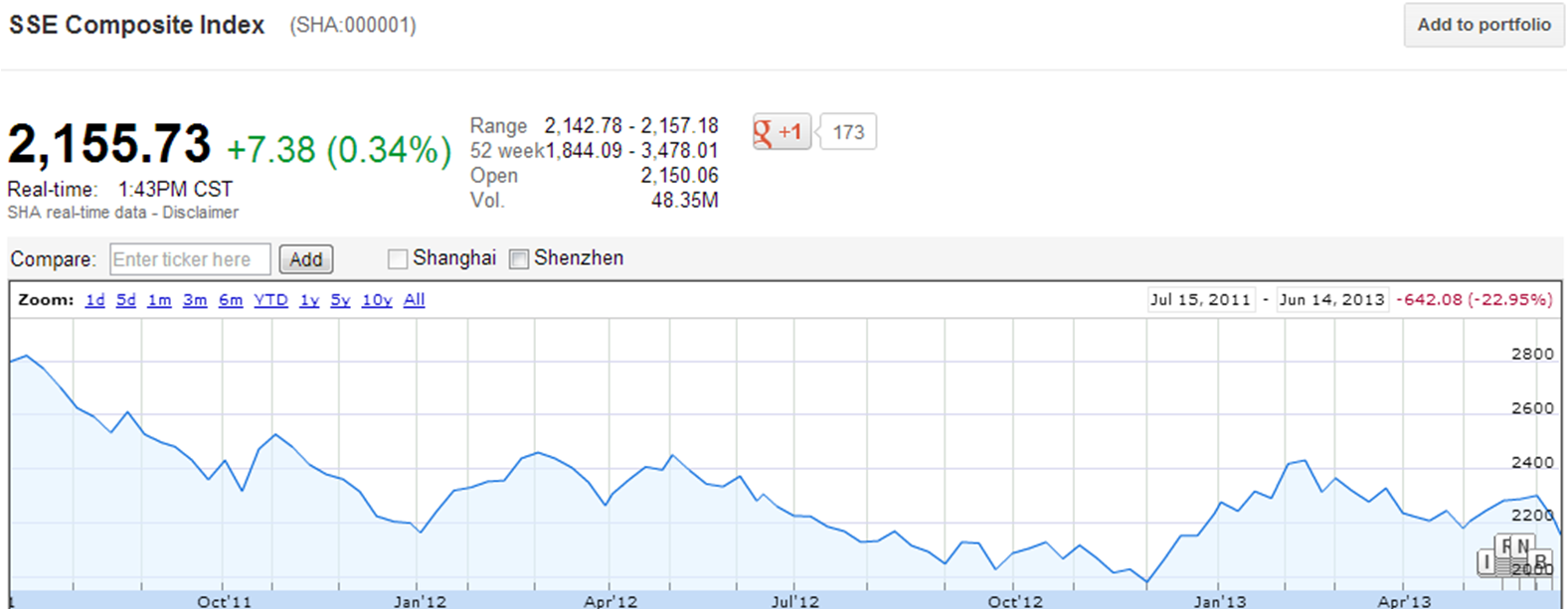
China Debt Sale Fails for First Time in 23 Months on Cash Crunch; The ministry’s last failed auction was in July 2011 and Shanghai index was down 23% subsequently
June 14, 2013 Leave a comment
China Debt Sale Fails for First Time in 23 Months on Cash Crunch
China’s Finance Ministry failed to sell all of the debt offered at an auction for the first time in 23 months owing to a cash squeeze, according to two traders at finance companies that participate in the sales.
The ministry sold 9.53 billion yuan ($1.55 billion) of 273-day bills, less than the 15 billion yuan target, they said. Agricultural Development Bank of China Co. raised 11.51 billion yuan in a sale of six-month bills last week, less than its 20 billion yuan goal. The seven-day repurchase rate, which measures interbank funding availability, has more than doubled in the past month as banks hoard cash to meet quarter-end capital requirements and capital inflows ease.
“The cash crunch is curbing demand for bonds,” said Chen Ying, a fixed-income analyst at Sealand Securities Co. in Shenzhen. “The crunch may persist if the central bank doesn’t come out to inject more capital into the financial system. If it lasts longer, it may affect issuance of both government and corporate bonds.”
The average yield at today’s bill sale was 3.76 percent, said the traders, who asked not to be identified. That compares with a 3.14 percent rate yesterday for similar-maturity existing securities, according to data compiled by Chinabond, the nation’s biggest debt-clearing house. The ministry’s last failed auction was a sale of 182-day bills in July 2011.
Outlook Dims
The cash shortage is driving borrowing costs higher and may exacerbate a slowdown in the world’s second-largest economy. Expansion has held below 8 percent for the past four quarters, the first time that has happened in at least 20 years, and Morgan Stanley, UBS AG and Royal Bank of Scotland Group Plc are among at least seven global banks and brokerages that cut 2013 growth estimates for China this week.
The People’s Bank of China added a net 92 billion yuan into the financial system this week, down from 160 billion yuan in the five days through June 7, according to data compiled by Bloomberg. The monetary authority yesterday refrained from draining funds from the financial system for the first time in three months as money markets reopened after a three-day holiday.
“If the central bank doesn’t conduct reverse-repurchase agreements or short-term liquidity operations to inject capital, cash supply will stay tight for the rest of the month,” said Cheng Qingsheng, a bond analyst at Evergrowing Bank Co. in Shanghai.
The one-year interest-rate swap, the fixed cost needed to receive the floating seven-day repurchase rate, climbed 12 basis points, or 0.12 percentage point, today to 3.77 percent, according to data compiled by Bloomberg. It touched 3.78 percent, the highest level since October 2011.
Capital Inflows
Yuan positions at local lenders accumulated from sales of foreign exchange, an indication of capital flows into China, rose 294 billion yuan in April. The increase may have slowed to around 100 billion yuan in May, according to Chen Jianheng, a bond analyst in Beijing at China International Capital Corp., the nation’s biggest investment bank.
The State Administration of Foreign Exchange last month stepped up scrutiny of flows to prevent speculative funds from entering the country disguised as trade payments. The yuan is unchanged this month at 6.1345 per dollar as of 12:45 p.m. in Shanghai, after strengthening 1.5 percent in the January-May period.
The seven-day repo rate jumped 48 basis points to 6.87 percent, a weighted average by the National Interbank Funding Center shows. The yield on the 2.62 percent government bond due April 2014 climbed 10 basis points to 3.27 percent.
“We are still bearish on the liquidity outlook because banks will turn more cautious toward the end of June due to the need to fulfill loan-to-deposit requirements and we will also head into another tax payment season in July,” said Pin Ru Tan, an interest-rate strategist at HSBC Securities Asia Ltd. in Hong Kong.
To contact Bloomberg News staff for this story: Judy Chen in Shanghai at xchen45@bloomberg.net
By SHEN HONG
In a rare failure, China was unable to sell all of a government bond to banks Friday, heightening concerns about a severe funding squeeze in the money market that has sent interbank borrowing costs soaring.
Banks have been short of cash since the end of last month, as they kept more funds to meet regulatory requirements. But the liquidity crunch worsened recently as customers yanked out deposits ahead of a three-day holiday earlier in the week, pushing a seven-day benchmark for interbank funding costs up to 6.87% Friday from 6.39% Thursday and 4.8% two weeks ago.
The lackluster demand for the debt sold by the Ministry of Finance deals a fresh blow to China’s already-beleaguered financial markets, which have been hit by the slowing economy. Stocks slumped to their lowest in six months this week, and the currency weakened from a record as global investors pulled money out.
The Ministry of Finance last failed to sell an entire bond almost two years ago, and this time sold just 9.53 billion yuan ($1.55 billion) of 273-day government bonds, well below the originally planned size of 15 billion yuan, traders participating in the auction told The Wall Street Journal Friday. The government also had to pay more to borrow, with the yield at 3.76%–far higher than the 3.14% on similar bonds currently being traded.
“Tight liquidity is the main cause for the ministry’s failure to complete the bond sale today. The high funding cost in the interbank market has made such investments even less popular,” said Yan Yan, senior trader at China Guangfa Bank.
The failure isn’t the first, with state-owned Agricultural Development Bank of China only able to sell slightly more than half of a planned 20 billion-yuan bond on June 6.
Beijing has also been cracking down on a wide range of financial services and potentially risky wealth-management products that straddle the boundaries of the country’s conventional and unconventional financial systems. That has been cutting banks’ access to cash and restricting their options on how they raise funds.
“We believe the series of policy-tightening measures applied to the shadow-banking sector in the past three months has reached a critical mass, such that deleveraging in the banking sector is happening,” said Zhiwei Zhang, economist at Nomura.
“We expect liquidity to remain tight in June and July” given leaders in Beijing have recently signaled that monetary policy loosening is unlikely in the short term, Mr. Zhang added.
China Merchants Bank 600036.SH -0.89% analyst Liu Junyu says the liquidity squeeze should end by the end of next month, but how fast funding costs will fall back will depend on policy makers’ outlook and the decisions they make to help the broader economy.
Beijing will most likely continue to use short-term liquidity tools to adjust the supply of funds, rather than pulling the trigger on cutting interest rates, Mr. Liu said.
“That means people will have to get used to short-term volatility in the money market,” he added.
By TOM ORLIK
A surge in money-market rates points to growing stress in China’s financial sector.
The overnight borrowing rate in China’s money markets rose to 9.6% last week, a record high, and was still high at 7% as of Friday. The sharp increase reflects problems with liquidity management caused by China’s overextended banks and growing wealth-management sector.
With a weak branch franchise, China’s small banks are perennially starved of deposits. Wealth-management products—short-term investments that offer some of the security of a deposit but higher returns—help them attract funds to expand their business. WMPs grew to 7.1 trillion yuan at the end of 2012, from virtually nothing a few years ago.
So far, so good. But with a mismatch between short-term liabilities and long-term assets in WMPs, banks are sometimes forced to tap the money market for funds to repay investors. One measure of that is turnover in the money market, which more than tripled from 2007 to 2012 according to data from the People’s Bank of China.
The surge in money-market rates isn’t driven solely by the growth of WMPs. Tax season and a three-day holiday, both of which add to demands on liquidity, also played a part. Capital inflows may also have slowed, reflecting growing risk aversion in global markets. Rumors of a money-market default also pushed rates higher.
Nor does the surge represent an imminent crisis for China’s financial system. With 19 trillion yuan in deposits held in reserve, China’s central bank has ample resources to ease liquidity constraints if it wishes. If sharply higher borrowing costs in the money market encourage China’s banks to manage their balance sheets more conservatively, it could even be a positive.
But with concerns about China’s growth are mounting, a cash crunch in the financial system—which drives up the cost of borrowing—isn’t well-timed. And with slowing growth adding to existing strains on China’s overstretched financial system, the current surge in money-market rates likely won’t be the last.
 About bambooinnovator
 Bamboo Innovator