How did we get here? A “map” of the Fed’s balance sheet’s history
June 14, 2013 Leave a comment
SATURDAY, JUNE 8, 2013
How did we get here? A “map” of the Fed’s balance sheet’s history
Some in the mass media continue to be confused about the historical trajectory of the Fed’s balance sheet. People have trouble distinguishing between the liquidity facilities provided by the central bank and the various monetary expansion activities. Here is a historical “map” to show how we got here.
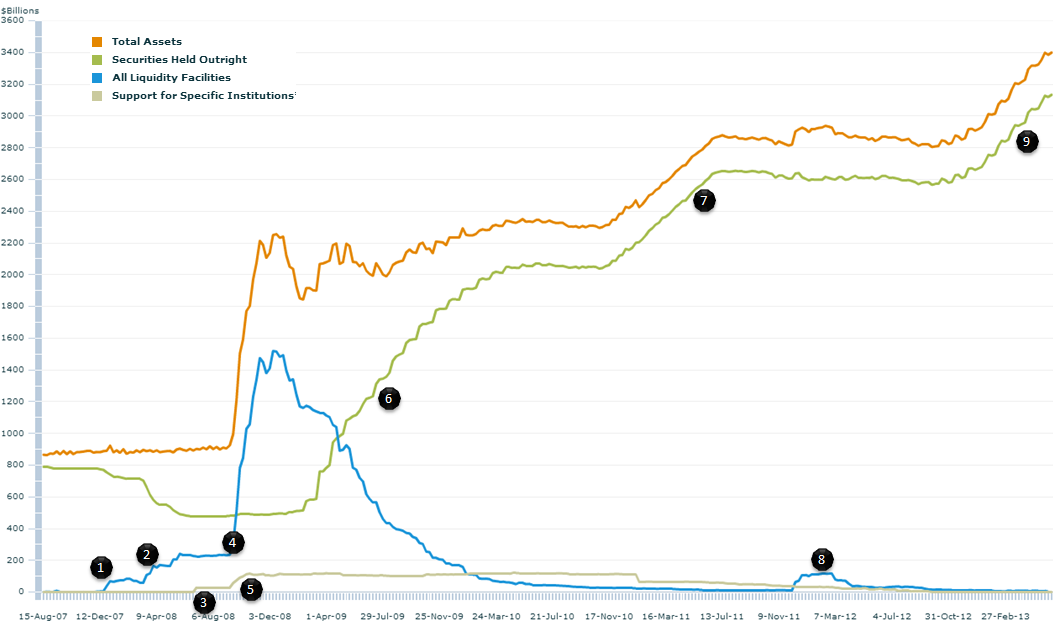 1. The Fed launches the Term Auction Facility (TAF) to replace term interbank funding and commercial paper for banks who started having trouble rolling short-term debt. The Central Bank Liquidity Swap Facility was also launched at the time to provide dollars to other central banks.
2. Increase in TAF demand (it’s no longer taboo to use the facility) and increase in the Central Bank Liquidity Swap Facility as foreign banks start having trouble raising dollars to fund their dollar assets.
3. The Fed provides Bear Stearns (Maiden Lane) funding to support the purchase of Bear by JPMorgan.
4. All hell breaks loose as the Fed is forced to ramp up TAF and the Central Bank Liquidity Swap Facility (as foreign banks desperately need dollars). The Fed also launches the Commercial Paper Funding Facility (CPFF). Among other reasons, CPFF was meant to help corporations like GE Capital, who relied heavily on commercial paper funding and were beginning to have trouble rolling debt.
5. Around the same time as #4, AIG failed. The Fed responded with Maiden Lane II (see post), Maiden Lane III (see post), as well as direct funding for AIG. This was the one move by the central bank that made Bernanke especially angry.
6. QE1 (treasuries and agency MBS). Shortly after, the TALF program was launched (relatively small impact to the balance sheet).
7. QE2 (treasuries).
8. Central Bank Liquidity Swap Facility facility picks up again as the various Eurozone banks lose their ability to roll dollar commercial paper (US money market funds cut exposure) – see posts here and here.
9. QE3 (treasuries and agency MBS).
 About bambooinnovator
 Bamboo Innovator