In China, Philanthropy Gains Cachet; people are now eager to show off pictures they took at an earthquake-stricken zone or on visits to rural schools
June 14, 2013 Leave a comment
June 13, 2013, 2:06 p.m. ET
In China, Philanthropy Gains Cachet
By WEI GU
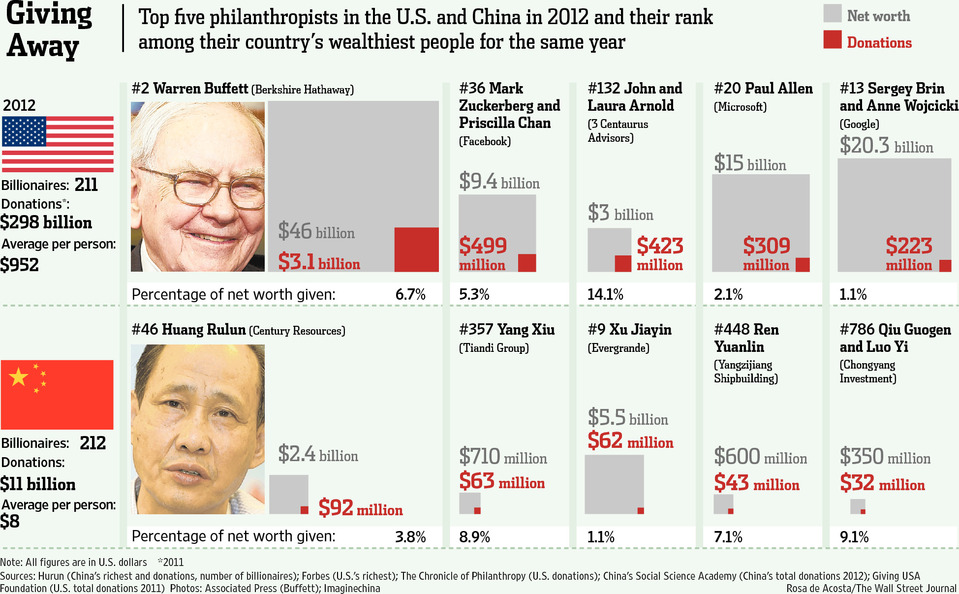
When Warren Buffett and Bill Gates asked 50 of China’s richest people to a philanthropy dinner in Beijing in 2010, a third turned down the invitations, fearing they would be pressed to donate money.
Three years later, rich Chinese are starting to get more comfortable with giving.
Social media are abuzz with pictures of charity dinners and celebrities promoting causes. Displays of wealth are calming down, and people are now eager to show off pictures they took at an earthquake-stricken zone or on visits to rural schools.Yet judging by the overall amount of donations, not too much has changed. In fact, total donations in China dropped 17% year on year, according to a recent study released by China’s Social Science Academy.
Despite China surpassing the U.S. this year as the country with the most billionaires, according to Shanghai-based research firm Hurun, total charitable giving in the country is just 4% of the U.S. level.
“Given the wealth in the society and the need for more attention, charitable giving hasn’t got to a meaningful level in China,” said Gary Rieschel, founder of China-focused venture-capital fund Qiming Venture Partners, who is involved in several charities in China and the U.S.
It may just be that the Chinese are doing things differently, though.
The official donation number doesn’t track the funds going to unofficial channels, which have grown in recent years after some state-run charities have been hit by scandals.
Despite the drop in donation value, the number of nonprofit organizations rose 6% in 2012 as more Chinese want to play an active role in philanthropy. Businessmen are increasingly turning to nonprofits where they feel they can contribute. For example, the Society of Entrepreneurs and Ecology, a non-profit organization run by property developers, uses its $4.7 million of assets on projects such as waste-water treatment.
“Chinese donors are very hands-on,” said Wei Wei, Asia director of UBS‘sUBSN.VX +0.80% Optimus Foundation, an independent foundation that offers the Swiss bank’s clients options to support charity projects. “They don’t want to just write checks. They visit often and do a lot of due diligence.”
Philanthropy is on the rise in China as many realize that charitable giving can bring substantial benefits to their finances, careers and families. Being perceived as a caring entrepreneur can helpful in a society that tends to resent those who get rich fast.
According to one study by the Center for Family Heritage at China Europe International Business School, entrepreneurs who rank higher in terms of philanthropy are less likely to suffer from government investigations, stock-price declines, and reduced government subsidies.
Charity involvement can also open new doors for individuals. Companies like to recruit people who have acquired skills from nontraditional work and challenging environments. Teach for China, a volunteer program for young graduates modeled after Teach for America, has seen a few of its former teachers go on to work for McKinsey and Goldman Sachs GS +2.45% . Chinese parents also are starting to understand that volunteer work is important when it comes to applications to top universities abroad.
As first-generation Chinese entrepreneurs have started thinking about wealth succession, charity has become an essential part of it.
“A big topic in Hong Kong is the family succession fight. So for high-net-worth individuals, it is important to establish the value early on,” said Amy Lo, head of UBS’s ultra-high-net-worth clients in Asia. “It is also about building ties to the next generation and engaging the family.”
Trusted charities are faring better. In the first day after a big earthquake hit Sichuan in April, martial-arts star Jet Li’s One Foundation took in more than $1.6 million. Half the Sky Foundation, a charity started in the U.S. that helps children in China, said its fundraising in China has happened faster than expected.
“Chinese people’s hearts are just as wide open as people in the U.S.; there is no deep culture difference,” said Jenny Bowen, founder and CEO of Half the Sky. “People just need the evidence that their money is not going to a hole somewhere.”
 About bambooinnovator
 Bamboo Innovator