In Southeast Asia, the Web Gets Tangled Amid Dissent
June 14, 2013 Leave a comment
Updated June 12, 2013, 8:42 p.m. ET
In Southeast Asia, the Web Gets Tangled Amid Dissent
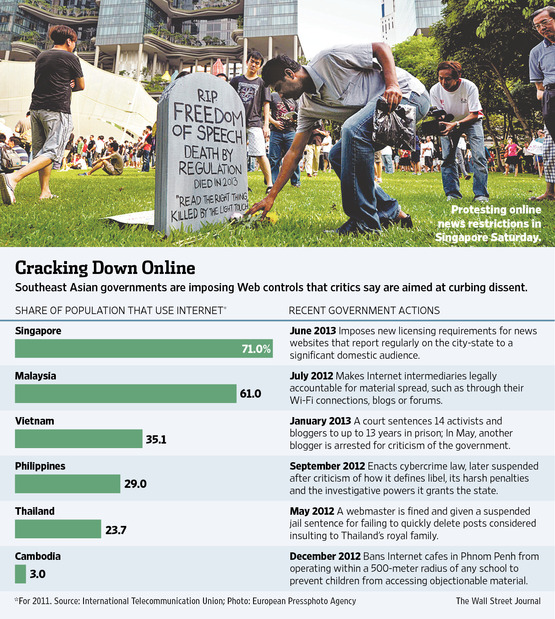
Southeast Asian governments are reaching for new legal tools and raw state powers as the Internet increasingly enables younger citizens to criticize their long-serving political leaders.
Not all these countries are as effective as China and its famed “Great Firewall,” which filters everything from microblog posts to ordinary Internet searches. But the speed with which countries such as Singapore, Malaysia, Cambodia and Vietnam are moving to impose Web controls is worrying human-rights advocates, who fear further curbs on Internet freedoms could suppress free speech and strip these economies of their vitality.Singapore this month imposed targeted controls on Internet news media, while Malaysia says it could introduce additional Internet regulations in the name of protecting minors. Cambodia is considering anticybercrime legislation that activists say could be used against government critics, just as the Philippines battles legal challenges against its own such law passed last year. Vietnam, meanwhile, has jailed more dissident bloggers so far this year than in the whole of 2012.
Such efforts come amid a rapid expansion of broadband and mobile Web access in Southeast Asia, home to some of the world’s fastest-growing developing economies. The upshot, analysts say, is that the region’s emerging middle classes are better educated and less deferential toward political incumbents.
“Many governments are starting to regulate the Internet out of fear of how social media can support unfettered debate or social movements,” particularly in countries that already exert heavy influence or control over traditional media, said Cynthia Wong, senior Internet researcher at Washington-based advocacy group Human Rights Watch.
But “many governments are still struggling to understand how the Internet works…As a result, they are extending traditional media laws to the Internet that don’t really make sense, given how different the technology is,” Ms. Wong said.
In Singapore’s case, analysts say the new measures mark a departure from a so-called “light touch” regulatory approach, under which the ruling People’s Action Party has largely spared online media from the heavy state influence applied to mainstream newspapers and broadcasters.
Officials have stressed that the new rules are meant to harmonize its media laws and aren’t meant to curb online dissent. Activists fear that the PAP—which has dominated Singapore since 1959—is trying to prevent the Internet from providing further momentum to critics, particularly after historic opposition gains in recent elections.
In Malaysia, authorities had considered more Web controls after the National Front coalition, in power since 1957, narrowly won elections last month against an opposition movement that relied heavily on Internet-based journalists and social media to garner support. Prime Minister Najib Razak ruled out following Singapore-style regulations, but suggested that self-regulatory measures could be pursued to encourage blog and news Website owners to reveal their identities. Any further rules would follow in the wake of a new law passed last year that makes Internet intermediaries—such as owners of Wi-Fi connections or website editors—legally accountable for material considered inflammatory or libelous spread through their accounts.
“Such laws provide a backdoor route for controlling the Internet, and could pose a serious threat even if the government doesn’t use them immediately,” said Fathi Aris Omar, editor of popular independent news portal Malaysiakini.
Malaysian Communication and Multimedia Minister Ahmad Shabery Cheek said the government was considering regulation to protect minors from objectionable online content, but said the country “remains committed to freedom of expression” that comes with accountability for Web users.
In the Philippines—known for its freewheeling press—a new anticybercrime law has been suspended amid legal challenges from journalists and rights activists. Critics have attacked its broad definition of online libel, the harsh penalties it prescribes—up to 12 years in jail—and extensive investigative powers that could infringe on privacy, prompting authorities to propose revisions taking such concerns into account.
Cambodia is thinking about an anticybercrime law that activists fear could be used to curb criticism against long-serving Prime Minister Hun Sen. Already, Phnom Penh authorities in December banned Internet cafes from operating within a 500-meter radius of any school or educational institution—a move that authorities say is meant to limit children’s access to objectionable material like pornography, but one that is criticized by activists as a crackdown on online dissent.
Then there is Thailand, where critics say authorities have used lèse-majesté and computer-crime laws to police the Internet and deter potential rivals. In May 2012, a Thai webmaster was convicted for failing to quickly delete commentary deemed insulting toward the monarchy. She was fined and given a suspended prison sentence.
In neighboring Vietnam, the ruling Communist Party has extended a crackdown on bloggers for allegedly posting antigovernment articles.
One bright spot for expanded Web freedoms is Myanmar, where a quasicivilian government has allowed greater press freedoms and promoted Internet usage as part of broad economic and political changes aimed at modernizing the impoverished country as it emerges from half a century of military rule. Nonetheless, repressive laws previously used to jail journalists and dissidents remain on the books.
Such methods will likely be retained by governments that lack advanced resources for Internet policing, analysts say. Even so, there are also parallels with surveillance efforts by some Western governments, including the secret U.S. Prism program that obtains information from American Internet firms for foreign-surveillance purposes, recently exposed by former National Security Agency contractor Edward Snowden. U.S. officials have defended the program and are considering prosecuting Mr. Snowden, who was last known to be in Hong Kong, where he gave a newspaper interview published Wednesday.
“What the balance should be between freedom of expression and security is an open and contested question,” said Robin Mansell, a new-media and Internet professor at the London School of Economics. “Traditions are clearly different in countries in Southeast Asia but the question is similar.”
In Singapore, more than 1,000 people protested Saturday against the new Internet licensing rules, a rare demonstration in the regimented city-state. Dozens donned black T-shirts, paraded placards, and paid respects to an ersatz tombstone lamenting the perceived death of free speech.
Such backlash shows how greater censorship can backfire given the rise of a technologically savvy middle class, said Bridget Welsh, a political scientist at the Singapore Management University. “Governments are looking to the past when the reality is that they are trying to manage the future.”
 About bambooinnovator
 Bamboo Innovator